Blog Archives
More than a Stereotype

Butterfly Games follows Swedish countess Jacquette Gyldenstolpe as she navigates the glittering yet treacherous royal court of 1800s Europe, where one misstep in love or politics could mean ruin. What was the inspiration for the setup of your story?
Like so many of the interesting paths I’ve taken in my life, Butterfly Games began with a book. As a teenager, I loved Annemarie Selinko’s Désirée, about the French silk merchant’s daughter who was once engaged to Napoleon and later became Queen of Sweden. Years later, I began researching her descendants, the Bernadotte dynasty, and discovered Jacquette Gyldenstolpe.
Jacquette immediately fascinated me. She was a young Swedish countess whose life became entangled with Désirée’s son, Prince Oscar, soon after his family arrived from France and became Swedish royalty. Sweden was in an extraordinary moment of transition: it had lost Finland in a war with Russia, deposed a king, and imported Oscar’s father, a French commoner, to establish a new dynasty. Into that political uncertainty came two young people, Jacquette and Oscar, who were outsiders in very different ways.
The more I researched Jacquette—her childhood at Finspång Castle, her parents’ scandalous divorce, the letters she and her family left behind—the more I knew I had to write this novel.
The concept of the “Butterfly Game” as a social code is fascinating. Is it based on historical practice or your own invention?
A little of both. The phrase itself has a historical origin, but the larger meaning it takes on in the novel is mine.
While translating material connected with Queen Hedvig Elisabeth Charlotta’s extensive diaries, I came across the Swedish word fjärilsleken—literally, “the butterfly game”—in an annotation describing the queen’s husband’s philandering with women at court. Titles are hard, but this one—Butterfly Games—locked in the first time I translated the term.
In the novel, I expanded the meaning of the Butterfly Game into shorthand for the unwritten rules governing court life: who could marry whom, who had access to power, who possessed useful information, and how sex, gossip, friendship, family connections, and political alliances could all become currency. Women could not command armies or hold political office, but they could form alliances, circulate information, influence powerful men, and occasionally bend the system to their advantage.
So, there was no historical rulebook called “The Butterfly Game.” The phrase is, however, a real historical term; the social and political game Jacquette struggles to understand is my fictional interpretation of the world she faced.
Jacquette is a compelling heroine. Did any historical figures influence her creation?
Jacquette Gyldenstolpe is a historical figure, which is part of what made writing her so irresistible. History (largely written by men) had reduced her largely to a stereotype: the Swedish countess who had an affair with Prince Oscar. I wanted to know who she was before she became the prince’s favorite.
Researching the true story of Jacquette’s life took years. I eventually discovered hundreds of letters written by her and members of her family, many of them in French, along with memoirs, court records, newspapers, and later a wonderful Swedish-language biography. Those sources gave me the framework of her life, but inevitably there were gaps. No archive has documentation about what she and Oscar said when they were alone or how she felt at the most consequential moments of her life. As a historical novelist, that’s where my fun began.
The women around Jacquette also helped me understand the choices available to her. Her mother, Aurora, was pragmatic and politically astute; her Aunt Emilie had survived scandal of her own; Queen Charlotte understood the uses of court influence remarkably well. They lived in a society that placed severe limits on women, yet they still found ways to exercise power. I wanted Jacquette to belong to that world rather than giving her twenty-first-century attitudes. Her rebellion had to be the rebellion of a young woman born in 1797.
Can we expect a sequel or continuation of Jacquette’s story in future works?
Yes. And I should be in my writing space drafting Book Two of the Butterfly Games series right now. When the first book closes, Jacquette and Oscar’s story is very much unfinished.
Book Two begins after the events of Butterfly Games, with Jacquette no longer the bullied teenager readers first met. She is a married woman who understands far more about the world she inhabits—and about the cost of playing, or refusing to play, the Butterfly Game. Oscar is now crown prince, first in line to the throne, so the choices they made when they were younger carry much greater consequences.
And then there is Carl Löwenhielm. He can offer Jacquette something Oscar cannot: a socially acceptable future. I’m fascinated by love triangles in which the choice is about more than two men, because each relationship represents a different possible life. Book Two increasingly asks a third question beyond Team Oscar or Team Carl: what would it mean to be Team Jacquette?
Author Links: GoodReads | X | Facebook | Website
In the opulent world of the Swedish royal court, Jacquette Gyldenstolpe walks a dangerous tightrope between romance and political intrigue. Neglected by her parents and ostracized by the people around her, the young countess falls in love with Prince Oscar, heir to the Swedish throne—but their passionate affair has far-reaching consequences for the new Bernadotte dynasty, which is already challenged by threats from inside Sweden and beyond.
By the time Jacquette learns that the Butterfly Game is not for the faint-hearted, it is too late. For she has a secret—one as precious to her as it is potentially devastating to the crown—and she will stop at nothing to protect it.
Based on a true story and set in stormy early-1800s Europe, Butterfly Games is a sweeping historical tale of forbidden love, fierce duty, and the cost of ambition. From the lavish ballrooms of Stockholm to the elegant manor houses of the Swedish countryside, Jacquette’s story will transport readers to a world where every whisper could lead to triumph or ruin.
Butterfly Games: A Novel of the Swedish Royal Court
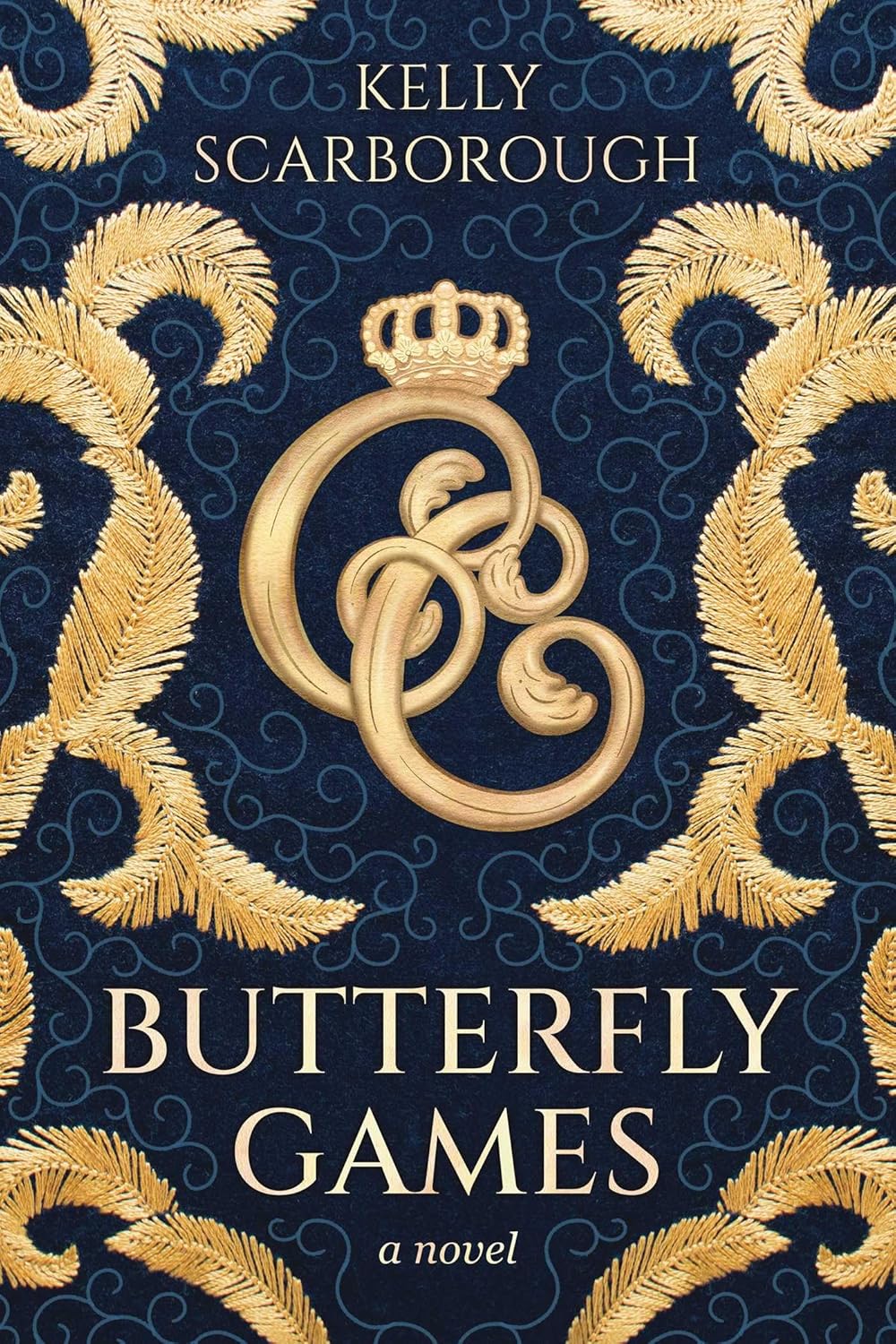

Europe in the early 1800s shimmered with luxury for the elite, yet beneath the gilded surface lurked danger, deception, and social ruin. Few know this duality better than Jacquette Gyldenstolpe, a young Swedish countess entangled in the glittering web of royal court life. At the heart of Butterfly Games lies Jacquette’s growing attachment to Prince Oscar, heir to the throne. His affection is returned in kind, but romance in royal circles is anything but straightforward. Secrets cling to Jacquette’s past, and her grasp of the court’s intricate social codes, known as the Butterfly Game, is tenuous at best. One misstep could mean disgrace. Or something far worse.
In Butterfly Games, Kelly Scarborough crafts a work of historical fiction that feels as lavish as it is perilous. The book leans into the elegance of Bridgerton, the stately tension of The Crown, and the shadowy power plays that recall Game of Thrones. Yet it is not merely derivative; it holds its own through vivid detail and sharp emotional insight.
Scarborough possesses a gift; she draws readers into this world with deceptive ease. Whether familiar with 19th-century Sweden or not, readers will find themselves immersed. Her prose doesn’t rely on heavy exposition. Instead, she layers atmosphere and character through action and dialogue, allowing the era to unfold naturally.
Jacquette, as a protagonist, radiates quiet strength and charm. Around her swirls a vibrant ensemble, each character drawn with precision. Prince Oscar may occasionally come across as lacking in dimension, but the court’s darker players, manipulators, schemers, rivals, more than make up for his shortcomings. These figures inject tension and unpredictability, driving the plot with palpable stakes.
Set pieces dazzle. The dialogue crackles. Twists emerge where least expected. The novel refuses to settle into predictability, favoring an unfolding mystery that remains grounded in emotional realism.
This is more than a historical romance. It’s a rich tapestry of ambition, identity, and survival. And while the genre often leans heavily on either character or plot, Scarborough achieves a rare balance, interweaving both with skill. Butterfly Games is proof that a well-told story can transcend category, appealing to lovers of history, drama, and good storytelling alike.
Pages: 256 | ASIN: B0FBLZMQHH



