Blog Archives
Uncomfortable Question

In ARTIFICIAL EVERYTHING, you make the argument that our tendency to trade human connection and experiences for digital convenience is slowly erasing what makes us functional human beings. Why was this an important book for you to write?
I kept observing the same pattern everywhere: as we remove effort and friction from life, we also remove the very conditions that build human capability.
This book came from that discomfort. Not from theory, but from watching children, professionals, and entire systems slowly become more dependent while appearing more efficient.
I didn’t write it to critique technology. I wrote it to ask a more uncomfortable question: what are we becoming when nothing requires us anymore?
Did you learn anything in your research that surprised you?
What surprised me wasn’t a single finding, but the consistency of the pattern.
Across completely different areas — childhood, work, relationships — the same mechanism repeats: remove friction → capacity doesn’t develop → dependence increases.
What’s striking is how invisible this is in real time. Everything feels easier, better, more efficient… until you realise something fundamental is no longer there.
Were there parts of your own life where you noticed a shift away from human connection before you started writing?
Yes, and that’s part of what made the book unavoidable for me.
You start noticing how quickly even highly capable people reach for AI before thinking, or how communication becomes easier but less real, or how silence and boredom have almost disappeared.
It’s not dramatic. It’s gradual, and that’s exactly why it’s powerful.
What is one thing you hope readers take away from ARTIFICIAL EVERYTHING?
Awareness.
Not rejection of technology, but recognition that convenience is not neutral. It shapes what we become.
If readers finish the book and simply pause before taking the easiest option, and ask, “What am I not developing here?” Then the book has done its job.
Author Links: GoodReads | Amazon
In ARTIFICIAL EVERYTHING, Dr. Carine Jennings examines a pattern that has quietly reshaped childhood, work, social life, and human capability itself.
Across domains, friction has been systematically removed, replaced by screens, algorithms, automation, and artificial substitutes. What was once built through struggle, effort, and necessity is now outsourced, optimized, or eliminated.
This is not a book about technology as innovation. It is a book about technology as substitution.
Drawing on sustained observation rather than academic theory, Jennings traces how convenience alters development:
Children grow without unstructured play.
Professionals outsource thinking to AI.
Social connection becomes performance.
Conflict is avoided rather than resolved.
Productivity increases. Capability declines.
The result is a new human type; highly functional in mediated environments, increasingly fragile without them.
ARTIFICIAL EVERYTHING is not anti-technology and not nostalgic. It does not argue for going backward. It asks a harder question: what do we lose when every human challenge is replaced with an artificial solution?
Written as cultural diagnosis rather than prescription, this book names what is eroding, why it matters, and why the consequences may only become visible when it is too late to reverse them.
For readers interested in cultural critique, human development, leadership, education, and the long-term cost of convenience, this book offers clarity where reassurance is easier.
ARTIFICIAL EVERYTHING
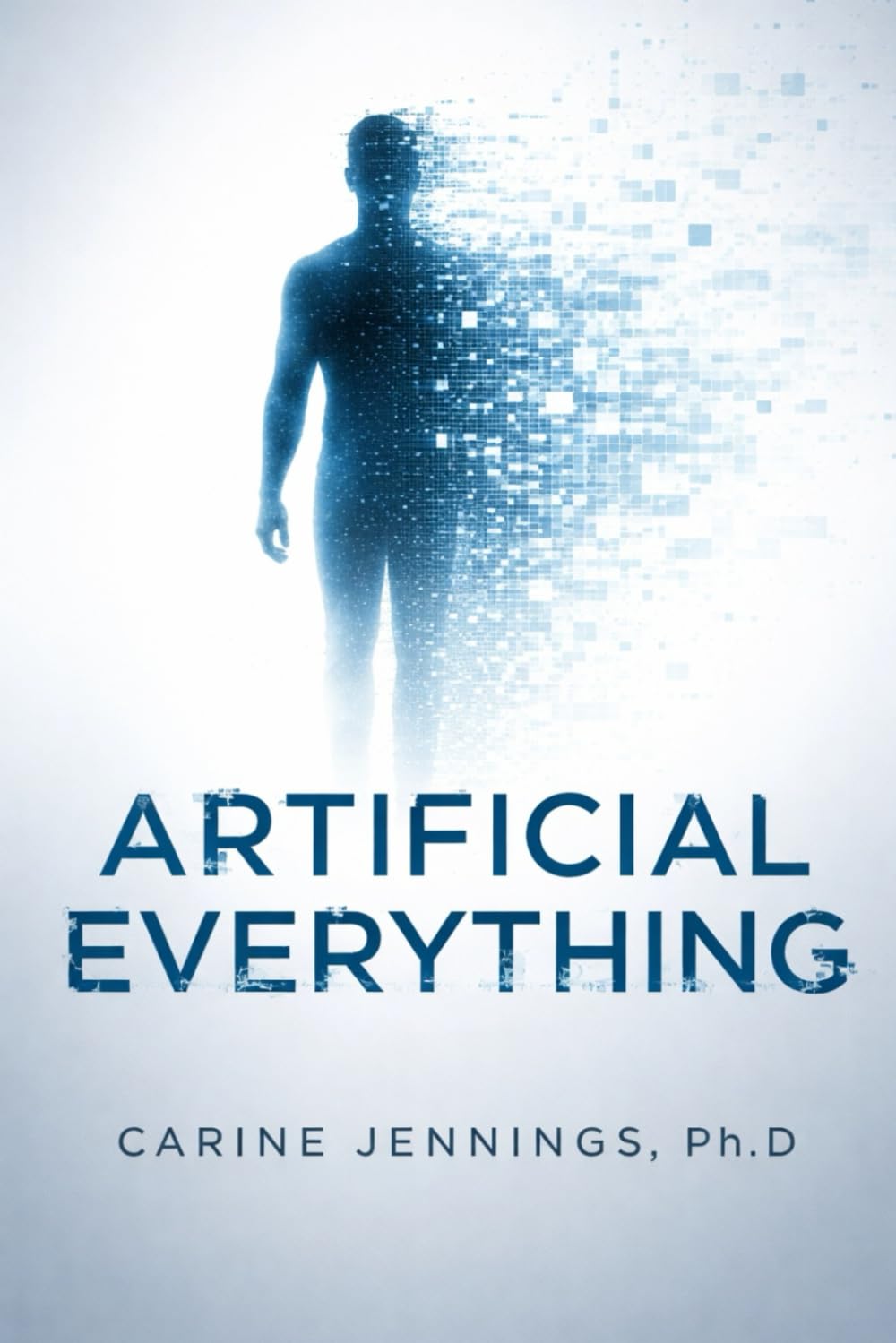

In Artificial Everything, author Carine Jennings, PhD, zooms out on modern life and argues that we have quietly swapped real, effortful human experience for digital convenience in childhood, work, and relationships. Childhood moves from barefoot streets and unsupervised play to single kids indoors on screens. Work shifts from thinking through problems to throwing everything at AI. Connection slides from talking in person to performing feelings online. Across four parts, she keeps coming back to one core idea. When we remove the friction that used to build us, we don’t just get comfort, we slowly erode the basic capacities that make us functional humans.
The tone is plainspoken and blunt. She tells you upfront that this is not an academic book, and she sticks to that, with no studies, no graphs, just clear scenes and repeated patterns she sees in everyday life. The chapters about 90s childhood, the single child alone with a screen, and the empty neighborhood feel vivid and oddly intimate, even though she is mostly describing general situations rather than specific people. The repetition of certain phrases works on you over time, like a drumbeat. The prose is direct, sharp, and easy to read, and it manages to sound serious without falling into heavy jargon or tech-speak.
The ideas themselves landed with more emotional weight on me than the casual style might suggest. Her picture of “artificial work” hit a nerve. The way she describes professionals reaching for AI before they even try to think, and how that slowly hollows out expertise, feels uncomfortably plausible. The argument about “comprehensive convenience” is the strongest thread in the book. She draws a line from GPS to social media to AI tools and shows how every convenience chips away at our ability to navigate, relate, and think on our own, until we are only capable when the systems around us are working perfectly.
What moved me most was the final stretch, where she turns to parents and to the question of what still actually requires a human being. She argues for “intentional friction” in a world that pushes us to smooth every rough edge. Her list of capacities worth protecting physical capability, face-to-face emotional connection, cognitive independence, frustration tolerance, real self-direction feels grounded and practical. She talks about choosing difficulty in some places, accepting that kids will complain, that society will question you, and that you will only know if you were right many years later. That uncertainty, laid out so plainly, gave the book a bittersweet tone.
I would recommend Artificial Everything to parents, teachers, therapists, and anyone working in tech or knowledge work who feels vaguely uneasy about how easy everything has become and can’t quite put their finger on why. If you are open to a clear wake-up call about what our devices and conveniences are doing to our basic human skills, this is worth your time. It’s the kind of book that may not change your mind in one sitting, yet it will change the way you look at an empty playground, a silent open-plan office, or yourself when reaching for a shortcut before your mind has even had a chance to try.
Pages: 202 | ASIN : B0GHKCJH69



