Blog Archives
Connections Make the World Go Round

Before We Arrived follows three people, each marked by loss, resilience, and quiet strength, who seek refuge at a goat sanctuary; they find not only healing but also a found family. What was the inspiration for the setup of your story?
First I’d like to thank Literary Titan for the interview. I absolutely loved writing this novel and am thrilled it’s resonating with people on a deep level.
The idea for the rescue sanctuary came easily. I adore animals and the notion that they have the power to aid in the healing process for humans. ‘Herd’ species—goats, donkeys, horses, and alpacas—were chosen because they need each other as well as their human caretakers. It was also a way to inject a bit of fun into the mix with their shenanigans. I was keen to have the work volunteers live on-site, enjoying shared meals and private sleeping spaces. I’ve had personal experience with various forms of communal living and it made sense to incorporate that. I wanted King Solomon Sanctuary to serve as an interactive setting that chunks of the story arcs could pivot around. The workers have the option to come and go as they please during off-hours but most choose to stay in close proximity to one another and the animals—it’s their own special tight-knit community of second chances.
Henry, Rivka, and Jayce all come to the sanctuary for different reasons, holding onto trauma that has kept them closed off until now. What was the inspiration for the relationship that develops between the characters?
Connections make the world go round. In Before We Arrived we witness the interactions within each of the biological families, as well as between the narrators and secondary characters as new friendships are forged and old ties change shape. All three families have struggled through adversity, and we learn the details of their backstories as the chapters progress. The world can be harsh and cold, relationships complicated and messy. What are the multitude of elements that guide our path and our decisions? Can we build a meaningful life after experiencing tragedy? How do we best care for ourselves and each other? These are the kinds of questions that motivate me to create stories.
What were some themes that were important for you to explore in this book?
I’ll preface this answer by noting that I did not set out to write a book specifically about grief and resilience; that just happened organically as the outcome of each character’s story and their relationships with one another.
The novel explores questions about race/culture/identity, the short and long-term effects of personal and generational trauma, family dynamics, and issues around marginalization. I’ve also had a perennial fascination with ancestral memories, so that was layered in, along with the underlying truths about the universality of suffering and the value of connection and empathy. Naturally some of these themes overlap.
What is the next book that you are working on, and when can your fans expect it to be out?
Before We Arrived was recently released and I’m not quite ready to think about beginning a new project. Writing does energize me so another novel is within the realm of possibilities.
Author Links: GoodReads | Website
In the summer of 2005, three dissimilar people—Henry, a grieving Black landscaper; Rivka, a restless Jewish social worker; and Jayce, a guarded Indigenous archaeologist—find their lives colliding in quiet, powerful ways.
From New England to Vietnam, this lyrical novel traces their search for peace, meaning, and joy amid the rubble of personal and ancestral trauma. Lush, moving, and deeply human, Before We Arrived is a celebration of resilience, found family, and love in its many forms.
Before We Arrived is a soulful, literary journey through grief, healing, and unexpected connections. Fans of James McBride and Lily King will feel right at home.
Before We Arrived
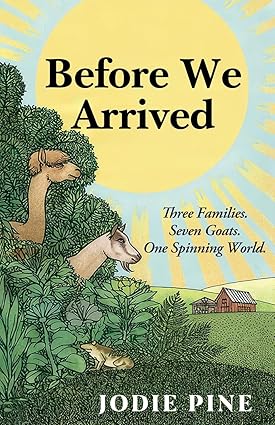

Jodie Pine’s Before We Arrived spins a beautiful tapestry of interconnected lives across time, grief, and healing. Told through alternating chapters set between 1975 and 2005, the story traces three families—each marked by loss, resilience, and quiet strength—as they find each other through fate and a shared sanctuary. A former archaeologist, a social worker, and a man recovering from injury and trauma become unlikely kin under the roof of a goat sanctuary, of all places. But it’s more than goats. It’s about second chances, and third. It’s about holding sorrow in one hand and still reaching out with the other.
As a widow, I didn’t expect this book to hit me like it did. From the very first chapter with Henry and his mangled hand, I felt my heart slide into that familiar hollow space. The line—“trying so hard to keep things light”—caught in my throat. That’s exactly what it’s like when you’re walking around with your grief zipped up under your coat. Henry’s story reminded me how healing doesn’t look like a movie montage. It’s awkward, reluctant, even a little muddy. His growth is slow but steady, like learning how to breathe again after forgetting for a while.
Then there’s Rivka. Oh, Rivka. I adored her. The way she stepped into Nina King’s quiet, grief-soaked apartment, dripping wet and uninvited, but still offering help with a kind firmness—it was deeply moving. Her voice felt familiar to me, like someone I would’ve met. Her compassion for baby David, and her refusal to flinch in the face of Nina’s silence or mistrust, showed the kind of stubborn kindness I’ve come to cherish in my own life. The moment when Nina finally lets her hold the baby? That nearly did me in.
Jayce’s chapters, especially the funeral scene and the pact he makes with his mother, stirred something in me. We can’t disappear with our dead. I loved how his archaeology background tied into the theme of digging—literally and emotionally—for what’s been buried. His arc wasn’t flashy, but it was profound. Quiet endurance. I know it well.
What Jodie Pine does so beautifully is show how people can be shattered and still be whole. There are no villains here, just folks doing their best with their pain. The prose is warm and alive, sometimes messy, just like real conversation. I chuckled more than once—especially during Henry’s first day with the goats—and found unexpected joy in the ordinary moments: Rivka eating Fig Newtons at her desk, David fixing a bike, a fox sculpture on a table. These small details made the world feel lived-in, like someone left the light on for you.
This book is for anyone who’s ever been broken open and needed help stitching themselves back together. It’s for people who are lonely but not hopeless. For readers who don’t mind stories that move like real life—with detours, overlaps, long silences, and sudden beauty.
Pages: 395 | ASIN : B0FG3L2V5Q




 LITERARY TITAN