Blog Archives
Writing Is Learning
Tangled Iron Cages on the Prairie follows three people living in a farm town in Illinois during the ‘50s and ‘60s and the events that shape them into who they are. What was the inspiration for the setup of your story?
I grew up in Illinois farm country and knew individuals like them. Jennifer is seeking her freedom from the iron cages of the farm life. As with many farm kids, she wants to escape, and college is her path out. In her search, she discovers that she is bound to different iron cages and her freedom is to choose her own iron cage which limits and guides her in what she can do. She is a strong person who does not readily accept the traditions of the countryside. As one example, she writes her own marriage vows which eliminate “obey.” She searches to define her own life and follow her own path.
Bob, Jennifer’s boyfriend and later husband, wants to escape with a good job where he can live in a city with a picture show. Intellectually, he does not understand iron cages, but experiences limitations on what he can. After his best friend’s tragic death, college and a practical engineering degree is his escape. He takes life much as it is given without deep introspection, but with limited curiosity. He has his moments of awe and amazement as his infinite tower – a Babel if you will, leading to a discussion of sin. When trapped, he cannot break out.
Helen, Jennifer’s mother is a strong, determined, self-centered individual by necessity as much as desire. As a single mother, her life has not been easy, more one of survival. She studied to be a nurse and is a caring professional. Helen is generous, yet domineers Jennifer. She puts no limits on how to achieve her wants, breaking norms and traditions, betraying love and acting as a cunning blackmailer.
These characters are fictional – a combination of individuals and events that I have seen and imagined. I tried to capture who these prairie folks are – both the good and bad. They are realized in the story by what they think and what they do in this place and time. The place is the Illinois farm country. The chosen time period is circa 1960, but could be most any time of the last one hundred years as the people are much the same and the movement of country folks to the city from high school through college continues. Their search for freedom by changing iron cages goes on.
Each character has hidden secrets and dreams that shape them into who they are in this story. What were the morals you were trying to capture while creating your characters?
Jennifer is a moral person. She knows what is right and wrong, and wants to act accordingly. In her search among her evolving iron cages she stays within the norms and traditions of the countryside. She wants to be a good Methodist even while rejecting the traditional marriage vows. Seducing the minister is not right, not to be done. She has fantasies and dreams about Paris, but accepts Peoria as it is reality. No hidden secrets, she is serious, yet grounded in her search for freedom.
Bob has a hidden relationship with Helen, Jennifer’s mother. It is immoral in the country side traditions and he knows it. Yet, he won’t face it head on and do anything about it. Perhaps that is the greater immorality; he is too weak to take the risk and possible consequences of what might happen if revealed. Without action, he knows he is likely to lose Jennifer’s love and their dream of a better life away from Plainsboro. His iron cage is self-imposed and he is trapped in his own immorality.
Helen, Jennifer’s mother, betrays Jennifer’s love and blackmails Bob without remorse. She takes her own selfishness to realize what she wants, ignoring the consequences for people she loves. Rather, she feeds on her control of others to their detriment and ultimately her own. She may be narcissistic, but surely is an evil bitch.
There are traditions and norms of behavior which are time-honored on the prairie, providing some guardrails. Morals are individual as I have tried to capture. There are events and experiences particular to the countryside which foster individual actions and morals. Nonetheless, morality is personal here.
What were some goals you set for yourself as a writer in this book?
First, I try to develop a good relationship with the reader. I would like for the reader to join me in this journey of writing while reading. I want the reader to imagine and project while reading. Both of us want to be entertained, intrigued, and surprised. Humor is one bridge. Together we must feel the emotions of the characters and why they struggle and fail, yet laugh at themselves, feel pain, and also smile.
Second, writing is learning – here, about myself and what it is to be from the farm. Writing is a journey of searching. You never know what you will write or experience until you do it. You feel the character’s joy and pain. I want to honor my homeland and reveal my respect for the folks of the prairie.
On a different dimension, I wanted to learn and understand what it is to write fiction and the process of publication. There are many books with good advice on how to write. For me, the Nike tagline, “Just Do It,” works. Then the process of rewriting, editing, thinking more deeply about how characters feel and what they do and why, and finding a publisher who is supportive is very interesting. In the end, you have to have fun and keep your sense of humor – and imagination.
What is the next story that you’re writing and when will it be published?
I am writing a sequel to Tangled Iron Cages on the Prairie. Bob and Jennifer are there, as well as Paul, the Methodist minister. Jennifer breaks out with PhD studies. She has a baby who is the next generation beyond the farm. Jennifer and her daughter are the main characters who have complicated adventures and relationships.
Midwest people are city folks as well. The interplay among ministers, professors, farmers and Europeans explores what is the Midwest of this later generation. At the same time, the story is still anchored in the Midwest plain.
It is a new book that can be experienced independent of Tangled, or not. Either way, I am enjoying the journey of writing and learning to engage the reader as writer.
While keeping my sense of humor and with luck, it will be published in late 2024. Deadlines, even personal ones, are mandatory.
Author Links: GoodReads
Bob, a student engineer lost in his infinities; daughter Jennifer, an emerging college intellectual in her search for freedom; mother Helen, a nurse with a past: all struggle individually and together on journeys from high school to college through iron cages of hope and disappointment to find who they are and want to become – and whether or not they will find love.
In Tangled Iron Cages on the Prairie, Cecil Homer explores the everyday humor and trauma of life in a direct sparse Midwest style to probe: tragedy, farm values, college experience, religion, deception, sex, blackmail, and troubled love in the 50s-60s transition on the Illinois farm plain.
Tangled Iron Cages on the Prairie
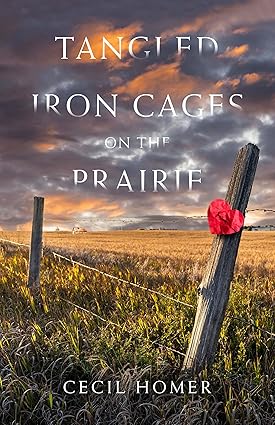

Bob, Jennifer, and Helen possess a profound understanding of life within the confines of a small, prairie town. While the close-knit community offers its advantages, Bob is burdened by the incessant rumors and scandalous conjecture that follow him following a near-fatal accident. Despite Helen’s esteemed reputation as a nurse, she is well aware that her past harbors certain secrets that some astute individuals may uncover. Jennifer finds herself caught between the realm she has explored at college and the duty to remain close to her mother. As they traverse through life, both as a unit and as individuals, Jennifer frequently reminds them that existence, in all its forms, resembles an iron cage, and genuine liberation lies in the ability to shape one’s own destiny.
In Tangled Iron Cages on the Prairie by Cecil Homer, this intricate narrative unfurls the tale of Bob and Jennifer during their final years in high school and the subsequent college experiences while intricately delving into their unique connections with Helen. The backdrop of a rural Illinois prairie town in the late 1950s conjures a bygone way of life imbued with a surreal quality. Homer skillfully portrays their existence as simultaneously vapid and all-encompassing. The story adeptly shifts perspectives among all three characters, yet it is Bob who emerges as the driving force behind the plot. His enigmatic past hinted at but never overtly revealed, along with his intricate relationships with both women, renders him the most captivating character within these pages.
A recurring theme that resonates profoundly throughout this narrative is the notion that freedom is but an illusion. Each character grapples with this idea, often oblivious to its profound impact on their own lives. Despite Jennifer’s frequent elucidation, she remains the sole individual who seems to grasp the full implications of this concept. Buried within these pages lies an undeniably extraordinary and enthralling story, yet the narrative structure often reads more akin to an instructional manual than a work of fiction. Furthermore, the language employed is excessively formal and stilted, deviating significantly from authentic dialogue. Regrettably, these factors detract from the book’s poignant moments and dilute the genuine humanity of its characters. However, it is worth noting that Homer’s unconventional choice for the book’s conclusion exhibits a commendable audacity, despite its departure from traditional norms.
Tangled Iron Cages on the Prairie by Cecil Homer is a compelling look at life in the 50’s and 60’s in the Midwest state of Illinois. This blend of themes from family values, life in a farming community, religion, sex, and blackmail make this first novel by the author one readers will be drawn into. Despite some of the drawbacks, this is a wonderful story to pick up and travel back in time to a different way of life.
Pages: 152 | ASIN : B0B6GL3GGT




 LITERARY TITAN