Blog Archives
Inspired by Historical Fiction

A Tapestry of Two Worlds follows a young boy growing up in 19th-century Lancashire and his family’s transition to life during the Industrial Revolution. Where did the idea for this book come from?
A Tapestry of Two Worlds tells a story based on the life of my Great-grandfather. Using the known facts of his life blended with social history, I imagine dialogue, reactions to those events, and interaction with other characters, to build the character arc. This story breaks his world into two distinct aspects; his life in Northern England compared to the last half of his life in India.
How much and what type of research went into planning and writing this novel?
I begin my stories with a timeline of factual events for my protagonist and key relationships in their lives. Layered in, I research the social history of the places during those times. Extensive research happens before and during the process of crafting the manuscript. I discovered my protagonist on a ship’s passage notice in the China and London Telegram, a paper used by the P&O Shipping line to share news from the colonies. Another great find came from a letter posted on a blog site, detailing a similar journey around the same time. As it turns out, this person travelled on the same ship my character did.
What draws you to the historical fiction genre?
We have such a rich world of stories in our history. Exploring the lives from the past can teach us about resilience, courage, and inventiveness. I love writing in this genre. Recently, I’ve explored other forms of writing from poetry to flash fiction, but still find myself inspired by historical fiction.
What is the next book that you are working on, and when will it be available?
Due in 2026! Story Synopsis:
In 1932, at the age of 47, Victor Veevers, left his Indian birthplace, Bombay, to settle his family in London, England. Born in 1885 to a British father and a mother of Portuguese and Indian descent, he lived during a period of growing unrest in India and sought economic security as well as protection from the mounting resentment his family faced in Bombay.
Vic’s skills as a photographer and cine-recorder, along with his local knowledge of India, earned him a spot on the British Gaumont Studios production team hired to film the 1933 Lady Houston Mount Everest Expedition. The daring adventure would test both aviation and photographic technology by attempting to take aerial images of one of the last frontiers of the world, Mount Everest. The story arc follows the production unit as they prepare and film the events, culminating in the Academy Award for short film in 1936.
Within a year of leaving the birthplace that rejected him and his family, Victor finds himself back in India. The story reveals challenges and triumphs on his path of acceptance as Victor explores the dual perspectives of his British and Indian heritage.
It may also include memoir pieces; the discovery of my heritage, and the mixed-race heritage influenced future generations.
Author Links: GoodReads | Facebook | Website | Substack | Instagram | Amazon
Raised in a middle-class English family during the Industrial Revolution, James Harrison Veevers escapes to East Asia in 1863. Exchanging pastoral views, dingy factories and crushing poverty in his Lancashire home, for the exotic, intoxicating culture of India. James pulls at the threads, unraveling the expectations of others. Determined to design his own life, James artistically weaves a colorful new tapestry from the filaments of his experiences gathered across two continents.
If you love stories rich with description and adventure, share the journey with James as he travels to the exotic world of India.
A Tapestry of Two Worlds
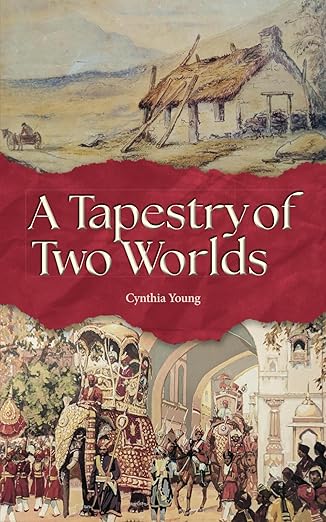

A Tapestry of Two Worlds is a lovingly detailed historical journey through the life of James Veevers, a young boy growing up in 19th-century Lancashire. Cynthia Young draws from rich family history to paint a vivid picture of a Quaker family navigating personal change, industrial progress, and emotional upheaval. We follow James from the rolling countryside of Thurnham Mill to the gritty, clanging streets of Preston and onward to the structured halls of Ackworth boarding school. Through letters, losses, and quiet observations, Young reveals not just the evolution of one boy but the pulse of a whole generation caught between the pastoral and the industrial.
I found myself falling into the rhythm of Young’s writing—it’s gentle, poetic, and textured with care. The opening chapter, where young James tries to mimic his older brother’s footsteps and gets his face smudged with boot polish, charmed me. That scene nailed the cozy chaos of big family life. The dialogue, especially between James and his mother, was warm and believable. But what really hit me hard was the moment Ellen—James’s beloved sister—dies. It was unexpected, raw, and beautifully restrained. James’s stunned reaction to the letter announcing her death made me stop and just sit with that grief for a while.
The rich detail that makes scenes feel so alive also, at times, slows things down. A page describing a carriage ride or school routine might’ve been trimmed without losing emotional weight. That said, the effort Young puts into anchoring us in the time and place is admirable. The way she threads in historical elements—the cotton mill strikes, the Quaker influence, the transition from child to young worker—is smooth and feels organic. It’s clear this isn’t just a fictional tale. It’s a tribute to real people and real lives. I especially appreciated how James’ quiet personality wasn’t overwritten; his sensitivity and struggle to find his place made him feel like a real person, not just a character.
In the second half of A Tapestry of Two Worlds, the narrative takes a bold and refreshing turn as James relocates to India, expanding the scope of the novel from a personal coming-of-age story to a cross-cultural journey of identity and belonging. This half of the book doesn’t just shift location—it deepens the themes of cultural tension, faith, and personal growth that began in Lancashire, ultimately bringing James closer to a hard-won sense of peace and self-understanding.
By the end, I found myself caring deeply about James and his family. This isn’t a book full of action or big drama, but it’s a tender and thoughtful coming-of-age story that sneaks up on you. If you love family sagas, especially ones rooted in real history, this book will speak to you. It’s a great read for fans of Call the Midwife or North and South, or anyone who enjoys a slow burn that leaves a lasting mark.
Pages: 380 | ISBN : 978-1738288847




 LITERARY TITAN