Blog Archives
Proving A New Way To Fly Into Orbit

Hans-Peter follows a secretive inventor who is trying to build a tri-propellant rocket engine to get people into space cheaply. What was the inspiration for the setup of your story?
I have always found aerospace design fascinating and I began thinking about an airplane that could fly into Low Earth Orbit back in the days of the X-15 and Project Mercury. When the first Space Shuttle flew in April of 1981 and turned out to be more than ten times as expensive than promised, I started to refine my thinking. The grounding of the Space Shuttle fleet compelled me to summarize my thinking and write-up my conclusions concerning rocket engine performance.
I found the science in the novel to be well-developed. What kind of research did you do to make sure you got it right?
By way of background, before I started writing, I worked in aerospace in electro chemistry at Lockheed and then systems analyses at both TRW and Northrop Aircraft. My novel started life as a performance inquiry into the math and physics for a real airplane/spaceship that could replace the Space Shuttle; but when I had the right math to support the configuration, I decided to write a novel rather than a technical paper. I had a lot more fun turning the study into a novel than trying to publish it in the right periodical.
What character did you enjoy writing for? Was there one that was more challenging to write for?
I enjoyed writing Traypart, he thinks and says things that I have thought and said in similar situations during my aerospace career. I always find writing distinctive voices for each character a challenge. Max was easy and fun, but I needed to think hard about getting it right for Ruthiebelle.
What is the next book that you are working on and when will it be available?
I have a novelette titled, The Peril of Liquid Nitrogen, that I may release through one of the Kindle options. As of yet I’m not sure which one is best. For the interested, my other novel is, The Prisoners of Technocracy, and it is also on Amazon.
Hans-Peter, the novel’s namesake, has spent his considerable career looking for that truly low-cost way into orbit. From an abandoned Air Force Base now called Norton Field, he has focused on tri-propellant rocket engines. His work is generally scoffed off as science fiction, but who is to say how near we are to his hypersonic airplane.
Ruthiebell, an old college acquaintance and now the science editor of the largest newspaper in L.A., is one of the few people who remember Hans-Peter’s interest in Low Earth Orbit. She is also discreet enough that “Black World” whistleblowers are willing to give her their best information. She knows things most insiders don’t and has developed her own agenda.
When she learns that Hans-Peter’s titanium metals factory has rolled out a new hypersonic airplane, she decides to renew her acquaintance. She knows from anonymous sources that at extreme altitudes and hypersonic speeds there’s more up there than thin air. On the pretext of reporting his experimental flights, she hopes to achieve her own goals. She decides to visit him and see how much she can squeeze out of her old friend.
Hans-Peter
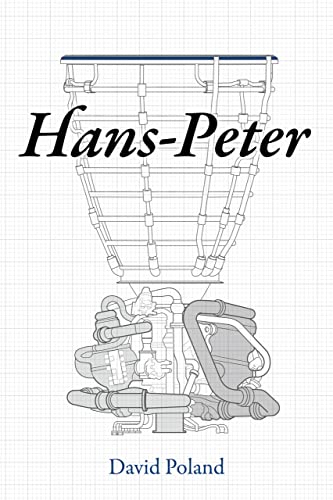

Hans-Peter by David Poland is a fantastic piece of realistic fiction that explores the development of new technology and alien phenomenon. The story arc follows the development of a new type of aircraft invented by Han’s Peter, a genius inventor who has so far kept his inventions under wraps from both the public and the government. He has developed an aerospace plane capable of flying into orbit with a new type of tri-propellent engine and fuel that utilizes nuclear cold fusion.
We follow the story through the eyes of several high-profile technology journalists, the staff at a nearby military base, Cactus Patch, and the employees of the Federal Aviation Administration. The unfolding story is told from one of the story’s main protagonists, Trayparts’ perspective, written in a first-person narrative. Traypart is a well-respected technology and aerospace journalist who came to California to report on aerospace and spaceflight technology.
I really enjoyed this novel. It is written in a hyperrealistic fashion tackling the science of Hans-Peter’s new technology and the implications for the earth regarding this new type of technology. One of the underlying themes is the frontier of space, how emerging technology will affect our ability to travel to space, and the possibilities of what we may encounter if we do so. “Okay,” I said reluctantly. “So way back in college, he was talking about rockets and F-111s.” “Way back then, he told me he was thinking about how to blend a nuclear reaction into a liquid fuel rocket engine. Do you think that’s even possible?” p 13
The overall story develops slowly throughout the novel, with the plot being slowly revealed to the reader as the book develops. I particularly liked how the novel uses the different characters’ perspectives to relay the story as it develops. The main characters are well-written and appropriately complex, and they came across as extremely convincing in their roles. It worked well to have the different perspectives of the unfolding story. As the story progresses, the reader is introduced to possible sightings by the military of UFOs and a cover-up of previous alien contact. However, I felt the story was slightly too heavily focused on the character’s dialog in some parts.
We also witness a problem with the ISS space station after a meteor strike, leaving the astronauts onboard needing rescue. This development and the possibility of a daring space rescue by Hans-Peter and his new aircraft up the story’s stakes and add an effective extra level of interest for the reader. Toward the end of the novel, the author David Poland adds a big twist to the story, which left me genuinely surprised.
Hans-Peter is a riveting science fiction adventure novel that gives readers much to contemplate. The story is compelling and will hold readers’ interest till the end.
Pages: 295 | ASIN : B08NWB13PR




 LITERARY TITAN