Blog Archives
Hope to Eradicate the Vestiges of Slavery

Child Care Justice examines the historical, political, economic, educational, and cultural systems that continue to oppress early care educators and, by extension, racialized children and children in poverty. Why was this an important book to write?
The reason this was an important book to write is that during the COVID 19 pandemic, when the book project began, child care surfaced as an important factor for the country’s economic recovery in terms of parents being able to work with the comfort of knowing their children were being cared for. However, while child care was being touted as the engine for economic recovery, not many people were aware of the fact that the institution of slavery, and its low regard for humanity, through its economic and physical exploitation of the enslaved, continues to this day, and stigmatizes workers in the various care industries through racial injustice, gender injustice and economic injustice. Thus resulting in a class of low wage, low status individuals, primarily women of color, on whose shoulders the country intended to rebuild the economy.
With such a complex topic, how did you narrow the focus to the important ideas for you to share in this book?
As you can imagine, the outline for a book of such scope and complexity requires a lot of rethinking and multiple iterations in order to tell as story that has congruence and coherence. However, it was the skillful eyes and ears of my brilliant, co-editor Kyra Ostendorf who brought it all together. She took what started out as my topical outline, and converted it into chapters that made sense and hung together.
The authors cover a wide range of topics in this book and present facts from various sources. How much research did you undertake for this book, and how much time did it take to put it all together?
The selection of authors was a carefully, curated process that was a combination of matching authors that we already knew with the chapter topic and discovering new, fresh authors whose body of work was amazing, compelling and unknown. However, the beauty of this undertaking was our monthly author’s workshops that followed a protocol that created a sense of camaraderie and morphed into a problem solving lab. I believe that it created a sense of community that lent itself to the book’s cohesiveness. All total, it took about two years to bring the book to publication. However, it was a labor-intensive, multiple writes and rewrites process, with some serendipity along the way.
What is one thing that you hope readers take away from Child Care Justice?
I hope that the reader takes away a sense of hope that we can eradicate the vestiges of slavery, and past injustices by creating a national movement of low wage, low status workers across organizational lines.
Author Links: Website
Book Features:
Centers the historic and current oppression of Black people in the United States as foundational to the disregard for child care workers today.
Uses Paulo Freire’s critical consciousness framework to guide readers to see, analyze, and act.
Calls for a multiracial coalition of activists for racial justice, gender justice, and economic justice.
Across the Kentucky Color Line: Cultural Landscapes of Race from the Lost Cause to Integration
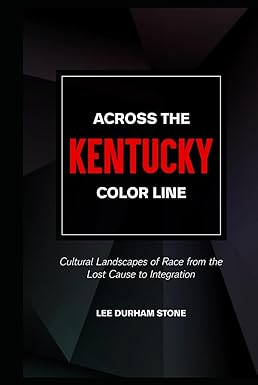

Across the Kentucky Color Line, by Lee Durham Stone, stands as an exquisite exemplar of non-fiction historical literature, delving into the intricacies of racism within the American tapestry, with a particular focus on its evolution within the state of Kentucky. The book navigates with precision through the intricate landscape of history, offering incisive insights and robust research, an ideal companion for both history enthusiasts and scholars alike. In this meticulously crafted work, Stone not only delivers a comprehensive discourse but also makes the labyrinthine subject accessible to a wider audience.
The book’s overarching theme, encapsulated in the tagline Cultural Landscapes of Race: From the Lost Cause to Integration, succinctly encapsulates its exploratory essence. Stone’s exploration delves deep into historical chronicles, dissecting their reverberations across the broader cultural currents that continue to shape contemporary society, particularly in the context of racial dynamics in the United States. Across the Kentucky Color Line weaves an intricate tapestry, chronicling the intertwined social histories of White and African-descended Americans in Kentucky, the ‘color line’ emblematic of the symbolic and physical divide between racial groups. Stone’s scrutiny commences in the aftermath of the Reconstruction era following the Civil War in 1876, traversing milestones like the era of Jim Crow, and culminating in the late 2010s. While the book’s core essence lies in the presentation of factual accounts interwoven into a vivid tableau of Kentucky’s racial history, the prologue serves as an engaging gateway, narrating a captivating anecdote that beckons readers into the narrative’s embrace. The brilliance of this book is not confined solely to its scholarly rigor; it extends to its captivating narrative framework. The book seamlessly blends historical verities with storytelling prowess, thereby illuminating its central arguments with vivid prose. Stone employs a multidimensional approach, wielding both the arsenal of factual precision and the artistry of narrative finesse to underscore his thesis. Through this creative synergy, readers are drawn into the very heart of the narrative, transported through time and circumstance.
A compelling call to action resonates from the pages of Across the Kentucky Color Line. It stands not only as an essential resource for history aficionados but also as a vital literary artifact for individuals seeking a profound understanding of their societal underpinnings, particularly within the United States. In an age where awareness of our collective history is tantamount, this work emerges as a beacon of knowledge, offering a lucid window into the shaping of an evolving nation.
Pages: 311 | ASIN : B0CNPT26PN

Child Care Justice: Transforming the System of Care for Young Children

Child Care Justice: Transforming the System of Care for Young Children critically examines the stigma rooted in this history, which has unjustly relegated modern childcare workers to a status of low prestige and pay. It features expert authors who offer research, insights, and practical knowledge on equity and social justice, dissecting the systems that sustain oppression within early childhood education. The narrative confronts both past and present injustices, advocating for social justice and cultivating critical awareness. The authors call upon educators, activists, and supporters to imagine and construct a more just system, underscoring that true national integrity—liberty and justice for all—hinges on recognizing and valuing historically marginalized childcare workers.
I found this book particularly compelling for several reasons. The dedication and passion of the authors are palpable and significantly influence my engagement with and perception of the book’s message. This commitment elevates the work from a mere academic discussion to a heartfelt call to action. Moreover, the book was revelatory for me. As someone from a predominantly Caucasian country, I was not deeply engaged with or knowledgeable about the political issues in other nations. Yet, the book opened my eyes to the fact that the injustices and inequities discussed are not foreign but are present in my own country, affecting adults and children alike, often based on ethnicity. The dialogue initiated by this book is crucial, particularly for children who are inherently vulnerable and learning to interact with the world. It suggests that broader conversations are needed, ones that the authors and readers may not even fully realize. I am convinced that change can begin with one person, and I commend the authors for their courage and advocacy.
I would recommend Child Care Justice: Transforming the System of Care for Young Children to anyone grappling with injustice, to childcare and other low-wage workers, and to anyone seeking to understand the realities faced by many people. It is an enlightening read that calls for awareness and action towards a more equitable society.
Pages: 207 | ASIN : B09Y8NRFGW



 LITERARY TITAN