Blog Archives
Human Stupidity

Endless Fall of Night follows a woman who is convicted as an insurrectionist and sent to prison, where she is compelled to join a mission to discover what has happened to the Martian colony that has gone dark and left severed heads in its wake. What was the inspiration for the setup of your story?
The set up was the novella Heart of Darkness by Joseph Conrad. Similar to that work, I wanted to show how the human condition and society has not changed much whether it is a Belgium Company’s outposts along the Congo River in Africa in 1899 or a US Swift Boat going up the Nung River in Vietnam in 1969, human emotions and behaviors construct our present day of 2025 and sets the stage for a future like 2126.
What are some things that you find interesting about the human condition that you think makes for great fiction?
Themes around prejudice, racisms, fascism, misogynistic and misanthropic bents will still be challenged by courage, strength in community and resilience are all part of being human. It is the journey that makes us. It is the discomfort and challenges that forge who we are.
What were some themes that were important for you to explore in this book?
Of all the themes presented, human stupidity is the focus of this story as defined by Carl Jung – blaming others for own flaws, inability to self-reflect, rigid thinking and dogmatism, lack of empathy and emotional intelligence, overconfidence without competence and repeating the same mistakes without learning.
Will there be a follow-up novel to this story? If so, what aspects of the story will the next book cover?
The Heavy Weight of Darkness, published in September 2024 follows one of the antagonists tasked with terminating the heroine, and then finds himself transformed.
Author Links: GoodReads | Instagram | Website | Second Website
Based on Joseph Conrad’s Heart of Darkness, we see our future that shows striking similarities to this age of imperialism, classism, and capitalistic expansion where racism is commonplace, slavery exists, and a minority of people are in absolute power. Instead of Belgium Company’s outposts along the Congo River in Africa in 1899 or a US Swift Boat going up the Nung River in Vietnam in 1969, this is the great Third Republic on Earth and colonies on Mars in the year 2126.
Cassandra XI, patrician and first-class citizen, is exposed to a traumatic experience that later has her questioning the established social order. She is eventually tried and convicted as an insurrectionist, her personal AI deactivated, social status and titles revoked, and she is sent to prison. Cassandra is then approached by Captain Willard Bennett of the light cruising ship the Jefferson Davis to investigate why the Martian colony New Georgia went dark, leaving severed heads on spikes and the message “Bring Cassandra Kurtz.”
With no choice but to go, Cassandra’s life is about to change in unimaginable ways.
Endless Fall of Night
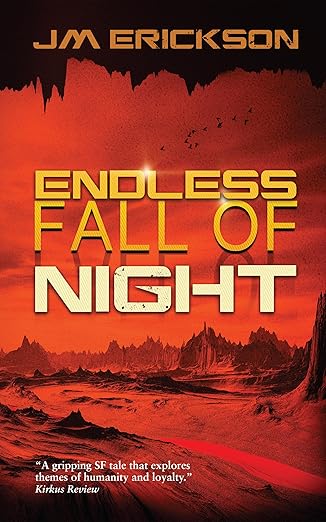

This book is a dystopian firestorm wrapped in razor wire. Endless Fall of Night throws us into a bleak future where racial purity and social stratification rule the day, and one woman, Cassandra IX, stands at the heart of it all, defiant, broken, and brilliant. The story kicks off with her trial and sentencing for crimes that are more moral rebellion than criminal offenses, and it doesn’t let up. From sterile courtrooms to hellish prisons and eventually deep space, Erickson drags us through the slow-motion car crash that is Cassie’s journey, and you can’t look away.
The writing hits hard; it is not elegant or flowery. And that’s what makes it work. The courtroom scenes early in the book are brutal, especially the way the government lawyer describes Cassie’s supposed betrayal. “She can’t help it,” he sneers while showing ancient libraries going up in flames. You want to scream. Erickson doesn’t just hint at dystopia; he makes you choke on it. His use of visuals, like the collapsing libraries or the image of Cassie bleeding and broken, is cinematic in the best (and most horrifying) way.
Cassie is no hero in the classic sense. She’s angry, complicated, and tired. Her inner voice, especially after she loses her AI companion Aletheia, is a mix of grief, sarcasm, and deep loneliness. And the prison chapters? They’re suffocating. I felt like I needed to open a window. Erickson builds this terrifying sense of powerlessness without ever turning Cassie into a victim stereotype. She fights. She cracks. She rages. She survives. Her whispered line might be one of the most powerful moments in the book; it’s a punch in the face to a rotten empire.
The pacing gets a little weird after Cassie leaves prison. Once she boards the Jefferson Davis, the tone shifts. It’s still good, creepy, mysterious, and loaded with dread, but the rhythm wobbles. Still, the moment her AI returns through a charged music device is oddly beautiful. Aletheia’s voice is like a flashlight in a cave, and it reminded me of how much I missed her presence earlier in the book. Their bond is one of the best parts of this story, part friendship, part lifeline, part rebellion.
Endless Fall of Night made me mad. It made me sad. It made me weirdly hopeful. It’s not a fun read; it’s a furious one. But it’s worth it. If you liked The Handmaid’s Tale or V for Vendetta, this is your book. Just be ready: it doesn’t hold your hand. It holds a mirror up and dares you to look.
Pages: 131 | ASIN : B0D6JSPDDY




 LITERARY TITAN