Blog Archives
Thief of Echoes


Thief of Echoes, by Sandra Boyle, is a fast, moody sci-fi thriller about memory, identity, and the danger of letting powerful institutions decide what counts as truth. Elara Vale works inside a system built to extract, archive, alter, and erase memories, but the story really begins when one corrupted thread pulls her toward a buried part of her own past. Early on, she asks, “What does it say about me that I’m better at stealing memories than saving them?” That question becomes the emotional engine of the book.
The novel’s world is sleek, cold, and unsettling in a way that fits the story perfectly. The Ministry, neural syncs, memory residue, echo files, and underground networks all feel like pieces of a society that’s learned how to control people without always needing chains. Boyle gives the tech a haunted quality, so the book doesn’t read like a gadget-heavy future. It reads like a mystery where every machine might be hiding a ghost.
Elara is the heart of the book, and she’s easy to follow because her fear never makes her passive. She’s scared, confused, angry, and often unsure of what’s real, but she keeps moving anyway. Her relationships with Milo, Maren, Lena, and the other fractured figures around her give the story its warmth. The book works best when it lets those connections push against the colder conspiracy plot, especially as Elara starts to understand that memory isn’t just evidence. It’s selfhood.
One of the strongest threads is Elara’s struggle to trust herself when her own mind has been tampered with. Her father’s warning, “Don’t trust the official version of your own story,” lands as both a plot clue and a personal command. That line captures what the book is doing: turning a rebellion against a corrupt system into a fight for the right to own your own past. The shifting points of view also help widen the story, showing how many people have been damaged, rewritten, or made complicit by Mnemosyne’s machinery.
As the first book in a series, Thief of Echoes builds toward revelation while leaving plenty of doors open. It’s a story about a woman pulling herself out of someone else’s design, one memory at a time. The ending gives Elara a sense of hard-won agency, while the epilogue makes it clear that the larger conflict is only beginning. Readers who like conspiracies, fractured memories, secret archives, and heroines who have to rebuild themselves from stolen pieces will find a lot to enjoy here.
Pages: 319 | ASIN : B0FQCC129W

Saving Mathis (Steamy Cyborg Romance)
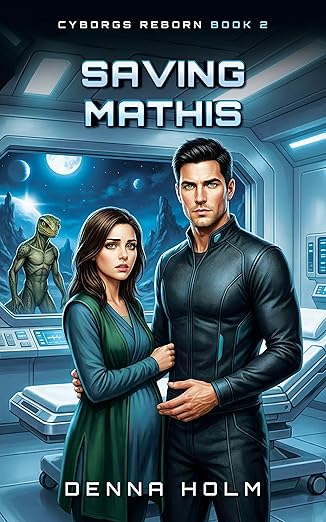

Denna Holm’s Saving Mathis is a science fiction romance built around Tara, a woman from 2026 who wakes aboard the cyborg ship Freedom with no clear memory of how she got there. Thrown into a future filled with cyborgs, alien species, and dangerous political tensions, Tara has to make sense of a life she never chose. From there, the book becomes a mix of survival, trauma recovery, alien politics, and slow-building trust between Tara and Mathis, the cyborg medic who saves her life.
Tara’s voice gives the novel its personality. She’s scared, confused, pregnant, and surrounded by people who distrust humans, but she still has a dry, wit that keeps the story from feeling too heavy all the time. Mathis starts out cold and clinical, shaped by cyborg history and his own fear of human control, but his protectiveness toward Tara gradually turns into something warmer and more personal.
The romance is tied closely to healing, which gives it more weight than a simple attraction story. Tara has to process what happened to her, what her pregnancy means, and whether she can build a life in a future that doesn’t feel like hers. Mathis also has to learn how to care without treating emotion like a system error. When he tells her, “I believe you will make an excellent mother, Tara,” it works because the book has spent so much time showing how badly both of them need tenderness, patience, and trust.
The larger world is packed with cyborgs, Vesperians, the Human Alliance, Raiden, Magenta, and a broader conflict that clearly reaches beyond this one couple. Holm gives the shipboard setting a tense, closed-in feeling, where every hallway and medical room reminds Tara that she’s both rescued and confined. The side characters, especially Althena, Illiana, Tessa, and Silvano, help widen the story into something bigger than one romance while still keeping Tara and Mathis at the center.
Saving Mathis is a dramatic and emotional sci-fi romance about finding safety in a place that first feels hostile. It has alien biology, cyborg politics, found family, trauma, motherhood, and a relationship that grows through uneasy conversations rather than instant trust. Readers who enjoy character-heavy futuristic romance with serious stakes and a lot of heart will find plenty to settle into here.
Pages: 352 | ASIN : B0DS1GXSN9
Passion and Rage

Gaia’s Revolution follows a brutalized climate scientist, a fanatical deep ecologist, and two exploited orphans through the birth of a future Gaian order where the dream of saving Earth mutates into ecology, surveillance, and authoritarianism. What drew you to the idea of ecological devotion becoming a form of authoritarian power?
As an ecologist and environmental activist, I’m intrigued by the notion of what a caregiver and protector of the environment would do when pushed beyond their limits. Ecological devotion is a form of passion, borne and nurtured by strong and complex emotion; strong emotion—like love—can be subverted when threatened, and this can lead to a corruption of fair-mindedness, ultimately resulting in tyranny. Passion and rage are emotional cousins.
As climate change and habitat destruction foment chaos and uncertainty, our sense of democracy and fairness will erode even as protectionism and fanaticism increase—a result of our increasingly fractured and polarized societies. Fanatics prefer to see the world in binary form—black and white—often with marked boundaries of inclusion and exclusion. This “all or nothing” attitude can easily morph into an authoritarian approach that refuses to recognize compromise and leads to extremism. I wanted to explore that possibility by featuring actors deeply involved through their convictions in the big decisions that face humanity.
It was easy to come up with characters like Eric Vogel and Monica Schlange, who both exercise authoritarian power over humanity on behalf of an oppressed and silent environment. Eric escaped the shadows of an oppressive Stasi mother and restless regime to witness the inaction of North America’s oligarchs. Monica had grown up on a small farm in Ontario with a strong tie to the land when she was orphaned and ‘betrayed’ by an exploitive and deceitful government. She found and rekindled her power when she became the environment’s fierce champion.
Monica Schlange is both visionary and monstrous. How did you approach writing a character who believes so completely in her own necessity?
Monica’s personal history created motives for her extremism, fanatical directive, and warrior spirit. Seeing herself as a hero and champion for all who were silenced and ‘othered’ gave Monica a righteous strength and a conviction that she was an important arm of the “right side” in an environmental war. Ripped from her peaceful life on her father’s farm by loss and treachery beyond her control, Monica witnessed how selfish and unconnected humanity could be. Her passion for life, family, and the environment armed her with an incredible conviction to make a difference as she vowed to rise out of the oppression and doom that befell her feckless parents. She became a warrior and championed the ‘other’: those without a voice—the environment and the orphaned children who—like her—lost their innocence far too young. She never stopped believing that she was right. This belief gave her both incredible vision and clarity to act, but also gave her a blind arrogance in her faith that she was always right.
What were some themes that were important for you to explore in this book?
The main theme of the novel is the loss of our innocence in a world in which humanity becomes increasingly separated from Nature—with devastating consequences. Gaia’s Revolution is foremost a cautionary tale that explores possible scenarios of our lack of connection and respect for the environment. The book is the first of a trilogy that explores many themes within this larger one: themes that investigate our use and abuse of various technologies such as artificial intelligence, genetics & cloning, bioengineering, and behaviour modification—all overseen by catastrophic climate change.
Gaia’s Revolution feels part thriller, part manifesto, and part warning. How did you balance storytelling with the book’s scientific, philosophical, and political ideas?
Gaia’s Revolution is essentially a climate thriller and a story with a large scope—invoking large societal considerations, from science to politics. The novel covers upheaval, change, war, and great struggle on an epic scale. I balanced the large scope with compelling storytelling by focusing on the personal experiences of both main and minor characters. Each character experienced the revolution and its aftermath differently, each according to their own place, personal history, and character—and ultimately their relationship with the natural world. Given the circumstances, virtually all the characters had to transform in some way to simply survive.
The effects of climate change, societal upheaval, revolution, and war all created a world that was itself a strong character. Much like Thomas Hardy’s Egdon Heath in The Return of the Native, the world of Gaia’s Revolution is an imposing character, exerting great influence on virtually all the characters of the novel. And in a world torn apart by environmental calamity and war, innocence is the first casualty. The true—and only innocent—protagonists in this story are the three orphans, who must navigate the harsh environment their elders have created for them. In some ways they—and the loss of their innocence—are at the heart of the story.
Author Links: GoodReads | Gaia’s Revolution | X (Twitter) | Bluesky | LinkedIn | Website | The Meaning of Water | Nina Munteanu | Amazon
The Icarian Trilogy opens in Berlin, 2022, and hurtles into a near future on the brink of collapse, where twin brothers Eric and Damien ignite a revolution that could save the planet—or erase humanity altogether.
The population is expendable.
As climate catastrophe scorches the Earth, Eric makes a ruthless, Machiavellian choice to “save” the world at any cost. He unleashes a DNA-targeted plague to cull the human population, then tightens his grip on the survivors through behavior engineering, genetic manipulation, and Techno-clones—man-machine enforcers that herd humanity into sealed megacities known as Icarias.
The war is inevitable.
Horrified by his brother’s genocide and technocratic tyranny, Damien strikes back. He forms the Gaians, a radical eco-terrorist movement, and sparks a brutal uprising against both the regime and the blood that binds them. His weapon is a sentient symbiotic virus designed to enhance human cognition and help humanity thrive in a post–climate change world. Instead, it fractures reality—killing some hosts outright, while allowing others to communicate directly with artificial intelligence.
As the brothers spiral into all-out war for the fate of the planet, a far more dangerous player emerges. Monica Schlange, a ruthless eco-extremist, manipulates both men like chess pieces in her own endgame: saving Earth from humanity and ruling the enclosed world of Icaria. To achieve it, she exploits three orphaned children who hold the secret to an intelligent virus—and the blueprint for an entirely new humanity.
Saving the world was never meant to save everyone.
Trusting the Reader

In a fractured city built on control and genetic hierarchy, a manufactured soldier and a rebel outsider form a dangerous bond. The title Caenogenesis suggests new or altered origins. What does that idea mean within Yin’s story?
Caenogenesis is a biological term for developmental traits that appear in an organism without precedent in its ancestors—new features that deviate from the inherited pattern. Within Yin’s story, that idea operates on at least two levels.
The literal one is straightforward: Yin is a being without precedent. She’s the first human grown outside a womb, engineered from Aja’s and Ryūnosuke’s genetic material, designed to be something humanity has never produced before. Her very existence is a caenogenetic event.
But the deeper resonance is in what Yin becomes versus what she was made to be. Her Creator designed her as a weapon and then stripped away the traits he considered flaws. Her “ancestral pattern,” so to speak, was a blueprint for a perfect soldier. What emerges instead is something her creators never programmed and couldn’t have predicted: a person who learns what home means, who chooses to sacrifice herself not because she was ordered to, but because she wants to protect someone she cares about. Her arc from “I am not a person” to “you are my home” is itself a kind of caenogenesis. It’s a development of something genuinely new from a template that was never supposed to produce it.
There’s also the species-level layer. Aja’s entire crusade is predicated on the belief that humanity needs a new origin to survive. They believe that the old evolutionary pattern is a dead end in a post-nuclear world. Yin was supposed to be the proof of concept for that new beginning. The irony is that Aja sees her as a tool for species-wide salvation while treating her as an object, while Kraken—who has no grand evolutionary agenda—is the one who actually witnesses and nurtures the new thing Yin is becoming.
Yin begins as detached and controlled, yet becomes deeply human over time. What was the hardest part of writing that shift?
The hardest part was keeping Yin’s voice intact while letting her evolve. She speaks in a very specific register, and that voice is core to who she is. It’s not a mask she’s wearing that gets peeled away to reveal a warmer person underneath. It’s genuinely how she processes and communicates. So the challenge was never “how do I make Yin sound more human?” It was “how do I show humanity growing inside someone who will never express it the way we expect?”
The shift had to be subtle. Yin doesn’t learn to say “I care about you.” She drops the word “Human” from Kraken’s name. She doesn’t tell him she was worried. She finds the medical kit on her own, kneels beside him, and while she’s cleaning bullet wounds out of his arm and leg, she tells him his injuries suggest “carelessness and poor tactical judgment” and that this is “hardly a surprise” because he’s human. She doesn’t laugh at his jokes, but she attempts one of her own and has no idea it landed. Those micro-movements had to carry the entire emotional arc because anything bigger would have betrayed the character.
The real tightrope was the moments where emotion overtakes her against her will. She doesn’t have the vocabulary for what she’s feeling, so she frames it as a problem to solve or a weakness to overcome. Writing those moments meant trusting the reader to recognize the emotion Yin herself can’t name.
If she’d suddenly started speaking in warm, flowing sentences, the whole arc would have collapsed. The point is that she becomes deeply human while still sounding exactly like herself. The growth isn’t in how she talks. It’s in what she chooses to do.
The action scenes are sharp, but the novel keeps returning to the cost of violence. Why was that important to explore?
Because action without consequence is just spectacle. And that’s not the story I wanted to tell.
Kraken is one of the most capable fighters in the book. He can clear a room, hack a prison, and outrun a gang. But every time he pulls the trigger, it costs him something. He kills Markus, the leader of the Metal Vultures, a man who used to be his brother in everything but blood, and the weight of it doesn’t lift from his chest. He whispers “sorry” to a man he just stabbed. He shoots three gangsters, and then he stares at the bodies and feels that cold, sour twist in his gut. I needed the reader to understand that being good at violence and being okay with violence are two very different things.
Yin carries violence differently. She never flinches from a fight and never looks back at the bodies. Her Creator carved out the part of her that would care. So her healing doesn’t come from reckoning with what she’s done. It comes from learning that people have value. The first time Kraken cries out in pain while she’s treating his wounds, something unnamed seizes in her chest, and she doesn’t know what to do with it. She turns away from him, shoves the medical kit shut, because the feeling is so foreign it confuses her. She’s coming to the realization that someone else’s pain matters to her. And once that door opens, it changes everything. It’s what eventually drives her to throw herself between Yang and Kraken, choosing his survival over her own.
The two of them together tell the full story of what violence does. Kraken shows what it costs to feel everything and still have to fight. Yin shows what it costs to have that ability taken from you entirely. Both are consequences.
And then there’s the political cost. Aja weaponizes other people’s violence to justify authoritarian control. Elder Statesman Valenstrom’s murder gets repackaged as a righteous cause. The Farm’s destruction becomes propaganda. Violence in this world doesn’t just hurt the people involved. It reshapes the entire society around it.
But violence in Ignis isn’t limited to bullets and bombs. The wall between Modernist and Retro Ignis is violence. The sweeps that drag homeless people off Market Street before the Liberation Festival so the city looks presentable, that’s violence. Tracking citizens through implanted chips based on where they were born is violence. Kraken walks into Nassar Industries and feels physically sick because the opulence exists specifically at the expense of people like him. The system that starves Retro Ignis while Modernist Ignis glows with LED displays is doing damage every single day.
We live in cities where neighborhoods a few miles apart have life expectancy gaps of decades. Where people are criminalized for being poor and then blamed for the desperation that poverty creates. Where governments respond to protests by expanding police power instead of addressing what people are actually protesting about. Aja’s playbook, using fear to pass authoritarian legislation, framing dissent as terrorism, and manufacturing consent through tragedy, none of that required much imagination to write. I just had to pay attention.
The Metal Vultures are desperate people in survival mode, shaped by a system that abandoned them. Kraken says it himself. The question the book keeps asking isn’t “who is violent?” It’s “what made them that way, and who benefits from keeping it going?”
As the first book in The Gemini Files, what groundwork were you most focused on laying, and where will the next installment take readers?
Caenogenesis is the appetizer before the main course. It’s there to draw readers into the world, get them invested in these characters, and set the table for what comes next. Yin and Kraken’s bond had to feel earned. Everything in the sequel depends on the reader believing that bond is real.
The political groundwork mattered just as much. Aja’s rise had to feel inevitable rather than sudden. Every move they make across Caenogenesis builds toward the epilogue: Valenstrom removed, the R.R.C.A. passed, the Outsiders crushed, and Aja sitting in their dead mentor’s chair holding his wooden dove. The reader needed to watch each piece fall into place so that by the time Aja wins, the horror isn’t a surprise. You saw it coming and couldn’t stop it. Neither could anyone in the book.
As for Metempsychosis, the title means the transmigration of the soul into a new body after death. I’ll leave it to readers to discover how that applies. What I can say is that the world expands far beyond Ignis, the stakes become deeply personal, and everything Yin learned about herself in Caenogenesis gets tested in ways she could never have prepared for. Aja is still moving pieces. And the consequences of that epilogue follow everyone.
Author Links: GoodReads | Facebook | Instagram | Amazon
A wall isn’t the only thing dividing the ruined city of Ignis.
In a post-apocalyptic world of gleaming towers and crumbling slums, the high-tech Inner Ring thrives while the Outer Ring fights to survive. Political corruption runs deep, and the government’s grip tightens daily. Rebels like The Outsiders are branded as terrorists—except for those trapped in the shadows, they’re the only hope left.
For Theopold Kraken, a genetically-engineered Recombinant with enhanced abilities, rebellion is more than survival. It’s a cause worth dying for. When Yin, a mysterious woman who may not be entirely human, crashes into his path, everything changes. She’s secretive, strange, and dangerous… and Kraken can’t walk away. As their fragile alliance deepens, he sees in her not just a failed experiment, but someone who longs for freedom—just like him.
Yet trust is lethal. And saving her may cost him everything he’s fought to protect.
Yin doesn’t remember much, but she knows she’s being hunted. Built for a purpose she’s no longer sure of, emotions were never part of the design. Though Kraken’s loyalty and stubborn compassion stir something unexpected in her: curiosity, respect, and the terrifying whisper of humanity. As she strays from what she was made to be, Yin faces a choice: embrace the humanity she was programmed to ignore or run from it forever.
Two broken souls. One chance at freedom. In a world where trust can kill you, choosing each other might be the most dangerous act of all.
Explosive, witty, and raw, Caenogenesis is a genre-bending sci-fi dystopian where identity is rewritten, survival is anything but clean, and what it means to belong when your entire existence was engineered to be alone.
Genetic Testing

The Killing Gene follows a genetic research team as they discover the gene pattern they believe is linked to violent tendencies and serial killers. Where did the idea for this book come from?
My niece was getting IVF, and I overheard that she had selected certain characteristics, eye, hair, skin, and educational background. Then I recalled my son’s genetic testing for Down Syndrome and cystic fibrosis, and it made me think about the pro-life/pro-choice issue. I wondered–and it’s in no way related to my niece’s child–after seeing parents being taken to court for the crimes their sons committed in a school shooting. What if there is a serial killer gene that is passed along to the children, which is triggered, apart from the nature vs. nurture theory?
Can you share a little about the research process required to put this book together?
First, I had to find other illnesses found in genes that are passed from grandparents, skip a generation, and affect the grandchild. I finally found a disease like cancer that affects the whole family or a gender only. I did not want to write a science book, but I had to mention basic genetic testing and technology like CRISPR that can identify genes and order.
Many characters are described as relatable and even flawed. Was that intentional to mirror the complexity of the book’s central question?
Yes, I went with the simple answer with triggers to activate the “killing gene,” a violent sexual act towards the grandfather, Malcom Lynn. The lead geneticist, Tatiana Mirzo, also had a sexual trigger that is kept silent but shows up during the act. The journalist, Maggie Rally, had old-school determination and limited time to solve the murders and was not afraid of getting too close.
Can we look forward to more work from you soon? What are you currently working on?
Yes, I have a new book, and I have about 90% done, but I had an accident and have trouble typing fast enough to finish. The new book is called The Suicide Council, inspired by Kurt Cobain’s suicide. I always wanted to know why, especially when the victim does not leave a note. So this is a fantasy, I do not know if it is classified as a thriller because it involves a Spiritual Council of saints and prophets who visit the victims just before they commit the action. They record why, but they have rules. They cannot change their mind because of free will. And close ones can find out why it happened only when they reach heaven. They can look up the files of the victim’s life filed by the Suicide Council. So I have a collection of stories about victims, different situations, and characters.
Author Links: GoodReads | Website | Amazon

From current choices for parents to make about what their babies will look like. In the near future, parents will be able to find a gene that will show a psychopathic tendency leading to violence. The parents will be able to decide on the birth of a child with Down syndrome. With characters involved with the geneticist’s background and suspecting colleagues, and a report that connects the dots on an ongoing Serial killer investigation with the help of the Main geneticist
The Second Coming: Divine Deception
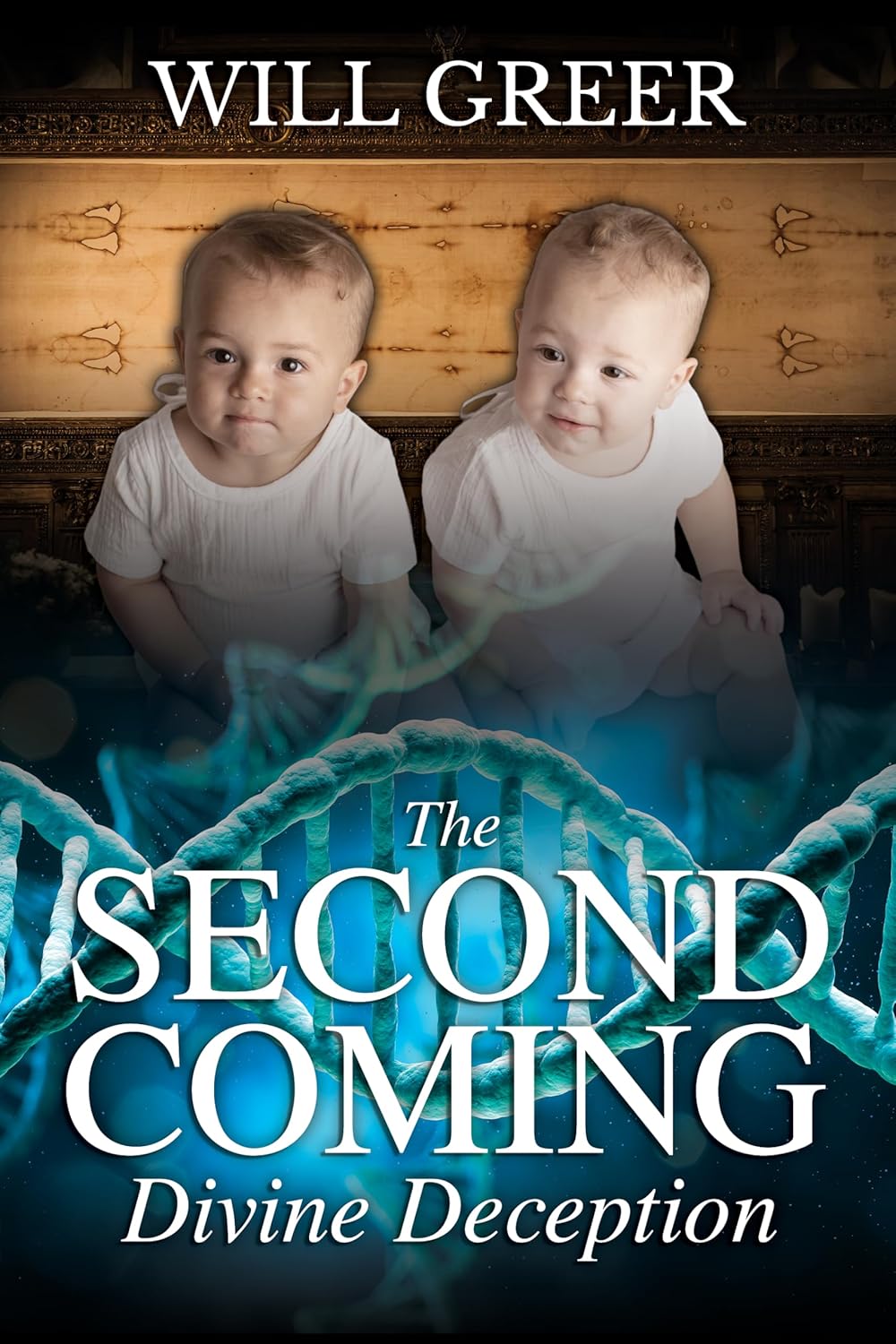
In this religious science fiction thriller, the Vatican secretly launches Project Genesis, using DNA from the Shroud of Turin to create a child they hope will be the new Messiah. At the exact same time, in Nazareth, a struggling young woman named Rachel miraculously conceives a son of her own. The lab-grown boy, Michael, is raised in a hidden Swiss facility and slowly groomed into a global spiritual superstar, while Joshua grows up poor, loved, and quietly gifted, healing people in back alleys and shelters. The novel follows both of them from birth toward a foretold showdown at thirty-three, moving from Vatican back rooms to “New Rome” in Switzerland and refugee camps in Jerusalem as the world decides which “second coming” it believes in.
What I liked most about the writing is how straightforward it is. The opening in the cold Turin lab is tight and visual, and the book keeps that almost cinematic style as it jumps between Sarah in the Vatican project, Rachel in Nazareth, and later Joshua and Michael as they age. The pacing is very much in a thriller mode: short chapters, scene breaks that end on a hook, time jumps that move you from embryo to child prodigy to viral press conference without getting stuck in the weeds. The tech and theology are kept pretty simple. You get just enough genetic jargon to buy the premise, then the story goes back to people in rooms making scary choices. Sometimes the dialogue is a bit on the nose, but this is a book that wants you turning pages, not dissecting sentences.
Where it got interesting for me was in the author’s choices around the two “messiahs” and the whole obsession with proof. Michael, the lab child, is polished and almost inhuman from the start, his miracles wrapped in spectacle and data and political theater. Joshua, the boy from the shelter, is messy, kind, and often unsure of himself, his “powers” showing up in subtle moments like sitting with a dying woman or patiently talking a selfish kid into sharing. Watching the Church, governments, and media fall for Michael’s controlled displays while Joshua refuses to market himself felt uncomfortably close to how we treat charisma and certainty in real life. I liked that the book keeps circling that tension: faith versus proof, love versus control, free will versus “certainty.” At the same time, the moral lines can feel very clean, although you do get flickers of regret and doubt that hint at something more complicated under the surface.
By the time the story moves into the later chapters, with New Rome rising around Michael’s empire and Joshua building a much smaller, scrappier movement in Jerusalem, the book starts to feel less like a standard thriller and more like a long parable about what kind of power we actually want shaping us. The religious science fiction frame lets it play with mind control, viral media, and miracle tech in a way that feels familiar without needing real-world brand names spelled out. I found myself thinking about algorithmic feeds, personality cults, and our cultural hunger for “certainty” while Joshua insists that truth does not need to shout or trend to be real. The ending is hopeful, more about the legacy of ordinary courage and love than about who can throw the biggest miracle, and that choice left me with a warm feeling.
I’d recommend The Second Coming: Divine Deception to anyone who enjoys religious thrillers but wants something a bit more heartfelt than puzzle-box conspiracy stories, and to readers of soft science fiction who like their big ideas wrapped in very human stakes. If the idea of an Antichrist born in a Vatican lab squaring off against a quiet healer from a homeless shelter sounds intriguing, and you are curious about how faith, science, and power might collide in a hyperconnected world, this novel will give you a lot to think about while still being a fast and engaging read.
Pages: 101 | ASIN : B0F7K3JQ5V
Courage Facing Overwhelming Odds

Promise of Mercy blends political upheaval, telepathic warfare, and a frantic intergalactic rescue mission involving the Dreamscape Warriors. What was the inspiration for the setup of your story?
The triplets (Deirdre, Aisling, and Bayvin) get their inspiration from their father, who is their hero. In the first book, Price of Vengeance, Liam became an orphan at two when giant insects called “Chitin” destroyed his family’s farm and killed his parents. Taken in by a prominent family on the planet of Etrusci, they raise him alongside their own son, Randolf. Liam joined the city’s military as an adult. When he is cut off from the last city on the planet, he discovers an alien intelligence (named Azurius) controlling the Chitin and that a traitor is responsible for his parents’ deaths. After getting back into the city, he discovers the traitor had his beloved foster parents murdered. While doing what he can to thwart the alien, he gives in to his desire for vengeance and slaughters the traitor. However, his moral upbringing reasserts itself. Left full of remorse, he still needs to defeat Azurius and save his people from destruction.
In the second novel, Legacy of Valor, the triplets are only children, having grown up hearing stories of their father’s exploits. Liam now leads Etursci’s Special Operations Company and is attached to the New Terran Marine Corps’ Third Division to retake the moon of Treespo, orbiting the planet Beta Proximus IV, from Marshal Kergan’s Rebel forces. “No plan survives its first encounter with the enemy,” is an old Marine saying. Minutes after landing on the hostile surface of Treespo, treachery decapitates the division, leaving Liam the senior combat officer. Treachery has stripped the Third Division of its support. As forces scramble to assist both sides, Liam must keep the warriors under his command alive.
For personal inspiration, there are science fiction books that use ESP (Extra Sensory Perception), though I put my unique twist on it. Few military science fiction books explore a person’s consciousness being used outside the body, which is called “Dreamwalking.” While Dreamwalking a person often has to fight enemy Dreamwalkers. I also drew inspiration from video games such as Halo, in particular with weapons and tactics in space combat.
How do you manage character development throughout your series?
I decide what type of character I need. Sometimes it develops organically. Other times, I must do research on the type of training they would require and the equipment they would use. Then I develop their backstory to figure out what motivates them. Things like childhood trauma, safety, and support during formative development, and how this shapes a character in the novel. This was especially true in Price of Vengeance, where the death of Liam’s birth parents helped to shape him.
In Legacy of Valor, I set up a scenario where Liam was forced to take charge of a campaign, fighting against overwhelming odds. I needed characters who were combat veterans on both sides. This included a solid Rebel Commander in the form of General Sorel Maranz. Marshal Kergan, who, like Liam, suffered from childhood trauma but dealt with it by becoming vengeful. The story also required an experienced, no-nonsense non-commissioned officer. Enter Gunnery Sergeant Anthony Russo.
In Promise of Mercy, the triplets, Aisling, Bayvin, and especially Deirdre, needed to be their father’s daughters. The girls returned home after advanced training in the Finnian Shock Forces. They’ve inherited their father’s marksmanship, his leadership skills, and his ESP powers. However, they aren’t clones of each other. Deirdre is their best shot, and leadership comes naturally to her. Aisling is an explosives expert and pilot. Bayvin specializes in electronic warfare and excels in military intelligence. Their brother is still in his teens but is already a skilled pilot. We also meet Marissa, a former Rebel war criminal who must confront her past once her daughter, Gayla, is born. Marissa goes against Kergan to befriend Liam and return him to his family.
What were some themes that were important for you to explore in this book?
As this is the third book in my series, several themes from the first and second novels carry through: the importance of family ties, the pitfalls of vengeance, and the need for courage when facing overwhelming odds. Liam draws strength from his family, even though he was an orphan. His love for family led him down a path of revenge against a traitor. Upon achieving his vengeance, Liam instantly realized it was a mistake, eventually evolving past the need for revenge.
Kergan lost his family when he was young as well and is still traumatized by it. This makes him obsessed with punishing those responsible. Kergan is an effective leader, and his followers are loyal. Yet, holding on to his pain has made him ruthless to his enemies. Deirdre, in Promise of Mercy, has sworn to kill a Rebel war criminal named Marissa for her crimes. As she continues the search for her father, doubt gnaws at her.
Courage is another central theme. Liam and his family face overwhelming odds throughout the series. Liam has needed to push past physical injury in Price of Vengeance. In Legacy of Valor, he must step into shoes seemingly too big for him and keep the combined human forces alive until help can arrive. Deirdre keeps a larger Rebel force at bay as they search for their father and seek to deny Kergan the use of his new terror weapon.
Can we look forward to a fourth installment of the Dreamscape Warriors series? Where will it take readers?
In the fourth book, Addiction of Power, Liam is older. His daughters are now middle-aged. His son, Aidan, is a veteran fighter pilot. The daughter that Liam and his wife Celinia conceived in Promise of Mercy, Tetia, is in her teens and planning to follow her mother’s path as a priestess and healer. The theme of family carries over. Aidan agrees to deliver information to Finnian Intelligence while on a trip with his Great Aunt Máire and sister Tetia when Kergan attacks their ship. After escaping, Marissa and her daughter Gayla, whom the audience meets in Promise of Mercy befriends Aidan and his family. This starts a journey to end 700 years interstellar civil war. Factions on both sides of the conflict must wrestle with the implications of peace; an end to the bloodshed versus losing power. It also plants the seeds for threats from beyond the Milky Way
Author Links: GoodReads | X | Facebook-Author | Facebook-Book | LinkedIn | Website | Blog

Love, Loyalty, and Moral Choice

The Accelerates: Forty Days to Dust follows a genetically engineered child and his teenage brother and protector, who struggle to survive in a post-apocalyptic society that is in collapse. What was the inspiration for the setup of your story?
Years ago, in a shopping mall, I watched a boy, perhaps seven years old, aggressively demanding something from his parents. When they refused, he lay down on the floor and began pounding it with his arms and legs. That image stayed with me and led me to wonder what the world would look like if children were born fully developed and, within forty days, began demanding from adults their jobs, homes, and everything earned over a lifetime. I noted the idea without knowing where it would lead.
My wife and I both grew up in households rooted in love and devotion to siblings, and we raised our two sons the same way. I have one brother, three years younger than me. Growing up in the former Soviet Union, the streets were tough, and we learned early to watch each other’s backs with loyalty and care. Now, in our seventh decade of life, that bond remains unchanged. I also witnessed the same devotion among my wife and her four siblings.
A few years ago, a tragedy struck our family when my wife’s oldest brother passed away in his mid-fifties. After his death, my thoughts returned to childhood, especially to memories of a young boy’s devotion to his baby brother during a serious illness. From there, imagination took over, and the emotional core of the story formed.
When I took early retirement, I finally had the time to do what I love most, telling stories on canvas, on paper, and through words.
That is why I dedicated this novel: For the ones we love, and for those in memory.
The supporting characters in this novel, I felt, were intriguing and well-developed. Who was your favorite character to write for?
All the characters are drawn from my family, so choosing a single favorite is difficult. Leo is inspired by my younger brother and by my brother-in-law, who passed away in his mid-fifties. Ethan reflects both my brother-in-law and myself. Clara is based on my wife’s older sister, as well as my wife. Mia is inspired by my niece.
Writing these characters felt less like invention and more like remembering. Each one carries a piece of someone I loved, which made them especially meaningful to bring to the page.
What were some themes that were important for you to explore in this book?
Many of my family members are doctors, including my wife, my older son, my brother-in-law, my sister-in-law, and her two sons, as well as many close friends. Because of this, I have spent years surrounded by conversations about moral and ethical questions in our society.
Those discussions shaped the heart of this novel. The most important themes I wanted to explore were morality and ethics, along with love, devotion, and family loyalty. In a collapsing world, I wanted to ask what values remain, and how human responsibility toward one another survives when structures and systems fall away.
What is one thing that you hope readers take away from The Accelerates: Forty Days to Dust?
I hope readers come away with a renewed sense of responsibility toward one another. In a world that often feels fractured and rushed, I wanted to remind readers that love, loyalty, and moral choice still matter, especially in times of collapse. If the book leaves them thinking about how we care for family, protect the vulnerable, and honor memory, then it has done its work.
Author Links: GoodReads | Facebook | Website | Amazon
When Clara gives birth to Ava, a genetically altered child, the echoes of a failed experiment ripple across time.
Leo is one year old, trapped in a five-year-old’s body, carrying the mind of someone a century old. Fragile, brilliant, haunted, he bears the weight of humanity’s final gamble.
Beside him stands Ethan, his reluctant protector, and Mia, hardened by loss and fury. Together, they scavenge what’s left of a world that forgot how to breathe. But in the shadows, a presence waits. Ava, part girl, part code, all vengeance, hunts them from the fire they tried to escape
Time is unraveling. The infected dream in equations. And every breath could be their last.
The Accelerates: Forty Days to Dust is a poetic, post-apocalyptic reckoning: part genetic horror, part elegy, part love letter to the children grown too fast.
For readers who believe memory is a weapon worth wielding.


