Blog Archives
Walking Wounded

From Depression to Contentment: A Self-Therapy Guide is a book that provides help for readers who are experiencing depression and desire an alternative to outside therapy. It presents well-researched techniques and methods that are straightforward to implement. Why was this an important book for you to write?
Actually, the book title addresses depression because my publisher is very firm: each book should seem to limit itself to one problem. However, psychotherapy doesn’t actually work like that. With suitable modification, essentially the same tools will provide a path out of chronic anxiety, addictions, anger… basically, human suffering. This is because, as I say in the book, classifications like in the Diagnostic and Statistical Manual are basically science fiction.
Second, the therapy bit is only halfway, from ongoing agony to “normal,” which is the walking wounded. Then the tools of positive psychology and Buddhist psychology allow you to rise WAY above that.
This book is the distillation of decades of my personal experience, study, and therapeutic practice. I wrote it to be of service to as many people as possible, then a few more.
How much research did you undertake for this book and how much time did it take to put it all together?
In a way, no research at all — specifically for this book. When I started university, I decided not to go into Medicine because it was a 6-year course, then at least 4 more years of training. Then, overall I spent 14-and-a-half years as a student. And in my profession, you don’t ever stop learning. A condition of being registered is continuous study. And even though I retired in 2013, I have kept up with new research, just from interest.
So, while this research and study were not for the book, all that information and knowledge is in there. Well, it is, up to the publication date. It’s annoying, but when I sent my time machine in for service, they returned it to an alternative universe. What’s happened since is only marginal, but it doesn’t matter all that much, because therapy, including self-therapy, will work if three conditions are present, as Carl Rogers has described. These are empathy, love of the kind Buddha, Jesus and many other sages have told us to give to everyone, and genuineness. That last one is that it has to be honest.
What were some ideas that were important for you to share in this book?
• Chronic emotional suffering beyond what the situation warrants is always due to the interaction of
several factors. One of them is childhood trauma, as seen through the child’s eyes.
• Depression, chronic anxiety and the like are not due to faulty brain chemistry.
• Using the tools I teach in the last part of the book, you can live a contented life in any situation.
What is one thing that you hope readers take away from From Depression to Contentment?
The more you give, the more you get, and also the more you grow.
Author Links: GoodReads | Twitter | Facebook | Linkedin | Mastodon | Website
Every tool in this book is based on research, but presented in an easy to understand, easy to apply manner.
With homework assignments, you will find your inner strengths, uncover the true source of happiness and develop great resilience.
Learn how to put the philosophies of all great religions to practical use, even if you are an atheist.
This program can help you start a new life – one of meaning, positivity and purpose.
Unlike instructional books, this book is not only useful but also enjoyable.
From Depression to Contentment: A self-therapy guide
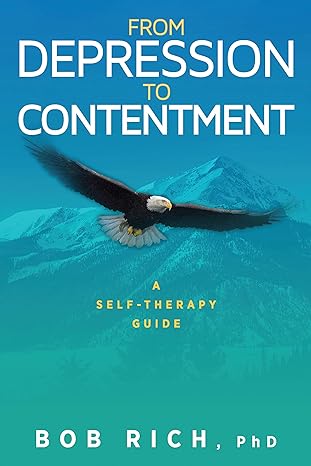

From Depression to Contentment: A Self-Therapy Guide, by Bob Rich, is an enlightening and approachable book that tackles the complex topic of depression. Rich’s book is not just a clinical discourse but a practical guide filled with empathy that draws from the author’s own experiences and psychological expertise.
Rich’s writing style is both engaging and easy to understand, a breath of fresh air in the often technical world of psychological self-help books. His personal anecdotes add a level of authenticity that’s both relatable and inspiring. The book’s approach of viewing depression not just as a medical issue but as a perspective on life is a refreshing angle. It challenges readers to rethink their own views on depression, making it an engaging read for anyone interested in mental health.
The book is skillfully structured, guiding the reader through various strategies, from basic self-care to deep psychological work. Particularly impressive is the chapter on “Controlling Depression,” where Rich introduces practical methods to reframe negative thoughts, encouraging a proactive stance in dealing with depressive thoughts. It is worth noting that some readers may find the chapter on spirituality less applicable, depending on their personal beliefs.
The conclusion of the book underscores a crucial message – the importance of actively applying these strategies in one’s life. This is where Rich’s guide distinguishes itself; it’s not just informative but also motivational.
From Depression to Contentment is a highly recommended read for anyone who is struggling with depression or has an interest in mental health. It’s particularly suited for readers seeking a blend of professional insight and practical, easy-to-implement strategies.
Pages: 157 | ASIN : B07PGQMP4Q




 LITERARY TITAN