Blog Archives
The Liberating Characteristic of Grace

From Theocracy to Democracy is a sweeping historical and theological argument that challenges Christianity’s reliance on fear-based authority while calling the Church back to the grace and love at the heart of Jesus’s message. What compelled you to connect the history of the papacy with the psychological effects of fear and obedience?
As a psychologist, I recognized that the anxiety about the gods that motivated obedience to authority and justified the ideology of all the theocratic empires throughout history mirrored the infant’s response to its fear of abandonment by its mother or caretaker. As a theologian and historian, I knew that this same theocratic worldview shaped the papacy after it gained control of the Christian Roman Empire. As a consequence, the liberating characteristic of grace preached by Jesus was never unambiguously taught by the Church or joyfully appreciated by Christians.
The First Communion story is deeply affecting. How did that memory shape the emotional and theological direction of the book?
In that childhood event, I remember clearly the anxious speed with which the nuns removed the girl from the Eucharistic celebration. I eventually appreciated how those nurturing women had had to suppress their human feelings in order to obey the Church’s law.
You argue that grace is central to humanization itself. How do you hope readers will understand grace differently after reading your book?
Grace is the vision of existence that sustains our right to define our humanity not merely to defend preordained divine rights. By liberating us from fear of divine retribution and abandonment, unlike the “puppet people” who execute a preordained divine plan, grace is whatever enables us to develop and enjoy our lives to the best of our cherished insights and ethical judgments.
For readers who may resist your critique of papal authority, what would you most want them to sit with before drawing conclusions?
I would ask them if they experienced any anxiety about this issue when they think about their God and to understand how theocracy’s claim that “all authority comes from God” has dominated humanity’s development and history.
Author Links: Amazon | GoodReads
From Theocracy to Demoracy: Can the Papacy move from Authority to Grace
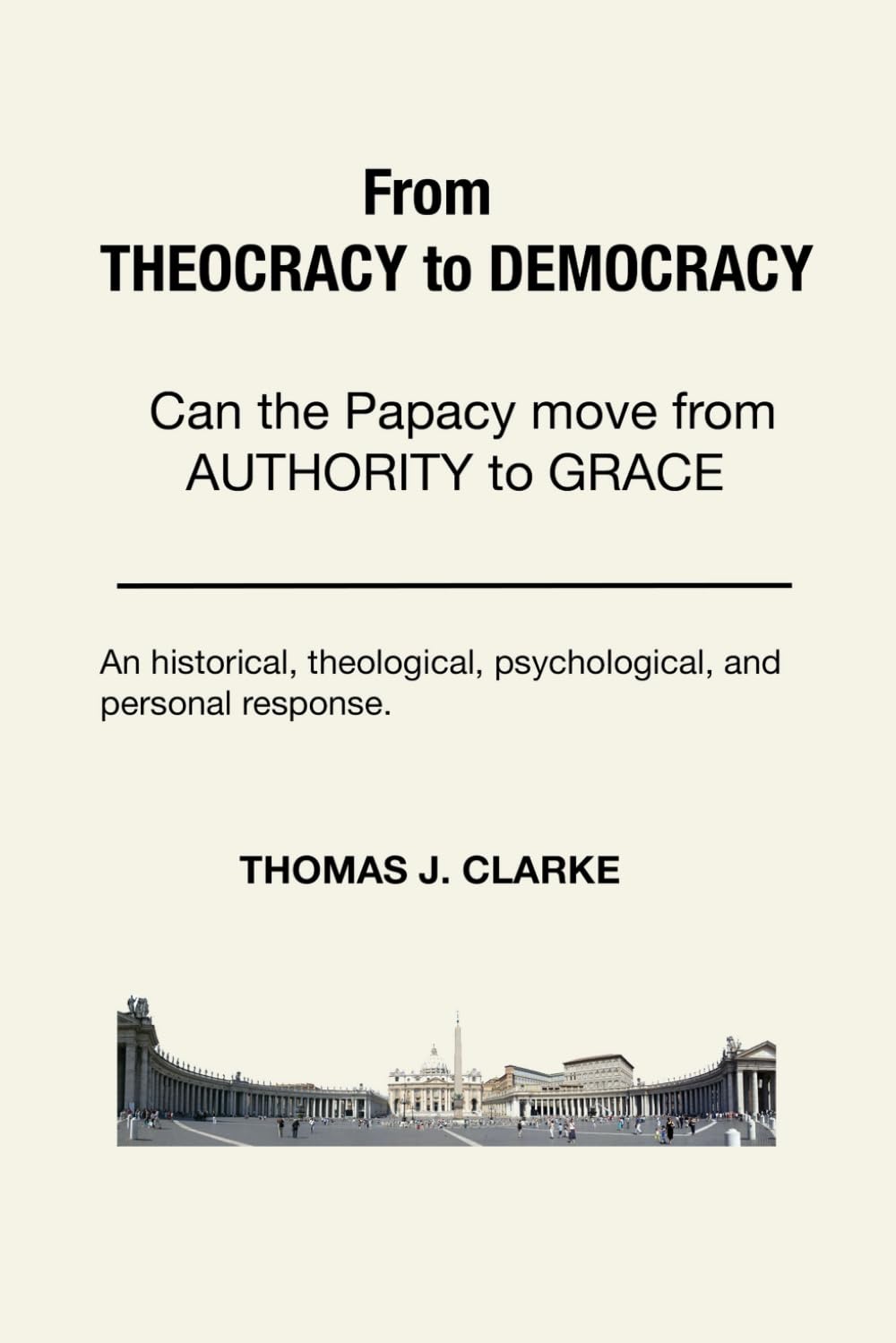

From Theocracy to Democracy is Thomas J. Clarke’s sweeping historical, theological, psychological, and deeply personal argument that Christianity, and especially the papacy, has too often exchanged the liberating grace of Jesus for the anxious machinery of theocracy. Clarke moves from ancient kingship and the “cosmological” ordering of society through Augustine, medieval papal power, the Reformation, Vatican II, and Pope Francis, always returning to one central wound: the Church has taught fear and obedience more clearly than it has taught unconditional love.
What moved me most is the way Clarke refuses to let abstraction remain bloodless. The opening memory of the little girl removed from First Communion because she had eaten or drunk after midnight is profoundly affecting in its simplicity. It tells the whole story before the argument begins: holiness made brittle by fear, authority mistaking itself for reverence, a child’s trembling body becoming the price of doctrinal anxiety. Clarke’s prose can be forceful, even thunderous, but beneath its severity I felt a sorrowing tenderness. He isn’t writing as someone eager to destroy the Church. He’s writing as someone who has loved it long enough to be wounded by it, and who still believes it might become more gracious than guarded.
Clarke’s range is formidable: the Sumerian Kinglist, the Enuma Elish, Hammurabi, Plato, Paul, Augustine, Luther, papal infallibility, fascism, Vatican II, and Francis all enter the same charged conversation. The argument presses so insistently on the contrast between theocracy and grace that the rhythm becomes more prosecutorial than exploratory. Yet the best passages have a grave, luminous power. I was especially struck by the book’s insistence that grace isn’t merely mercy after failure, but the substance of humanization itself. The late image of the man at the plane line, lifting the author into a crushing embrace, makes the theology suddenly warm. Grace becomes not a concept to be defended, but a life recognized in another person’s arms.
From Theocracy to Democracy is an impassioned and morally serious book, one whose urgency comes from both scholarship and lived pastoral ache. Clarke’s conclusions are not modest, and some readers will resist his psychological framing or his sharp critique of papal authority, but I appreciated the courage of a mind trying to rescue faith from fear without flattening its mystery. I think this book would be good for readers interested in Catholic history, theology, religious psychology, Vatican II, and the long struggle between institutional authority and human freedom. It’s a searching work for readers willing to sit with discomfort, and its final gift is a hard-won hope that grace, not anxiety, might yet have the last word.
Pages: 678 | ASIN: B0F4Q1HMQG



