Blog Archives
Kintsugi

Asayi: An Autistic Teen’s Journey to Topple a Shogun in Medieval Japan follows an autistic teen on a journey to challenge the oppressive regime and find her tribe and love. What are some things that you find interesting about the human condition that you think make for great fiction?
In Asayi – An Autistic Teen’s Journey to Topple a Shogun in Medieval Japan, the main character, Asayi, presents as mute. She understands what is spoken to her and can copy text, i.e., ink Japanese characters, but in book one, she is illiterate.
So Asayi has a rare skill, but is hampered by her lack of literacy. Not being able to speak is a severe disability in a culture that is with obsessed with perfection. That is why Nabui constantly repeats that the Shogun “had given him a defective gift” when Yoshinori Ashikaga arranged for Nabui to marry Asayi after her father’s death. The Shogun felt that the daughter of the late Chief Scribe needed to be placed in Nabui’s household since he was the next Chief Scribe. Asayi’s “defectiveness” led to beatings, rape and other cruelities in Nabui’s household. It was not until Yoshinori’s successor, Yoshimasa, came to power that the obsession with perfection came to be a bit dispelled. Yoshimasa introduced the art of “kintsugi” in the 15th century wherein broken porcelain was repaired with gold welding to restore its wholeness and utility.
While life has many struggles, the disabled in Medieval Japan suffered through more struggles than the average person. Had Asayi not been connected through her Chief Scribe father to the power circles, she would have no doubt been killed as a child or used as a household slave. As it was her father kept her condition a secret from the court during his lifetime. Asayi’s humanity is affirmed as she learns to communicate with others by drawing. Thus Asayi adapts to her limitation and uses her prowess with the brush to have a voice.
What were some themes that were important for you to explore in this book?
Certainly, I wanted to touch upon the norm of perfection held by the aristocratic class and present its impact on an autistic young girl. I also wanted to touch upon the severe restrictions on the lives of women in this period as they were ruthlessly governed by fathers, brothers, and husbands. When I asked a friend of mine who I worked with to teach me Japanese, he told me that I needed to learn the language from a woman. I then discovered the Japanese language spoken by women was like a different language, filled with many honorific words for males that the women were to use in conversation with men!
What is the next book that you are working on, and when will it be available?
In my next book I will be covering the theft of the Imperial Regalia from the Northern Court. Controlled by the Ashikaga family for generations by the Southern Court, which was the province of the emperor. The regalia consisted of a sovereign sword, a many-sided mirror, and some gems. Whoever possessed these objects had the mandate to reign, and they were coveted by each Court. Asayi goes underground to recover these objects, so another adventure lies ahead.
Author Links: Website | YouTube | GoodReads | Librarything
Layers of nuance unfold: the vulnerability of an autistic young woman in a merciless time period; political unrest, physical survival, secret identities, and finding one’s tribe and love while facing injustices and revolts that are just as real as today’s inequities and discontents.
The underdogs prevail in this remarkable medieval Japanese saga replete with true to life characters, political and personal sagas, and the enduring Asian cultural icon: the ghost.
Asayi: An Autistic Teen’s Journey to Topple a Shogun in Medieval Japan
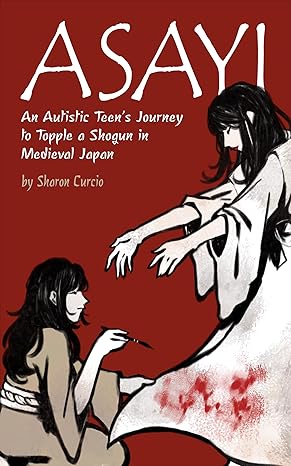

Asayi: An Autistic Teen’s Journey to Topple a Shogun in Medieval Japan, by Sharon Curcio, is a compelling narrative that immerses readers into the tumultuous life of Asayi, an autistic young woman navigating the perilous landscape of medieval Japan. From the very beginning, the story is laden with tension as Asayi confronts political intrigue and social turmoil, resolutely determined to challenge an oppressive regime. The story unfolds through a rich tapestry of court drama and shadowy characters spanning all social strata. Deception is rife, yet amid the swirling machinations, the truth gradually emerges. The portrayal of Asayi’s vulnerability, coupled with her formidable resolve, offers a deeply nuanced perspective on the challenges faced by individuals with autism in a ruthless era.
Asayi’s journey transcends mere survival; it is about discovering her tribe and finding love amidst chaos. The relationships she forms, particularly with her father, the housekeeper Hatsu, and the ever-present spirit of her late mother, Omari, are both touching and profound. These connections ground her as she confronts numerous challenges, including the daunting prospect of an arranged marriage and the scrutiny of the Shogun’s court. Curcio’s masterful storytelling brings to life the visceral reality of political unrest and the constant fight for survival.
Asayi’s journey, marked by secret identities and the relentless pursuit of justice, echoes enduring struggles against inequities and societal discontent, resonating with contemporary issues. The narrative not only highlights Asayi’s personal battles but also her quest for belonging and love, weaving a powerful tale of finding one’s tribe amidst chaos. The novel’s strength lies in its authentic depiction of true-to-life characters and the enduring cultural motif of the ghost, enriching the story’s historical and emotional depth. Asayi is a remarkable saga of resilience and empowerment, where the underdogs ultimately prevail.
For those who appreciate historical fiction with profound emotional and cultural dimensions, Asayi is an unforgettable read. The book captures the essence of medieval Japan while addressing universal themes of identity, resilience, and justice.
Pages: 160 | ASIN : B0D3FRCC19



 LITERARY TITAN