Blog Archives
Marble and Mud


K. E. Thompson’s Marble and Mud is a sprawling, character-driven novel about a woman who goes looking for purpose and winds up in a place where almost everyone has a complicated claim on what belongs to whom. Lauren Fischer, a twenty-nine-year-old nurse tired of her carefully controlled suburban life, inherits a huge Victorian mansion in the nearly forgotten California mountain town of Stewart’s Camp. She arrives imagining that restoring the house might become the significant thing she’s been waiting to do with her life. The mansion immediately complicates that dream. It’s filthy, altered, half-abandoned, and stripped of much of the collection supposedly left to her. Still, Lauren sees the craftsmanship under the damage and begins working on it room by room. Her fixation on lists, cleaning, repairs, and order makes the restoration feel like an extension of her personality. At the same time, she starts becoming useful to Stewart’s Camp in ways she never planned, especially after delivering fifteen-year-old Tristin Jensen’s baby and becoming an apprentice to the eccentric local healer, Doc Pottinger.
What gives the book its energy is that the house keeps getting larger as a symbol while Lauren’s actual control over it keeps shrinking. Gwendolyn Barnes, the deceased owner’s estranged daughter, arrives with her own entourage and simply moves in, even though Lauren has the deed. Lauren then discovers that the history of ownership stretches back further still, to Murray Stewart, whose connection to the original family makes the legal question much less satisfying than the moral one. Meanwhile, Gwendolyn converts the mansion into the Alpha Male Inn, an elaborate brothel that becomes the center of the town’s gossip, hypocrisy, economic anxiety, and resentment. Thompson lets this plot expand into a genuine ensemble story. Tristin, Jonathan Porter, Doc, Jack Fletcher, Kate, Bob, Gwendolyn, and even the visiting clients all develop motives and secrets of their own. That makes Stewart’s Camp feel less like a backdrop than a closed ecosystem where everybody’s choices eventually affect everybody else.
I would compare this book to Fannie Flagg, particularly Fried Green Tomatoes at the Whistle Stop Cafe. Thompson has a similar interest in eccentric small-town communities where humor, tragedy, gossip, prejudice, loyalty, and buried history all occupy the same few streets. Like Flagg, she moves easily among different characters instead of keeping the camera fixed on one protagonist. Thompson’s version is rougher and more spiritually argumentative, though. Marble and Mud spends a lot of time with Christianity, moral judgment, sexual hypocrisy, poverty, and the danger of turning conviction into self-righteousness. The late novel’s attempted lynching is where those ideas collide most forcefully. Jonathan, normally one of the quietest people in town, breaks the mob mentality by effectively asking everyone to widen the circle of guilt until they realize nobody can stand outside it. The sequence is exaggerated and darkly funny in places, but it also exposes the book’s central moral concern: people are far more comfortable naming someone else’s corruption than examining their own. Lauren herself has to confront that problem when she realizes she’d turned the mansion into a kind of personal Promised Land and cast herself in a role that allowed her to sort people too easily into righteous and wicked.
Thompson’s style suits this messy moral landscape. She likes close third-person narration that borrows the vocabulary, prejudices, jokes, and blind spots of whichever character currently owns the scene. That can make the novel deliberately uncomfortable because characters say offensive, foolish, selfish, or naïve things without the narration constantly stepping in to clean them up. The result feels appropriate for a book whose title comes from Hawthorne’s idea that life contains both the beautiful and the sordid. Thompson repeatedly turns that idea into something physical. The mansion has parquet floors and crown molding alongside mildew, needles, junk, and rotten furnishings. Stewart’s Camp contains generosity beside cruelty. Lauren’s desire to do something meaningful contains both genuine compassion and vanity. The book is funniest when those contradictions are allowed to coexist without being neatly explained, and Doc Pottinger is especially good at puncturing Lauren’s tendency to turn life into a system she can understand and manage.
The ending is what makes Marble and Mud work as more than an eccentric small-town saga. Lauren loses the physical object she thought would give her life meaning just as she discovers that her real importance has been accumulating elsewhere, through nursing people, delivering a baby, learning the town, forming relationships, and being present when she’s needed. Afterward, Doc explains the lesson more clearly than Lauren would probably prefer: purpose isn’t something a person gets to design in advance, but something that may only become visible after a long series of ordinary choices. The epilogue then reaches back to 1919 and reveals another layer of love and grief embedded in the house itself, including Beth’s ashes sealed into its structure, which gives the mansion’s destruction an unexpectedly tender final resonance.
I came away thinking the title is exactly right. Marble and Mud is about beauty mixed with embarrassment, faith mixed with ego, good intentions mixed with terrible judgment, and people who become meaningful to each other while they’re still trying to figure out what their lives are supposed to mean. I recommend Marble and Mud to readers who enjoy small-town stories, eccentric characters, and thoughtful explorations of purpose, relationships, love, grief, and finding meaning in ordinary acts of kindness.
Pages: 354 | ASIN : B0FJ7T3C19

Unwavering Devotion

A Time for Us is a heartfelt historical romance that follows two love stories across 1947 New York and 1987 North Carolina, asking whether a bond powerful enough to survive prejudice and loss can also survive death. What was the inspiration for the setup of your story?
The inspiration for A Time for Us began with a real moment in my life. In 1987, I was working the breakfast shift at a fast-food restaurant in Clayton, North Carolina; a married mother of two, living a very routine life where I saw the same faces every day.
Then one morning, a new face appeared. There was an instant, unexplainable familiarity between us. We found ourselves stealing glances, both trying to place where we might know each other from. When he came through my line, we realized we were strangers, but neither of us could shake the feeling that we weren’t.
He was in town temporarily, and for the next several weeks, he came in every day, always choosing my line. Our conversations were light and innocent, but there was an undeniable connection neither of us could explain.
On his last day, he brought me two dozen yellow roses to thank me for making his time in town special. I told him I couldn’t take them home, but I accepted them anyway. Before he left, he looked at me and said, almost in disbelief, “I still feel like I know you… maybe from another lifetime.” I laughed it off at the time, but that moment stayed with me.
I never saw him again. But I kept one of those roses, pressed inside a book of poetry that I still have. And over the years, I found myself wondering… what if that feeling meant something more?
That question became the seed for A Time for Us. The story itself is fiction, but that moment… that unexplainable connection was very real.
How did you approach writing the 1947 romance so that its tenderness and danger would feel equally present?
I’ve always been drawn to historical documentaries, especially those centered around organized crime. That’s where the element of danger in their story was born. The tenderness, though, came from a much more personal place. It was shaped by my imagination and reflects the kind of love I believe in and would want for myself (minus the “forbidden” complications, of course).
What I love most about Mario and Jeannette is that they choose each other again and again, under every circumstance. Even when tragedy should have driven them apart, they hold on tighter. There’s something incredibly powerful about that kind of unwavering devotion.
What drew you to write a love story that is so openly sincere and emotionally heightened rather than restrained?
I write the way I live my life now: from my heart. And I think that’s exactly why it took me over 30 years to finish and publish A Time for Us. For a long time, I lived with a quiet fear of what people might think of me, of my choices, of my voice.
If I had published this story decades ago, it would have been very different. More restrained. More concerned with being palatable… telling a neat, tidy story that didn’t push too far or risk offending anyone.
But the version I ultimately wrote is the one I was always meant to tell. It’s raw. It’s real. It leans fully into emotion without apology. And if that sincerity feels a little too much for some… well, I’m finally at a place where I’m okay with that.
What do you hope readers carry with them after finishing A Time for Us, the romance, the idea of fate, or something else entirely?
More than anything, I hope readers walk away believing in the power of love, not just the idea of it, but the kind of love that endures. The kind that isn’t conditional or convenient, but steady, selfless, and deeply rooted.
Life is going to bring obstacles; we all know that. But when you have real love in your life… not the transactional kind we sometimes settle for, but the kind that says, “I’m here, no matter what”, it gives you the strength to face anything.
If readers close this book feeling like that kind of love is possible… and worth holding onto… then I’ve done what I set out to do.
Author Links: GoodReads | Facebook | Website | Amazon
In A Time for Us, readers are drawn into the life of Deborah, an African-American woman whose dreams reveal a connection to a previous existence. These dreams lead her to Pauli, a Caucasian man whose presence stirs a deep sense of familiarity within her. As Deborah explores the concept of reincarnation, she uncovers the tumultuous love story of Jeannette, an African-American seamstress from Harlem, and Mario, an Italian man entangled in the dangerous world of organized crime in 1940s New York City.
Deborah’s journey is fraught with peril as she risks everything to uncover the hidden truths surrounding Jeannette and Mario’s lives. Each revelation pulls her deeper into a historical landscape marked by racial tensions and societal constraints, where love defies the boundaries of time and circumstance. The intensity of Jeannette and Mario’s love story resonates with Deborah, forcing her to confront her own feelings and the commitments she has in her current life.
As she navigates the complexities of her dreams and the realities of her present, Deborah finds herself in a profound struggle between the haunting allure of a past love and the fragile ties of her current existence. A Time for Us is a compelling exploration of love’s endurance across time, challenging readers to reflect on the choices that shape their lives and the legacies of love that linger long after the moments have passed.
Living an Honest Life

Where Truth Lies Waiting follows a woman who has a traumatic accident that leaves her suspended between life and death, and develops a sixth sense, allowing her to hear the thoughts of those who visit her. What was the inspiration for the setup of your story?
The inspiration for the setup of this story can be traced to my childhood. I was always fascinated with how people’s actions did not always match their spoken words. Say and do could be very different things. With this preoccupation, I always wondered what it would be like to know what people thought and how different it would be from what they shared verbally. As I got older and self-reflected, I realized that this “sixth sense” could be as harmful as it could be helpful in really knowing a person deeply.
What are some things that you find interesting about the human condition that you think make for great fiction?
I feel that most people are pleasers. They will tell you what they think you want to hear. Honesty, on the other hand, does not flow as freely from people. I would also say that most people aspire to be good and do good. But being and doing good usually require sacrifice and giving. It is not always easy, and that is when things get interesting. In my opinion, the “what ifs” are what drive good fiction.
What were some themes that were important for you to explore in this book?
One theme that is at the forefront of this novel is living an honest life. Honesty applies not only to others but to one’s own self and it can change over time, given how each of us changes and evolves. Forgiveness fits perfectly into this theme as there is bound to be a need for forgiveness as each of us searches for our own truth.
Another theme that was important for me to explore was the possibilities of what happens to us when we die. Our culture works hard at preserving youth and seeking longevity. Most people I know would not find a conversation about death and dying a very desirable topic. We tend to run from the one true fact that we are guaranteed in life: We will all die. Exploring it in fiction offers a safe space to imagine and consider, even for a moment.
What is the next book that you are working on, and when can your fans expect it to be out?
This is my third novel. At this point, I have been encouraged to write a sequel for my second novel, Three Days in Amsterdam. I am mulling that idea around. These three novels were written with a specific purpose. In all honesty, I am waiting to be inspired because that makes the pen flow with a fluidity that is magical. I strive for that magical inspiration always.
Author Links: GoodReads | Facebook | Amazon
See Tina Now. She lies in a hospital bed, her broken body tethered to life by tubes and machines. Suspended between life and death, Tina’s spirit lingers in a space where memories resurface, and questions arise.
Feel Tina’s struggle as she confronts the cracks in her once-ideal life. Her only connection to the world is her sight-until an unexpected sixth sense emerges, allowing her to hear the unspoken thoughts of those who visit her bedside. What begins as fascination soon turns unsettling, as their inner truths challenge everything Tina assumed she knew about her relationships and herself.
Piece by piece, Tina must rely on the raw, unfiltered thoughts of her visitors to uncover the mystery of how she ended up in this shattered state. Each memory offers a clue, shedding light on hidden truths and unresolved conflicts from her past.
In the end, as the cause of her tragic circumstances become clear, Tina gains a profound understanding- but it’s far from what she expected.
Tanja Davia’s third novel, Where Truth Lies Waiting, takes readers on an extraordinary journey into the liminal space between life and death. It explores the fragile balance of perception and truth, the weight of our choices, and the seemingly random events that shape our life. Yet, as Tina begins to wonder-are any of these events truly random?
Where Truth Lies Waiting
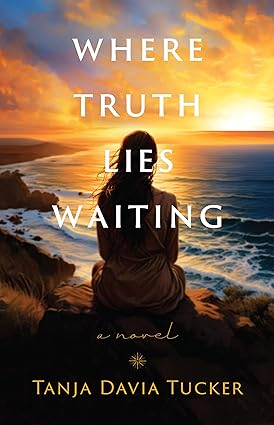
Where Truth Lies Waiting is a moving and deeply introspective novel that follows Tina, a woman caught between life and death, as she reflects on her past, her relationships, and the truths that shaped her existence. After a traumatic accident leaves her hovering in an out-of-body state, Tina watches her own life unfold from above, visiting memories, conversations, and unresolved moments with a keen emotional eye. As her spirit wanders through these reflections, the story reveals the intricate ties of love, friendship, and grief, especially the ways honesty and truth both heal and hurt. Layer by layer, the novel uncovers the weight of unspoken truths and the surprising ways clarity can surface when we let go of control.
The writing has a slow, poetic rhythm that draws you in, even when the subject matter is heavy. I was struck by how intimate Tina’s thoughts felt like paging through someone’s private journal. Tanja Davia Tucker does a beautiful job of painting Tina’s inner world with honesty and raw emotion. The early chapters, especially the ones about Tina’s childhood and the death of her father, resonated with me. It made me pause and think about the things we carry from childhood that quietly shape us well into adulthood. The writing is calm and clean, but there’s real power in its simplicity. Every sentence feels deliberate. You can tell Tucker poured her soul into this story.
There were moments where switching perspectives from Tina to others pulled me out a little. Some of the flashbacks were so vivid and moving that I wanted to linger, but the pace often moved me forward. Still, I can’t fault the book for that. It’s reflective and careful, like Tina herself. What hit me most was the recurring theme of truth. How it’s not always simple, not always kind, but still necessary. It made me rethink moments in my own life where I either held back or pushed too hard in the name of “being honest.” The book doesn’t pretend that truth is easy. It shows how it can crack things wide open, or quietly save us.
I would recommend Where Truth Lies Waiting to anyone who’s ever grieved deeply, loved fiercely, or struggled with what to say when words feel too small. It’s a quiet book, but it echoes long after you close the cover. If you’re the kind of reader who enjoys stories that make you feel something real, especially those that sit in the emotional in-between, this one’s for you. It reminded me that sometimes we find peace not in having all the answers, but in being brave enough to ask the questions.
Pages: 220 | ASIN : B0F7GRHNR6
Deadly Secrets

Deadly Secrets is a high-stakes political thriller that drops readers straight into a near-future America fractured by extremism and secession. Centered around Annie Price, an investigative journalist still healing from a past ambush, the story unpacks the creation of a new state called Westcarolina—a theocratic breakaway backed by religious fanatics, corrupt politicians, and shadowy powerbrokers. As Annie chases leads through bombings, government secrets, and personal betrayals, the book balances political commentary with the pulse of a fast-paced mystery.
Let me just say it up front: I devoured this book. The writing has that brisk, no-nonsense cadence you want in a thriller—nothing bloated or overly poetic. Every sentence moves the story forward. Nancy Stancill doesn’t waste time. Her protagonist Annie is sharp without being snarky, tough without being cartoonish. And while the plot careens through explosions, shady politicians, and mounting paranoia, it never forgets the emotional toll all this takes. Annie’s moments of doubt and trauma hit hard. You don’t just watch her chase a story—you feel the cost.
Some characters lean toward caricature, especially the villains. Reverend Kingston Avery, the zealot who builds a “Christian state,” reads at times like a mashup of every televangelist villain trope. That said, his hypocrisy and ambition feel eerily relevant. What really surprised me, though, was how layered the story becomes—especially in the way it weaves Annie’s personal entanglements with broader questions about truth, faith, and power. The romantic subplot adds tension without slowing things down, and there’s this subtle ache in Annie’s longing for normalcy that sneaks up on you.
Deadly Secrets feels like a warning disguised as entertainment. It’s a propulsive, emotionally grounded novel that juggles political fiction, crime drama, and character study without dropping the ball. I’d recommend it to fans of investigative thrillers, political dramas, and anyone who likes their mysteries with a bite of real-world grit. If you’ve ever wondered how close fiction can creep to reality, this one might leave you a little uneasy, in all the right ways.
Pages: 240 | ASIN : B0DHWFSXF4

A Hush at Midnight

In A Hush at Midnight, Marlene M. Bell crafts a fast-paced and suspenseful murder mystery that plunges celebrity chef Laura Harris into a nightmare. Accused of the brutal murder of her confidant and mentor, Hattie Stenburg, Laura finds her life spiraling out of control. The headlines splash her name and the accusation everywhere, and the question haunts us: how could someone like Laura, admired and celebrated for her culinary genius, end up at the center of such a dark scandal? As everything around her unravels, the stakes couldn’t be higher.
Laura Harris is a powerhouse of resilience. Her journey through false accusations and the fight to clear her name is inspiring. Despite the crushing weight of public scrutiny, she pushes forward, showing incredible strength and determination. I found myself rooting for her at every turn. Laura emerges from her ordeal not just stronger but transformed, and it is impossible not to admire her grit. She quickly became my favorite character, a testament to Bell’s skill in crafting a compelling and relatable heroine. The plot had me hooked from the very start. Every twist and revelation pulled me deeper, refusing to let go. I couldn’t help but keep turning the pages, desperate to piece together the mystery. Bell’s narrative keeps the suspense high and the action relentless, making the book nearly impossible to put down. As I read, the story’s rhythm kept me constantly engaged. The way the tension built and unfolded made for an utterly consuming reading experience. But it’s not just the plot that stands out. Bell’s writing style is another highlight. She writes with a vivid and immersive quality that brings every scene to life. Her descriptions are rich and detailed, making the atmosphere almost tangible. As someone who deeply appreciates the craft of writing, I was impressed by her ability to paint such a vivid picture with words. Her prose pulls you right into Laura’s world, and it’s clear that Bell has a gift for creating a setting that feels as real as the characters.
Marlene M. Bell proves herself to be an exceptional novelist. Her storytelling captivates, her characters resonate, and her writing elevates the entire book. I highly recommend A Hush at Midnight to anyone searching for a gripping, well-written mystery. If you’re a fan of thrilling plots and strong, enduring protagonists, this novel will not disappoint. Bell has crafted a story that stays with you long after the final page.
Pages: 303 | ASIN : B0DFWW9GWF
Kintsugi

Asayi: An Autistic Teen’s Journey to Topple a Shogun in Medieval Japan follows an autistic teen on a journey to challenge the oppressive regime and find her tribe and love. What are some things that you find interesting about the human condition that you think make for great fiction?
In Asayi – An Autistic Teen’s Journey to Topple a Shogun in Medieval Japan, the main character, Asayi, presents as mute. She understands what is spoken to her and can copy text, i.e., ink Japanese characters, but in book one, she is illiterate.
So Asayi has a rare skill, but is hampered by her lack of literacy. Not being able to speak is a severe disability in a culture that is with obsessed with perfection. That is why Nabui constantly repeats that the Shogun “had given him a defective gift” when Yoshinori Ashikaga arranged for Nabui to marry Asayi after her father’s death. The Shogun felt that the daughter of the late Chief Scribe needed to be placed in Nabui’s household since he was the next Chief Scribe. Asayi’s “defectiveness” led to beatings, rape and other cruelities in Nabui’s household. It was not until Yoshinori’s successor, Yoshimasa, came to power that the obsession with perfection came to be a bit dispelled. Yoshimasa introduced the art of “kintsugi” in the 15th century wherein broken porcelain was repaired with gold welding to restore its wholeness and utility.
While life has many struggles, the disabled in Medieval Japan suffered through more struggles than the average person. Had Asayi not been connected through her Chief Scribe father to the power circles, she would have no doubt been killed as a child or used as a household slave. As it was her father kept her condition a secret from the court during his lifetime. Asayi’s humanity is affirmed as she learns to communicate with others by drawing. Thus Asayi adapts to her limitation and uses her prowess with the brush to have a voice.
What were some themes that were important for you to explore in this book?
Certainly, I wanted to touch upon the norm of perfection held by the aristocratic class and present its impact on an autistic young girl. I also wanted to touch upon the severe restrictions on the lives of women in this period as they were ruthlessly governed by fathers, brothers, and husbands. When I asked a friend of mine who I worked with to teach me Japanese, he told me that I needed to learn the language from a woman. I then discovered the Japanese language spoken by women was like a different language, filled with many honorific words for males that the women were to use in conversation with men!
What is the next book that you are working on, and when will it be available?
In my next book I will be covering the theft of the Imperial Regalia from the Northern Court. Controlled by the Ashikaga family for generations by the Southern Court, which was the province of the emperor. The regalia consisted of a sovereign sword, a many-sided mirror, and some gems. Whoever possessed these objects had the mandate to reign, and they were coveted by each Court. Asayi goes underground to recover these objects, so another adventure lies ahead.
Author Links: Website | YouTube | GoodReads | Librarything
Layers of nuance unfold: the vulnerability of an autistic young woman in a merciless time period; political unrest, physical survival, secret identities, and finding one’s tribe and love while facing injustices and revolts that are just as real as today’s inequities and discontents.
The underdogs prevail in this remarkable medieval Japanese saga replete with true to life characters, political and personal sagas, and the enduring Asian cultural icon: the ghost.
Asayi: An Autistic Teen’s Journey to Topple a Shogun in Medieval Japan
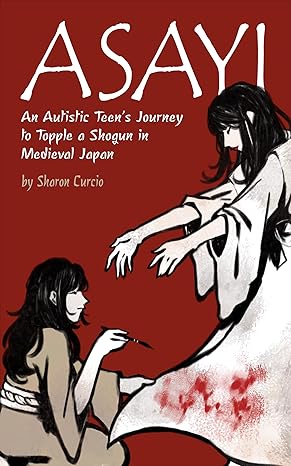
Asayi: An Autistic Teen’s Journey to Topple a Shogun in Medieval Japan, by Sharon Curcio, is a compelling narrative that immerses readers into the tumultuous life of Asayi, an autistic young woman navigating the perilous landscape of medieval Japan. From the very beginning, the story is laden with tension as Asayi confronts political intrigue and social turmoil, resolutely determined to challenge an oppressive regime. The story unfolds through a rich tapestry of court drama and shadowy characters spanning all social strata. Deception is rife, yet amid the swirling machinations, the truth gradually emerges. The portrayal of Asayi’s vulnerability, coupled with her formidable resolve, offers a deeply nuanced perspective on the challenges faced by individuals with autism in a ruthless era.
Asayi’s journey transcends mere survival; it is about discovering her tribe and finding love amidst chaos. The relationships she forms, particularly with her father, the housekeeper Hatsu, and the ever-present spirit of her late mother, Omari, are both touching and profound. These connections ground her as she confronts numerous challenges, including the daunting prospect of an arranged marriage and the scrutiny of the Shogun’s court. Curcio’s masterful storytelling brings to life the visceral reality of political unrest and the constant fight for survival.
Asayi’s journey, marked by secret identities and the relentless pursuit of justice, echoes enduring struggles against inequities and societal discontent, resonating with contemporary issues. The narrative not only highlights Asayi’s personal battles but also her quest for belonging and love, weaving a powerful tale of finding one’s tribe amidst chaos. The novel’s strength lies in its authentic depiction of true-to-life characters and the enduring cultural motif of the ghost, enriching the story’s historical and emotional depth. Asayi is a remarkable saga of resilience and empowerment, where the underdogs ultimately prevail.
For those who appreciate historical fiction with profound emotional and cultural dimensions, Asayi is an unforgettable read. The book captures the essence of medieval Japan while addressing universal themes of identity, resilience, and justice.
Pages: 160 | ASIN : B0D3FRCC19


