Blog Archives
Multidimensional Characters

Lovestruck Maggot follows a scarred, middle-aged, fiercely competent woman working on a brutal alien world where scavengers harvest volatile creatures for profit, who risks everything to rescue the man she loves. What was the inspiration for the setup of your story?
I’ve found that writing’s first step—determining what you want to write about—is by far the most difficult. Therefore, I’ve started giving myself “challenges” to simplify this step. For my last novel, Children of Madness, I challenged myself to write a story that had giant snails at its center. For this one, I was intrigued with the idea of writing a love story with the word “maggot” in the title. With this in hand, I simply began asking myself questions. What would a human “maggot” do? Would this “maggot” be a male or female? etc. Once I settled on a female main character, I asked myself what would put such an obviously tough woman on “love tilt.”
After the particulars of their love affair were figured out, I was reminded of the 80s movie Romancing the Stone, and everything started to come together. I was going to write a sci-fi Romancing the Stone—words that no one would ever put together in a sentence.
Kalderra feels alive, toxic, and strangely beautiful. What inspired the planet’s ecosystem and tone?
Two things led to the creation of Kalderra. First, I’ve always been intrigued by the idea and visuals of bioluminescent plants/forests. You can see this in my novels Station and Children of Madness. So, I knew I wanted the planet to have such flora. Then, when I was playing around with potential names for the planet, I stumbled upon the word “caldera,” which is a large crater formed by the collapse of the ground surface after a massive volcanic eruption. I thought that these craters could be the perfect places to “plant” my magic forest. Once that decision was made, endless possibilities blossomed regarding the planet, its history, and its potential desirability on the galactic economic scale.
The novel moves between humor, violence, and emotional vulnerability with confidence. How did you manage those tonal pivots?
Honestly, I don’t have a great answer for this. One of my favorite book genres is the “new weird,” which usually entails severe tonal shifts. I like books that keep me on my toes, finding humor in the horrific and allowing characters to be both strong and weak at the same time. I think the key to this is creating fully fleshed-out, multidimensional characters and understanding how these characters would interact with each other. After that, it’s simply a matter of letting them talk to each other and acting more like a stenographer than a writer. In my opinion, my best stuff comes when I’m thinking the least. Not sure what that says about me lol.
Mona’s love for Darien is intense, but also complicated. Did you want readers to question it, believe in it, or both?
Oh, so this is an easy one for me. Please… question it! Love is a strange thing because it can often have more to do with yourself than the other person, which can make the mind do cartwheels. For example, being with this person makes me feel better about myself, and I think I love them for it. But is this the purest form of love? Is it even love? Just questions to be pondered.
I thought of successful people with “trophy” partners (individuals with little to offer beyond their glossy exteriors) and asked myself, “What would make a successful and confident but hardened woman love someone she had nothing in common with?” The answer came quite easily.
Throw this in the pot with my idea for a sci-fi Romancing the Stone, and you have Lovestruck Maggot, an odd fireball of a novel that burns fast and hot and is over before you know it… much like many love affairs.
Author Links: GoodReads | Website | Amazon
The planet Kalderra is known for several things. A blue sun. An oversized, violet moon. Massive craters formed through past volcanic activity. Strange forests comprised of the rarest, most magnificent trees in the galaxy. And kameeba, bizarre creatures whose scavenged parts can smooth skin, extend lives… and power worlds.
Mona “Ripper” Ripple is a Maggot—responsible for harvesting the volatile yet prized remains of recently deceased kameeba. As leader of the elite Karcass Five unit, Mona is the best Maggot that Kalderra has ever known. Tough and ill-tempered, demanding and crude, she’s also on the far side of forty—ancient for one in her trade—with all the scars and wrinkles and terrible memories to match.
Mona Ripple is also in love.
Smitten by a handsome recruit named Darien Vance, Mona revels in finally having something beautiful to call her own. She dares to dream of a picturesque future defined by passionate devotion rather than butchered extraterrestrials. As young Darien sleeps in her acid-burned arms, Mona prepares for their eventual planetary exit… together.
Unfortunately, Mona’s plans unravel when Darien catches the crimson eye of the reviled Countess Desma Ghool, who abducts the young man, adding him to her revolving collection of unwilling paramours.
As warm love gives way to cold rage, Mona sets out on a dangerous mission to liberate Darien from Ghool, a key figure in the galaxy’s ruling Morishita Syndicate, requiring her to forge an unwanted partnership with her least favorite Maggot—a notorious Space Cowboy named Mickie Brass.
Together, the improbable pair embark on a perilous journey that quickly goes beyond mere rescue operation, revealing the twisted history of the planet, the vital role of the kameeba, the horrifying intentions of the native Kalderrans, and what it truly means to be lovestruck.
Lovestruck Maggot
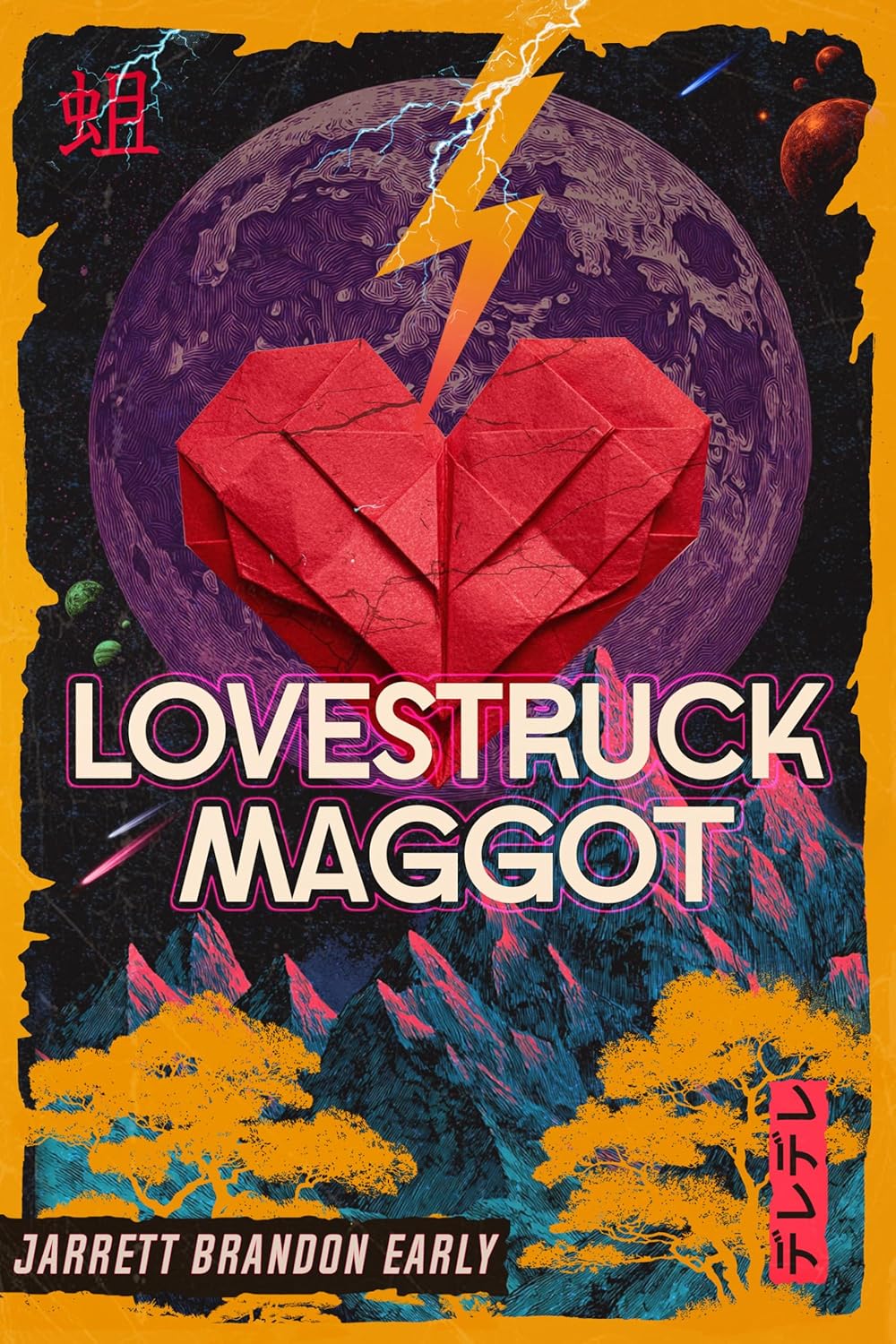

In Lovestruck Maggot, we follow Mona Ripple, scarred, middle-aged, fiercely competent, and disastrously in love—as she tries to claw a future out of the brutal colony world of Kalderra, where “Maggots” harvest volatile alien carcasses under the shadow of corporate greed, native mystery, and lethal beauty. What begins as a break-for-freedom story, with Mona dreaming of buying out her and Darien’s contracts, quickly widens into something stranger and more dangerous: a planet-scale power struggle wrapped around devotion, exploitation, and the mad hope that love might still mean escape.
What I liked most is that the novel never treats love as a softening agent. It treats it as an accelerant. Mona’s voice has grit under the fingernails: funny, vulgar, wounded, possessive, tender, and a little frightening all at once. I didn’t read her as a neat heroine; I read her as a person whose longing has warped around survival until the two are nearly indistinguishable. That gives the book a welcome asymmetry. The romance is not dainty or idealized. It’s hungry, bruised, delusional in places, and therefore weirdly moving. The author understands that desire can make people luminous and ridiculous in the same breath, and he gets a lot of charge out of that contradiction.
I was also taken by the texture of the worldbuilding. Kalderra doesn’t feel like wallpaper pasted behind the plot; it feels mined, lit from below, and faintly toxic. The opening planetary report gives the book a sly, cold-blooded frame, and then the novel drops into a much hotter register: banter, violence, class resentment, strange ecologies, and the eerie glamour of the subarashi forests. I especially admired the tonal audacity here: the book can pivot from gallows humor to menace to aching sincerity without losing its footing.
I’d hand this to readers who like space opera, science fiction, romance, survival adventure, body horror, dystopian fiction, and weird western-inflected SF with a sharp voice and a taste for the baroque. It should land especially well for people who want character heat inside a dangerous speculative setting rather than clean hard-scfi sterility. It feels closer to Kameron Hurley than to sleek blockbuster space adventure; there’s also a bit of Gideon the Ninth’s irreverent bite in the way it lets sentiment and savagery share the same room. Lovestruck Maggot is proof that even in the harshest world, love can still be the most explosive substance on the page.
Pages: 365 | ASIN : B0GPRPR53S

A Universal Truth

Children of Madness follows five children from an outcast town who are promised a better life if they fulfill a dangerous quest from the realm’s king. What was the inspiration for the setup of your story?
My six-year-old daughter Alex Beam. Every day she proves how much of a better person she is than me. She is positive and outgoing, dumbly brave, and non-judgmental. Down for anything and always expecting the best out of people. Loyal to a fault.
My previous sci-fi trilogy (The Station Trilogy) focused on true anti-heroes, damaged characters who did as much bad as good. It was dark and brooding and lacked hope. With Children of Madness, I wanted to write about true heroes with pure hearts. I wanted to showcase the power of children, who maintain wonderful qualities that most adults lose somewhere along the way.
Light shines brightest amidst darkness, so I needed to place this group of child friends in a world of war, sickness, greed, and perversion. But unlike adults, who would fold under such evil pressures, the children would persevere, powered by duty, loyalty, love, and friendship.
Finally, I wanted to show that, despite best intentions, well-laid plans, and strong support systems, bad things happen… horrible things. The world can be ugly, but there is always beauty to be found. Unfortunately, oftentimes only young eyes can see it.
All of your characters are well-developed and bring the story to life, drawing readers into their lives. What character did you enjoy writing for? Was there one that was more challenging to write for?
Potty-mouthed Fincher Bugg was great fun to write for. I’d like to say that I based him on myself, but this would be a lie. Fincher was who I wanted to be—brash, outspoken, and confident which is why I really connected with the Ditto character. Ditto was quiet, fiercely loyal, and unsure of himself. Take away Ditto’s size, strength, and maturity, and you probably come close to me as a kid.
None of the characters were particularly challenging, but Ash changed quite a bit from my initial plans. Ash was going to be the fearless one, the first to throw a punch or leap into danger. However, given her past trauma and great physical loss, it made more sense that she would be the careful, practical member of the group. We all think we’re immortal until we glimpse death, and that permanently changes how we view the world and our fragile place within it. Ash Bugg was no different.
What were some themes that were important for you to explore in this book?
Above all, friendship, loyalty, and duty, particularly regarding those that you choose to call family. I also wanted to touch on elements of oppression and discrimination, believing that many of the most wondrous individuals are products of such environmental factors—pressure creates diamonds, you know. Finally, I wanted to tell a story that showcased a universal truth that we all are guilty of forgetting or discounting—adults can learn more from children than they can from us.
Is this the first book In the series? If so, when Is the next book coming out, and what can your fans expect in the next story?
Coming on the heels of a trilogy that took a lot out of me (and tired of all the series that flood the fantasy market), I was determined to write a standalone novel. In my opinion, the story has been completed… at least for now. But I admittedly love these characters. If the perfect continuation or prequel idea came to me (well down the road), I would be open to revisiting the world. I mean, who doesn’t want to see old friends again?
Author Links: GoodReads | Amazon
FOR A WORLD GONE CRAZY, ONLY THOSE RAISED AMONG MADNESS CAN HELPThe Imperator of Quaan restlessly awaits the centennial arrival of the Snail-Gods to cure the Gloomtide, a shadow of melancholy blanketing the Titian Empire. But when the Supreme Helices finally make landfall, they do so just out of reach of the distressed monarch, beyond a poisonous grove that separates man from messiah.
Fincher Bugg leads the Sour Flower Gang, the preeminent child harvesters of the Stenches, a town of outcasts condemned to diminished lives toiling away in toxic conditions. As Fincher and his four friends endure external abuse from outsiders, internally they also suffer, watching as their parents slowly succumb to the Maddening. Despite the solace of unbreakable friendship, life is unrelenting.
When a desperate king makes a seemingly magnanimous offer to a hopeless population, the Sour Flower Gang sets out on a harrowing expedition to find God for the very people who cast them aside.
During a journey in which the children encounter the unimaginable—both beautiful and nightmarish—a terrifying question takes shape. Are the Snail-Gods here to once more save mankind, or is the Gloomtide that has enveloped Quaan a precursor to humanity’s deserved end?


