Blog Archives
The Wizards And Their World

Queen of Starlight follows the elves of Edira and the wizards of Malicath who discover a darkness is attacking both their worlds, draining and corrupting their magic. Elves and wizards must overcome a difficult history to confront a common threat. What interested you about making reconciliation part of the central conflict?
I’ve never been one to write entire groups of characters as all bad or all good. In the first book, Daughter of Starlight, the wizards of Malicath are mostly seen as the enemy, so for the second book, I was eager to bring a more nuanced approach to both the wizards and their world.
Reconciliation is not easy; it is often messy and uncomfortable, especially when past grievances run deep. This concept was important for me to include in Queen of Starlight because its impacts can be explored on both the personal level and on the level of a broader community. It forces different characters, each in their own way, to confront their own biases, and to wrestle with the messiness that comes with breaking down layers of mistrust. All of this not only helps me expand character development, but also the need for an alliance between former enemies matches the book’s broader theme of finding and embracing balance.
Luma has to reckon with her mother’s dark magical legacy in this book. How did you develop that inheritance as a source of both threat and ultimately power while avoiding the trap of making it purely a burden?
When I first began thinking about how to approach the main themes of this book, it was important to me to focus on the idea of balance as a core concept: the idea that everyone has dualities within them, and that this fact is nothing to be ashamed of.
As Luma explores the history of her mother’s dark magic, she is forced to confront the legacy passed down to her. In doing so, she grows from someone who thought she had to hide or ignore parts of herself, to someone who sees the power inherent in embracing all aspects of her magic.
At the end of the first book in the series, Daughter of Starlight, Luma rejects the role and title of Queen. In this second book, Luma’s evolving understanding and acceptance of her mother’s dark magic legacy helps prepare her not only to defeat Hex but also to step into the role of Queen in a way that feels authentic to her.
What attracts you to young adult fantasy as a way of exploring subjects such as identity, grief, responsibility, love, and power?
Growing up, I was (and still am!) a voracious reader, and the books I read as a young adult not only shaped my worldview then but also continue to inspire me today!
Now, as an author myself, I love writing in the Young Adult genre because in your teens and twenties, sometimes the search for identity and for love, combined with the transformative power of grief and taking responsibility for yourself, can feel lonely and overwhelming. The Young Adult fantasy genre lets me use unique settings and magical systems where the books’ characters can wrestle with and confront these same feelings in a way that, I hope, helps my readers navigate their own journeys in the real world a little more easily.
Are there characters or corners of this universe that you would especially like to revisit in future books?
If I were to write a third installment of this series, I think it would be a prequel focusing on Luma’s mother. I believe there could be a fun story there, exploring Seren’s adventures on Edira more deeply as she navigates and grows into her own inherent magic as a dark witch.
Author Links: GoodReads | Facebook | Website
A year after defeating the evil wizard army, the elves of Edira prosper, yet Luma, the Daughter of Starlight, senses something is amiss. Shadows move where light should reign, and ominous whispers fill her mind, hinting that this hard-won peace may be more fragile than anyone realizes. Soon, attacks by a vicious darkness confirm her fears, and Edira is not the only world under threat. Malicath, home of the wizards, faces the same darkness, which drains and corrupts magic, including Luma’s own powerful starlight. Faced with a shared enemy, Luma and the elves form a tenuous alliance with the wizards. Together, they search for the Unseen Star, an ancient magical relic capable of restoring balance to both their worlds. But as the darkness grows stronger and time runs out, Luma realizes that all magic demands a price—and this one may be more than she can pay.
Return to the magical world of Edira in this sequel to the multi-award-winning YA fantasy, Daughter of Starlight.
Deep Kindness and Sincerity

Daughter of Starlight follows a young woman aging out of foster care who finds that a hidden cave holds the secret to her true identity. Where did the idea for this novel come from?
I have always loved the concept of “ordinary people doing extraordinary things.” Magical worlds aside, I believe we all have special gifts that we can share with one another, but first, we have to recognize and embrace those gifts within ourselves. Luma’s starlight power is innate, but it’s not easy—she has to work at it. This forces her to confront parts of herself that she never had the courage to face before, and in doing so, she steps into her true identity. I think the fantasy genre has a unique way of helping people see secret magic and possibilities in the everyday, so when I decided to write a fantasy story, I knew that was where I wanted to start.
What was your favorite scene in this story?
One of my favorite scenes in the story is when Luma decides to leave the safety of the mage’s island and help defend the elven forces at Northhelm from the attacking wizards. I really like this scene because it is the first time we see Luma truly trust herself and her abilities. Up until that point, her powerful starlight magic manifested sporadically in moments of adrenaline and fear; she had not felt confident in her magic, and it even scared her a little bit. But in that scene, she has the option to stay hidden and safe, to say “sorry, I’m not ready,” and no one would blame her for it – but she doesn’t. Whether she truly feels ready or not, she still chooses to go to the aid of her friends, trusting that she can offer them the best chance of survival, even if it means putting herself in danger. This scene marks a significant turning point in her character development, a moment where she first steps into her power and becomes ready to shoulder the mantle of leadership.
Was Luma’s backstory something you always had, or did it develop as you were writing?
When I draft, I create a rough outline for my characters to help map their goals and progress throughout the story. However, as I write, many characters grow and develop in ways I didn’t expect! Luma was definitely one of them. I originally outlined her to stay very guarded and cynical for most of the story. While she does start out that way at the beginning, it soon became clear, as I was writing, that Luma possesses a deep kindness and sincerity, even optimism, that was just waiting for the right circumstances to bring it out. Seeing this character evolution manifest itself on the page is one of my favorite aspects of writing.
I find a problem in well-written stories, in that I always want there to be another book to keep the story going. Is there a second book planned?
Yes! I am currently writing a sequel to Daughter of Starlight, and I hope to complete it by early next year. Stay tuned!
Author Links: GoodReads | Amazon
Daughter of Starlight
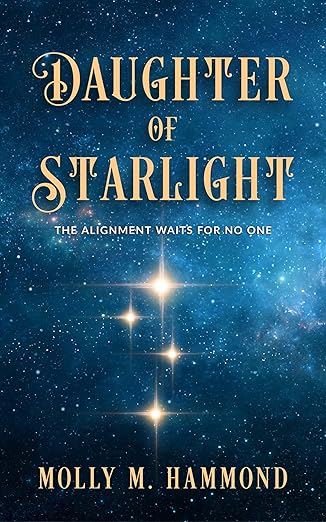

Daughter of Starlight follows Luma, a fierce, guarded young woman aging out of foster care, who stumbles across a hidden cave in the Colorado mountains and ends up transported to the magical world of Edira. There, she learns she’s no ordinary girl; she’s the one marked by the stars, the key to healing the ancient Sacred Stones and stopping a dark tide of invading wizards. With a mix of gritty real-world struggles and rich fantasy adventure, Molly M. Hammond spins a story that feels both deeply personal and sweepingly epic.
Hammond’s writing made a profound impact on me from the very first chapter. She sets up Luma’s pain, the blood on her knuckles, the loneliness, the worn kindness of her social worker Frank, with such realness that I was immediately hooked. That opening scene, where Luma picks at the scars on her palms while waiting to be lectured, felt so heartbreakingly tangible. Hammond doesn’t waste words but paints her world with quick, sharp brushstrokes that sink in deep. Even later, when Luma first hears her name whispered in the mountains during the storm, I could feel the same eerie pull she did. It’s hard to find YA fantasy that captures both grounded reality and wonder so seamlessly, but this book pulls it off.
While the middle of the book took a slightly more deliberate pace, I appreciated the deeper look into Luma’s early interactions with Corr, the gruff yet oddly endearing elf guide. Their spirited exchanges added texture to their relationship and highlighted Hammond’s talent for character dynamics. Moments like Luma’s stumbles and Corr’s teasing remarks provided a playful contrast to the story’s more intense scenes. And when the raptera attack burst onto the page, chaotic, brutal, and utterly thrilling, the story’s momentum surged, and I found myself completely engrossed once again. Hammond’s prose truly shines during these breathtaking moments of magic and mystery.
The themes explored in the novel, particularly those concerning destiny, loneliness, and belonging, resonated with me more deeply than I had anticipated. Luma’s reluctance to embrace the role of a hero and her belief that she is not inherently special felt especially poignant, reflecting sentiments with which I could personally identify.That deep reluctance, that aching disbelief in her own worth, felt incredibly real. When she finally unleashes her starlight powers to save Corr from the monstrous bird (and then immediately pukes afterward, because of course she would), I found myself grinning like an idiot. Hammond doesn’t write magic as something clean or effortless; it’s messy, painful, and exhausting. That choice made Luma’s journey feel earned instead of just fated.
I came away from Daughter of Starlight deeply moved by its heart and emotional resonance. It is a beautifully crafted fantasy that offers real emotional depth, a stubborn and relatable heroine, and a story that intertwines everyday struggles with dazzling magic. It is the kind of book that keeps you reading late into the night and leaves you sitting quietly afterward, feeling both a little wrung out and a little more hopeful as you linger over the final page.
Pages: 289 | ASIN : B0DHWBV71Q



