Blog Archives
The New World Order

In your memoir, Octagon Pillars and Domes, you take readers on a wild, emotional, and surprisingly personal ride through history, religion, politics, and memory. Why was this an important book for you to write?
In order to understand how we have arrived at this present state of affairs both nationally and globally, especially since the presidency of Barack Obama in 2009, who advanced a globalist agenda beginning with the American Recovery and Reinvestment Act (HR1) and at which time my research began, it was important to take a close look at events that have occurred since WWI, specifically, the rise of class-based Marxism and the establishment of the Federal Reserve Bank by President Woodrow Wilson in 1913 under the advisement of his chief economic advisor and the leader of the Progressive and Zionist movements, Louis Brandeis.
What were some ideas that were important for you to share in this book?
Since the beginning of recorded history in Ancient Mesopotamia and Egypt in 3,500-4,000 B.C., the acceptance of creationism and related causal morality has served as the basis for law. However, due to perceived injustices experienced by Jews under creationist regimes including the Habsburgs and Romanovs during the 18th and 19th centuries, Karl Marx’s classist philosophy challenged these ideas, which gained acceptance by European intellectuals and academic circles at the Frankfurt School during the rise of German Industrialism. Of course, they already were immersed in Hegelian (deconstructionist) philosophy toward achieving absolute knowledge via rationalism. It is my belief in contrast to our founding principles rooted in Natural Law which formerly served as the rule of law, Marxism infected the United States at least by 1913, with the creation of the Federal Reserve, and certainly by the 1919 Paris Peace Conference (Treaty of Versailles), which established The League of Nations, a global peace-keeping force and precursor to the 1948 United Nations’ declaration of Human Rights as the revised rule of law. Since then, Progressive policies have established class protections for individuals and (immoral) behaviors that would have fallen well outside Federal law, according to our founding principles. I also wanted to clear up a common misunderstanding regarding the “separation of church and state,” which according to Thomas Jefferson’s 1802 letter to the Danbury Baptists, was intended to protect the right to worship (God), rather than exclude Biblical morality from legislation, which is an argument that has been misappropriated by The Left.
What was the most challenging part of writing your memoir, and what was the most rewarding?
They are one and the same: researching historical events, with all their details and nuances, which have led us to this moment, in order to gain a clear picture of opposing forces and political occurrences over the last 100 years that have perpetuated Progressive ideology. I will say my research into Egyptology was especially rewarding, inherent to which are the ideas of divine birthright (Horus), salvation, and spiritual rebirth, and which likely served as the template for Christianity.
What do you hope is one thing readers take away from your story?
Marxist class-based protections were established in opposition to political systems perpetuated by Christianity’s old-world order, including the notion of the Divine Right of Kings, Natural Rights, and Democracy, which has far-reaching implications and conclusions. Finally, though it has been implemented under the auspices of humanitarianism, it is apparent globalism, assisted by technology, is an effort by international bankers and global oligarchs to harness formerly distant workers for the purposes of control and taxation. Indeed, the New World Order is upon us.
Author Links: GoodReads | Facebook | Amazon
Octagon Pillars and Domes
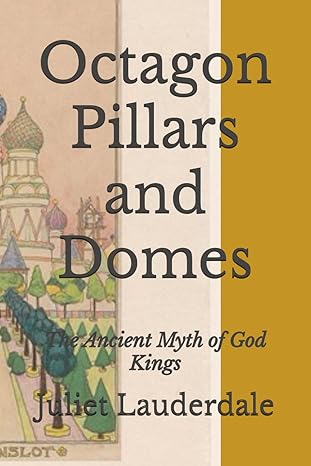

Octagon Pillars and Domes is a wild, emotional, and surprisingly personal ride through history, religion, politics, and memory. The book starts with her work on a government healthcare project and slowly opens up into something much bigger. It touches on her Jewish and aristocratic German roots, the trauma passed down from war, and her search for meaning through ancient philosophy, faith, and modern politics. It’s part memoir, part deep dive into big ideas, and part spiritual reflection.
I really enjoyed this book. It’s not your average memoir. Lauderdale writes from the heart and pulls no punches. She mixes stories from her childhood with reflections on religion and political shifts in a way that made me think hard about things I hadn’t connected before. There were moments when the details got heavy or the history felt like a lot to take in, but even then, her voice kept me going. She’s not trying to sound polished or academic. She just tells her truth, and there’s something refreshing about that.
The best parts for me were when she opened up about her family, her faith, and her struggles. You can feel how much this story means to her. It’s clear she spent years thinking about all of it, and the effort shows. She goes deep into some complicated stuff, but it always feels like she’s just trying to understand the world and her place in it, and I found that really moving.
If you’re someone who likes books that jump between personal stories and big questions about life, history, and faith, I think you’ll get a lot out of this. It’s not a quick read, and it asks you to slow down and sit with some tough topics, but it’s worth it. I’d recommend it to anyone who enjoys thoughtful writing. It’s honest, it’s bold, and it’s unlike anything I’ve read in a while.
Pages: 550 | ASIN : B0F6NZCBR7




 LITERARY TITAN