Blog Archives
Obadiah and the Last 100 Prophets of Edom
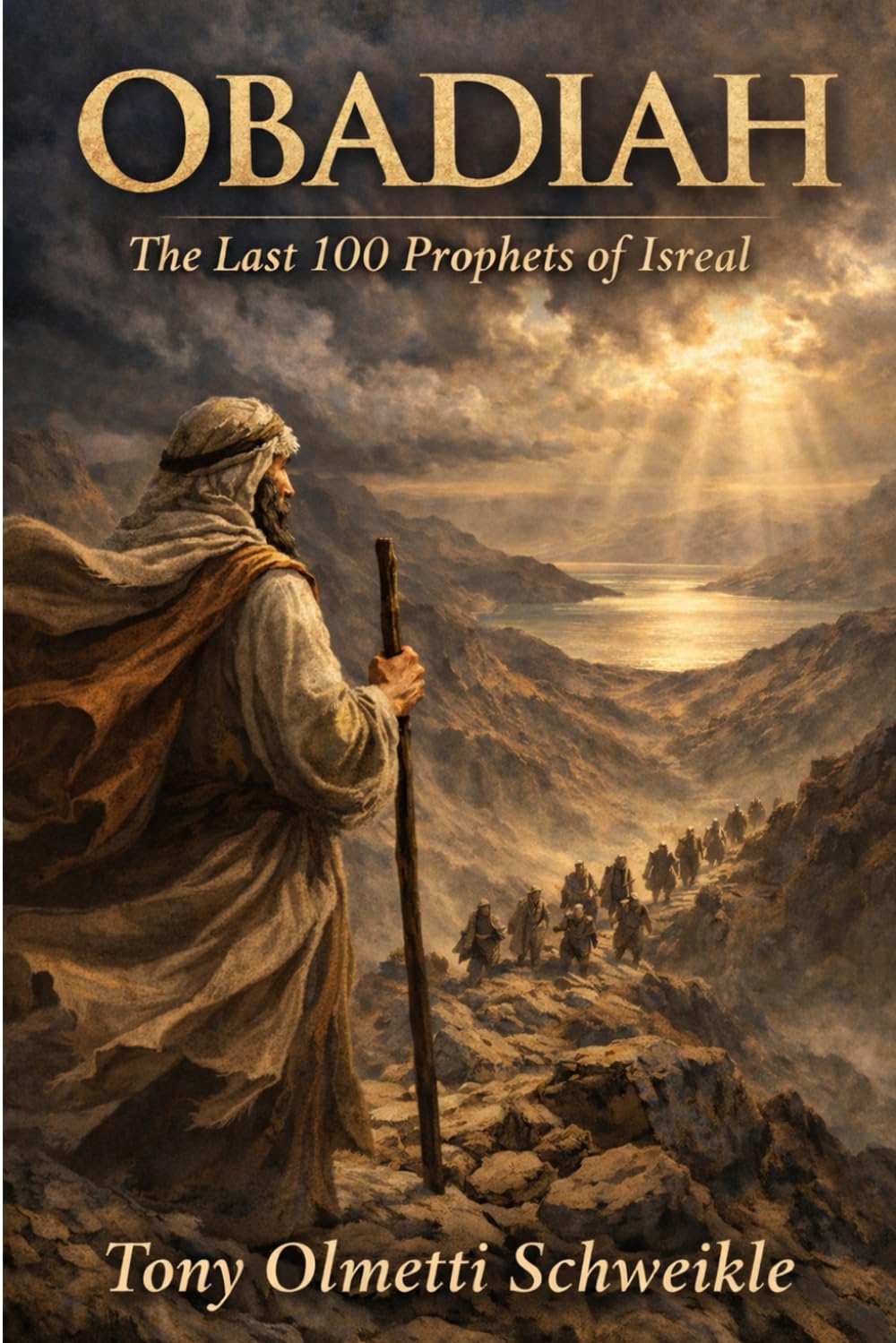

Obadiah and the Last 100 Prophets of Edom, by Tony Olmetti Schweikle, is a biblical historical novel that reads like a sustained act of witness. It takes the world around Ahab, Jezebel, Elijah, Naboth, and Obadiah and turns it into a landscape of drought, persecution, flight, and stubborn belief. From the opening battle scenes to the cave hideouts and tense village encounters, the book keeps returning to one central conviction, stated again and again in different emotional keys: “There is only One God.” That refrain gives the novel its spine and its sense of purpose.
What makes the book work is its seriousness. The author isn’t treating this material like a distant legend. He writes it as immediate, physical, and costly. Crosses line the road into Jezreel, Naboth’s vineyard becomes a site of both injustice and sacred memory, and Obadiah’s loyalty is measured in hunger, grief, and risk. The novel is full of kings, soldiers, priests, shepherds, traders, and villagers, so faith never feels abstract. It’s social, public, dangerous, and tied to land, bread, water, and survival.
I also liked how the book handles its characters in moral terms without flattening them into symbols. Ahab is brutal, but he’s also uneasy. Jezebel is cold and forceful, and the book gives her a real presence whenever she enters a scene. Obadiah, though, is the center of gravity. He isn’t drawn as flashy or invincible. He’s steady, grieving, practical, and quietly persuasive. That matters because it lets the novel become not just a story about defiance, but a story about endurance and teaching, about how belief gets handed from one frightened person to another.
The prose itself is direct and emphatic. It uses strong images, sharp confrontations, and declarative endings. Sometimes that gives the book the feel of oral storytelling, and sometimes it leans toward something almost cinematic, especially in the long middle stretch where action, dialogue, and visual staging take over. That hybrid energy turns out to be part of the book’s identity. It feels like a novel written by someone who can already see the scenes onscreen. Even when the language is simple, it’s aiming for momentum, clarity, and conviction rather than ambiguity.
What I liked most was that the book understands faith as something lived under pressure. It’s there in the markets, in whispered conversations, in stories told by lamplight, and in the refusal to surrender what is holy. A line like “The truth remained, unchallenged and eternal” captures the book’s posture. This is a novel of declaration, pursuit, and testimony, and it knows what story it wants to tell. If you’re open to a fervent, dramatic retelling of biblical conflict with a strong devotional core, this book has a clear voice, and it commits to it completely.
Pages: 142 | ASIN : B0GPLSLY4P



