Blog Archives
Build From Your Past

Pioneers reveals eight timeless principles behind immigrant-built businesses that endure—showing how resilience, community, and purpose create lasting success beyond profit. What sparked the idea for writing Pioneers?
I originally set out to write about business resilience, which then evolved into resilience at work. However, after nearly two years of rejections and multiple iterations of the business-resilience idea, I came across a striking statistic: immigrants make up roughly 14–15 percent of the U.S. population, yet immigrants and their children founded about 46 percent of Fortune 500 companies. These companies generated $8.6 trillion in revenueand employmore than 15 million people worldwide. Immigrant-founded businesses also tend to have greater longevity and economic impactthan their counterparts. Then there is innovation: immigrants have founded more than half of U.S. billion-dollar startups, account for a disproportionate share of U.S. patents, and have received around 40 percent of U.S. Nobel Prizes in the sciencessince 2000.
I realized that in the academic literature, while many scholars talk about and research why immigrants are more likely to become entrepreneurs (this is where necessity entrepreneurship comes in), no one had made the connection or asked the deeper question: why are immigrants more likely to create businesses that last?
One could say that the book was always in me, because I am an immigrant entrepreneur myself. We have a leather products business that is now in its 26th year, and when I went on to do my PhD, one of my research topics was ethnic entrepreneurship. In that sense, the book was two decades in the making. And yet, when I finally sat down to write it, I completed it in just six months. It was one of the best times of my life, because I felt honoured and deeply grateful to finally get it all on paper.
How did your own journey from Bulgaria to the U.S. shape the lens of this book?
It is the reason why the book exists. I was born in Bulgaria to a Turkish ethnic minority family, and in 1989, we became refugees, with only two suitcases to our names. It was at that very moment, when we crossed the border—with my father screaming like a wounded animal, and fear etched across my mother’s face—that I made a decision: I need to get a good education.
Looking around me, it did not seem that this would be possible. We started life in a refugee tent, and I quickly learned that our Turkish language did not sound at all like the Turkish spoken in Turkey.
Courage is making a decision. I had made a decision to get a good education, and I held onto it as my North Star. That decision led me to graduate as a valedictorian and to receive financial aid to study business at the University of Miami. You can only imagine how unsettling this was for me as an 18-year-old who packed yet another suitcase and suddenly found herself on the palm-tree-lined streets of Miami, on a college campus filled with students who drove slick cars, seemed at ease in their surroundings, and spoke to professors with a confidence that felt entirely foreign to me.
The place where my anxiety was most acute, however, was the computer lab. It was the first time I had ever seen a computer, and now I was expected to work on one—and even receive a grade at the end of the course. It was in that same computer lab that I made a startling discovery. I learned that the chip inside those computers had been developed by Andrew Grove, whose work at Intel made the personal computing revolution possible.
And he, too, was an immigrant—just like me.
How can companies build genuine communities, not just networks?
I draw a distinction between social capital and community because companies often conflate the two. Social capital is about connections — networks, introductions, homophilic ties. Those matter, and immigrant entrepreneurs are often very good at building and maintaining them. Community is different. A genuine community is built on mutual responsibility, not just shared interest. It exists when people feel that risk, success, and failure are collectively borne, rather than pushed downward or outward.
What I found in my research is that immigrant entrepreneurs tend to take community seriously because many come from contexts where it was a necessity rather than a choice. When you’ve experienced displacement or instability, you invest in trust and reciprocity for the long term, not just for advantage.
For companies, this means shifting the question from “How do we connect people?” to “What obligations do we have to one another?” That shows up in how decisions are made, how transparently trade-offs are handled, and whether people feel protected when things go wrong. Networks help organisations grow. Communities are what allow them to last.
What advice would you give immigrant founders just starting out?
I would tell immigrant founders to start with the problem, not the business. Focus on creating real value for others. If you do that well, profitability usually follows. Too many people feel pressure to prove themselves quickly, especially immigrants, but the businesses that last are rarely built that way.
To solve a meaningful problem, I think it’s important to look inward. Your lived experience is not something to hide or smooth over. It’s often the source of your strongest insight. Immigrants are naturally positioned between worlds – different cultures, countries, systems, and languages – and that perspective allows you to see things others miss. Many opportunities sit exactly in those gaps.
Finally, I would encourage founders not to erase their past in order to fit in. The people I’ve studied who build the most resilient businesses are those who integrate their experiences into what they’re building. They don’t see their past as something to overcome, but as something to build from. That tends to create companies with more trust, more purpose, and ultimately more staying power.
Author Links: GoodReads | Website Author | Website Book | LinkedIn
In Pioneers: 8 Principles of Business Longevity From Immigrant Entrepreneurs, academic, entrepreneur, and consultant, Neri Karra Sillaman, delivers a one-of-a-kind exploration of the remarkable success of immigrant entrepreneurs. The author writes about how immigrants, often starting with limited capital and connections, have built iconic and enduring businesses. Sillaman combines rigorous academic research with compelling case studies and personal experience and narrative to uncover the principles that drive these stunning achievements.
Pioneers offers a blueprint for business leaders seeking longevity, profitability, and sustainability in the contemporary marketplace. You’ll find:
Strategies for building resilient businesses that embrace diversity and inclusion
Explanations of the power of community and how you can leverage it for business growth
Stories of the importance of creating a legacy that goes beyond mere profit
Techniques and actionable advice to turn past failures into future success
Exploring the dramatic immigrant success stories powering such well-known brands as Chobani, WhatsApp, and BioNTech, this book is a must-read for entrepreneurs, business leaders, and anyone else interested in the dynamics of immigrant entrepreneurship. Pioneers is a transformative and inspiring business guide that will help you build a company that stands the test of time.
Pioneers: 8 Principles of Business Longevity from Immigrant Entrepreneurs
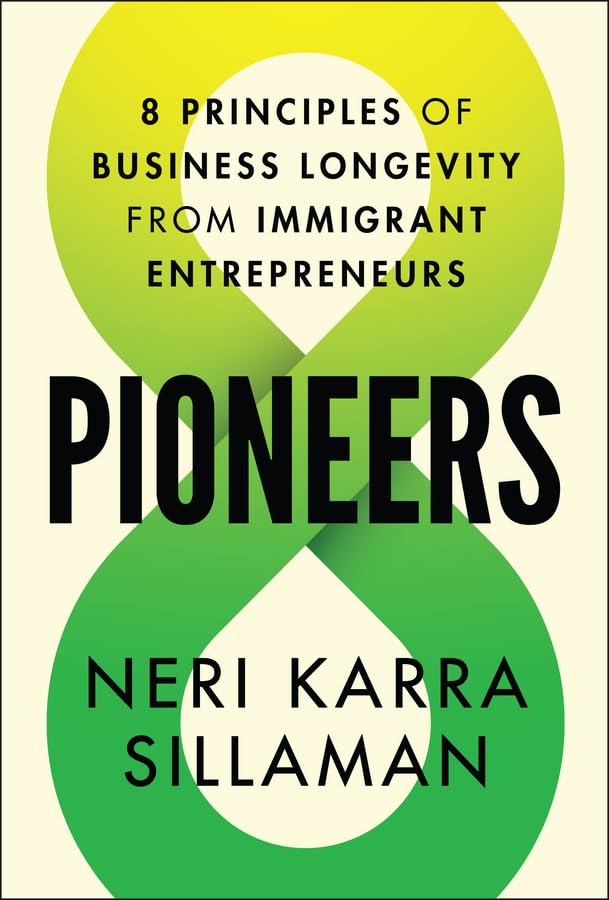

Pioneers traces the journeys of immigrant entrepreneurs and distills from their experiences eight principles for building businesses that last. It mixes memoir, research, and storytelling to show how people who cross borders develop resilience, creativity, and a sense of purpose that shape the companies they build. The book moves from myth-busting to vivid historical accounts, such as Andrew Grove’s escape from Hungary and rise at Intel, and blends these with the author’s own story of leaving communist Bulgaria, arriving in the United States, and discovering how immigrant ingenuity fuels sustainable business success. At its core, the book argues that true longevity comes less from chasing profit and more from creating legacy, community, and meaning.
This is a very stirring and thought-provoking read for me as an immigrant. I kept catching myself nodding along because the writing has this straightforward honesty that sneaks up on you. The author offers big ideas, yet she never hides behind jargon. Instead, she speaks from lived experience and lets the stories do the heavy lifting. I felt pulled in by the mix of hardship, chance, grit, and hope. The scenes of her early years in Miami hit especially hard as she describes feeling lost in a computer lab while also discovering that the device baffling her had been shaped by an immigrant like herself. That moment alone carried so much emotion that I had to pause for breath. The writing lands because it feels authentic. It is part history lesson, part personal confession, and part rallying cry.
What also stayed with me was the way the book reframes business. Instead of the usual talk about scaling fast or beating competitors, the author insists that legacy matters more. That idea caught me off guard, and honestly, it warmed me. The stories show people building with care, whether they are taking tiny steps in cramped workshops or making life-altering decisions at national borders. I loved how she exposes the myths we cling to about entrepreneurship and gently replaces them with something truer. At times, the stories stirred sadness, especially those describing refugees fleeing violence, yet they quickly turned into something brighter. That emotional swing gave the book a rhythm that felt relatable and alive.
By the end, I felt energized. The book would be wonderful for people who enjoy real stories about how success is built from the inside out. Entrepreneurs starting from limited resources will find comfort here, and leaders who want to build mission-driven companies will get a push to rethink what longevity means. Honestly, anyone who wants to remember that business is made by people, not numbers, will find value in these pages.
Pages: 231 | ASIN : B0F723TMDZ



