Blog Archives
Always Asking Questions

Rebels and Saints follows a ragtag group of rebels fighting against the oppressive rule of a corporate regime that controls food, water, and livelihoods in a post-collapse America. What was the inspiration for the setup of your story?
America has been riding high in many ways since WW2. The US ended up being the most powerful nation in the modern world. And yet… How then can there be no universal health care? So many gun deaths? Teachers paid a pittance? So much poverty in a country with so much? Such a division between the haves and have-nots, as well as polarized politics?
Maybe it’s my Canadian showing (and we’re no 51st state), but I fear a collapse could happen. I doubt it will be like my books, but there are too many problems for things not to come to a head. It’s easy to imagine corporate overlords running the government when so much is about the bottom line and making money.
The GreenCorps towns were modeled on coal mining towns of the past and the monopoly of the company stores, as was District 12 and the Seam from The Hunger Games. Some of my inspiration came from reading The Glass Castle by Jeannette Walls and watching the movie October Sky, about Homer Hickum and the Rocket Boys. Escaping that kind of life of drudgery was so difficult.
Another inspiration was for the entire series. The train hoppers were modeled on my grandfather, his brother, and a friend who hopped trains from Utah to California and back several times during the Great Depression.
The landfill scavengers of SoCal were inspired by Ada’s Violin: The Story of the Recycled Orchestra of Paraguay by Susan Hood.
I also wanted to set some of my story in Utah because I was born in Ogden. My family moved to Canada when I was two, but we visited every year through my childhood, and we went on several road trips using Ogden as a starting point. I’ve hiked in the canyons, swam in the Reservoir, and visited dozens of towns and cities in the west. I also forced my husband to detour to Craters of the Moon on our Volcanoes Roadtrip in 2010, so I loved that I could picture the landscape and setting of the story.
Your characters are wonderfully emotive and relatable. Were you able to use anything from your own life to inform their character development?
I always borrow bits of myself and people I know when writing. I hope I can get inside my characters and make them feel real. Clark, for example, doesn’t connect well with others and always feels alone. I’ve felt that way often, and like Clark, I went through a short phase when I couldn’t speak around others. Elsa is tough and doesn’t give in to peer pressure and constantly strives to do better, which I can also relate to. Plus, she’s much happier and more secure with Walker. I can relate to having a partner who makes me feel safe and accepted as myself.
I find that, while writing, you sometimes ask questions and have the characters answer them. Do you find that to be true? What questions did you ask yourself while writing this story?
My editor has pointed out that I ask a lot of questions, and I’m working on reducing the number. That said, I have constant questions and things I’m wondering-my head is a very busy place. I used to think everyone was that way, but it seems I might have been mistaken. I think it might be more common with a neurodivergent brain.
When I was writing, I asked myself what would make the story satisfying? What would happiness look like to the different characters? What would they need to show their hope, their belief in a better life? I thought about what would make a rebellion successful. I didn’t want huge battles and a huge war, but I asked myself how else an uprising could work. My answer was that everyone scared to take part needed to choose a side and be brave in their own way.
I hope the series continues in other books. If so, where will the story take readers?
I have two ideas…so far.
1. Wade got away. I think Tatsuda, Ginger, and Wade might meet again in a few years.
2. I have a story on the shelf, one written in 2020, that I plan to revise. It’s set in 2192 across the continent in Salem, Massachusetts. It could be the opening of another series that might connect to the Train Hoppers, showing what’s happening in other places throughout North America post-collapse.
Author Links : GoodReads | Facebook | Instagram | Website
With renewed hope, they return to join the rebels. Some sneak into SoCol to free Elsa’s family, others lead teams to collect seeds from the bunkers, and others bring hope to the populace and free the downtrodden.
Like Elsa, Janna grew up in SoCal, but instead of escaping, her brother sold her as a prostitute. Liberated by the rebels, she plans to fight alongside them.
Clark grew up in rebel Utah and, one by one, has lost his family to GreenCorps. Broken, he hides among the neutral Saints, taking refuge and avoiding his problems—until he meets Janna.
Though cracks have appeared in the Greencorps stranglehold, it will take everyone working together to break them apart. Without them, the rebel cause will fail and the corporatocracy will once more prevail.
Grab your copy of Rebels and Saints: Catching Freedom, the action-packed conclusion to the Train Hoppers series.
Rebels and Saints: Catching Freedom
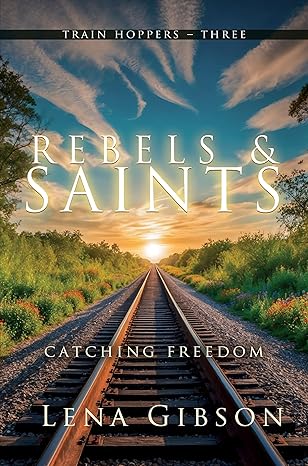

Lena Gibson’s Rebels and Saints is the gripping third installment of the Long Haul trilogy, a dystopian saga that follows a ragtag group of rebels fighting against the oppressive rule of GreenCorps, a corporate regime that controls food, water, and livelihoods in a post-collapse America. Set in the year 2195, the novel continues Elsa’s journey as she leads the fight to distribute long-lost seed reserves that could free people from corporate dependency. With high-stakes train-hopping, underground bunkers, and daring escapes, the book is a thrilling blend of adventure and rebellion, all while exploring themes of survival, autonomy, and hope in a bleak world.
Right off the bat, the pacing had me hooked. This is a full-throttle, edge-of-your-seat kind of ride. One of my favorite scenes happens early on when Mason and his team are sneaking off a train into enemy territory. Gibson has this great way of making every movement feel significant and every risk feel personal.
What really made this book stand out wasn’t just the action it was the characters. Elsa, Walker, Mason, and Caitlyn aren’t just rebels with a mission they’re people with relationships, regrets, and fears. Elsa’s internal struggles, especially in moments where she realizes just how much power she wields, feel incredibly real.
The world-building is superb. Instead of drowning readers in exposition, Gibson reveals details naturally through the rebels’ experiences. The concept of train-hopping as a means of resistance is brilliant, adding a sense of motion and unpredictability to the story. And the contrast between GreenCorps-controlled zones and rebel havens is stark. That contrast makes the fight for freedom feel even more urgent.
By the time I hit the final chapters, my emotions were all over the place. There’s a sense of triumph, yes, but also loss—because the fight doesn’t end just because the book does. That’s the hallmark of a good dystopian novel. If you love fast-paced adventure with heart and if you enjoy stories about found families and underdogs taking on impossible odds, this book is a must-read.
Pages: 371 | ASIN : B0DVNLNMGC




 LITERARY TITAN