Blog Archives
Be Kind To Others
Fahrenheit 2600 follows a teen boy battling his demons who, after getting into some trouble, meets a dreamer with a crazy plan and forms a bond of friendship in a steel foundry. What were some ideas that were important for you to share in this book?
I wanted to capture the spirit of 1970s Australia—the grit, the slang, the music, and the quiet dignity of people who broke their backs every day just to get by. But I also wanted to explore the irony behind the old adage, “they don’t make them like they used to.” The so-called good old days weren’t always so good. Yes, we worked hard and faced real physical challenges, but there was also a kind of silent suffering that went unnoticed. Pain buried under pride, humour, and often long shifts at a factory.
Today’s world—while more comfortable—comes with its own brand of pain. We may not be toiling on production lines, but we’re caught in the exhausting, cerebral maze of social media, identity, and constant comparison. The struggle has shifted—from the body to the mind—and both eras carry their own kind of scars. I wanted to give that some air, to draw a line between those two worlds, and maybe bridge the generations a little.
What was the most challenging part of writing your memoir, and what was the most rewarding?
My first book, Wog in a fish shop of which Fahrenheit 2600 is a sequel, was a challenge in a different way. I forced myself to revisit a tough childhood, but I wanted to tell it with humour and warmth. I wrote it in an anecdotal style, leaning into the absurdity of certain moments to make it more entertaining than heavy.
Fahrenheit 2600 was tougher in that I didn’t just want another collection of memories—I wanted it to feel like a proper story, with a clear protagonist, stakes, and a reason to keep turning the pages. That shift from memoir to narrative was an enormous leap for me. The hardest part was editing it down—it was nearly twice the length at one point. Being brutal with the cuts, killing off scenes I liked for the sake of pace and structure, that was painful but necessary.
One thing that really helped me through the process was something my daughter, Jess Leondiou, taught me. She’s a journaling advocate who is podcasting about the benefits of writing down both positive and negative thoughts and can help rewire the brain. That practice helped me push through the doubts and stay clear on why I was writing this book in the first place.
What do you hope is one thing readers take away from your story?
It might sound like a cliché, but I truly believe the most important thing in life is to be kind to others. No matter how they present themselves—More often than not they are carrying some kind of internal struggle. In Fahrenheit 2600, I wanted to show that via the conflict between the main character and the antagonist, who at one point are on the brink of actual violence. But as the story unfolds, something shifts. There’s a twist near the end that I hope catches readers off guard—in a good way—and shows just how complex and surprising people can be when you look past the surface. If that moment leaves readers thinking twice before judging someone too harshly, then that’s a good thing.
Author Links: GoodReads
Fahrenheit 2600
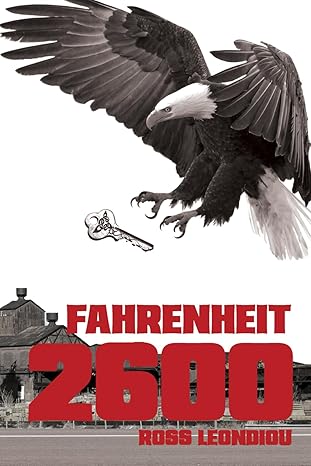

Fahrenheit 2600 is a raw, funny, and emotionally jagged memoir that plunges us into the smoky foundries and chaotic adolescence of 1970s Adelaide. It’s a follow-up to Wog in a Fish Shop, picking up with Ross—now a teenager—ditching school, diving into grueling night shifts at a steel factory, and navigating the messy business of identity, friendship, drugs, and growing up Greek-Australian in a time and place where racism was casual and relentless. Told in vivid scenes and bold honesty, the book captures both the despair and hilarity of youth with a punch to the gut and a smirk on the face.
One of the things I loved most about this book is how unfiltered it is. Ross doesn’t sugarcoat anything, not the work, not the people, not even himself. The opening chapter, where he describes sitting in his freezing car before a night shift, feeling broken and staring at a road-killed cat, just hits. The metaphor is subtle but powerful: he’s roadkill too, flattened by the hopeless routine of factory life. “I live in myself like a mouse lives inside a cage,” he writes. That line was lodged in my head for days. He paints the factory not just as a place but as a spiritual void, a black hole that sucks away your dreams. Yet even in that bleakness, there’s humor. There’s grit. There’s Roberta Flack on the radio and the absurd comfort of a half-smoked cigarette. You feel it all.
But Ross isn’t just bitter—he’s observant, reflective, and surprisingly tender. Especially when he talks about Stag, his wild, fearless best friend who kind of becomes a stand-in for freedom. Their friendship is beautiful and unhinged. There’s a sweetness to it that makes you nostalgic for a kind of reckless, deep-in-your-bones teenage bond. I was moved by how openly Ross recalls their connection. It made me think about my own teenage years, the weird mix of invincibility and vulnerability.
Ross Leondiou has a voice like no one else—rough around the edges but poetic in all the right places. Sometimes, it’s downright brutal, like when he gets arrested for punching a cop and ends up in solitary confinement. Those chapters don’t ask for sympathy, they just lay it out: the fear, the shame, the weird mix of institutional coldness and sudden kindness.
If you like memoirs that aren’t trying to impress you but instead invite you into someone’s honest-to-God life, this is it. If you’ve ever felt stuck, angry, out of place, or just a little broken—this is your book. Fans of gritty coming-of-age stories, readers who dig working-class perspectives, or anyone who grew up straddling cultures will find something to love. It’s definitely not a “light read,” but it’s the kind that stays with you.
Pages: 398 | ASIN : B0DLFZXCG2




 LITERARY TITAN