Blog Archives
We Have Agency
Time and Space follows a woman on the verge of turning forty who, on the way to work, is kidnapped by three university-aged young men from the future and is taken forward in time to a society built on patriarchal dominance. What was the inspiration for the setup of your story?
I remember becoming angrier and angrier at the objectification of women and the failed promise of equality.
Women’s Liberation hit the news when I was in school. I also grew up with a Zoroastrian father who taught us, in accordance with his religion, that men and women are equal. I didn’t understand the need for Women’s Lib until my later university/early working years, when I saw how women were treated in the workplace. Decades on, and except for Federal and provincial Canadian laws, nothing had changed. Women who felt they were liberated because of issues around sex having been loosened were wrong. It seemed like only the older generation understood that changing laws and mores didn’t translate to women being treated and perceived as equal to men. Whether women were virtually unclothed in one culture or covered up to the eyeballs in another, they were still being treated as objects for men to control. They still had less value.
I was also getting fed up with how Toronto and Ontario treat Toronto’s public transit and the commodification of every aspect of life.
On a personal note, I had little control over any part of my life because of my brain injury. I guess I was telling myself through Time’s story that we may not see it, but we have agency.
What are some things that you find interesting about the human condition that you think make for great fiction?
Our weaknesses. And the forces that both exploit them and force us to grow. That often surprises us when they lead us to fulfilling our own potential.
What were some themes that were important for you to explore in this book?
Sexism:
- The objectification of women and how they’re perceived as either baby bearers or sex fulfillers for men.
- What equality truly looks like when men and women perceive women as having inherent worth.
- Women recognizing their own intelligence, both to receive help and to problem-solve their own challenges.
Classism:
- Through the neglect of public transit.
- In the commercial arena or public spaces.
Racism:
- I’ll leave this to the reader to ponder the way I presented it and its meaning.
Ageism:
- I made Time an older woman.
- Since then, I began writing a trilogy (The Q’Zam’Ta Trilogy) featuring a woman in her 60s. Book one, The Soul’s Awakening, is out now.
- With such an emphasis on stories with younger people and the whole mindset that the youth will “save us,” we need to hear stories about older people also able to “save us,” especially older women in nondescript jobs.
What is the next book that you are working on, and when can your fans expect it to be out?
I’ll be publishing The Soul’s Reckoning, book 2 of The Q’Zam’Ta Trilogy, in December 2025 and am currently writing book 3, The Soul’s Turning, which I hope will come out at the end of 2026.
I’m particularly excited about The Soul’s Turning because it’s set in far, far future Toronto, London, and Mumbai, and expands on some of the technology and themes I first explored in Time and Space. However, I’ll be making climate change an essential background to the character development and plot settings. And unlike Time and Space, it delves into the latter aspects of Revelation — what would a world without Satan and the beasts of “the elite” actually look like?
Author Links: GoodReads | Bluesky | Website | Amazon
Time is turning forty, but her ordinary morning walk to work shatters when three university-aged boys from the future snatch her into a shimmering white cube. Their destination: a technologically advanced, male-dominated future where girls are tightly controlled, kept cosmetically perfect, and denied knowledge and autonomy.
When their professor discovers the abduction, he’s furious. The boys had promised never to interfere with the past again. Now he orders them to dump Time in a desolate era few dare visit, The Nasty Time. It’s 2411. The world is stripped of equality, connection, and choice. Time is abandoned and left stranded.
But someone unexpected intervenes, offering Time a sliver of hope—and knowledge she never asked for. Now, survival may depend on learning more than she ever imagined.
Smart, satirical, and deeply unsettling, Time and Space is a genre-defying journey across centuries and systems of control. Shireen Jeejeebhoy blends speculative science, biting social commentary, and sharp humour in a story that asks: “What happens when the powerless are forced to reclaim their life—or be erased from their future?”
Time is waiting. Don’t delay.
Failure of Relationships and Medicine
The Soul’s Awakening follows a reserved, chronically ill woman who chooses medically assisted death to escape her suffering, and instead of finding peace, she is hurled into a series of metaphysical realms examining her own psyche and human experience. What was the inspiration for the setup of your story?
I wanted to write a trilogy about death, life after death, and life after life after death (as N.T. Wright calls the Resurrection). I was asking myself, given our current knowledge of theoretical physics, cosmology, near-death experiences, terminal lucidity, and so on — and thinking on Revelation and the Zoroastrian Gathas — what would life after death and the Resurrection actually be like? I wanted to start book one with my main character’s death but didn’t know how she would die. As I thought on it and researched background information, the main character came to me, with her double name and personality and soul family. But I still didn’t know how she’d die.
Then one day she told me — in the way characters often drive the narrative — that she would be dying via MAiD, Medical Assistance in Dying. I was not happy. I didn’t want to get into that. Even though I have strong opinions on how it’s a failure of relationships and medicine, I find it emotionally distressing. But my character Charlotte Elisabeth insisted. And so I reluctantly agreed and read up on the technical aspects as much as I could tolerate.
The metaphysical realms were inspired by the Gospel of Mary. In reading this gospel in the Nag Hammadi and comparing it to the four gospels of the New Testament, I realized it agrees with them, reflects the culture of the time, and provides a compelling foundation for what happens after death. Near-death experiences that I’d read about and watched documentaries on also provided inspiration.
What are some things that you find interesting about the human condition that you think make for great fiction?
Ever since I was a teen, I’ve wondered why people do the things that they do. That’s why I chose psychology as my specialty in university. But fiction lets you break the boundaries of accepted wisdom, dig into diverse disciplines, and explore. I find myself drawn to tragedies created by irrational fear, self-centredness, resistance to change, justifying abandonment, fear of others knowing our core selves, the superficiality of modern friendship, “blood is thicker than water” myth, the 2D perception of life is only material, the arrogance that youth know better than older generations while at the same time insisting life experience counts as valuable as learned knowledge, free will and God, and death and grief. As much as romance is popular — for good reason! — I also think we haven’t yet tapped true intimacy.
What were some themes that were important for you to explore in this book?
This book began with me writing a play on the Resurrection, based on a close reading of the four gospel accounts. I’d gotten fed up with the focus on the Passion Play when the main point of Easter is Jesus’s rising not his death. Shouldn’t the theme be life not death? I discovered aspects of the gospels’ accounts I hadn’t noticed before, which got me curious.
I wanted to explore what dying actually is — as much as current research and various scriptures tell us — and what happens after we die beyond the usual popular story tropes. And then dig into what it means to be immortal. I don’t believe we’ll get bored and end up yawning, “Been there, done that,” nor that it’ll be all harps and roses and stress-free. We’re a curious species who thrive on exploring. Our brains and minds have incredible untapped potential. I believe that the brain and mind are not the same and wanted to work that out. In addition, N.T. Wright pointed out aspects of the resurrected Jesus that gave me pause to think on what kind of beings we are and will become.
Putting these together, I asked myself: What would life really be like after death? What are we meant to accomplish as a person before we die? What is the nature of existence? What does euthanasia reflect about ourselves and a society that declares it good? Can we ever fully live when we close off parts of ourselves to others? What is Hell and the journey to Heaven like? What is death?
When will book two be available? Can you give us an idea of where that book will take readers?
I’m aiming for book two to be out at the end of 2025. It’ll relate to Charlotte Elisabeth’s next phase of her Soul Track: reconciliation.
Of course, Charlotte Elisabeth resists! After all, how can a spirit reconcile with a material human being still physically alive on Earth who can’t perceive spirits? I explore how.
After passing through the Barrier, she tries to run away from this unexpected challenge. But she encounters new characters on their own Soul Tracks who befriend her and the Lion’s family who’s out for revenge. She learns a bit more about the mysterious man we see in book one. When Charlotte Elisabeth realizes she has to reconcile with not only her immediate family but also harmed animals and unknown ancestors, she attends Heaven School to learn how to exist in her new form and survive on Earth before being sent back to either succeed in reconciling or start on the path to second death.
Author Links: GoodReads | Bluesky | Website | Amazon
The Soul’s Awakening, by Shireen Anne Jeejeebhoy is a deeply moving journey through life, death, and the realms beyond.
Charlotte Elisabeth has chosen to end her suffering through euthanasia, only to awaken in an unfamiliar, soul-stirring space—caught between life and death in the Earth-Heaven Interdimensional Expanse. Disoriented and disillusioned, she is confronted by the horrifying realization that death is not the escape she expected.
In this strange new realm, Charlotte must face the Distortans—mysterious, otherworldly beings that challenge her very essence with unrelenting, probing questions.
As she is pushed to confront her past, her choices, and her deepest fears, Charlotte’s survival depends on her ability to embrace the truth of who she is, and to answer the questions that hold her prisoner.
The Soul’s Awakening, book one of a metaphysical trilogy, is an exploration of self-discovery, spiritual transformation, and the quest for redemption. With rich philosophical themes and a compelling narrative, this spiritual fantasy will captivate fans of religious fiction, spiritual journeys, and thought-provoking fantasy.
Can Charlotte find peace and acceptance, or will she remain forever lost in the endless questions of the afterlife?
Are you ready to face the unknown? Dive in now.
The Soul’s Awakening
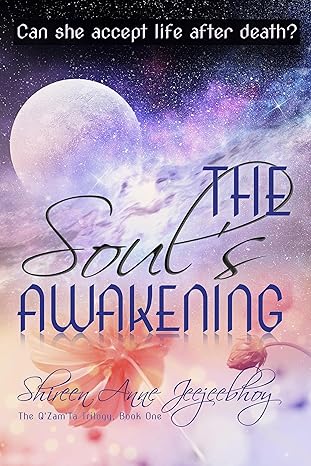

Shireen Anne Jeejeebhoy’s The Soul’s Awakening is a surreal, unsettling, and emotionally provocative dive into what comes after death, at least according to one soul’s cosmic detour. We follow Charlotte Elisabeth, a reserved, chronically ill woman who chooses medically assisted death to escape her suffering. But instead of oblivion, she wakes up on the ceiling of her deathbed, hovering above her body. From there, she’s hurled through a series of metaphysical realms, Dark, Desire, Ignorance, Wrath, and more, each representing pieces of her own psyche and human experience. It’s one part metaphysical fantasy, one part psychological reckoning, with a healthy dose of spiritual allegory and raw existential dread.
The writing style is unapologetically internal, immersive, and sometimes disorienting, but in a deliberate way. Jeejeebhoy isn’t interested in linear storytelling or easing you into big ideas. Instead, she tosses you into the deep end from chapter one and then lets the reader sink or swim. The scene where Charlotte finds herself hovering over her dead body while the nurse and doctor argue casually over her corpse? That was chilling. And weirdly, darkly funny. The book constantly blurs the line between what’s tragic and what’s absurd, and that’s part of its power.
Charlotte’s loneliness, her desire for control, her fear of change, all of it felt so raw and real. And then the universe goes, “Cool, we’re going to personify every single flaw and emotion you’ve been repressing.” There’s a moment with “Desire,” this gelatinous being in an ice cream parlor, that felt so ridiculous and yet so uncomfortably honest about what we really want when we say we want “peace.” That scene sticks with you not because of how wild it is but because it hits a nerve. And then there’s “Ignorance,” a trio of sketchy, sarcastic hexagons with weird smells and bad attitudes, who offer Charlotte a pair of glasses to help her “unsee” the truth. It’s brilliant and brutal.
The book is dense and, at times, leans heavily into philosophical abstraction. There were moments when I had to stop and reorient myself, questioning the narrative’s direction or purpose. Yet, this disorientation feels intentional. The reader is drawn into the same bewildering emotional and existential currents that Charlotte navigates, lost, overwhelmed, yet inching toward clarity. Jeejeebhoy’s greatest strength lies in her ability to render internal chaos in a way that remains both comprehensible and, at times, strikingly lyrical. There is a deliberate rhythm in the disarray, a poetic vulnerability that adds surprising depth to a story centered on death and awakening.
The Soul’s Awakening isn’t just a story about dying. It’s about being seen. About confronting the selves we’ve buried beneath routine, trauma, and silence. It’s weird and heavy, but it’s also oddly hopeful. I’d recommend it to readers who loved The Midnight Library or to anyone who enjoys a spiritual journey that doesn’t coddle you. This one’s for the thinkers, the feelers, and those who’ve ever sat in a quiet room and asked, “What if death isn’t the end?”
Page 292 | ASIN : B0DDG41PH4



 LITERARY TITAN