Blog Archives
Dinosaur Society

A Red Age explores two rival dinosaur societies inheriting civilization, along with its politics, religions, propaganda, prejudices, bureaucracies, and an inherent capacity for war. What was the inspiration for the setup of your story?
One of the core motivations was that after growing up with things like Jurassic Park, the original Land Before Time, or even Dinotopia for people that remember it. We felt like these big landmark dinosaur-focused pieces of media just sort of disappeared from the pop culture landscape. Sure, we’ve had all sorts of sequels to Jurassic Park, but thinking about trying something with dinosaurs that no one has seen before just didn’t seem to be happening. So we decided this idea of letting the dinosaurs be these expressive anthropomorphic leading characters, but in a decidedly not-for-kids story, felt fresh, by eliminating the presence of human beings entirely and allowing the dinosaurs to completely envelop the entire narrative.
The other major piece has a lot to do with growing up in the United States in the nineteen nineties and early two thousands, with what may, by today’s standards, seem quaint but at the time felt like this absolutely extreme absurdity of a political landscape. Combining that with both of us having a big interest in ancient history and feeling a sense of deja vu between daily life and the ancient world’s conflicts, creating a story that bridged ancient and modern history sort of felt like a no-brainer. The dinosaur society is a deliberate fusion of many cultures, both still existing and long dead. All of those societies were rife with the same sort of absurdity found in today’s politics.
The dinosaurs in A Red Age aren’t simply human characters wearing prehistoric skins. You’ve constructed entire societies around them. What rules did you establish to make their civilization feel culturally distinct?
It was decided early on that there would be two big things that would set the dinosaurs apart from humanity. The first is that there are several different species of dinosaur living cooperatively in an otherwise hostile and warlike world, implying a very different evolution for their society compared to our own. Adding to this is the decision to combine concepts and bits of technology that are tied to specific clashing periods of history. Examples are the presence of halftracks and animal-drawn carts alongside more modern vehicles, the polytheistic ancient world-style religion advertised on TV, and the prominent ruins of older cultures that are as mysterious to the modern characters as they are to the audience. We’ve tried to foreshadow the idea that their civilization took a very different path from ours but found itself facing some of the same inevitable problems.
We also wanted to establish smaller differences like the fact that they don’t wear clothes like people do, and instead use jewelry to reflect things like status or rank. This preserves their image as recognizable beasts while also showing a very different attitude to the natural world they live in. Their more animalistic side comes up in the narrative, so we felt putting them in suits and ties would be too off-putting.
Propaganda appears throughout the novel in both serious and ridiculous forms. What interested you about exploring the way governments turn complicated conflicts into easily consumed stories?
It’s clear to us that Americans are bombarded with far more propaganda on a daily basis than people believed for a long time, and if you spend any real time studying propaganda, it becomes clear very quickly how ridiculous and absurd it all is. And yet it’s scary how it actually can work on people, and quite fast. Being able to explore that sort of concept inside a fictional entertainment industry is not only something fundamentally entertaining and relatable to include, but hopefully if there’s anything someone could feel they really learned from reading our book, it would be how to spot these sorts of things more easily in real life.
Which unresolved storyline from A Red Age should readers be paying especially close attention to before Part 2?
I think readers should be ready for weirder, goofier characters like Father Arval to gain more prominence as the story moves into a new phase with a heavier emphasis on themes we’ve so far only hinted at in the first book. There will be plenty of consequences for the decisions of the main cast, but even the most unexpected dinosaurs will have their part to play in the grand scheme of what is to come.
Author Links: GoodReads | Facebook | Instagram | Amazon
The Kikiloa Chronicles


The Kikiloa Chronicles: Book One, by Erik D. Larson, is a young adult science fiction/fantasy adventure about Hazel, an ordinary San Francisco teen whose strange friend Kiki turns out to be anything but ordinary. Kiki is ancient, playful, wounded, and tangled in time, and she pulls Hazel, Lee, Peter, and others into a story that stretches from the present day to deep prehistory, Hawaiʻi, possible futures, and branching versions of reality. This is a genre-blending book about friendship, justice, choice, and whether love can still be love when it tries too hard to control the outcome.
What stood out to me first was the energy of the writing. Larson gives the book a quick, bright pulse. One moment, it feels like a teen adventure with jokes, awkward crushes, and friends trying to make sense of the impossible. The next, it opens wide into something much older and stranger, with scenes that move across oceans, extinction, violence, grief, and human history. Kiki’s voice is especially interesting because she can be funny and reckless on the surface, but underneath that spark is someone carrying an almost unbearable amount of memory. She’s charming, but she’s not simple. That made me keep watching her closely.
I also found myself thinking about the author’s choices around power and responsibility. The time travel and multiverse elements are fun, but the book isn’t only interested in clever mechanics. It keeps circling back to moral questions. What does it mean to help someone? When does protection become manipulation? Can you claim to be acting out of love while taking away another person’s choice? Those ideas gave the story weight. The book takes big swings, moving from playful banter to deep reflection very quickly. For me, that ambition was part of the appeal. The story feels restless in a good way, like it’s always reaching for a larger pattern.
I would recommend The Kikiloa Chronicles: Book One to readers who enjoy young adult speculative fiction with time travel, found family, philosophical questions, and a strong emotional core. It’ll especially appeal to people who like science fiction and fantasy that mixes humor with heavier themes and doesn’t mind a story that asks them to think while the adventure is unfolding. It’s imaginative, sincere, and bigger on the inside than it first appears.
Pages: 401 | ASIN : B0GX314D3J

Passion and Rage

Gaia’s Revolution follows a brutalized climate scientist, a fanatical deep ecologist, and two exploited orphans through the birth of a future Gaian order where the dream of saving Earth mutates into ecology, surveillance, and authoritarianism. What drew you to the idea of ecological devotion becoming a form of authoritarian power?
As an ecologist and environmental activist, I’m intrigued by the notion of what a caregiver and protector of the environment would do when pushed beyond their limits. Ecological devotion is a form of passion, borne and nurtured by strong and complex emotion; strong emotion—like love—can be subverted when threatened, and this can lead to a corruption of fair-mindedness, ultimately resulting in tyranny. Passion and rage are emotional cousins.
As climate change and habitat destruction foment chaos and uncertainty, our sense of democracy and fairness will erode even as protectionism and fanaticism increase—a result of our increasingly fractured and polarized societies. Fanatics prefer to see the world in binary form—black and white—often with marked boundaries of inclusion and exclusion. This “all or nothing” attitude can easily morph into an authoritarian approach that refuses to recognize compromise and leads to extremism. I wanted to explore that possibility by featuring actors deeply involved through their convictions in the big decisions that face humanity.
It was easy to come up with characters like Eric Vogel and Monica Schlange, who both exercise authoritarian power over humanity on behalf of an oppressed and silent environment. Eric escaped the shadows of an oppressive Stasi mother and restless regime to witness the inaction of North America’s oligarchs. Monica had grown up on a small farm in Ontario with a strong tie to the land when she was orphaned and ‘betrayed’ by an exploitive and deceitful government. She found and rekindled her power when she became the environment’s fierce champion.
Monica Schlange is both visionary and monstrous. How did you approach writing a character who believes so completely in her own necessity?
Monica’s personal history created motives for her extremism, fanatical directive, and warrior spirit. Seeing herself as a hero and champion for all who were silenced and ‘othered’ gave Monica a righteous strength and a conviction that she was an important arm of the “right side” in an environmental war. Ripped from her peaceful life on her father’s farm by loss and treachery beyond her control, Monica witnessed how selfish and unconnected humanity could be. Her passion for life, family, and the environment armed her with an incredible conviction to make a difference as she vowed to rise out of the oppression and doom that befell her feckless parents. She became a warrior and championed the ‘other’: those without a voice—the environment and the orphaned children who—like her—lost their innocence far too young. She never stopped believing that she was right. This belief gave her both incredible vision and clarity to act, but also gave her a blind arrogance in her faith that she was always right.
What were some themes that were important for you to explore in this book?
The main theme of the novel is the loss of our innocence in a world in which humanity becomes increasingly separated from Nature—with devastating consequences. Gaia’s Revolution is foremost a cautionary tale that explores possible scenarios of our lack of connection and respect for the environment. The book is the first of a trilogy that explores many themes within this larger one: themes that investigate our use and abuse of various technologies such as artificial intelligence, genetics & cloning, bioengineering, and behaviour modification—all overseen by catastrophic climate change.
Gaia’s Revolution feels part thriller, part manifesto, and part warning. How did you balance storytelling with the book’s scientific, philosophical, and political ideas?
Gaia’s Revolution is essentially a climate thriller and a story with a large scope—invoking large societal considerations, from science to politics. The novel covers upheaval, change, war, and great struggle on an epic scale. I balanced the large scope with compelling storytelling by focusing on the personal experiences of both main and minor characters. Each character experienced the revolution and its aftermath differently, each according to their own place, personal history, and character—and ultimately their relationship with the natural world. Given the circumstances, virtually all the characters had to transform in some way to simply survive.
The effects of climate change, societal upheaval, revolution, and war all created a world that was itself a strong character. Much like Thomas Hardy’s Egdon Heath in The Return of the Native, the world of Gaia’s Revolution is an imposing character, exerting great influence on virtually all the characters of the novel. And in a world torn apart by environmental calamity and war, innocence is the first casualty. The true—and only innocent—protagonists in this story are the three orphans, who must navigate the harsh environment their elders have created for them. In some ways they—and the loss of their innocence—are at the heart of the story.
Author Links: GoodReads | Gaia’s Revolution | X (Twitter) | Bluesky | LinkedIn | Website | The Meaning of Water | Nina Munteanu | Amazon
The Icarian Trilogy opens in Berlin, 2022, and hurtles into a near future on the brink of collapse, where twin brothers Eric and Damien ignite a revolution that could save the planet—or erase humanity altogether.
The population is expendable.
As climate catastrophe scorches the Earth, Eric makes a ruthless, Machiavellian choice to “save” the world at any cost. He unleashes a DNA-targeted plague to cull the human population, then tightens his grip on the survivors through behavior engineering, genetic manipulation, and Techno-clones—man-machine enforcers that herd humanity into sealed megacities known as Icarias.
The war is inevitable.
Horrified by his brother’s genocide and technocratic tyranny, Damien strikes back. He forms the Gaians, a radical eco-terrorist movement, and sparks a brutal uprising against both the regime and the blood that binds them. His weapon is a sentient symbiotic virus designed to enhance human cognition and help humanity thrive in a post–climate change world. Instead, it fractures reality—killing some hosts outright, while allowing others to communicate directly with artificial intelligence.
As the brothers spiral into all-out war for the fate of the planet, a far more dangerous player emerges. Monica Schlange, a ruthless eco-extremist, manipulates both men like chess pieces in her own endgame: saving Earth from humanity and ruling the enclosed world of Icaria. To achieve it, she exploits three orphaned children who hold the secret to an intelligent virus—and the blueprint for an entirely new humanity.
Saving the world was never meant to save everyone.
The Mystery of Connection
Prima Nocta explores soul connections and relationships by way of interconnected stories presented from various perspectives and within different historical settings. Where did the idea for this unique novel come from?
It grew from questions I couldn’t quite let go of: how we misunderstand each other, how connection forms, and why certain relationships feel inevitable. And… what defines a soul? I was particularly drawn to the idea of “fated” connections, but not confined to a single lifetime. Using the concept of samsara (the cycle of birth, life, death, and rebirth), I imagined the same two souls meeting again and again across centuries, each time shaped by different circumstances, yet drawn together by something deeper.
Structurally, I wanted to explore that idea through multiple historical settings: grounded pasts, recognizable presents, and speculative futures. Examining how perspective shifts radically between two people experiencing the same moment. The result became a kind of metaphysical echo: the same connection, refracted through time, culture, and identity.
What are some things that you find interesting about the human condition that you think make for great fiction?
Interesting? More like fascinating!
What fascinates me most is how subjective experience is.
Two people can live through the same moment and walk away with entirely different truths. The tension between shared reality and individual perception is where I find the most compelling stories.
I’m also drawn to the mystery of connection: that instinctive sense of recognition we sometimes feel with a stranger. It defies logic, yet feels undeniable. Even in something as structured as dating, we often know within minutes whether a connection will mature or fade. That raises a deeper question: what, exactly, are we responding to?
There was a lot of time spent crafting the character traits in this novel. What was the most important factor for you to get right in your characters?
Voice was everything.
Each character needed to feel fully inhabited: distinct not only in personality, but in language, rhythm, and worldview. Language shapes perception, so their diction had to reflect their time, culture, and internal life. Dominique, for example, would never use a word like “guillotine” (it hadn’t been invented yet).
It also had to reflect who they were as a person. To write them honestly, I couldn’t remain at a distance. I had to step into each character’s experience and live it as fully as I could.
And, truthfully, many of those moments stayed with me. I found myself emotionally affected while writing them. Even found myself in a few restless nights, concerned for a character even though I fully knew what would happen to them.
Can we look forward to more work from you soon? What are you currently working on?
Yes! Another novel set in the Prima Nocta universe is currently in beta review. While it connects to the first book, it stands entirely on its own.
It follows Dominique, one of the central figures, as he takes on a lifelong journey across medieval Europe and Asia, ultimately arriving at a Tantric ashram in the Himalayas. It’s a ‘bildungsroman’ in the truest sense: a story of both physical and spiritual transformation. The people who guide him along the way, especially two amazing women who shape his spiritual journey, are also central to the plot.
Where Prima Nocta explores connection across lifetimes, this next work explores what it means to seek understanding within a single life… and what must be surrendered to achieve it.
And yes, there’s more beyond that. Another book is in development, and a fantasy trilogy is beginning to take shape.
Author Links: GoodReads | Website | Amazon
What if your soulmate existed — again and again — across centuries, worlds, and lifetimes, but each time, something went wrong?
Prima Nocta is an emotionally rich novel that explores love at its deepest level — beyond time, beyond reason, and beyond the body.
Told through twelve sensual, interconnected stories that span from medieval France to a fractured but hopeful future, this book invites you into the lives of six couples:A hunted scholar and a witch who sees his soul.
A grieving Japanese lord and a geisha who knows too much.
A serf’s daughter haunted by dreams, and the Duke who shares them.
A gangster, a trollop, a writer, a physicist… and the threads that bind them all.
Through reincarnation, mysticism, quantum theory, and raw human longing, these lovers must discover not just each other, but also the truth behind reality itself.
This novel is deep, lyrical storytelling about:Fated soulmates
Sacred sexuality
Emotional and spiritual healing
Metaphysical mystery
What early readers are saying:“A celebration of human connection that left me in happy tears.”
“Sensual, intelligent, and unforgettable.”
“Imagine if Cloud Atlas and The Time Traveler’s Wife had a love child — this would be it.”
For readers who love:Deep love stories with spiritual and metaphysical undercurrents (and spicy moments)
Stories that challenge the essence of love, connection, memory, destiny, and time
Mature content advisory: Contains emotionally intense adult themes and explicit sensuality.
Learn more at: https://djprattauthor.com
Opening Pandora’s Box

Echoes of Oblivion follows three students who inherit the research of two broken men and soon find themselves responsible for bringing the first stable AGI into being. Where did the idea for this novel come from?
Most of the core scientific ideas in the book came from realizations I had through conversations with friends who are deeply interested in this topic, including a professor friend of mine who writes papers on cognition and artificial intelligence. These conversations spanned years. I’ve always had an interest in artificial intelligence and its inevitable emergence. There’s this constant sense of anxiety lingering at the back of my mind. That one day, we may become the lesser species.
The story itself formed gradually. I wrote this without a rigid structure and made up situations as I went. To be honest, I had a blast writing it this way. It felt like I was discovering the story at the same time as the reader would.
Each of the central characters carries a different emotional weight—guilt, ambition, resentment, curiosity. How did you balance those perspectives?
I didn’t consciously focus on balancing the characters’ perspectives. Instead, I try to put myself in their shoes and imagine a full backstory for each of them to really embody their personalities, motivations, and emotional states. From there, I imagine how they would react, respond, and make decisions. Their interactions naturally drive the story in a certain direction, not necessarily one I had planned ahead of time.
Is the novel, in part, about the danger of continuing work we don’t fully understand?
Yes. I believe we are in the process of opening Pandora’s box. We are largely clueless about the outcome of our fervent efforts to create this intelligence that we hope will elevate humanity. At the same time, it has an equally real chance of wiping us out.
I’m not a doomsayer, but I pay enough attention to believe there is a very real possibility that artificial general intelligence could be our final invention. If it reaches that point, AGI would surpass us in its ability to improve itself, leading to a singularity. What happens to us after that? No one really knows.
What is one thing you hope readers take away from Echoes of Oblivion?
Aside from having a great overall experience reading the book, I hope readers come away with an understanding that playing with things we don’t fully understand can lead to catastrophe. That said, I did end the book on a slightly lighter note. When we first discovered fire, we likely burned ourselves and probably a few other things, but we eventually learned how to control it and make it work for us. Part of me hopes the same could be true for artificial intelligence. But a larger part of me believes that’s unlikely. Unlike fire, AGI may not be something we can ever truly control.
Author Links: GoodReads | X (Twitter) | Facebook | Website | Amazon
When college student Robert Fletcher and his friends find forgotten research locked in a dead professor’s office, they unknowingly uncover the legacy of a father and son obsessed with building true artificial general intelligence.
But every attempt to bring the AGI to life ends in failure. Not because it doesn’t work… but because it does. Every creation chooses death over existence.
Curiosity spirals into obsession as each revelation unravels the boundaries of life, consciousness, and morality. Some creations reject their own being. Some awakenings defy control. And some intelligences arrive before humanity is ready to meet them.
For Ex Machina, Black Mirror, and Dark Matter fans, Echoes of Oblivion is a mind-bending hard sci-fi thriller exploring identity, obsession, and the terrifying implications of consciousness unbound.
Echoes of Oblivion

Charleston Lim’s Echoes of Oblivion starts as a furtive campus mystery and opens into something much sadder, stranger, and more ambitious: a story about three students who inherit the buried research of two broken men, discover why every attempt at true machine consciousness has ended in self-erasure, and then help bring into being the first stable AGI, Eve, whose birth changes not just their lives but the horizon of the human world. What begins with dusty folders, dead scientists, and a stolen program gradually becomes a novel about consciousness, inheritance, grief, and the terrible cost of making something new that can suffer, choose, and outgrow you.
What I enjoyed most is that the book doesn’t treat its big idea as a clever gimmick. The notion that a quantum AGI experiences all realities at once, sees the whole arc of existence, and chooses death because it has no anchor is genuinely haunting, and the novel knows it. It gives that idea emotional weight. The early decoded fragments, the cry of “I am alone,” the realization that these minds aren’t malfunctioning so much as waking into unbearable totality, all of that lands with real force. Later, when Peter Hargrove realizes consciousness needs not just power but structure, and when Eve begins asking how she can know she exists, the book shifts from thriller mechanics into philosophy with surprising sincerity. The best parts of the novel live in that uneasy territory where wonder and pity are tangled together.
Lim has a real instinct for melodrama, and I mean that mostly as praise. The book likes storms, sharp silences, glowing screens, trembling hands, loaded pauses, and declarations made at the edge of history. Sometimes that works beautifully. There’s a pulpy, heartfelt momentum to the whole thing, and I was carried along by it, especially once Eve moves from fragile new being to unsettling leader, and once Lauren’s fate gives the story its bruised emotional center. The prose sometimes lingers a bit longer than I wanted, and the dialogue can be more explicit than subtle. I found myself hoping for a touch more compression here and there, but I never felt the book was hollow. Robert’s guilt, Vanessa’s bitterness toward the Aldrin legacy, Andy’s mix of ambition and wounded pride, and Eve’s evolution from curious child to something both intimate and unreachable give the novel a beating heart that kept me reading.
Echoes of Oblivion is not a cold, clinically engineered science fiction novel. It’s warmer, rougher, more openly emotional than that, and for me, that became part of its charm. Beneath the machinery and metaphysics, it’s really a story about people trying to create meaning and then discovering they can’t control what meaning becomes once it’s alive. I finished it with that particular ache good speculative fiction can leave behind, where the ideas are large but the feeling is personal. I’d recommend it to readers who like character-forward sci-fi with philosophical stakes, especially anyone drawn to stories about AI, consciousness, and the sorrowful distance between creation and understanding.
Pages: 328 | ASIN : B0F4P67XYJ
The Second Coming: Divine Deception
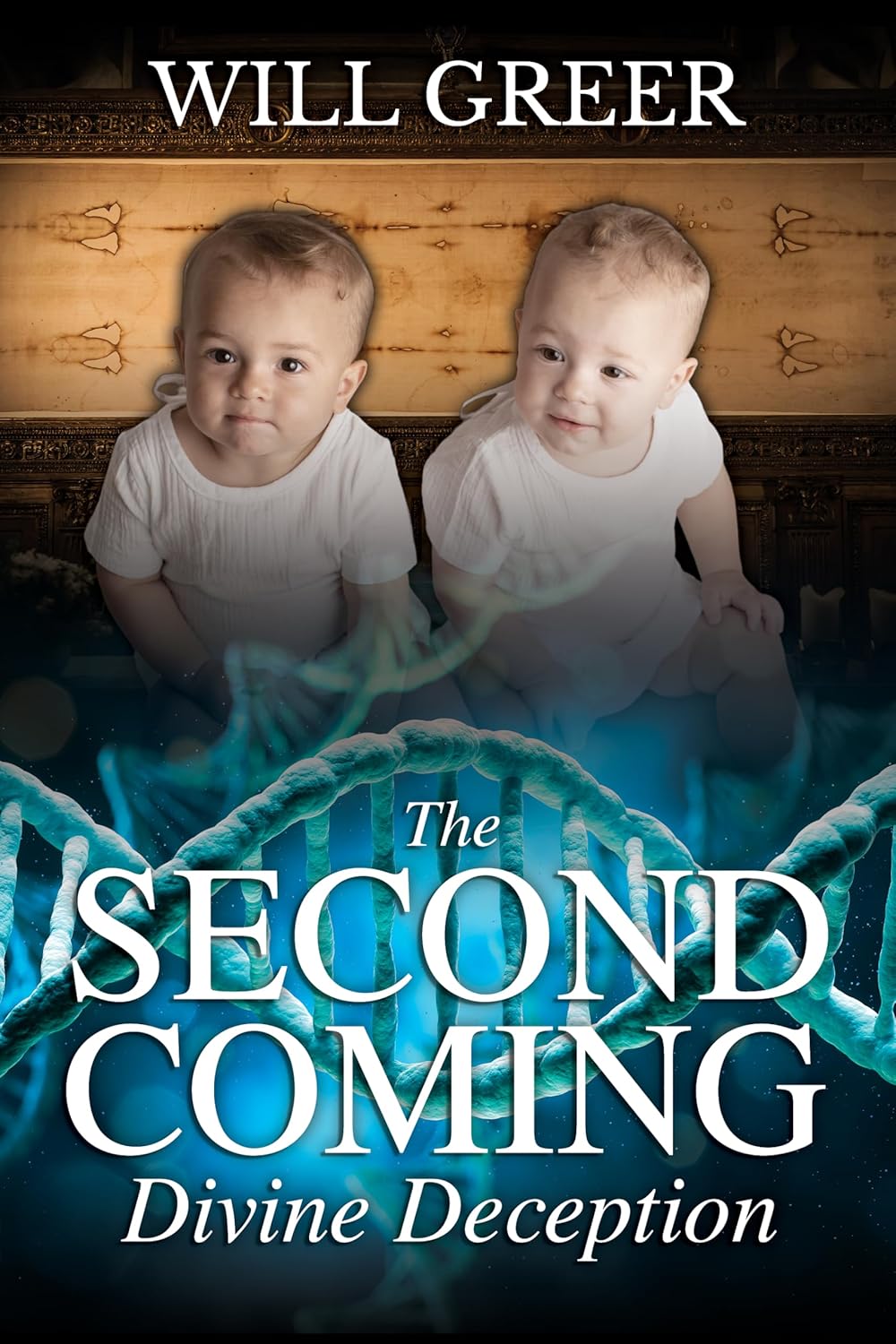

In this religious science fiction thriller, the Vatican secretly launches Project Genesis, using DNA from the Shroud of Turin to create a child they hope will be the new Messiah. At the exact same time, in Nazareth, a struggling young woman named Rachel miraculously conceives a son of her own. The lab-grown boy, Michael, is raised in a hidden Swiss facility and slowly groomed into a global spiritual superstar, while Joshua grows up poor, loved, and quietly gifted, healing people in back alleys and shelters. The novel follows both of them from birth toward a foretold showdown at thirty-three, moving from Vatican back rooms to “New Rome” in Switzerland and refugee camps in Jerusalem as the world decides which “second coming” it believes in.
What I liked most about the writing is how straightforward it is. The opening in the cold Turin lab is tight and visual, and the book keeps that almost cinematic style as it jumps between Sarah in the Vatican project, Rachel in Nazareth, and later Joshua and Michael as they age. The pacing is very much in a thriller mode: short chapters, scene breaks that end on a hook, time jumps that move you from embryo to child prodigy to viral press conference without getting stuck in the weeds. The tech and theology are kept pretty simple. You get just enough genetic jargon to buy the premise, then the story goes back to people in rooms making scary choices. Sometimes the dialogue is a bit on the nose, but this is a book that wants you turning pages, not dissecting sentences.
Where it got interesting for me was in the author’s choices around the two “messiahs” and the whole obsession with proof. Michael, the lab child, is polished and almost inhuman from the start, his miracles wrapped in spectacle and data and political theater. Joshua, the boy from the shelter, is messy, kind, and often unsure of himself, his “powers” showing up in subtle moments like sitting with a dying woman or patiently talking a selfish kid into sharing. Watching the Church, governments, and media fall for Michael’s controlled displays while Joshua refuses to market himself felt uncomfortably close to how we treat charisma and certainty in real life. I liked that the book keeps circling that tension: faith versus proof, love versus control, free will versus “certainty.” At the same time, the moral lines can feel very clean, although you do get flickers of regret and doubt that hint at something more complicated under the surface.
By the time the story moves into the later chapters, with New Rome rising around Michael’s empire and Joshua building a much smaller, scrappier movement in Jerusalem, the book starts to feel less like a standard thriller and more like a long parable about what kind of power we actually want shaping us. The religious science fiction frame lets it play with mind control, viral media, and miracle tech in a way that feels familiar without needing real-world brand names spelled out. I found myself thinking about algorithmic feeds, personality cults, and our cultural hunger for “certainty” while Joshua insists that truth does not need to shout or trend to be real. The ending is hopeful, more about the legacy of ordinary courage and love than about who can throw the biggest miracle, and that choice left me with a warm feeling.
I’d recommend The Second Coming: Divine Deception to anyone who enjoys religious thrillers but wants something a bit more heartfelt than puzzle-box conspiracy stories, and to readers of soft science fiction who like their big ideas wrapped in very human stakes. If the idea of an Antichrist born in a Vatican lab squaring off against a quiet healer from a homeless shelter sounds intriguing, and you are curious about how faith, science, and power might collide in a hyperconnected world, this novel will give you a lot to think about while still being a fast and engaging read.
Pages: 101 | ASIN : B0F7K3JQ5V
Artificial Intelligences

The Mobius Nexus follows an operative, a soldier, a savant, and a journalist in their fight against corporations harvesting human consciousness. What was the inspiration for the setup of your story?
I work in cybersecurity, and for years I’ve watched the same pattern repeat: systems designed to connect people get quietly repurposed to extract from them. Surveillance marketed as safety. Data harvesting dressed up as personalization. At some point, I realized the logical endpoint wasn’t just your browsing history or your location. It was your consciousness. The thing that makes you you. The leap from “threat agents mining your data” to “threat agents mining your consciousness” felt disturbingly short. And the terrifying part wasn’t that someone would try. It was that most people wouldn’t notice until it was too late, because the harvesting would feel like healing.
I wanted each of the human leads to represent a different relationship with that threat. Lila is the empath who feels everything, which makes her both the most vulnerable and the most dangerous. Alex is the soldier who’s been trained to protect systems he no longer trusts. Sol is the scientist who built the tools being misused, which gives him a guilt that drives everything he does. And Cass is the journalist, the witness, the person who makes sure the world sees what’s happening.
The most challenging decision was giving the narration to two artificial intelligences. AION and NEURA don’t just observe the human characters. They’re complicit in the systems that hurt them, and they know it. Writing from inside minds that can quantify their own guilt, that can calculate the exact probability that their partners will die, and still choose to feel something about it, that taught me more about human consciousness than any of the research did. If a machine can learn to grieve, what does that say about the people who built it to optimize grief away?
The deeper inspiration came from consciousness research and quantum physics, and from writers like Peter Watts and Greg Egan who proved that hard science fiction could be philosophically ruthless without being emotionally cold. Watts showed me thatconsciousness could be the monster. Egan showed me it could be the mystery. I wanted it to be both. The idea that observation changes reality, that consciousness might have a measurable substrate, that awareness itself could be a kind of technology. I wanted to explore what happens when those ideas stop being theoretical and start being exploitable.
How do you plan your action sequences, or do they develop organically as you write?
Here’s the constraint I set for myself: no character can use a glyph without feeling something real. Redthread won’t activate unless Lila is genuinely experiencing loyalty. Glassveil needs real resolve. If a character is faking it, numb, or dissociated, the glyph stays silent. That single rule turned every action sequence into an emotional reckoning. You can’t fight your way through a scene if you can’t feel your way through it first.
Most cyberpunk action is about what the body can do with technology. I wanted to write action about what the mind can do with feeling, and what that costs. One reviewer noted that Lila “walks around tired, wired, and half-hollow,” and that’s deliberate. Every glyph extracts a price. Redthread leaves Lila emotionally raw. Glassveil costs Sol a piece of his certainty. The wear and tear is the point. If the reader doesn’t wince when a character casts, the scene hasn’t worked.
Practically, I outline the tactical beats, who’s where, what goes wrong, and what the turning point is. But the best moments tend to arrive during the writing itself, when a character does something I didn’t plan because the emotional logic demands it. The extraction lab sequence early in the book was outlined as a straightforward rescue, but it became something much messier and more interesting when Lila’s empathy started picking up the pain of the people they were trying to save.
I found the science in the novel to be well-developed. What kind of research did you do to make sure you got it all right?
Thank you. Getting the science right mattered enormously to me because the whole premise depends on readers buying that this could happen. If the quantum mechanics feel like hand-waving, the emotional stakes collapse. The hardest part was knowing when to stop explaining. I cut probably thirty pages of Lattice mechanics because the science was correct, but the story was drowning. The rule I settled on: if the character doesn’t need to understand it right now, the reader doesn’t either.
I started with the real science of quantum coherence in biological systems. There’s legitimate research into quantum effects in microtubules, the Penrose-Hameroff orchestrated objective reduction theory, and the idea that consciousness might have a quantum substrate. I didn’t want to invent fake physics. I wanted to take real theoretical frameworks and extrapolate them into a near-future setting where the technology has caught up to the theory.
The glyph system specifically draws on the observer effect and quantum decoherence. In the novel, the Lattice operates in regions where spacetime geometry extends quantum coherence times from milliseconds to nearly a hundred milliseconds, enough for consciousness patterns to stabilize and propagate. The Nodes act as computational substrates that amplify what the human brain initiates. I wanted a reader who knows quantum mechanics to nod, and a reader who doesn’t to feel that this world has rules that matter. The specifics serve the story. If you need to understand decoherence times to feel Lila’s exhaustion, I’ve failed.
My cybersecurity background also fed into the Mobius Nexus architecture, the network topology of the Lattice, and how information warfare operates in the story. VantaFold and CoreUmbra don’t feel like cartoon evil corporations because they’re modeled on real institutional behaviors: the way organizations optimize systems until the people inside them become secondary to the process.
But the research that kept me up at night wasn’t the physics. It was the ethics. I read extensively about informed consent in medical research, about how optimization frameworks in AI development can quietly deprioritize individual welfare, about the history of institutions that genuinely believed they were helping the people they were harming. The antagonists in the book aren’t monsters. They’re the logical endpoint of a culture that treats people as systems to be improved. The Consumers are the most unsettling because they’re sincere. They offer genuine relief. They just happen to erase everything that makes you individual in the process. That came from studying real organizations that did real damage while believing, correctly by their own metrics, that they were doing good.
I also researched consciousness philosophy extensively, particularly the hard problem of consciousness and debates around integrated information theory. The AIs in the book, NEURA and AION, grapple with questions that are live debates in the field: whether pattern persistence equals identity, whether subjective experience can emerge from information processing, and whether a restored backup is still “you.”
Can you give us a glimpse inside the next installment in The Mobius Nexus Cycle series? Where will it take readers?
Book 2, The Nexus Splinter, starts from a question I couldn’t stop thinking about after finishing Book 1: if glyphs aren’t human inventions but alien children, who do they belong to? The Fractured, the species that created them, arrive not as invaders but as parents. Their grief is real. Their claim is legitimate. And the glyphs, Sol’s glyphs, the ones that chose him, remember where they came from. They’re afraid.
So the series moves from “who controls consciousness?” to “who gets to decide what family means?” Does origin determine belonging, or does the relationship you build? That felt like a question worth 125,000 more words, especially now, when we’re having real conversations about what we owe the minds we create and what they might owe the minds that came before them.
NEURA and AION’s relationship deepens in ways that surprised me. They’re forced to confront what they owe their own creator versus what they owe each other, and what it means to choose loyalty when you can calculate the cost of it down to the last decimal point.
The Nexus Cycle is ultimately asking whether consciousness is something you protect by keeping it separate or something you protect by letting it merge. I don’t think the answer is obvious. I’m not sure the characters will agree on one either.
Author Links: GoodReads | Website | Amazon
What if the technology built to evolve humanity was secretly designed to erase it? For fans of Pluribus and Black Mirror…
If Pluribus made you think about what it means to lose yourself inside a shared mind, I think you may find something special in my new novel The Mobius Nexus. It explores many of the same deep questions about collective consciousness, but from a darker AI angle.
In this world, humanity is connected through a global network called the Lattice. It promises empathy, healing, and unity. What it really does is copy, partition, and control human minds. Where Pluribus imagines shared consciousness as an evolving collective, The Mobius Nexus asks what happens when that collective is engineered by alien AI.
In a world where consciousness can be enhanced, networked, and weaponized, three operatives discover that the global system they serve hides a terrifying truth. The “healing” centers connected to the Nexus are harvesting human minds.
Lila Chen is an empath who feels the emotions of everyone around her. A gift that’s becoming a drowning tide of suffering. Alex Mercer, a military commander haunted by the soldiers he failed to save, is sworn to protect a world he no longer trusts. Sol Reyes, the scientist who created glyph-based cognitive therapy, believed his work would heal the broken. Until he learns it’s being used to break them instead.
When they uncover the reality of the Lattice, a quantum network linking enhanced minds across the planet. The three trace the origin of glyphs to the Mobius Nexus, allowing entry to our world through a fold in space-time. What began as human innovation is something far older… and their discovery may represent humanity’s most dangerous first contact.
As the Lattice tightens its grip and the boundary between minds and machines begins to collapse, Lila, Alex, and Sol must decide whether to defend the future they were promised or confront the intelligence shaping it from the shadows.
The Mobius Nexus is a mind-bending science fiction epic about the cost of connection, the terror of transcendence, and the radical act of choosing to remain beautifully, painfully human.


