Blog Archives
Navigating What’s Ahead

The Coming Disruption provides readers with the tools needed to survive the coming changes associated with Artificial Intelligence in the workplace. Why was this an important book for you to write?
Because too many people are being told half the story about what’s coming. Most conversations about AI focus on tools, trends, or fear — not on how work, organizations, and leadership are actually changing right now.
I wrote The Coming Disruption because this shift isn’t theoretical. It’s already reshaping who wins, who struggles, and who gets left behind in the workplace. Organizations that don’t adapt quickly won’t slowly decline — they’ll fall behind all at once. I wanted to give leaders and workers a clear, honest framework for navigating what’s ahead, without hype and without sugarcoating the consequences of inaction.
I also wrote this book in honor of my father. He believed deeply in hard work, responsibility, and adapting to change rather than resisting it. This book reflects those values — and my hope is that it helps people face what’s coming with clarity, courage, and agency, just as he taught me to do.
Can you share a little about the research behind The Coming Disruption?
The research behind this book isn’t academic; it’s operational.
It’s based on decades of building and scaling technology companies, leading through rapid growth, market disruption, and crisis, and watching firsthand how organizations behave when pressure increases.
I also studied historical inflection points – from the Industrial Revolution to the rise of digital platforms, to understand how productivity shocks change labor, management, and power structures. The patterns are remarkably consistent: technology doesn’t eliminate work, it redefines value. AI simply accelerates that process faster than anything we’ve seen before.
The book combines real-world experience, economic data, and pattern recognition, not speculation.
Did you learn anything while writing this book that surprised you?
What surprised me most was how fast the gap is widening.
I expected AI to create advantages for early adopters. What I didn’t expect was how quickly organizations that move first begin to outpace everyone else, not incrementally, but dramatically in speed, output, and decision-making.
I also came to appreciate just how much of today’s work exists to manage friction, not create value. AI exposes that immediately. Writing this book made it clear that the disruption isn’t just technological, it’s cultural and structural.
What is one thing you hope readers take away from your book?
That they still have agency, but not unlimited time.
This book isn’t meant to scare people. It’s meant to wake them up. The coming disruption will reward those who adapt early, learn continuously, and focus on producing real value. It will punish hesitation, denial, and comfort with outdated roles.
If readers finish the book understanding that this moment requires action — not someday, but now — then it’s done its job.
Author Links: GoodReads | X (Twitter) | YouTube | Website | Amazon
The Coming Disruption: How AI First Will Force Organizations to Change Everything or Face Destruction


The Coming Disruption is a blunt, high-energy warning shot aimed at anyone working inside an organization that hopes to survive the AI era. Author Fred Voccola lays out a simple message. AI is not a future trend. AI is a meteor already hitting the atmosphere, and every business, institution, and worker must adapt fast or get wiped out. He explains how AI multiplies productivity at a pace that makes earlier revolutions look sleepy, and he pushes the idea that becoming “AI First” means rebuilding the entire structure of an organization from top to bottom. The book blends history, economic analysis, and practical guidance, and it uses a vivid, almost urgent storytelling style to keep you moving through concepts that could reshape every part of modern work.
Voccola writes with a mix of confidence and impatience. Sometimes I nodded because the urgency made sense. Other times, I felt a little overwhelmed because the pace is relentless. Still, his arguments are sound. The idea that AI requires zero infrastructure change right now, and that the only barrier is leadership willingness, really resonated with me. I liked how he compared past transformations to the present because it made the speed of what’s coming feel real. I occasionally wished he explored a few examples more deeply.
What I liked most was his emphasis on internal AI. Not the headline-grabbing model wars. Not AGI speculation. The boring stuff inside every company that nobody glamorizes. I appreciated that focus. It made the book feel grounded. I kept thinking about how many organizations cling to outdated structures because they’re afraid to rip up the old playbook. His frustration with bureaucracy is loud and clear, and I found myself agreeing more often than not. His call to eliminate the “organizational deep state” is sharp, but it definitely made me think about how much waste we accept as normal. The book made me look at leadership, communication, and speed through a different lens.
I’d recommend The Coming Disruption to executives, founders, managers, and anyone who feels responsible for guiding others through change. It’s also a useful read for students and curious workers who want to understand the forces reshaping their careers. If you want a wake-up call that pushes you to think bigger, move faster, and challenge the comfort of slow adaptation, this book delivers.
Pages: 295 | ASIN : B0G2CNYPN6

Bots & Bosses: The Hilariously Chaotic Symphony of Management in the Age of AI
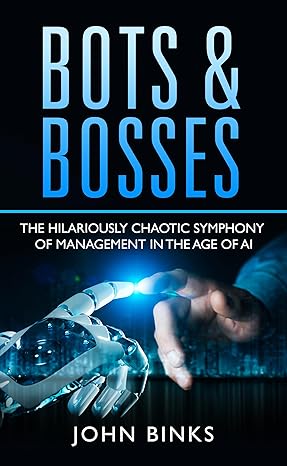
John Binks’ Bots & Bosses takes readers on a fast-paced, laugh-out-loud tour through the wild frontier of AI-driven management. With wit, sarcasm, and plenty of relatable workplace scenarios, Binks explores how artificial intelligence is reshaping leadership, teamwork, and office dynamics. From Siri giving questionable management advice to robots replacing office gossip, the book dissects the chaos and quirks of merging human leadership with cold, calculating algorithms. It’s a mix of humor, insight, and cautionary tales that’s perfect for anyone trying to navigate the AI revolution without losing their mind (or their job).
Binks has a gift for making complex topics digestible, but what really stood out to me was his humor. Chapter 1, “Hey Siri, How Do I Manage This Team?,” immediately sets the tone, painting a hilarious picture of AI stepping into managerial roles, often with disastrous results. The image of an AI assistant misinterpreting vague instructions and turning them into office-wide disasters is painfully real. His ability to poke fun at both human inefficiencies and AI absurdities makes the book informative and genuinely fun to read.
Beyond the jokes, Bots & Bosses raises some sharp insights. Chapter 5, “Don’t Take It Personally—It’s Just an Algorithm,” digs into the emotional divide between humans and AI. AI doesn’t get upset when it makes a mistake, but a human might when AI’s cold logic replaces their years of experience. The discussion on objectivity in Chapter 7, “AI in Performance Appraisals,” resonated with me. Binks argues that while AI can strip bias from evaluations, it also lacks the empathy needed to truly understand workplace contributions.
One of the strongest sections comes in Chapter 9, “AI Management Myths: Busting Them with Style and a Smile.” Here, Binks dismantles the biggest fears surrounding AI in the workplace, from “AI is here to steal our jobs” to “Only tech experts can manage AI.” He makes a compelling case that AI isn’t a villain, it’s a tool. The real issue is how we use it. This chapter alone makes the book worth reading, especially for managers feeling overwhelmed by the technological shift.
Bots & Bosses is a book for professionals who want to understand AI’s role in management without drowning in tech jargon. If you’re a manager trying to figure out how to work alongside AI, or just someone who enjoys a good workplace satire, you’ll get a lot out of this book.
Pages: 43 | ASIN : B0CCSSDMQD



 LITERARY TITAN