Blog Archives
Free People Free People

The Lie That Changed Everything is a memoir that blends sharp humour, biting honesty, and painful recollections into a story that feels both chaotic and deeply human. Why was this an important book for you to write?
This book goes right back to the moment that shaped me—a childish lie I swore on my father’s life, followed by his cancer diagnosis. For years, I carried the belief that I had somehow killed him. That single moment of guilt became the thread that ran through my childhood and beyond, influencing how I saw myself, my family, and even my faith.
Writing The Lie That Changed Everything was my way of holding that memory up to the light and finally making sense of it. But it’s not just about trauma—it’s about the absurdity of family life, the strange superstitions that guided us, and the humour that helped me survive. I wanted to show that even in chaos, there’s resilience and laughter, and that being human means carrying contradictions: grief and comedy, shame and love, darkness and light.
How did you decide what to include and leave out in your memoir?
That was one of the most complex parts of the process. Some of my family were opposed to me writing memoirs—both The Hate Game and The Lie That Changed Everything—because it’s difficult to face the dysfunction that runs through our family. But after years of working as a child protection social worker with hundreds of families, I know dysfunction is universal. The difference lies in whether we discuss it or keep it buried.
I chose to write my truth, but I also left things out. Some situations were too private, too sensitive, or simply not mine to tell. Respect was a guiding principle. What’s on the page is my perspective—my memories, my emotions—rather than an exposé. My brother, who is nine years older, helped me fill in gaps from the early years, and between his input and my mother’s knack for remembering everything, I had a wealth of detail to draw from. I’ve been blessed—or cursed—with an elephant’s memory of my own, so much of it was already stored in my brain in glorious technicolour.
In the end, I included what served the story, what illuminated the themes of guilt, resilience, and humour, and what felt authentic to share. A memoir isn’t the whole truth of a life—it’s the truth of a particular journey.
What was the most challenging part of writing your memoir, and what was the most rewarding?
The most challenging part was working through the trauma—breaking the silence I’d carried for decades. I hadn’t told a soul about the grief and guilt that shaped me. Fear and shame kept my story bottled up. Sitting down to write meant opening old wounds, but it also gave me a way to release them.
The most rewarding part has been the liberation that followed. Over the years, I discovered that I could share painful stories and still make people laugh, even in the darkness. Writing allowed me to see my parents in a different light, too. I came to understand how their own trauma defined them, and that gave me compassion instead of just confusion.
Ultimately, the memoir has helped me stop being defined by the same pain. I often say: hurt people hurt people; free people free people. Writing this book was my step into freedom.
What do you hope is one thing readers take away from your story?
I hope readers come away with the sense that it’s possible to carry both laughter and pain in the same story. Life is rarely one-dimensional—grief can sit beside humour, shame beside love, darkness beside resilience. For a long time, I thought my story was only about guilt and trauma, but writing showed me it was just as much about survival, absurdity, and even joy.
I was thrilled with one review that said, “If you enjoyed Angela’s Ashes, you’ll love The Lie That Changed Everything. My late mum’s favourite book of all time was Angela’s Ashes. To be compared with Frank McCourt’s work was very humbling, and my mum would be so chuffed to hear such a compliment.
If readers realise they’re not alone in their chaos: that silence can be broken, that healing can happen through honesty, and that humour can be a lifeline—then the book has fulfilled its purpose.
Author Links: GoodReads | X (Twitter) | Facebook | Website | Amazon
The Lie That Changed Everything is the story of a boy who was made to swear a lie on his father’s life, dreamed of his death, and witnessed it happen.
Trew’s story unfolds with unfiltered honesty and laugh-out-loud British humour as he reflects on a childhood marked by chaos, confusion and unexpected moments of grace. Set in the ’60s and ’70s, across RAF bases, hilarious first kisses and a botched “Ten Pound Pom” migration to Australia, the memoir centers on a mum who could scare the devil with her “scriptures” and a war-hero dad, whose reclusiveness left a heartache that humour alone couldn’t fill.
One little rascal. One very big lie. And one funny, unforgettable ride. Perfect for fans of Sedaris, Angela’s Ashes and The Glass Castle; Trew’s tale is as heartbreaking as it is hilarious.
The Lie That Changed Everything: The Memoir of a Little Rascal
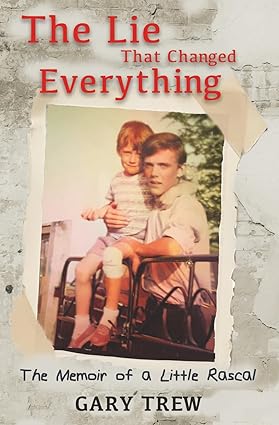

From the first page, Gary Trew makes it clear this is no sugarcoated stroll down memory lane. The Lie That Changed Everything is a memoir that blends sharp humor, biting honesty, and painful recollections into a story that feels both chaotic and deeply human. Trew recounts his early years with a mix of wit and grit, pulling readers through family dysfunction, childhood scrapes, and the bruising aftermath of being raised in a world where love often arrived tangled in trauma. It’s a tale of survival told with an irreverent laugh, even as it shines a light on moments of loneliness, rejection, and heartbreak.
I was taken in almost immediately by Trew’s voice. His writing has a rhythm that swings between wild comedy and gut-punch sadness, and that constant shift kept me hooked. Some chapters had me laughing at his absurd family stories, while others had me pausing to let the weight of what he endured sink in. The mix is unusual, but it works. He doesn’t let the pain take over, and he doesn’t let the jokes cheapen the truth either. At times, I found myself frustrated with the sheer cruelty he describes, but then he’d toss in a line of dark humor, and it felt like sitting in a pub listening to a mate tell a story he can only tell because he survived it.
There were moments where the writing felt a little jagged, but that roughness actually added to the authenticity. It made me feel like I was being trusted with unpolished truths rather than a neatly packaged memoir. I also found myself admiring his willingness to talk about shame, resentment, and fear without dressing them up. His honesty struck me as both brave and disarming. The book reminded me that family histories are rarely tidy, and sometimes the best way to survive them is to laugh at the madness and keep moving forward.
By the time I reached the final chapters, I felt both drained and strangely uplifted. This isn’t a book for someone who wants a gentle or inspirational memoir. It’s for people who appreciate raw honesty, gallows humor, and the messy beauty of a life that didn’t follow the script. If you’ve ever grown up feeling like the odd one out, or if you’re drawn to stories that reveal both the scars and the resilience of childhood, this book will resonate.
Pages: 278 | ASIN : B0FGKN1M47




 LITERARY TITAN