Blog Archives
The Edge of Now


The Edge of Now is a raw and heartfelt travel memoir by Thom Barrett that weaves together the physical landscapes of South America and Antarctica with the internal terrain of a man living with stage IV cancer. It chronicles Barrett’s journey through Argentina, Chile, Bolivia, and beyond, all while confronting his own mortality, redefining resilience, and wrestling with the question of how to live fully when time is uncertain. The book is structured around a physical expedition and a spiritual one, framed by his ARC Cycle—Awaken, Release, Change—and grounded in mindfulness, vulnerability, and deep reflection.
Reading this book was like sitting across from someone who’s been to the brink and come back with stories that matter. Barrett’s writing is lucid and personal, unflinching in its honesty. He doesn’t sugarcoat the toll illness has taken on his body, or the creeping doubts and insecurities that threaten to erode his sense of self. But his words are never maudlin. Instead, they carry a weight that feels earned. The balance between travel writing and personal introspection is beautifully done. Descriptions of thundering waterfalls or Antarctic silence fold seamlessly into thoughts on impermanence, love, and what it means to have enough. I found myself lingering on certain passages, not because they were complex, but because they hit so close to home.
What moved me most was the way Barrett writes about acceptance, not as some passive surrender, but as an act of courage. He challenges the reader to rethink what strength looks like. It’s not climbing the hardest peak, but knowing when to ask for help. It’s not pushing through at all costs, but listening when your body says stop. This hit me hard. His decision to value quality of life over extending it at all costs is presented not as defeat, but as deeply human. He writes like someone who’s let go of pretending and is inviting you to do the same. There’s a peace in that, and it’s contagious.
The Edge of Now isn’t just a book about dying. It’s a guide to living—not later, not when things are easier, but now, in all its messy, breathtaking glory. I’d recommend this to anyone who’s ever felt stuck, scared, or just unsure of how to keep going. It’s especially for caregivers, patients, and wanderers, anyone straddling the line between holding on and letting go. Barrett’s journey is personal, but his insights are universal. This book doesn’t just ask you to read—it asks you to feel, reflect, and maybe even change.
Pages: 291 | ASIN : B0F3367892

Living While Dying
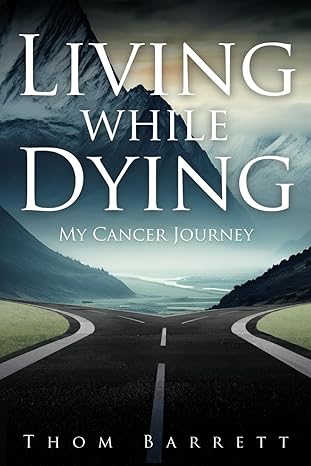
Living While Dying is a personal and often raw memoir chronicling Thom Barrett’s journey through prostate cancer—from diagnosis to treatment, and ultimately, acceptance. It spans nearly a decade of his life, including stints of remission, relapses, surgeries, radiation, hormone therapy, and the emotional toll all of it takes. But more than that, it’s a book about living—about pushing forward, finding meaning, chasing moments of joy, and learning to navigate life even when the road turns brutal and uncertain.
Right off the bat, Barrett’s voice hits you. It’s not polished in the way some memoirs are; it’s better. It’s real. In the Preface, he writes, “I call this book Living While Dying for a reason—that is what I have been doing without fully realizing it.” There’s something powerful about someone realizing they’ve been surviving all along, even when they thought they were just coping. The way he pulls passages straight from his journals adds an immediacy that makes you feel like you’re right there with him—whether it’s in the sterile discomfort of a biopsy or the aching silence of a sleepless night on Cape Cod. You’re not just reading. You’re witnessing.
What struck me hardest, though, was how open he was about the emotional stuff—especially the way cancer tore into his relationships. When he talks about telling his wife about his diagnosis late, and the tension that followed, it hit a nerve. He admits, “Unfortunately, I didn’t handle her concerns well.” That’s not something people usually own up to, especially in memoirs like this, but Barrett does, and often. He reflects without blame, just honesty. And when he questions whether his testosterone treatments—done in good faith—might have worsened the cancer, it’s not with bitterness, but a kind of weary clarity. That mix of vulnerability and self-awareness gives this book weight.
Still, it’s not all somber. Barrett finds light in woodworking, skiing, his dog Bailey, and especially his travels. Chapter 5, where he recounts road trips with friends and a season of skiing, almost reads like a travelogue tucked inside a cancer memoir. There’s a contagious energy in those stories—like when he describes building a camper or making rustic hickory cabinets. Even when his body fails him, he finds ways to build, to move, to dream. It reminded me how essential it is to make room for joy, even when the world says you should be miserable.
In the final chapters, as Barrett confronts his stage IV diagnosis and writes openly about his fears, purpose, and mortality, I found myself slowing down, not wanting to rush the words. His reflections in Chapter 20, Lessons Learned, felt like he was handing the reader a map—not to avoid the pain, but to navigate it. It’s not inspirational in the saccharine way. It’s brave, grounded, and unfiltered.
I’d recommend Living While Dying to anyone facing illness—directly or through a loved one. But it’s also a book for people who feel stuck, who wonder what it means to really live. Barrett doesn’t have it all figured out, and he never pretends to. But he writes like someone who’s wrestled with life, and who still—despite everything—believes in its beauty.
Pages: 243 | ASIN : B0CSZCR74R



 LITERARY TITAN