Blog Archives
Inspired By The Need For Balance

What inspired you to create the unique blend of cultures and characters found in Three People, Three Countries, One Path?
The unique blend of cultures was inspired by my interest in Buddhism, of which there are many variations and traditions that flow through the three countries in the book. I found it interesting to interlink these combining them with the complex history between India, Tibet, and China. Inspired by fate, destiny, and choice, this allowed me to explore the cultural norms and nuances of both the larger cultures and the people within them, as not everyone follows the norms as the book teaches.
For me, Pinia encompasses all of this—with his Indian and Chinese lineage he is already blended, yet whether due to circumstance or the middle ground he is most comfortable in the ‘middle’ in Tibet. I feel because of the travel aspect of the book, the natural inspiration was to blend these cultures. As the characters travel they learn and take away from their encounters.
The blend of characters came from real life inspiration thinking about how different people in my life have different perspectives on the same event. From this I thought about what motivates these responses and this enabled me to create the depth of characters. Pinia, Loysin, and Lakishma represent three different approaches to the plot yet they blend together to provide a full picture of what can and will happen. Many other characters enter the story to help blend the cultures and personalities of the main protagonists, which was inspired by the need for balance both in life and in the novel itself.
How did you research the cultural nuances of India, Tibet, and China to so accurately portray them in your novel?
Apart from researching into names of places and looking at maps enabling me to plot the journey the characters embarked on, I did not have specific time spent on research. I feel that I portrayed these cultural nuances through my vast reading on Buddhism, novels and biographies set in this region. At the time of reading these it was not planned research as the book had not been imagined yet. I always think you should write about what you know and from my general interest that is what I did, so the seed was planted long before the book took life.
If I am honest the writing of these different cultures and interweaving them to provide the nuances to make them individual all came very naturally to me as though the information was stored in a box in my brain waiting to be retrieved once the pen hit the paper.
I grew up in a spiritual household, so I have always been open to meditation. A lot of my information and answers came from this. When I had a block, I would sit back and focus on it until the answers came.
Pinia, Loysin, and Lakishma are unique characters each facing their own challenges. Which character was the most challenging for you to write and why?
Pinia was definitely the most challenging to write due to the extensive character development he has throughout the book. There are so many turnarounds and revelations for him that I needed to make them both believable and relatable to the reader so they would empathise and embark on the journey with him.
Without spoiling the book for people, his world, beliefs, and priorities shift in an almost 180° way, yet for much of the book these are beyond his control—something which echoed my own life. This made this aspect of Pinia both easier to write as I had experienced the emotions and confusion this provides internally, yet it was also harder because it made Pinia much more personal to me. Therefore, making that journey believable and honest was so important that it put pressure on the character.
Also, Pinia is a Buddhist monk who explores life through his spirituality making this realistic but accessible to all raised challenges, which the children aided in, so it was interwoven into the plot naturally.
Despite these challenges I feel I managed to create a complex but relatable character in the end.
The book emphasizes the power of choice over fate. How did you arrive at this theme, and what do you hope readers will take away from it?
I feel that although a path or fate may be laid out for you, you always have the choice to change this or the results of this. This theme was drawn from my own life, where a path was set out for me and I followed it for a long time before I realised I had the power of choice. The internal and external battles the characters face are close to my heart and the reason I am even doing this interview. If I had not learned to take my power I would not be an author.
From this theme I hope readers will be empowered to realise that they can make choices about their lives. No matter what their circumstances or what they are told about their path, ultimately they are in charge of their own fate, and they always have the power of choice.
Author Links: GoodReads | Facebook | Website
Pinia thinks his monk life is it. Until a devastating event brings Loysin and Lakishma into his life. Travelling through India, Tibet, and China, the three become a family. Destined to face a terrible test to balance karma that is not their own, can they remain as one?
In Three People, Three Countries, One Path by Cara A’court, we experience a journey of mind, body, and soul for all involved, reminding us that the choices we make define who we are, not our fate.
Three People, Three Countries, One Path
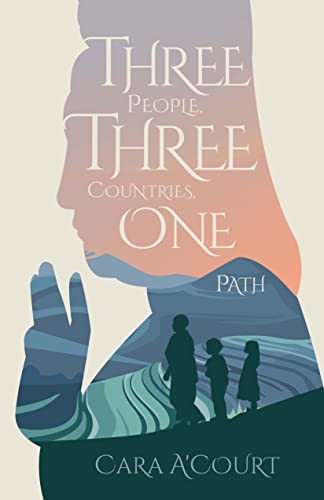

In Three People, Three Countries, One Path, Cara A’Court demonstrates exceptional prowess in crafting an adventure-filled narrative that deftly evokes a myriad of emotions within its readers. It is the hallmark of a truly talented author to elicit a genuine emotional response, and A’Court undeniably achieves this feat. I found myself engrossed in the book to such an extent that it demanded more time and attention than most others I have had the pleasure of reviewing. As an ardent reader, I reveled in this immersive experience.
The author masterfully weaves together various elements, including mystery, suspense, and revelations that elicit awe, particularly when delving into familial matters within the intricate tapestry of the settings. What truly left an indelible impression on me was the author’s skill in showcasing how even those we perceive as spiritually enlightened individuals grapple with the mundane concerns of everyday life. Ms. A’Court reminds us that life shows no partiality, irrespective of one’s status. If there lies a destined path waiting to be traversed, it matters not who or what the individuals are; the journey will unfurl before them.
Three People, Three Countries, One Path is a remarkable literary work that seamlessly blends adventure, emotion, and profound insights. Cara A’Court’s writing style resonates deeply, tugging at the reader’s heartstrings and provoking introspection. This book stands as a testament to the author’s mastery of her craft, leaving an indubitable impact on anyone fortunate enough to embark on its pages.
Pages: 327 | ASIN: B0C412ZZXB




 LITERARY TITAN