Blog Archives
A Life-long Quest For Understanding
Zen and the Art of Navigating College shares with readers a new perspective on going to college and how to get the most out of the experience that they can. Why was this an important book for you to write?
I really had no choice. I was compelled to write it. It was a culmination of a life-long quest for understanding. Thoughts and ideas would come to me at all hours, and if I didn’t put them down on pen and paper, they would haunt me.
When I was in my junior year, I experienced a personal crisis. I came to the realization that college wasn’t going to deliver on its promise and that the assemblage of professors, narrow-minded single subject savants were in no position to offer up any significant impact on my life. My expectations were based on a lot of false assumptions, although to be honest I could never really define those assumptions. I also knew this was a pivotal point in my life and my failure to be re-made would have consequences on my launch in life.
As a chemistry major, I was focusing on minutia. All of my professors were focusing on some minor molecule or set of molecules that was largely a theoretical exercise. I was shocked when I made the realization that most research was esoteric. Its purpose was more to attract grant money than to achieve some sort of breakthrough to advance mankind’s knowledge of the universe.
The college experience can be one of those great moments in one’s life. There are so many changes, adjustments, and developments taking place all at once. College can offer the prospect of great development. But college is also the first time in a student’s life that s/he is separated from everything they know, their home, family, friends and support system. They are forced to manage almost every element of their daily lives. But The demands of academia mean being forced to drink from a firehose in educational material and assignments.
But when we are young, we have a very romantic view of the world and we find ourselves exposed to a great many temptations and distractions. Instructors will try to recruit students to participate in their causes which may not have anything to do with academic pursuits, while classmates can offer an entirely different set of temptations.
It can be a staggering adventure but without the proper perspective, some students will find themselves either distracted or overwhelmed with their hopes derailed.
Anything that I can do to prevent or mitigate unnecessary suffering and anxiety and increase the student reader’s chances of success makes it all worthwhile.
What is one thing you hope readers take away from your book?
A student should expose themselves to as many disciplines as possible and at the same time conduct a personal agenda towards self-discovery, who are you, what motivates you, what are your aptitudes and what are you passionate about? Use the college’s counseling services and placement office resources to facilitate this agenda to determine your personality type. Myers Briggs is one of the personality typing systems out there but it has since been eclipsed by other personality type systems. Then use the discovered personality typing to trace your aptitude and interests and then trace those defined interests to decide on those disciplines of study that are compatible with your personal goals.
The more you know about yourself in combination with the confidence and authority that comes with an educated self-awareness that can be an inflection point that can serve as the basis of resilience. At some point in our lives (this happens to all of us) we will find ourselves entirely alone staring into the abyss and it’s at moments like that we will need to tap into that well of our making of resilience and hope.
What were some ideas that were important for you to share in this book?
It’s important that the reader understands the difference between academia which is an artificial construct supported by tuition versus life which is asymmetrical, unpredictable with moments of extreme disappointment and stress.
The education process should advance a student’s perspective to allow them to see from a higher ground to better navigate life. Milan Kundera just passed away. He wrote an extremely profound book, “The Unbearable Lightness of Being.” It’s a fictional account of life in Eastern Europe behind the iron curtain where nothing made sense. His characters in the book had a choice to make they could live their life heavy near earth or they could live it light far from the surface of reality.
Given the seriousness of life and the realization that we have only one life to live, makes every decision we make all the more important. All decisions have consequences while some will cast a long shadow on our lives; we must realize in making a decision we must give something up. It only serves to underscore the importance in making an educated decision.
Lastly, don’t look to others to validate you. Don’t let the limited view of gifted academics define you. Many are savants with a shared passion for a subject, just because you don’t share those same passions doesn’t limit you in any way.
What is a common misconception you feel people have about the importance of going to college?
I think people expect to show up on campus with the expectation that somehow they will be developed, and remade into an educated composed individual. Kind of like going to a hair dresser to have your hair made up and new you will show up.
The college institution can’t be expected to magically re-make the student into an educated composed individual. Institutions are made of academics and single subject savants and they are not capable of remaking anyone. You can’t be passive and rely on the institution or professors to facilitate your development.
You must take responsibility for your growth and development.
Author Links: GoodReads | Amazon
Drawing upon the great thinkers of contemporary philosophy, psychology, and science, this book reveals a revolutionary way to prepare for navigating the complexities and potential pitfalls of college, including:
How to look past the limited view of gifted but specialized academics
How to select courses that will help you get interviews with potential employers
How to develop a meaningful social and professional network, including outside the college community
How to take full advantage of college facilities and programs—including some you may not even be aware of
Robert Pirsig’s classic book Zen and the Art of Motorcycle Maintenance used metaphysical imagery to reveal a more holistic way to think about the world and our place in it.
In that tradition, Zen and the Art of Navigating College is a first-of-its-kind handbook for being prepared to get what you really NEED from the college experience—a path to discovering a greater purpose and the tools to achieve it.
Zen and the Art of Navigating College: An Inquiry into the True Nature of Education and the Power of Self-Discovery
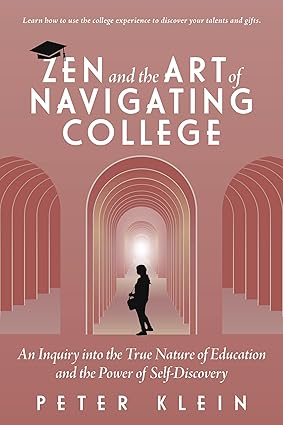

Zen and the Art of Navigating College, penned by Peter Klein, is a definitive guide that aims to not only optimize your college experience but harness it as a transformative journey. It offers a profound exploration of two overarching themes: the process of selecting an ideal college and the multifaceted nature of life on campus.
Klein supplements his discourse with an array of real-world examples, facilitating a richer comprehension of how higher education can be a transformative springboard. He provides an insightful critique of the college system while proffering valuable advice for students to unlock their potential.
Klein disseminates an abundance of knowledge essential for all prospective college students. He examines diverse college types and their distinct admissions approaches while imparting wisdom on how to transcend the traditional college experience. This includes aligning one’s choice of college with their personality type, leveraging the role of academic advisors, and contemplating internships. He also offers an authentic depiction of the challenges that freshmen face, comparing it to the magnitude of relocating to a foreign country.
One of the most compelling elements of Klein’s book is his candidness. He does not shy away from admitting that despite its numerous benefits, the college experience is far from perfect. Klein poses the question, ‘Is a college education worth the investment?’ and provides the reader with thought-provoking insights in response.
Initially perceived to be a handbook of college tips, it evolves into a comprehensive primer for college life and the world that awaits thereafter. It equips readers with the right mindset to confront college and the career landscape. This book transcends its obvious audience and extends to professionals considering a career pivot, offering valuable career insights.
Its practical guidance can significantly benefit potential students, current college attendees seeking to amplify their educational experience, and even graduates still on the hunt for a fulfilling job. In essence, it provides the third group with a compass to navigate their career path and instills in them the courage to persevere. Zen and the Art of Navigating College is an indispensable guide that transcends the college landscape, resonating with readers at various stages of their career journey.
Pages: 193 | ASIN : B0C6YGCZ6Z




 LITERARY TITAN