Mushroom Blues
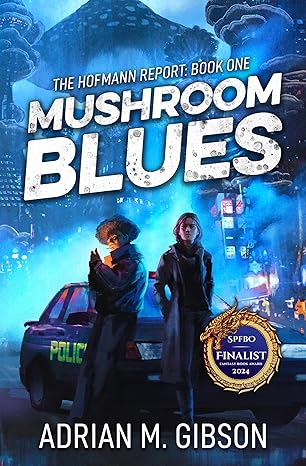

Adrian M. Gibson’s Mushroom Blues plunges readers into the “Fungalverse,” a dystopian blend of noir, science fiction, and surrealist horror. The story follows Detective Henrietta Hofmann, a weary investigator exiled to the oppressive, mushroom-drenched city of Neo Kinoko. Tasked with solving a gruesome murder, she navigates a tangled web of political corruption, cultural tension, and personal trauma in a world where humans and sentient fungal beings coexist uneasily after a brutal war.
Gibson’s depiction of Neo Kinoko—its decaying mushroom-topped towers, spore-filled air, and oppressive post-war atmosphere—was as immersive as it was revolting. I could practically smell the rotting mycelium and feel the grit of spore-laden winds on my skin. The mushroom-human dynamic adds a unique, eerie tension to the setting. The Mother Mushroom, a colossal fungal structure looming over the city, is both a symbol of cultural resilience and an unsettling presence. Gibson’s descriptions, such as the protagonist’s repulsion at fungal biology, made the world grotesquely alive. Henrietta Hofmann is a compelling lead. Her cynicism and mycophobia make her a fish out of water in the fungal-dominated Neo Kinoko, yet she’s tenacious and relatable. Her struggles with alcoholism and personal demons lend depth to her character, especially during moments of vulnerability. The story’s pacing mirrors its noir roots—deliberate and laden with tension. While the mystery at its core is intriguing, it’s the societal commentary that elevates the narrative. The portrayal of post-war xenophobia and systemic oppression is sharp and poignant, with parallels to real-world colonial histories. The protests and clashes between human authorities and the fungal populace stand out as some of the most gripping scenes, capturing the desperation and anger of a marginalized group.
Mushroom Blues is a bold and bizarre debut that will appeal to fans of genre-bending fiction. Its mix of noir grit, science fiction imagination, and social critique makes it perfect for readers who enjoy Adrian Tchaikovsky or Jeff VanderMeer. Its grotesque imagery and deliberateness are perfect for those who relish intricate world-building and morally complex characters and will find themselves enthralled—and perhaps a little spore-sick. It’s a dark, fungal-drenched trip worth taking.
Pages: 441 | ASIN : B0CTCF9TCF


Posted on December 5, 2024, in Book Reviews, Five Stars and tagged Adrian M. Gibson, author, book, book recommendations, book review, Book Reviews, book shelf, bookblogger, books, books to read, Crime & Mystery Science Fiction, Cyberpunk Science Fiction, Dystopian fiction, ebook, fiction, goodreads, indie author, kindle, kobo, literature, Mushroom Blues, mystery, nook, novel, read, reader, reading, sci fi, story, writer, writing. Bookmark the permalink. 1 Comment.



 LITERARY TITAN
Thank you so much for reviewing my book! I’m so glad you enjoyed it.