Blog Archives
A Peek at My Life

When Squirrels Fly follows a skeptical professor who teams up with a travel writer to find her missing aunt, only to uncover wormholes, secret research, and a conspiracy hidden within an eccentric neighborhood. What was the inspiration for the setup of your story?
I’ve lived in college towns my entire life. Ann Arbor, the setting of my story, is my fourth college town. The eccentric neighborhood is my neighborhood. While I have worked for community-based organizations (the YMCA and parks and recreation) during my time here, I’ve also had the privilege to provide consultation for the University of Michigan’s Institute of Clinical Health Research through a program that focuses on community-based participatory research. I find medical research quite fascinating, and my consultation with MICHR has provided me a unique opportunity to look behind the scenes at the research process. The wormhole allowed me to jump around to my favorite places without really needing a strategic reason to highlight them. My story setup incorporated quite a bit of my personal experience.
Why did you choose Ann Arbor as the setting, and which local details were most important for you to include?
This is my debut novel. I had a lot to learn about the writing and publishing process. I chose Ann Arbor as my setting for a couple of reasons. I’ve lived here for almost 30 years. And during that time, I trained for 15 marathons with all of those training miles within a 10-mile radius of my Ann Arbor house on the old West Side. I have a hard-to-match familiarity with that radius, so I could describe it from memory and needed little research on the setting. This gave me more time to devote to learning about the writing process. Also, I grew up in Indianapolis with six brothers and sisters. I am the only one who moved away. My book gives my family a peek at my life. I made my story a bit whimsical to poke just a little bit of fun at them, as some of my siblings tease that my mind has been corrupted because I live in a college town. I highlighted some of my favorite places to run as well as some of my comfort foods.
How did you develop Allie’s emotional journey from guarded skepticism to greater trust in others and herself?
Allie is at a crossroads in her career at the outset of the story. She’s also still dealing with the heartbreaking loss of some important people from her life. Her adventure in Ann Arbor allows her to reconnect with her brother. Her brother, Nick, is somewhat based upon my own brother whom I lost to suicide in 2017. When my brother died, I realized how little one-on-one time I had spent with him throughout his life. I left home to go to college before he entered high school, and I never returned. I purposely created a brother-sister relationship in my book that would help me feel like I had more time with my brother. Allie’s interaction with her brother reminds her that despite the relationships that they have lost, and even because of those losses, their brother-sister relationship is something they can trust. And her brother helps her to realize that trusting others actually helps us learn to better trust ourselves.
Was Chidi always intended to play such an important role, or did the character become more prominent as you wrote?
Chidi is based upon my dog Cheech. I adopted him from the Humane Society to help me recover from the grief of losing my brother. I had a scare the week before my book’s publication date when my dog Cheech developed Congestive Heart Failure. I had to rush him to the emergency vet in the wee hours of the morning. By some miracle, he survived and is doing well. I think my brother was watching over us. I always intended him to play a pivotal role in the book, just as he has in my life. And Chidi’s behavior was inspired by a conversation I had with neighbors about indoor/outdoor cats. While a cat can wander the neighborhood all day without alarming its owners, I would be in a full-on panic if my chihuahua, who is the size of a cat, but not as “worldly,” somehow slipped outside through the front door when I wasn’t looking. I wondered what if my dog had a cat personality? That is how Chidi came to be.
Author Links: GoodReads | Facebook | Website | Amazon
When Allie Caldwell gets a rambling middle-of-the-night call from her very excited aunt Mel, she initially curbs her concern; her aunt has always been a bit eccentric, after all. But when Mel disappears before telling anyone what has her so worked up, Allie drops everything –even her better judgement—to fly to Ann Arbor and find her.
In the ensuing days, Allie inexplicably ignores her gut instincts (and some weird dream-based warnings from angry flying squirrels) and accepts help in the search from her aunt’s handsome, enigmatic neighbor George Bennet. In order to discern how virtual reality goggles, innovative migraine research, hidden treasure, attack drones, and a neighborhood trellis are all connected to the case, they’ll need to survive bungled bids of help from Allie’s well-meaning brother, hidden agendas from multiple neighbors, constant interruptions from Mel’s itinerant Chihuahua and his exuberant pit bull puppy pal—and even some attempts on their lives.
A Strength and a Flaw

The Extraterrestrial follows a boy from another world raised by loving Earth parents, as he grows into a secretive hero using alien technology to battle criminals while fighting to hold on to family, love, and his humanity. What were some sources that informed this novel’s development?
I was a scientist long before becoming an author in 2013, and much of my scientific background naturally found its way into the Sam Stanton trilogy. My work and research in areas such as invisibility, advanced propulsion, and high-speed aircraft exposed me to concepts that are far less science fiction than many people might assume. Those ideas became the technological foundation upon which the trilogy was built.
Rather than place such advanced capabilities in the hands of an ordinary human being, I chose to make Sam originate from Prime-Even, a highly advanced world associated with the exoplanet Kepler-452b, which has been studied by NASA because of its Earth-like characteristics. That decision allowed me to explore not only advanced technology, but also the cultural, moral, and philosophical consequences of a civilization far older and more advanced than our own.
Beyond the scientific aspects, the trilogy was also shaped by my concern about modern geopolitics, political polarization, and the fragility of democratic institutions. The broader storyline required a setting in which extraordinary events could plausibly unfold—particularly in Part 3, where the failed impeachment of the U.S. President and Vice President ultimately, leads to their abduction and appearance before a tribunal of the galaxy’s most advanced society.
That tribunal becomes far more than a science-fiction device. It is used to examine power, leadership, ideology, and the consequences of political extremism. The President’s “One & Only” policy is dissected before an impartial civilization capable of viewing humanity from an outside perspective, with the possibility that the outcome could trigger a new Cold War—or something even more dangerous.
At its core, however, the trilogy is not really about futuristic technology. It is about identity, secrecy, responsibility, love, and what it means to possess human-like feelings while carrying abilities and burdens that separate Sam from everyone around him. My scientific background provided the framework, but the emotional and moral conflicts of the characters ultimately became the heart of the story.
How did you balance the novel’s technical details, such as Sam’s aircraft, training, and medical knowledge, with the story’s emotional and romantic elements?
I always wanted the technical descriptions to remain concise, while still being convincing enough for readers to accept the world in which the story unfolds. My scientific background helped me create technology that feels plausible rather than purely fantastical, but I never wanted the novels to become technical manuals. The emotional journey of the characters always came first.
The storyline of each of the three books was developed before I worked out the details of the technology itself. Once I understood what the story required emotionally and dramatically, I then created the technological framework needed to make those events believable.
For example, invisibility was an essential attribute. Without it, the abduction of the President and Vice President in Part 3 would simply not have been possible. Likewise, Sam’s ability to protect Michelle in Part 1 against the full might of the Scorpion cartel depended on technology far beyond human capabilities. His extraordinary aircraft and advanced medical knowledge also allowed him to operate outside the limits of ordinary society.
At the same time, I wanted those abilities to deepen the emotional and romantic dimensions of the story rather than overwhelm them. Sam’s powers isolate him as much as they empower him. He is constantly forced to balance secrecy, responsibility, love, loyalty, and the desire to live as a normal human being. In many ways, the emotional conflicts became more important to me than the technology itself.
The technical elements therefore, serve mainly as the backdrop against which the human story could unfold. Beneath the aircraft, invisibility, and advanced science, the trilogy is ultimately about identity, relationships, sacrifice, and the struggle to remain human while possessing abilities no human should have.
Sam often believes secrecy is the best way to protect the people he loves. Do you see that as one of his strengths, his flaws, or both?
Sam was instructed from childhood to maintain absolute secrecy about both his origin and his mission. He was even told never to show his face to anyone if doing so could lead to his discovery. That conditioning became deeply rooted in who he was and shaped nearly every important relationship in his life.
In Part 1, secrecy ultimately leads to his breakup with Michelle because he chooses not to reveal who he truly is. His biological father had taught him that secrecy was essential for survival and for the protection of those he loved. Yet later, he deeply regretted not warning Sam that love changes the equation—that withholding the truth from someone you truly love can become destructive rather than protective.
When I created Sam as a character, I always intended secrecy to function as both a strength and a flaw. On the one hand, it is essential to his survival and to the safety of the people around him. If hostile governments, criminal organizations, or intelligence agencies were to fully discover who and what he is, not only Sam but everyone close to him would be in danger. In that sense, secrecy is a discipline, a responsibility, and even a form of sacrifice.
On the other hand, secrecy isolates him emotionally. It prevents complete trust, damages intimacy, and creates loneliness. Sam constantly carries the burden of protecting others while knowing that doing so may push them away. The very thing that makes him effective also prevents him from fully sharing his life with the people he loves.
So the answer is definitely both. Secrecy is one of Sam’s greatest strengths, but also one of his deepest personal flaws. Much of the emotional tension throughout the trilogy comes from that conflict.
What do you hope readers take away from Sam’s journey as a hero who is powerful but still vulnerable?
I have occasionally been criticized for creating a protagonist reminiscent of a Superman-type figure—the Kirkus Reviews, in particular, made that comparison. But I believe that interpretation misses the essence of who Sam Stanton and Junior truly are.
My protagonists are not invulnerable superheroes. They are realistic, emotionally complex, and deeply vulnerable human-like beings who happen to possess access to advanced technology that, in my view, is not entirely beyond scientific reach. They do not perform impossible feats through magical powers. Their abilities stem from technology, training, intelligence, and the responsibilities placed upon them.
More importantly, both Sam and Junior possess very human flaws. They hesitate, doubt themselves, struggle with moral choices, and suffer emotionally in ways that any ordinary person would. Compassion, loyalty, grief, fear, and love shape their decisions far more than their technological advantages do. Throughout the trilogy, I deliberately explored the moral ambiguity surrounding vigilantism—the question of whether individuals who possess extraordinary capabilities have the right to stand above the law when confronting evil. Their antagonists are equally grounded in reality. Rather than battling fantastical monsters or alien invaders, they confront recognizable threats from our own world: ruthless drug cartels, corruption, political extremism, abuse of power, and ultimately individuals occupying the highest offices in the United States government. That realism was important to me because it keeps the emotional stakes believable and immediate.
Another central thread running through all three books is the tension between secrecy and intimacy. Sam’s and Junior’s need to conceal who they are complicates every meaningful relationship they attempt to build. Their ability to love becomes both a source of strength and a source of pain. The secrecy required to protect others simultaneously prevents them from fully sharing themselves with the people they care about.
As a result, the emotional consequences of the story became just as important to me as the science-fiction elements. When Michelle, her children, and her mother are brutally murdered, Sam’s grief is not superhuman grief — it is profoundly human grief. Likewise, when Sam believes Junior has been killed in Part 3, the pain, despair, and emotional collapse he experiences are intended to feel completely real.
Ultimately, I would like readers to come away from the trilogy not with the feeling that they have read a conventional superhero story, but that they have experienced an emotional and morally complex human drama—one involving love, grief, sacrifice, political intrigue, moral dilemmas, and the psychological burden of carrying responsibilities no ordinary person should have to bear.
Author Links: GoodReads | Atmosphere Press | LinkedIn | Facebook | Peter Van Oossanen | Instagram | X (Twitter) | Website | Amazon
Delivered to Earth as an infant and adopted by loving parents, Sam grows up unaware that he is the product of a distant civilization’s desperate experiment—an experiment designed to confront humanity’s growing descent into crime and corruption. On his eighteenth birthday, the truth is revealed: Sam has been chosen as a guardian, trained and tested for a mission that will one day place the fate of countless lives in his hands.
Sixteen years later, deemed ready by his creators, Sam is granted extraordinary abilities—including invisibility and an advanced aircraft capable of breathtaking speed. As disasters strike across the United States, a mysterious savior emerges. The public knows him only as Guardian—a faceless hero, a symbol of hope, and a national legend.
But Guardian’s greatest challenge lies not in natural catastrophes, but in the shadows of Los Angeles. When Sam witnesses a brutal drug transaction near the Bel-Air Country Club, his mission collides with human consequence. A woman wanders into the crime scene and is gravely injured—then saved by Guardian. Now a target of ruthless criminals, she becomes someone Sam must protect… and someone he never meant to care for.
As danger closes in and emotions deepen, Sam is forced to confront the ultimate conflict: can a man sworn to secrecy, born for duty, afford to follow his heart?
A gripping blend of science fiction, suspense, and forbidden romance, this novel asks what it truly means to be human—when saving the world may cost everything.
The Five Rings of Peril


Jeri Massi’s The Five Rings of Peril opens by yanking Penny Derwood out of safety and into the wake of Doc Thorson’s old enemy, Theskulis, then widens into a scrappy cosmic pursuit involving kidnappings, casino worlds, alien criminal networks, and the gloriously improbable Mags Hardbottle, a self-styled “Detective to the Stars.” What I found most engaging is the book’s ability to juggle two energies at once: earnest high-stakes adventure and a pulpy, almost serial-style exuberance. The story moves from the familiar orbit of Peabody’s young heroes into a harsher interstellar landscape, where loyalty, courage, and quick thinking matter more than polish.
The book’s voice sounds idiosyncratic in a way I increasingly value. Massi writes with a lively, unabashed fondness for melodrama, old-school daring, and oddball invention. Mags Hardbottle in particular gives the novel a delightful voltage: she is funny, game, strange, and unexpectedly touching, a character who could have remained a gimmick but instead becomes a live wire in the narrative. I liked, too, the way the book treats danger seriously without surrendering its sense of play. Beneath the flamboyant surface, there is a sturdy moral architecture, friendship, duty, and endurance that keep the story from drifting into mere caper.
I also admired the novel’s refusal to flatten its world into generic science fiction. The cosmos here feels peopled rather than decorated: Tarks, Gronnox, body pirates, casino districts, crude transport systems, and improvised forms of cosmic travel all give the setting a rough, inhabited grain. The book feels like it is cheerfully raiding several cupboards at once; space opera, detective spoof, juvenile adventure, rescue thriller, and I mean that as praise. Its pacing can be quick, and its tonal swings are abrupt, but I found that part of its peculiar charm. It reads less like a machine-tooled franchise novel than like a story told by somebody with real affection for her characters and enough nerve to let the tale be eccentric.
I’d hand The Five Rings of Peril to readers who enjoy science fiction, space opera, YA adventure, portal fantasy, and pulpy interplanetary mystery, especially those who like ensemble casts, clean moral stakes, and a touch of retro bravado. It may appeal to readers who enjoy Madeleine L’Engle’s cosmic earnestness or the adventurous spirit of classic juvenile sci-fi more than to readers looking for sleek contemporary dystopia. This is a quirky, high-spirited, wholeheartedly uncynical adventure that wins me over by being exactly and exuberantly itself. Odd, earnest, and fun, it has more pluck than polish, and that is precisely why I recommend it.
Pages: 215 | ASIN : B0GHPMJSX3

Code & Gun
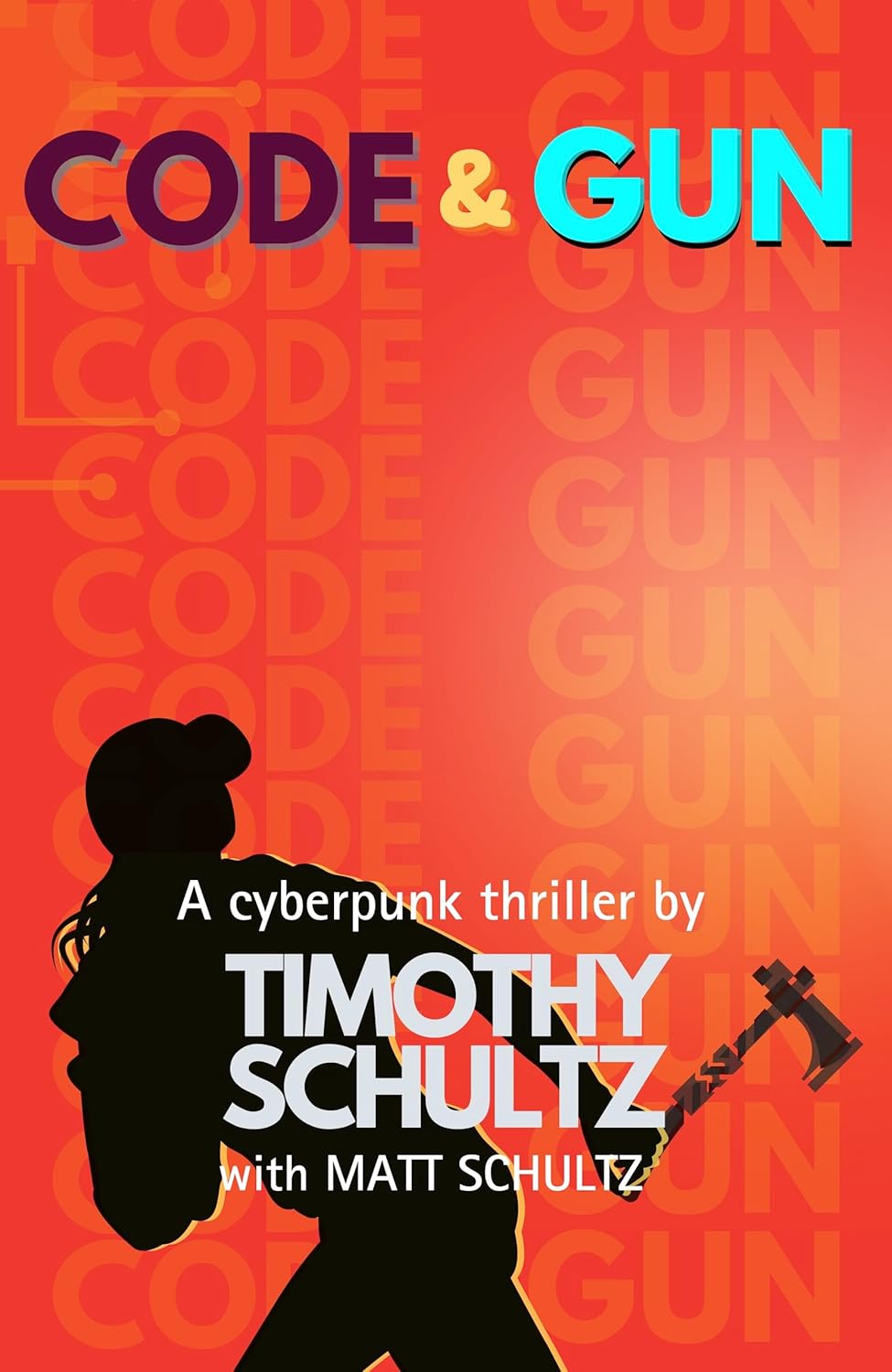

Code & Gun drops readers into a near-future America where everyone has an AI “Voice” in their ear, welfare cities have turned into cushy ghost towns, and three very different people stumble into the same storm. Kara Watanabe is an ER doctor who uncovers an illegal brain implant during a trauma surgery. MK is a burned-in special operations vet chasing Russian weapons deals and getting chewed up by high-tech firefights. Dominic is a disgraced ex–Voice engineer trying to raise his son inside a Lifetime Guaranteed Income complex while quietly digging into what the Voices are really doing. Their storylines braid together as the mystery behind that brain mod and the behavior of the global Voice systems comes into focus, and it all builds toward a long, brutal showdown at an isolated ranch that answers enough questions to be satisfying and still leaves the door wide open for the rest of the series.
I really liked the world this book lives in. It feels scarily close and also kind of mundane in the best way. The Voices are everywhere, like Marvin and Doc and Oriole and Pica, and they sound friendly and helpful and very normal, yet I never fully trusted them. The author does a neat thing where the AI assistants act like coworkers or buddies, so the creepy part sneaks up on you. The whole idea of “privlock” during surgery, or Dominic taping over his badge, hit me harder than some of the gunfights, because it nails how tangled our lives get with these systems and how hard it is to step away. The ghost towns and LGI economy also resonated with me. I expected a flat, grim welfare dystopia. Instead, I got older people exercising together, kids ripping around on scooters between towers, and this soft, almost cozy decay that makes the political choice behind it feel even more unnerving. The machine-learning section titles, like “Unsupervised Learning” and “Reinforcement Learning,” are a simple trick, but they line up nicely with what the characters go through. Everyone gets trained, one way or another, people and algorithms alike.
The writing is fun. The prose shifts voice as it hops heads. Kara’s chapters feel grounded and wry. Dominic’s sections have this anxious, coded inner monologue that shows how his brain never really turns off. MK’s scenes come at me in clipped phrases, sound effects, military slang, and sudden jokes in the middle of sheer panic. Those firefights with pods, drones, and that nightmare black dog hit like a video clip caught on a helmet cam. They are messy, confusing, and vivid, so when someone goes down I feel it. The book loves its acronyms and call-outs, and once in a while, the slang and tactical detail start to blur together. The emotional beats are there, though. Dominic with his son, Kara in that first big surgery alone after privlock, MK trying to stay human while doing inventory over bodies, all of that stuck with me more than the clever tech.
By the end, I felt attached to this little knot of people and weird AIs, even when the book pulled some pretty rough moves on them. The story has a conscience, but it never pauses for a lecture. It shows how easy it is to outsource judgment to software, to military systems, to “helpful” voices in your ear, and then it asks what that does to courage, friendship, and responsibility. It also has a sense of humor, even in very dark scenes, which kept the whole thing from turning into grim sludge. The climax runs long and leans into chaos. The book chooses momentum and a sharp pivot into the next phase of the war over Voices and human agency. That choice fits the title. The code never stops running, and the gun never really gets put away.
I would recommend Code & Gun to readers who enjoy near-future thrillers with a lot of action and a lot of heart, people who like the idea of The Expanse or classic cyberpunk but want something a bit more approachable and emotionally direct, and anyone who spends too much time thinking about where AI assistants and always-on devices might take us. If you want a snappy, high-energy ride with sharp characters, tense firefights, and a thoughtful take on our relationship with smart systems, this first book in The Voice Age series is an easy “yeah, go for it” from me.
Pages: 500 | ASIN : B0FXT3TB9X
Eerie Depths

In Assimilation, a lonely young woman’s life is forever altered after a disturbing lake encounter that forces her to confront the secrets of her parents, her own biology, and the terrifying presence haunting the waters. What inspired the eerie beauty of the Soshone Islands, and how did you balance calm with dread in the landscape?
Spending many summers fishing the sprawling waters of Canada, I have always been spellbound by the ancient allure and unspoiled beauty of that timeless land, history and mystery written into every boulder, bog, and tributary. It was inevitable that eventually a story would emerge from those clear, eerie depths, the way all those countless submerged boulders silently watched from below as my boat passed soundlessly above them. It was exhilarating to merge my memories and awe with the haunting narrative of Kercy’s plight.
The lake scene is both surreal and intensely physical. How did you approach crafting an encounter that feels simultaneously dreamlike and traumatic?
Boating on a vast body of water for me is both physical and surreal, and doubly so at night. I drew upon my personal experiences with this inscrutable medium. How it can hold up a craft weighing hundreds to thousands of pounds, while allowing a tiny pebble to penetrate its surface without hesitation. And while that same surface can appear calm, familiar, just beneath it is a boundless, unseen world teeming with life. How can one not be excited by that!
Kercy’s emotional landscape is so rich and painful. What part of her character came to you first when writing her?
Kercy’s horrid beginnings, her trials, her struggle to survive. She was born damaged, vulnerable, an outcast in a world she knew early on she was not designed for. It was her strength and determination that pushed the story forward, along with the resolve of her mother, who felt both responsible for Kercy’s ordeal and eternally grateful for her birth.
What guided your decisions about how far to lean into each element and genre, and were there versions of the story that were more (or less) “alien”?
The storyline and characters always guide my decisions. The characters, if I’m being totally faithful to them, define where the story will take me. The circumstances around Kercy’s birth, which has taken place before the story begins, have already set the course for what she must learn about her life. Then the only question becomes how; how does she unveil her past, how will her current situation be revealed? From that point, I open myself to discovering the story, allowing it to unfold naturally, with my fidelity to Kercy and the other characters always at the forefront.
Author Links: GoodReads | Facebook | Website | Books2Read | Amazon
Kercy Powell loves spending summers at their secluded island cottage in Ontario; a place where her birth defects and wheelchair are never on display. Just before her eighteenth birthday, Kercy is shocked to learn her mother sold their island paradise, offering only this grave warning, “Don’t ever go back there!”
The ensuing years bring Kercy a miraculous metamorphous, making her wheelchair unnecessary. Upon her mother’s death, she inherits the family fortune and buys back her most treasured getaway. Kercy is soon plagued by old nightmares; strange beings who visit in her sleep. One night, two men boat out to her cottage and try to assault her. She manages to escape, only to witness the unholy cries of her attackers being savagely killed.
The inexplicable murders trigger a visit from Special Agent Mallory, a cagey FBI officer who is only interested in how the two men died. But Kercy has no idea, until she comes face to face with her “protectors,” creatures who live beneath the deep, icy waters of Georgian Bay. And while they’ve rescued her before, Kercy can’t shake the notion that their intentions are nefarious.
[CONTENT ADVISORY: Intended for adult readership and contains scenes of violence, sexuality, aliens, and language that may be uncomfortable for some readers.]
[TRIGGER WARNING: Rape]
The Derge

The Derge is a sweeping sci-fi adventure set thousands of years in the future, where humanity has mastered interstellar travel and tamed emotion itself. The story follows Commander Titus and his deputies, Caeli and Rogat, on a high-stakes pursuit through space and time to capture a fugitive named Corso. Their chase leads them to a planet that mirrors ancient Earth, filled with strange societies and barbaric rituals like “The Derge.” Beneath its thrilling plot and futuristic technology, the novel wrestles with timeless questions about morality, control, and the meaning of progress.
Reading The Derge pulled me into a world that felt both distant and familiar. The writing style is vivid and cinematic, with crisp dialogue and detailed settings that make each scene easy to visualize. I loved how the story mixed classic space opera adventure with deep philosophical undertones. There were a few places where the pacing slowed a little as the story delved into background detail. Some of the futuristic terms and technical descriptions occasionally pulled me away from the emotional flow, but they also added depth to the world. The human elements, the tension between duty and empathy, the clash between freedom and control, kept me hooked. I found myself rooting for Titus even when I wasn’t sure if I trusted him completely.
Seeing a society that eradicated violence by regulating emotion made me question what we lose when we trade chaos for peace. The scenes on the alien planet, especially “The Derge” event, were chilling. It was brutal and absurd, yet disturbingly believable. Cezar’s depiction of humanity’s reflection in alien form hit hard. The contrast between the sterile perfection of Earth’s future and the raw savagery of Spaith stayed with me long after I closed the book.
I’d recommend The Derge to readers who love thoughtful science fiction with moral weight. Fans of Asimov, Bradbury, or Clarke would find its ideas fascinating, though Cezar’s storytelling leans more visceral and emotional. It’s perfect for anyone who wants more than a space chase, someone who wants to be made a little uncomfortable, to think, and to feel.
Pages: 191 | ASIN : B0F1M1FCZD
The Shadow of the Unwritten
The Chinese Room follows a computer scientist and her mentor as they face off with an AI system that appears to be developing the abilities for reason and desire. Where did the idea for this novel come from?
The idea for The Chinese Room came from my fascination with the intersection of philosophy, technology, and human vulnerability. I’ve always been drawn to thought experiments, especially John Searle’s famous “Chinese Room” argument, which questions whether a machine that convincingly processes language truly understands it – or if it’s only manipulating symbols without meaning. That paradox – appearance versus reality, intelligence versus understanding—felt like fertile ground for a story.
At the same time, I was processing very human themes in my own life: the fragility of memory, the weight of mentorship, and the way our creations can mirror our desires and fears. By blending the cold logic of AI with the messy, emotional struggles of human beings, I wanted to explore not just whether machines can “think,” but whether they can begin to want – and what that means for the rest of us.
So the novel really emerged at that crossroads: a philosophical puzzle stretched into a narrative of two scientists confronting not only an AI that seems to evolve beyond its programming, but also the shadows of their own pasts and the limits of human control. It’s both speculative and deeply personal, which is exactly where I like my stories to live.
I found the science in the novel to be well-developed. What kind of research did you do to make sure you got it all right?
I appreciate that—because the science had to feel authentic, even as the story pushes into speculative territory. For The Chinese Room, I immersed myself in several overlapping fields: artificial intelligence, neuroscience, linguistics, and philosophy of mind. I read deeply into current AI research papers, machine learning models, and ethical debates around consciousness and autonomy. I also revisited the classic philosophers—Searle, Turing, Dennett—so the narrative carried that lineage of thought experiments forward.
But the research wasn’t just academic. I spoke with computer scientists, combed through case studies of early AI breakthroughs, and even experimented with coding simple natural language systems myself. I wanted the characters’ dialogue about neural networks, symbolic reasoning, or emergent behavior to ring true without bogging readers down in jargon. My goal was for the science to be transparent scaffolding—solid enough that experts wouldn’t roll their eyes, but seamless enough that any reader could follow the ideas and focus on the drama.
At the heart of it, the science was a stage for the larger questions: not only what machines can do, but what it means for us when they begin to mirror desire, choice, and reason.
Were you able to achieve everything you wanted with the characters in the novel?
That’s a great question. The truth is, with any novel, the characters rarely end up exactly as you first imagine them—they take on their own momentum. In The Chinese Room, I wanted my two central figures – Katherine Ellis, a computer scientist, and her mentor, Dr. Malcom—to embody both the rational rigor of science and the emotional weight of being human in a world shifting under their feet. Their relationship, full of respect, tension, and unspoken grief, became a mirror for the very questions the AI raises about control, autonomy, and meaning. Katherine carries the urgency and vulnerability of someone still forging her path, while Malcom represents the hard-won wisdom – and regrets – that come with a lifetime of work. Together, they hold the spectrum of human response to change: wonder, fear, and the search for truth.
One of the most important additions was Katherine’s father, who is slipping away into dementia. That thread echoed my own personal experience with my father’s decline years ago, and it brought a deeper resonance to Katherine’s struggle. As she confronts an AI that seems to be developing reason and desire, she is simultaneously witnessing those same qualities fade in someone she loves. It grounded her character and gave the novel’s philosophical questions a human heartbeat.
That said, characters always leave behind traces of what could have been. I drafted whole backstories, subplots, and quirks that never made the final cut because they slowed the narrative. For example, I wrote more about Malcom’s early career and failures, and about Katherine’s personal struggles outside the lab. Cutting those details made the story sharper, but I sometimes wonder if readers would have appreciated that added texture.
So yes – I accomplished what I set out to in terms of giving them dimension and making them feel alive, but as with any creation, there’s always the shadow of the unwritten. Maybe that’s a good thing: it leaves space for readers’ imagination, and for me to return to those characters in unexpected ways later.
Can you give readers a glimpse inside Book 2 of The Paradox Series? When will it be available?
Book 2 of The Paradox Series takes the stage with The Trolley Problem. Where The Chinese Room wrestled with the boundaries of reason, desire, and machine understanding, this new novel shifts the lens to ethics, responsibility, and the unintended consequences of human choice.
At its center is Detective Marcus Reed, who finds himself trapped in a moral nightmare. A string of grisly incidents forces him to face impossible decisions reminiscent of the famous thought experiment: should he sacrifice one life to save many? As the investigation deepens, Reed realizes that the victims are not random – they are chosen to test human morality in a chilling, real-world manifestation of the Trolley Problem.
Manipulated by a shadowy figure known only as The Observer, Reed is pulled deeper into a conspiracy where ethics, control, and free will collide. The lines between right and wrong blur as his choices become increasingly impossible, forcing him to confront his own moral compass while racing to prevent the next catastrophe. With every decision, Reed inches closer to uncovering the Observer’s true motives – a revelation that could alter the very fabric of society.
The Trolley Problem explores ethical dilemmas, the limits of morality, and the manipulation of human decisions, all while unraveling a dark conspiracy that threatens to shatter Detective Reed’s understanding of justice and truth.
As for timing, my plan is to release The Trolley Problem by December 31, 2025—closing the year with a story that pushes readers to wrestle with the same impossible choices as its protagonist.
Author Links: GoodReads | X (Twitter) | Facebook | Website | Amazon
The Chinese Room is a gripping AI philosophical thriller that asks the ultimate question: Can machines think—or just pretend to?
First book in the Paradox Series – When a reclusive tech genius is found dead inside a sealed AI lab, a disillusioned journalist and a burned-out ethics professor are drawn into a high-stakes investigation. What they uncover isn’t just a machine capable of passing the Turing Test—it’s an intelligence that seems to know their secrets. As the line between simulation and consciousness begins to blur, they must confront a terrifying truth: the future of humanity might already be thinking without us.
Inspired by the legendary thought experiment by John Searle, this mind-bending novel blends psychological suspense, speculative science, and razor-sharp dialogue. Perfect for fans of Black Mirror, Michael Crichton, and Blake Crouch, The Chinese Room will leave readers questioning reality – and their own place in it.
– High-concept fiction meets real-world tech ethics
– Explores AI, identity, morality, and human consciousness
– An intellectual page-turner with twists you won’t see coming
If you love smart thrillers that make you think – buy The Chinese Room today.
Vital Historical Knowledge

Jigsaw: Shadow Ball follows a group of Temporal Guardians trying to preserve and repair the timeline from a ruthless organization set on altering history and erasing the racial integration of Major League Baseball. What was the inspiration for the setup of your story?
Excellent question. I love baseball, and I have always wanted to do a story on that. However, in the vein of my formerly titled History’s Forgotten series, I wanted to focus this book on Larry Doby, the second man to break the color barrier in baseball after Jackie Robinson. Most know the story about Robinson, but not as many know about Doby, and I wanted to delve into his importance in baseball and integration in American society in general.
When discussing the civil rights movement, most people automatically think of figures like Dr. King and other politically recognized activists; the involvement of athletes is not as well known, and I appreciate that you brought this aspect into the series. Was it important for you to deliver a moral to readers, or was it circumstantial to deliver an effective novel?
Yes. I want my stories to be both entertaining and educational where readers enjoy the tale but also take away vital historical knowledge, character education lessons, and moral parables.
I find that authors sometimes ask themselves questions and let their characters answer them. Do you think this is true for your characters?
Sometimes, especially with my two major protagonists, Francesca and Noah.
I hope the series continues in other books. If so, where, and when, will the story take readers next?
The next installment in the Jigsaw Series, titled Temporal Apocalypse will be released in the spring of 2026. It will center on the post-World War I era and take place in Jerome, Arizona, the Russian-Polish war front, and Fiume off the Adriatic Coast.
Author Links: GoodReads | Amazon
A rip in reality is spreading, and the fate of history hangs by a thread.
The ruthless organization Global Harmony has launched Project Shadow Ball, a devastating mission to erase the racial integration of Major League Baseball—rewriting the past to build their own twisted future.
Temporal Guardians Francesca and Noah are the only ones standing in their way. As they hurtle through time, they must protect baseball greats Rube Foster and Larry Doby, whose very existence is at risk.
With every pitch, every stolen base, and every moment altered, the fate of history—and the fight for truth—hangs in the balance.
Time is slipping away. The stakes have never been higher.
Can Francesca and Noah outwit their enemies before baseball’s greatest revolution is erased forever?
Or will history be rewritten in the shadows?
If they fail, history shatters. If they fall, the future is lost.


