Blog Archives
The Golden Ladder: How Inequality Built Civilization, Until We Made Climbing Illegal


In The Golden Ladder, Anthony Cornyn takes on one of the most contentious economic questions of our time: Is inequality necessarily bad for society? His answer is more nuanced than the usual political arguments suggest. Cornyn believes inequality has played an essential role in human progress, providing the concentrated wealth needed to finance everything from Renaissance masterpieces to modern technological breakthroughs. The real issue, he argues, is whether wealth creates opportunities for others or protects the privileges of those who already have it. This distinction between productive and extractive inequality forms the foundation of the book. Drawing on his seventeen years at the Federal Reserve and his experiences advising governments around the world, Cornyn approaches the subject with a combination of economic knowledge, historical perspective, and personal conviction. His central metaphor is especially effective: A healthy society has a ladder people can climb, while a struggling society allows those at the top to make the lower rungs increasingly difficult to reach.
Cornyn introduces readers to the Medici bankers who helped finance the Renaissance, the Dutch merchants who transformed financial markets, and industrial giants such as Andrew Carnegie, John D. Rockefeller, and Henry Ford. He also explores Singapore’s extraordinary economic development under Lee Kuan Yew and the influence of contemporary entrepreneurs such as Elon Musk. Along the way, he draws on the ideas of Adam Smith, Joseph Schumpeter, Henry Hazlitt, and Thomas Sowell to explain how markets, incentives, competition, and innovation shape prosperity. These historical accounts give the book considerable energy. Cornyn frequently opens chapters with vivid, dramatized scenes that make economic history feel immediate and personal. His prose is direct, sometimes provocative, and often entertaining. The recurring ladder metaphor also helps connect centuries of economic developments into a coherent argument about opportunity and advancement.
The book becomes particularly engaging when Cornyn turns his attention to the everyday consequences of economic policies. He examines housing restrictions, occupational licensing, healthcare regulations, government subsidies, and defense contracting to show how rules intended to serve the public can benefit established interests. His argument that excessive regulation and political influence can discourage competition deserves serious consideration, especially when he explains how seemingly reasonable decisions accumulate into expensive obstacles for ordinary people. Cornyn is particularly effective at illustrating the difference between creating new wealth and extracting money from an existing system. His confidence occasionally exceeds the evidence he presents, however. Some historical interpretations and economic comparisons are delivered with such certainty that readers may want additional context or supporting research. His treatment of government intervention also places considerable emphasis on its unintended costs. Still, his willingness to question familiar assumptions gives the book much of its appeal, and even readers who disagree with his conclusions will find worthwhile ideas to examine.
I recommend The Golden Ladder to readers interested in economics, history, entrepreneurship, public policy, and the relationship between wealth and opportunity. Business owners and aspiring entrepreneurs will especially appreciate Cornyn’s emphasis on innovation, competition, and the barriers facing people who want to build something of their own. Readers concerned about economic mobility and the growing influence of powerful institutions will also find plenty to think about. The book’s accessible storytelling makes it suitable for curious general readers, while its arguments offer enough substance to stimulate discussion among people already familiar with economic theory. I think what makes The Golden Ladder memorable is its insistence that the health of an economy should be judged by the opportunities available to people trying to improve their lives. Cornyn invites readers to reconsider what genuine economic progress looks like and whether today’s institutions still make that progress possible. It’s a timely, engaging, and thought-provoking contribution to an important conversation.
Pages: 260 | ASIN : B0HKCZJD8J

A Sustainable Life

Humanity in Trouble and Our Failure to Act is an unfiltered collection of essays that offer insights into the human condition, where humans have gone wrong, and potential solutions to alleviate human suffering on both individual and global scales. Why was this an important book for you to write?
Because as a species we have not improved our lot or reversed our negative impact on the environment and life on the planet. We have not lived up to our potential given our big brains and despite our “invention” of science and technology and subsequent understanding of how the Universe works.
What were some ideas that were important for you to share in this book?
Humanity’s lack of connection or respect for Nature resulting in our devastating effect on the environment.
Our lack of impulse control, egocentric nature, and failure to live up to the potential of our big brains.
Gradual but impending environmental devastation and high probability of species-level extinctions, including our own.
Perpetual emergence of dictatorial, warlike leaders throughout history, now armed with nuclear weapons.
What advice do you have for individuals who feel powerless in the face of the world’s current challenges and want to make a positive impact?
Start with working to improve all aspects of one’s own existence: live a sustainable life, support humanitarian and environmental action, vote for enlightened political candidates, practice charity, study the self, meditate, improve the education of children, and promote global peace.
What is one thing that you hope readers take away from Humanity in Trouble and Our Failure to Act?
You are not a “separate being” but rather a sentient member of the Universe interconnected with the web of all life, matter, and energy, and act accordingly by practicing gratitude, love, and compassion.
Author Links: GoodReads | X (Twitter) | Facebook | Amazon
This book is the result of overwhelming outrage and disappointment with our species, our failure to adequately address worldwide problems that threaten our very existence. We (if there is a ‘we’) should be embarrassed and ashamed. Nature has endowed us with near perfect bodies and amazing brains and for the most part we squander our evolutionary inheritance. And the greatest gift of all, consciousness, is under-developed in most of us. In this collection of essays, the author offers insights into the human condition, the reasons we have run afoul of the natural order, along solutions to alleviate human suffering on an individual and global scale plus some playful jabs at our human folly.
When Liberty Enslaves: The Toxic Blend of Faith and Politics
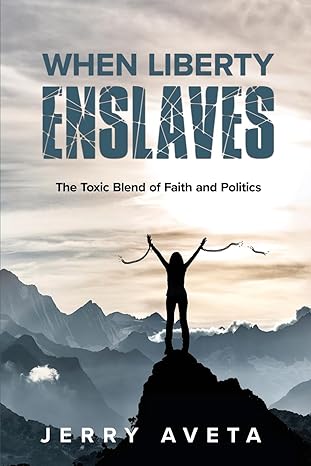
When Liberty Enslaves: The Toxic Blend of Faith and Politics by Jerry Aveta offers a detailed look at how the intersection of faith and politics has shaped the course of American history, particularly through the lens of liberty. The book draws comparisons between the pre-Civil War era and the present day, exploring how issues like faith, politics, and social justice continue to divide the nation. It examines themes like freedom, enslavement, and the consequences of intertwining religious beliefs with government decisions. Aveta ultimately reflects on the parallels between America’s past and its current political climate.
Aveta’s writing gets personal quickly, which makes the book feel relatable. The introduction about his disinterest in history early on hit home for me. I wasn’t expecting such a confession in a book that digs into heavy political and social themes. But it worked. The way he ties his personal disinterest in history to his eventual realization of its importance drew me in. There’s a clear shift when he discusses how today’s political climate echoes the tensions before the Civil War. That felt eerie and relevant, especially the parts comparing faith’s role in both eras. Aveta doesn’t just lecture; he reflects and invites you to think about it with him. One thing that kept me hooked was the comparison between old and current political issues. Aveta draws bold parallels between the pre-Civil War issues of slavery and today’s debates around gun rights and abortion. I didn’t expect the sections about the sanctity of life and how they pit people of the same faith against each other. That hit hard. The discussion on gun rights, especially how people interpret “liberty” differently in this context, made me stop and think. Aveta’s point about one person’s liberty potentially enslaving another was something I hadn’t considered before, and it made the book feel timely.
When Liberty Enslaves is a thought-provoking and timely read that encourages deep reflection on the role of faith in politics. Jerry Aveta’s personal approach, historical insight, and the way he connects the past to our present make the book both engaging and eye-opening. It’s a call to reconsider the impact of intertwining religion with governance, and it challenges readers to think critically about the state of liberty in America today. I’d highly recommend this book to anyone interested in politics, history, or religion.
Pages: 223 | ASIN : B0DCMG8MYK
Armageddon
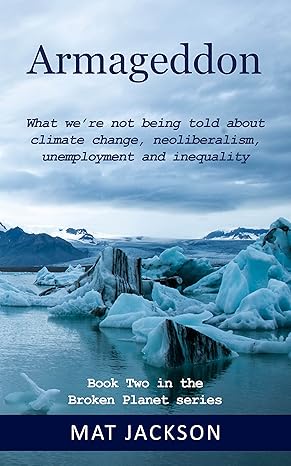
Mat Jackson’s Armageddon is a compelling exploration of global warming and international economic relations, structured in two distinct parts. The first section delves into the complexities of global warming, examining its causes, consequences, current mitigation efforts, and the challenges we face today. The second part shifts focus to the dynamics between developed and developing countries, scrutinizing how institutions like the World Bank and the IMF operate as instruments of Western economic power to influence and protect their interests globally.
Jackson’s analysis of IMF practices is particularly insightful, offering a balanced view of their benefits and drawbacks. He also explores how developing nations can leverage foreign policies and loans to foster economic growth and enhance their circumstances.
While the first half of the book addresses the crucial issue of global warming, it leans heavily on technical details, statistics, and scientific studies. I feel this data-centric approach, although informative, can somewhat overshadow the emotional connection necessary to engage readers on a human level. I believe incorporating more personal stories and emotional appeals might have made this discussion more impactful and accessible. Jackson’s thorough research and educational approach simplify complex subjects, making them accessible to readers with limited prior knowledge of international relations. His ability to present intricate information without overwhelming the reader is commendable. Each topic is clearly explained, with relevant references to historical and current events.
Armageddon is a thought-provoking and inspiring read, particularly for those interested in international relations and environmental issues. Mat Jackson’s work not only informs but also motivates readers to consider their role in making a difference in the world.
Pages: 206 | ASIN : B09H2Q4M52


