Blog Archives
Heroism

Only Breath & Shadow follows a blind and war-scarred English veteran living in Vienna as Austria slides toward Nazi control, who becomes the unlikely protector of endangered Jewish children. What was the inspiration for the setup of your story?
The inspiration for the story came about in part from Sir Nicholas Wynton. I remember him being on Esther Rantzen’s That’s Life in the late 1980s, and it was the first time I became aware of the Kindertransport programme. Sir Nicholas managed to bring 669 Jewish children from Czechoslovakia to England. As I researched the period, I found that nearly every country in the world had put strict limits on the number of foreign refugees that they allowed in. In England, the British government agreed to allow an unlimited number of child refugees to be given temporary refuge in Britain as long as there was no recourse to public funds. It was therefore left to Jewish groups, charities, and individuals to help Jewish children escape the persecution of the Nazis. However, while the children were permitted into the country, their parents were not. I therefore wanted to write about the heroism of the people who went to Germany, Austria, and Czechoslovakia to save countless children.
Christian begins as a man defined by loss. What did his journey toward purpose mean to you?
Christian’s early life was defined by his ability to paint, and his blindness stripped away what he perceived as his purpose in life. When Christian takes care of four Jewish children, he is given a new purpose. What it meant to me was that there is hope in people, not in society or in systems of religion, but in you and me and the kind acts of a stranger.
The novel suggests indifference is more dangerous than blindness. What does “seeing clearly” mean in a world where truth is actively denied?
I think that seeing clearly begins with asking whether what we are being told makes sense and whether it contradicts our moral compass. I believe that we are living in a difficult period of history, where disinformation and misinformation are now commonplace, and this concerns me. It is of note that the use of disinformation and misinformation was something that the Nazis were masters of.
I hope the series continues in other books. If so, where will the story take readers?
Thank you. I’ve had some ideas for books and even started writing some ideas and outlines. One idea. which I started 6 months ago, centred around the overthrow of the Iranian Government in 1953, with Basil Drewe’s son being trapped in Iran. Another idea was about the philosopher Jiddu Krishnamurti, who appeared in my first two books, Of All Faiths & None and A Remembrance of Death, and his alleged affair with Rosalind. However, at the moment I am taking a break from writing.
Author Links: GoodReads | X (Twitter) | Facebook | Website | Amazon
Christian Drewe a man blinded at the Somme sees the moral decay that Nazism brings to Vienna more clearly than the sighted world around him.
At the start of the novel Christian Drewe is a man without purpose, believing that his blindness defines him. But when the Nazis march into Austria, everything changes. When his Jewish friends are arrested and sent to the camps, their four children are left behind with no one to protect them.
Christian is their only hope.
In a city crawling with informants and watched by the Gestapo, he must do the impossible: hide the children, outwit a ruthless Nazi officer, and plan an escape from a world closing in around them, all without sight.
As danger tightens and time runs out, Christian is forced to confront a question he can no longer avoid:
How much can one man risk to save innocent lives?
Only Breath & Shadow is a powerful and deeply human story of courage in the face of unimaginable darkness.
Perfect for readers of All the Light We Cannot See, The Tattooist of Auschwitz and The Nightingale, this unforgettable novel explores sacrifice, love, and the strength to act when it matters most.
The Boy From Vines


The Boy From Vines is a historical fiction novel with a strong mystery thread and a light current of romance running underneath it. It begins with Ruth, a historian traveling in France, finding an old journal in an antique shop in Paris. The journal belonged to Joseph Durand, a young man in Nazi-occupied France whose entries move from ordinary vineyard life into fear, hiding Jewish families, loss, and dangerous acts of rescue. What follows is part wartime story and part present-day search, as Ruth traces Joseph’s path through Rouen and Normandy, uncovering family records, graves, photographs, and living descendants until the past stops feeling distant and starts pressing directly against the present.
I enjoyed the book’s sense of intimacy. Author Nicholas Teeguarden writes in a way that keeps readers close to the page. The journal entries give Joseph a quiet, steady voice at first, and then the pressure builds until even the simplest details start to feel loaded. I liked that choice. It lets the horror arrive by degrees instead of turning every scene into a performance. Ruth’s sections can be earnest, even openly emotional, but for me, that mostly worked because the novel is clearly invested in memory, witness, and what it means to treat history as human before treating it as argument. At its best, the prose has a patient, lamp-lit quality. It feels less like being told a story and more like sitting with someone who found something important and cannot quite get over it.
This is not just a World War II novel about danger and bravery. It’s also a book about archives, inheritance, and the uneasy line between evidence and belief. Ruth is not simply uncovering facts. She is constantly asking what kind of truth can be responsibly claimed from fragments, journals, graves, parish records, and family stories. I found that genuinely interesting. It gives the novel a professional edge that sets it apart from more straightforward historical dramas. The book does lean into coincidence and emotional symmetry in a way that some readers will embrace. I didn’t mind it much, because the story knows exactly what it cares about. It cares about names. It cares about remembrance. It cares about the moral weight of not letting people vanish twice, first in history and then in memory. That lands.
I came away feeling that The Boy From Vines will mean the most to readers who enjoy historical fiction that is reflective rather than flashy, especially if they like wartime stories told through personal documents, family memory, and the slow assembly of truth. I would recommend it most to people who enjoy novels where history, mystery, and emotion are braided together, and to readers who do not mind a story that pauses to think about what the past asks of the living. It is thoughtful, sincere, and easy to stay with. For me, that was the book’s real strength.
Pages: 317 | ASIN : B0GNKT6WKK

Operation South Pacific: The War Epic That Became a Rodgers and Hammerstein Sensation

Stephen J. May’s Operation South Pacific is a hybrid war-and-theater chronicle that follows James “Jim” Michener from a troopship ride into the Pacific “volcano” to the improbable afterlife of his wartime stories on Broadway. The novel opens with Michener arriving in the South Pacific on the Cape Victory, sick with dread and noticing how quickly men oscillate between childish ritual and mortal fear, then tracks his assignment under Captain Bill Stevenson, flying, inspecting, mediating, and gathering the human material that will later harden into Tales of the South Pacific. From there, the book pivots to the postwar scene: producers, contracts, rehearsals, and the long negotiation that turns Michener’s episodic war stories into Rodgers and Hammerstein’s South Pacific, including the decision to confront racism in the love stories rather than sand it down for comfort.
My strongest reaction, early on, was relief at the book’s refusal to glamorize war while still admitting its strange, intermittent beauty. May gives the Pacific the texture of a place you can almost smell, mangroves, monsoon mud, cheap coffee, and he lets Michener’s mind run in two directions at once: toward the military map and toward the sentence. A small mission, like checking on a silent Coastwatcher, becomes a neat capsule of the whole enterprise: danger, absurdity, dependence on local knowledge, and the thin thread of competence that keeps people alive. I also liked how the book keeps returning to “support” characters, engineers, medics, sailors, even the men who show up half-broken to watch a scrappy island-stage production, so the war doesn’t shrink into a single heroic silhouette.
In the second half, my enjoyment came from the whiplash: watching art get manufactured out of pain without becoming purely cynical about it. The Broadway chapters have a brisk, backstage electricity, auditions, money talk, egos, and the mild menace of deadlines, yet May keeps the moral stakes visible. When Rodgers and Hammerstein talk through the racial prejudice braided into Nellie/Emile and Cable/Liat, you can feel the gamble: not just “Will this sell?” but “Will this land without lying?” And there’s a sly satisfaction in seeing the machinery of mythmaking laid bare, how “Bali Ha’i” can be both a painted illusion and a serious attempt at truth, depending on who’s looking.
I think this will be perfect for readers who like historical fiction, war epic, biographical novel, Broadway history, and literary backstage drama, especially if you are curious about how lived experience gets alchemized into cultural legend. If you enjoy the big-sweep, place-soaked storytelling of James Michener (or the show-business saga feel of something like The Seven Husbands of Evelyn Hugo, but traded into mid-century theater), this will scratch the same itch while keeping its boots muddy.
Pages: 274 | ASIN : B0G4B365JT
Forgotten History

On the Wings of Flying Tigers follows a Florida farm boy turned pilot who goes from rural poverty into the morally uncertain skies of prewar China, where choosing to act may matter more than choosing sides. What was the inspiration for the setup of your story?
The almost forgotten history of the Flying Tigers, how they began our unofficial entry into the Second World War.
I used my recollections of a place where I had lived for several years, Palatka, Florida, to make the story more lifelike. As writing instructors say, “Write about what you know.” This farm town launched my story.
What boy doesn’t marvel at his first sighting of a prop plane sputtering overhead? I, too, held that fascination, but unlike my main character, I did not pursue that curiosity into a lifetime career. I chose instead the study of microbes that led to my becoming a pathologist. It’s a story about early impressions and where they might lead us.
One of the book’s strongest tensions is moral rather than military. Why did you want to focus on prewar ambiguity instead of clear-cut conflict?
Life is a constant struggle between what is right and what is easy. People are constantly torn between which fork in the road to take. Often lost in the noise of battle is the tenderheartedness of those in the trenches. I chose to focus on this aspect and not create just another story filled with bombs dropping and active trench warfare.
The book lingers on mechanical, physical details—oil-stained hands, training rituals, engineering problem-solving. Why were those moments important to you?
I felt it was important to transmit the experience of working on these machines, the training involved in getting the skills to put together these marvelous machines, and the constant technical attention to maintaining them to be airborne ready quickly to save lives. The mechanics who work on these fighter planes are unsung heroes.
What do you hope readers take away about conviction, courage, and responsibility?
I hope my readers take away the understanding that courage and conviction in doing what’s morally right isn’t always easy. One must live with the consequences of one’s choices, which may not be those that were truly right for us at the time.
Author Links: GoodReads | Amazon
But dreams come at a cost. Determined to serve and soar, Albert joins the military, enduring grueling hardship and sacrifice as he rises through the ranks. His journey eventually takes him halfway around the world, where he becomes part of the legendary Flying Tigers—an American volunteer group fighting under the Chinese Army’s banner during World War II.
In the cockpit, Albert finds the freedom he’s always sought. Yet every mission tests not only his courage but his very sense of self, reminding him that true freedom often demands the highest price.
Everyone Deserves a Home

Baer Charlton’s historical fiction novel, Everyone Deserves a Home, traces the intertwined lives of Walter Humphrey, Leatha, Betsy Turner, and eventually Hannah Mariah Rose Humphrey. It begins in the American South of the mid-1800s, moves through New Orleans, crosses the ocean to England, and follows a family shaped by secrets of race, identity, and survival. From the first chapters, the story lays out a complicated inheritance: hidden parentage, passing as white, the legacy of enslavement, and the formation of a chosen family built not by blood but by loyalty. Even early on, you see how Hannah’s future as a surgeon grows out of this unconventional household where medicine, language, theater, and resilience are all part of daily life.
The writing moves with an intimate, memoir-like rhythm, especially in the prologue, where adult children recount their mother’s hidden Black heritage and how she “became white” at five years old. That moment alone sets the tone. It’s direct, a little painful, and strangely gentle. Scenes stretch out with detail you can almost smell or touch. Then, suddenly, a sentence snaps short and lands like a stone in the gut. I liked that mix. It mirrors the characters themselves. Walter’s voice, in particular, blends clinical precision with emotional restraint. Meanwhile, Leatha’s chapters feel grounded and visceral, as if she’s speaking while chopping vegetables or tying on an apron. And Betsy’s early chapters shimmer with that mix of bravado and fragility found in a teenager who has survived too much too young.
What surprised me most was how the novel lets relationships carry the ideas. Topics like passing, racial identity, gender, sexuality, and bodily autonomy are present, but they arrive wrapped inside the everyday details of meals, births, surgeries, and whispered conversations over kitchen tables. The story never lectures. It just unfolds. Sometimes I found myself pausing, not because something dramatic had happened, but because a small detail shifted my understanding of a character. A hand on a shoulder. A joke in sign language. A quiet refusal to leave someone behind. These moments gave the book a warm undercurrent even when the history it leans on is harsh. And although the novel spans continents and decades, its emotional center always comes back to the home this unconventional family creates together.
By the end, I felt like the title wasn’t just a claim but a philosophy that the book keeps proving. The story champions people who carve out belonging in a world determined to deny it to them. It’s historical fiction, yes, but it reads with the intimacy of family lore and the clarity of someone finally ready to tell the whole truth. I would recommend Everyone Deserves a Home to readers who enjoy character-driven historical fiction, stories about identity and chosen family, and novels that blend emotional honesty with rich, lived-in detail.
Pages: 263 | ASIN : B0FL13PG6X
A Personal Journey

In the Face of the Foe is a collection of three tales following British prisoners of war struggling with choices that could either end their lives or set them free. What was the idea, or spark, that first set off the need to write this book?
My grandfather endured the majority of the Second World War as a prisoner of war. As a child, my limited memories of him are of a quiet, withdrawn man, who spent a large part of the day either in bed smoking his hand-rolled cigarettes or absent down the local pub. Now an adult and novelist, with a better understanding of the past and the suffering that forged the man I knew, I wanted to ‘talk’ about the world he was unable to: celebrate his and all his fellow POWs’ bravery and endurance. Through no fault of their own, they found themselves confined and forgotten as the world focused on the combatants and battles, while those lucky enough to return home after the war received no hero’s welcome, carrying guilt and their trauma for the remainder of their lives. So, I wanted to write a series of character-driven adventures, which never shun the darker side of prisoner of war life, but afford the protagonists their moment in the sun, replacing the unrelenting boredom of confinement with a heroic burst: a fact-based framework, supporting some fantastical adventures. This was not about claiming some unwritten truth but manoeuvring through the bustling crowd of heroic men and women from this golden generation and ensuring the POWs are noticed amongst them too.
How much research did you undertake for this book, and how much time did it take to put it all together?
Like all my novels, there is a long gestation period as ideas form, and I develop my knowledge, laying the foundation upon which I build my characters and narrative. Understanding my grandfather’s military service was a personal journey, not driven by a desire to borrow for my writing, but it certainly inspired me. Within the UK, family members can request the service records of those in the military in WW2. The documents are all penned in a matter-of-fact manner, with entries like ‘missing in action 25 May 1940’ or ‘war crime witness’. It stirs more questions than answers and encourages the author to populate the holes. Fortunately, we also have excellent regimental museums, holding the official records of the actions of their battalions. I was most grateful to receive from one of the select paragraphs which told the sorry tale of my grandfather’s battalion and its short-lived role in the first year of the war. Combining this personal research with the benefit of wonderfully researched non-fiction books and memoirs of survivors gave me a hint at the world to implant my hero within. As an author of adventure tales, I occasionally utilized my artistic license to bend the historic facts, adjusting the scenery for the action, but keeping it within an accurate historic stage remained important, and this would have been impossible without the contribution of other sources.
What were some themes that were important for you to explore in this book?
War is abhorrent and not worthy of celebration. However, the individuals dragged into war always have a worthwhile story to tell. The human spirit is tested to the extreme: there is the worst of humanity and the best, and it’s often the case that one side or one individual carries elements of both. In these tales, choice has a small role; it is necessity with survival at stake that shapes the lives of the prisoners. How they react, pull together, break down, recover, ride their luck, or make it through tells us about their core character, the weaknesses, and strengths. The final story in the collection is very important because, although told after the war, it explores how the experience of war and imprisonment has shaped and scarred Jock. His fight to survive the war did not end in 1945, and on release from the stalags, it followed him and directed him until his death in 1984. I question the legitimacy of the old adage, what doesn’t kill you makes you stronger, but there is something admirable about finding the strength to survive what killed so many others.
What is the next book you are working on, and when will it be available?
From the past, I will return to the future and work to finish the third and final book in my Liberty series, a dystopian adventure that explores the meaning of freedom in a broken world. Previously, the novels looked at how fear and ignorance impinge on our liberty (Liberty Bound) and how lies and illusions can be confused for freedom (Where Liberty Lies). In this final work, I want to explore the fragility and endurance of liberty, delivering my protagonists into another maelstrom of danger and suspense. It could take a while to finish it, so I may also take a small diversion to write a children’s novel. Too many children’s books unsubtly preach today, and I have in mind an old-fashioned treasure hunt adventure, where the children succeed because they do what children do: make mistakes, cause mischief, but grow through friendship, role models, and experience.
Author Links: GoodReads | Facebook | Website | Amazon
After surrendering to the all-conquering Wehrmacht in France in May 1940, Jock faces five years of captivity in distant Poland under the brutal Nazis, and a lifetime of trauma and torment from his memories. Disarmed and forgotten, starved and mistreated, Jock and his friends have their own battles to fight; none greater than surviving the war and then rebuilding their lives.
Triumphant Where It Dares Defy (1941) – For those in the British army captured holding back the advancing Germans, allowing their comrades at Dunkirk to evacuate, things look grim. The Nazis have stolen their freedom and dignity, but after a year in captivity, it’s time to steal something back. Against his better judgement, Jock Mitchell finds himself at the centre of a brazen plan to give Hitler a bloody nose. To succeed, he needs to break out of the prison camp… and back in.
A Place More Dark (1945) – After five years of hell, it’s about to get worse for the prisoners of Stalag XXA. Pawns in a deadly World War endgame, victory for the starved inmates is surviving their brutal Nazi overseers and an unforgiving winter’s march across Europe. Weak and a shadow of the man he once was, Jock still finds the strength to rescue the most unexpected of companions from the dangers of war-torn Europe. (Literary Titan Gold Book Award winner, Finalist in the Independent Authors Network Book of the Year Award 2025)
For All the Treasures Buried Far (1948) – (exclusive to this edition) – Germany has surrendered, but for the survivors from Stalag XXA, their war never ends. Still a prisoner of the ghosts and demons from his time as a captive under the Nazis, Jock returns to Poland, where death offers a drastic means of escape from his internal torment. But a greater, more appealing prize awaits if he can survive one last adventure in a new type of war against an old ally turned enemy, the Soviet Union.
In the Face of the Foe

In the Face of the Foe brings together three wartime tales that follow British prisoners of war and the strange mix of fear, grit, and shaky hope that shapes their survival. The story opens inside Stalag XXA, where boredom and danger sit side by side. Men spar, argue, dream, and stumble into choices that could kill them or free them, sometimes on the same night. The early chapters move from camp politics to tense missions beyond the wire, and the book keeps piling on moral knots that force each character to decide what they are willing to risk and who they want to be.
As I moved through the book, I felt myself leaning in, drawn by the rough humor and the raw strain between the men. The writing feels direct and sharp. It never hides the ugliness of fear. It also never forgets that soldiers can be petty and foolish and brave all at once. I liked how the author gives room for small moments that say more than the big ones. A quiet exchange over stolen cherries, the sting of a bad joke, the uneasy pause when a guard appears in the dark. These details felt honest, and they gave me a sense of standing right there in the mud with them. The dialogue sometimes slips into playful banter, and I found that mix of light and dark strangely comforting. It felt real in a way that polished war stories often miss.
The book kept raising questions without preaching. What does loyalty look like when every man is starving? What does courage mean when the cost falls on someone else? Some choices hit hard. One scene with a child had me holding my breath because the moment felt too close to the edge. The tension built slowly, then snapped tight. The writing does not tidy up the mess afterward, and I appreciated that honesty.
It is a story for readers who enjoy wartime fiction that focuses more on people than battlefields. Anyone who likes character-driven plots, moral puzzles, and a close look at the fragile ties that hold people together will find a lot here. I would recommend it to readers who want grit without glamor and heart without sentiment.
Pages: 508 | ASIN : B0G1K6GG7F
Like Embers in the Night
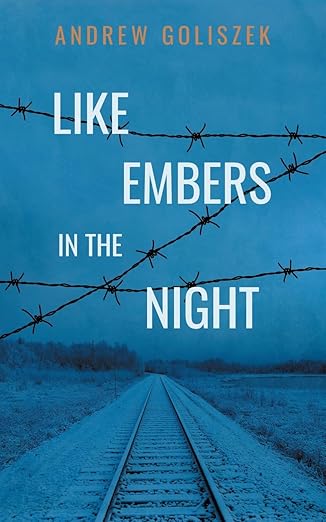
Andrew Goliszek’s Like Embers in the Night delivers a moving exploration of human endurance, inspired by real-life events during the Second World War and the grim realities of Soviet labor camps. At its core, the novel tells Wanda’s extraordinary story, a tale of survival, family, and love blossoming against the backdrop of unimaginable chaos. Goliszek juxtaposes human suffering with defiant acts of resistance, crafting a work of historical fiction novel that serves as a powerful testament to the indomitable will to persevere.
Through vivid and unflinching prose, Goliszek captures Poland’s anguish, caught between the brutalities of Soviet oppression and Nazi atrocities. The dehumanization faced by those imprisoned in labor camps and the relentless physical and emotional toll inflicted upon them leave a searing impression. Wanda’s resilience as a survivor of not just one but two merciless regimes resonated deeply with me.
The novel’s portrayal of war is unrelentingly raw, exposing the grim realities of trauma and suffering. Goliszek’s ability to immerse readers through evocative imagery and skillful storytelling is exceptional. Each scene pulses with intensity, making it nearly impossible not to feel the characters’ pain and perseverance. Particularly striking is the depiction of Wanda’s post-traumatic stress. Goliszek captures the subtle, heart-rending triggers, such as the delicate breath of a child, that unearth buried memories of Wanda’s darkest moments. These details lend an authenticity that lingers long after the final page.
At the emotional heart of the story is Wanda and Janek’s love, a relationship forged through shared hardship and sustained by hope. Their bond shines as a beacon in the pervasive darkness, offering glimpses of light amid the despair. The narrative structure, which alternates between Wanda’s present-day struggles with dementia in 2004 and flashbacks to her harrowing past, amplifies the emotional depth of her journey. Her unwavering love for her family becomes her anchor, sustaining her through unimaginable suffering.
Like Embers in the Night is an unmissable read for fans of historical fiction or those drawn to stories of resilience, love, and the triumph of the human spirit. Goliszek’s story not only immerses readers in the brutality of history but also leaves them with an appreciation for the strength and courage that emerges in the face of adversity.
Pages: 342 | ISBN : 978-1509259298


