Blog Archives
Not As Crimes, But As A Masterpiece

A Twisted Crucible follows a murderous woman who steals her dead best friend’s identity and fortune, only to discover during a cross-country crime spree that no disguise can save her from. What were some sources that informed this novel’s development?
During the 1990s, an acquaintance used my phone. I was unaware he was using it to conduct a drug deal. Since it was my phone, I was arrested and convicted. While serving time in prison, I encountered several notorious female killers. They agreed to speak with me about their crimes to gather realistic details for a book character.
What interested you about writing a killer who sees herself not simply as violent, but as an artist and protagonist in her own grand narrative?
Traditionally, killers in fiction are viewed as anomalies or disruptions to the social order. By making Julie Cromwell the “protagonist in her own grand narrative,” she takes complete ownership of her story, viewing her actions not as crimes, but as a masterpiece of art.
How did you approach balancing Julie’s genuine desire for companionship with her manipulation and grooming of Jamie?
Balancing Julie’s genuine desire for connection with her manipulative grooming of Jamie requires leaning into the contradiction at the heart of toxic relationships. A delicate line has to be walked showing that while Julie’s longing for companionship is real, it is simultaneously entirely self-serving. She genuinely wants someone close, yet she views that person as an extension of herself, rather than an independent individual with their own boundaries.
Why was it important for the novel’s final reckoning to center on family and identity rather than simply on Julie’s crimes?
Centering the final reckoning on family and identity rather than just Julie’s crimes shifts the story from a standard thriller to a deeper psychological study. Readers remember how characters change and heal far more than they remember the mechanics of a crime or a court case. Bringing it back to family and self-discovery gives the emotional closure that true psychological drama demands.
Author Links: Goodreads | Facebook | Website
Some secrets refuse to be buried. Some desires refuse to be denied. Haunted by her shadowed past and desperate for peace, Julie Cromwell accelerates full-throttle on a cross-country escape to the sanctuary of Trenton, New Jersey—her childhood home. But this journey isn’t one of solace. Instead, it’s a roadmap of derangement and bone-chilling encounters, punctuated by unforeseen alliances and an unsparing litany of killings.
A Twisted Crucible delves into the abyss of human depravity and the agonizing sacrifices made by a loving father when justice demands the ultimate price.
A Twisted Crucible: The Riddle of the Ruined Soul


A Twisted Crucible by Diana Louise Webb is a psychological crime thriller that mixes serial-killer fiction, road novel, dark comedy, and surreal horror into one deliberately feverish story. At its center is Julie Monroe Cromwell, a woman who’s stolen the identity of her dead best friend, Candice Wentworth, along with more than $1.5 million, and whose sense of reality is coming apart almost as quickly as her moral restraints. The book announces its personality immediately. Julie arrives at an airport under Candice’s name, carrying cash, jewelry, and guns while still under the influence of Ayahuasca, then turns a luggage mishap into another grotesque crime. From there, the story travels through funeral homes, motels, roadside attractions, cult hideouts, haunted spaces, and stretches of 1980s America that become increasingly warped by Julie’s imagination. It reads like a crime spree filtered through a funhouse mirror, with every stop giving Webb another opportunity to explore obsession, guilt, spectacle, and the strange logic Julie uses to keep herself moving.
Julie is the novel’s real engine, and her narration is fascinating because she’s funny, articulate, vain, cruel, frightened, and spectacularly unreliable, sometimes within the same paragraph. She doesn’t merely commit violence. She turns it into mythology about herself, treating murders as compositions and ordinary inconveniences as evidence that the universe has personally chosen her for some larger drama. That tendency becomes especially disturbing in her relationship with Jamie Owens, the daughter of the taxi driver Julie kills early in the story. Julie plays protector and companion while privately recognizing that she’s manipulating and isolating Jamie, even admitting to herself that she’s grooming her for something darker. Their cross-country relationship gives the book more emotional weight than the carnage alone could provide. Julie wants connection almost as desperately as she wants control, and the black stiletto she carries from Candice becomes a wonderfully macabre symbol of that contradiction: friendship, envy, identity, possession, and guilt all compressed into one object.
The closest comparison that came to mind was Bret Easton Ellis’s American Psycho. Both novels put readers inside the consciousness of a killer who interprets the world through status, objects, popular culture, appearance, and an unnervingly elaborate private mythology. Webb takes that basic kind of intimacy with a murderer and sends it in a much more hallucinatory direction. Julie converses with dead killers, encounters ghosts and apparent supernatural phenomena, rewrites memories while she’s remembering them, and fills the journey with references to music, movies, literature, food, fashion, crime, and 1980s Americana. Reality keeps changing texture around her. That makes A Twisted Crucible feel at times like a splatter film, a gothic ghost story, and an absurdist road movie playing simultaneously. The prose matches Julie’s mind: maximalist, excitable, sarcastic, image-heavy, and constantly looking for the next association. Even Jamie eventually recognizes Julie’s murders as a kind of “performance art,” which gets remarkably close to Julie’s own conception of herself.
I really liked the way all that flamboyant violence eventually circles back to something painfully personal. Julie spends much of the novel turning death into entertainment because spectacle lets her avoid looking directly at herself. By the final chapters, the disguises have collapsed. Jamie is dead after the catastrophic Winnebago crash, investigators have connected Julie to Candice and the other killings, and her father is forced to confront what his daughter has become. The return of Candice’s stiletto beside Julie’s hospital bed is especially effective because the object that helped Julie pretend to be someone else finally becomes the physical reminder of who she actually is. The closing confrontation between father and daughter gives the novel a surprisingly intimate finish after so much extravagant chaos. A Twisted Crucible is wild, grisly, mordantly funny, psychologically messy, and intensely committed to its narrator’s fractured point of view. Webb has built a story about a woman trying to steal another person’s identity only to discover that she can’t outrun the ruined self underneath it.
Pages: 236 | ASIN: B0H7T1QGZP

Betrayal of a Sudden Death

Last of the Autumn Rain follows a woman who witnesses the death of her best friend in a tragic nightclub accident, causing her to spiral into a psychological journey that touches on abuse, betrayal, obsession, and revenge. What was the inspiration for the setup of your story?
My best friend committed suicide, and my ex-boyfriend tried to murder me. I wanted to take those external events to explore the raw aftermath of sudden trauma.
What are some things that you find interesting about the human condition that you think make for great psychological fiction?
The fact that humans are often their own worst enemies and have a skewed perception of reality is a goldmine for psychological fiction. A character’s memories can be distorted by trauma, guilt, or self-deception, which creates suspense and forces the reader to question everything they’re being told.
What were some themes that were important for you to explore in this book?
(1) Betrayal: It’s not just the betrayal of a sudden death, but the suspicion of deeper betrayals that drive the plot. (2) The Unreliable Self: The protagonist isn’t just an unreliable narrator for the audience; she’s unreliable to herself. Her memories are suspect, her perceptions are skewed by trauma, and she struggles to differentiate between paranoia and genuine threats, and a search for justice. (3) Search for Justice: Can earthly justice truly be served when the motive is fueled by obsession and a distorted sense of reality?
Will there be a follow-up novel to this story? If so, what aspects of the story will the next book cover?
Last of the Autumn Rain: The Storm Within is Book 1 of a trilogy called the Broken Reflections Series. Book 2 of the series is titled A Twisted Crucible: The Riddle of the Ruined Soul, and Book 3 is titled Game of Souls: The Reckoning. A Twisted Crucible is a chilling tale of what turns out to be a serial killer’s descent into darkness and a father’s agonizing choice. Game of Souls is a poignant exploration of grief, guilt, and the human capacity for redemption through the eyes of a father. It probes the depths of the human psyche, examining the power of ancient rituals and the transformative potential of psychedelic experiences to seek healing and enlightenment.
Author Links: GoodReads | Facebook | Diane Webb | Diane Louise Webb | Amazon
Her life ignobly snuffed out at the young age of 32, Candice exemplified a fun-loving lifestyle and a warm kindred spirit—possessing all the requisite traits for a promising future. She never entertained a trace of ill will toward anyone. How could something so grisly happen to such a compassionate, enchanting human being?
Julie struggles to make sense of it all, reminiscing as she travels back to her hometown of Trenton, New Jersey. The two had met in Milwaukee and worked as underwriters for The Walden Company. But something went horribly wrong. Julie’s journey is one filled with elation and fear, jealousy and regret, happiness and indignation, and a horrifying act of disloyalty.
An unforgettable, tumultuous ride, Last of the Autumn Rain delivers an introspective and jaw-clenching tale, which not only rocks one’s moral compass, but invites a chilling question: in a world where the ground can literally fall out from under you, what else might be lurking beneath the surface?
Last of the Autumn Rain
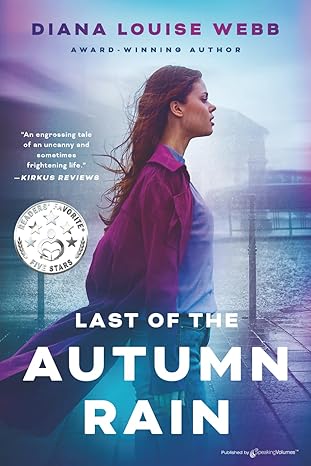
Diana Louise Webb’s Last of the Autumn Rain is an emotionally charged novel that weaves together trauma, tragedy, and mental health through the voice of a haunted narrator named Julie. The story opens with a deadly accident at a nightclub that kills Julie’s best friend and spirals into a psychological journey touching on abuse, betrayal, obsession, and revenge. As Julie revisits past experiences from her childhood in New Jersey to a near-fatal spring break trip to Mexico, she reflects on the forces that shape identity, morality, and the thin line between sanity and madness. With fictionalized events that feel brutally real, Webb holds nothing back in her mission to spotlight the stigma and neglect surrounding mental health.
The writing is sharp, vivid, and unsparing. Webb’s prose can be poetic in one moment and violently raw in the next. Her scenes of abuse and trauma are gut-wrenching without being gratuitous. I often found myself re-reading lines, not just for their emotional weight but because they caught me off guard in how directly they confronted the reader. There’s a beautiful messiness in the storytelling. Fractured timelines, flashbacks, inner monologues, and haunting hallucinations that all blend into Julie’s spiraling mental state. At times, the chaos felt overwhelming, but it always felt deliberate. It’s like the author doesn’t want you to read this passively, she wants you to feel every drop of blood, guilt, and silence.
I found myself torn over the narrator. Julie is not a reliable or particularly likable character. She is violent, self-serving, and damaged. But that’s kind of the point. I couldn’t shake the feeling that Webb was daring me to judge her. One moment, Julie is saving someone from abuse; the next, she’s casually describing a childhood act of horror with a twisted sense of pride. I didn’t always agree with the choices she made. The novel sometimes seemed to blur the line between victim and perpetrator, and I admired Webb’s courage in forcing us to sit with those contradictions. It’s rare to see a female protagonist written with this much moral ambiguity and rage. And it’s even rarer for a book to make me feel that conflicted and still want to keep reading.
Last of the Autumn Rain is not a light or easy read. It’s intense, messy, and emotionally exhausting, but in the best way. This book is for readers who crave raw truth over tidy resolution. It’s for those who have battled demons or known someone who has. I would especially recommend it to fans of Gillian Flynn or Alice Sebold, readers who don’t mind going into the darker corners of the human mind. Webb has something important to say about pain, silence, and survival, and she says it with brutal, unforgettable honesty.
Pages: 235 | ASIN : B0FGQMMC27


