Blog Archives
Sharing Hope

In Houses Built by Faith, you share the hardships and intense faith that shaped your early years and paved the way for a life of advocacy. Why was this an important book for you to write?
It was important for me to write this book because of what I witnessed in my work as an advocate/criminal defense attorney for those accused of crimes. I often meet clients at one of the most difficult moments of their lives, while they are incarcerated and enduring the heavy weight of the presumption of guilt. During those moments, I’d sometimes share my own story of past incarceration and the journey that eventually led me to become an attorney.
I’ve seen firsthand how my story changed the atmosphere. Clients who felt defeated suddenly found a reason to believe. After their cases were dismissed or they were vindicated and found not guilty, many of them told me that hearing my story gave them hope while they were behind bars. They saw that someone who once sat where they were sitting could still rise, rebuild, and serve others.
Those conversations made me realize, if my story could bring hope to people inside prison walls, it could also inspire people outside of them. This book is my way of sharing that hope with a broader audience. It’s a reminder that even in the darkest seasons of life, faith, perseverance, and purpose can build something new.
At what point did you realize that the three-house framework was the key to telling your story?
I realized that the three-house framework was the key to telling my story during a speaking engagement where I was sharing my life journey. After I finished speaking, a woman from the audience approached me and said something that immediately stayed with me. She told me that my life took place in “three houses”.
In that moment, everything clicked. I recognized that the stages of my life truly could be understood through those houses, each representing a different season of growth, challenge, faith, and transformation. It was not something I had originally planned, but when she said it, I knew she had captured something profound about my story.
From that moment forward, the three-house framework became the natural way to tell my journey. It fit perfectly, and I do not believe that was a coincidence. In many ways, it revealed that life is a series of places where we grow, rebuild, and rediscover who we are meant to be. I believe there are still more houses ahead of me, new seasons and new chapters waiting on the horizon.
I appreciated the candid nature with which you tell your story. What was the most difficult thing for you to write about?
The most difficult part of writing this book was exposing myself in a very visible and vulnerable way by revealing my mug shot. Looking at that photograph years later was an emotional experience. When I study my eyes in that image today, I can see a woman who was lost, uncertain, ashamed, and deeply distraught.
Seeing that photo again brought back memories that were not easy to revisit. It reminded me of a painful season in my life, one that did not feel good to relive. Yet, I also recognized that the photograph tells an honest part of my story.
today I can look at that image from a different perspective. Instead of only seeing the pain, I see the evidence of how far I have come. That moment did not define the end of my life. It was a chapter in a much larger story of perseverance, faith, and transformation. Including it in the book was difficult, but it was necessary because it reflects the truth of the journey.
What advice would you give to someone considering sharing their own memoir with readers?
My advice to anyone considering sharing their memoir is to be completely transparent. Authenticity resonates with readers because people can sense when a story is coming from the heart. When something is written from the heart, it has the power to reach the heart.
Do not be afraid to share the difficult parts of your journey. Those moments of struggle are often the very places where readers find connection and encouragement. We all endure hardships, and many people are searching for stories that remind them they are not alone.
At the same time, a memoir should not only tell the story of what happened. It should also give the reader hope for a better tomorrow. When readers close the book, they should feel strengthened by the journey you shared. They should walk away with the belief that whatever they are facing, they too can overcome and build something meaningful from their experiences.
Author Links: GoodReads | Facebook | Instagram | Website
Houses Built by Faith: Jailhouse. God’s House. Courthouse. is a powerful, faith-filled journey through places most people fear, but where God does His greatest work. Written by attorney Kaysia Monica Earley, Esq., her extraordinary journey unfolds across three pivotal “houses” that shape a life under pressure:The Jailhouse — where fear, consequences, and uncertainty collide
God’s House — where faith was rebuilt, purpose was restored, and hope was renewed
The Courthouse — where justice, truth, and redemption intersect, and destiny was fulfilled
Through personal insight, spiritual reflection, and real-world experience inside the criminal justice system, Houses Built by Faith reveals how God meets us in our lowest moments and transforms trials into testimony.
This book is for anyone who:Is walking through a legal battle, incarceration, or personal crisis
Feels overwhelmed by consequences but still believes God has a plan
Needs encouragement that their situation is not their sentence
Wants proof that faith can stand firm, even in jail cells and courtrooms
Rooted in Scripture and lived experiences, Houses Built by Faith reminds readers that every house we pass through can still be built on faith, and that God’s purpose is never delayed by man’s process. Once an incarcerated defendant, she rose to become a defender of justice. Houses Built by Faith is a powerful testament, when faith lays the foundation, redemption is inevitable. More than a memoir, Houses Built by Faith is a movement detailing how to break every barrier, heal from within, and activate the transformative power of faith.
ABOUT THE AUTHOR
Kaysia Earley is a devoted Christian, nationally recognized attorney, journalist, legal analyst, author, and founder of Earley Law Firm. She defends the accused with a powerful perspective from both sides of the legal system. She earned her Bachelor of Arts degree in Political Science at Howard University and her Juris Doctor from St. Thomas University School of Law. Kaysia has tried over 100 cases to verdict and earned numerous distinguished legal honors.
Guided by Luke 12:48, “For unto whomsoever much is given, of him shall much be required,” Kaysia mentors young women pursuing law and leads a jail ministry that brings hope through the Gospel of Jesus Christ in monthly sermons.
She resides in Florida with her husband of more than twenty years, David, and their four children, carrying her faith into every role as wife, mother, attorney, and servant of Christ
Houses Built by Faith- Jailhouse. God’s House. Courthouse.
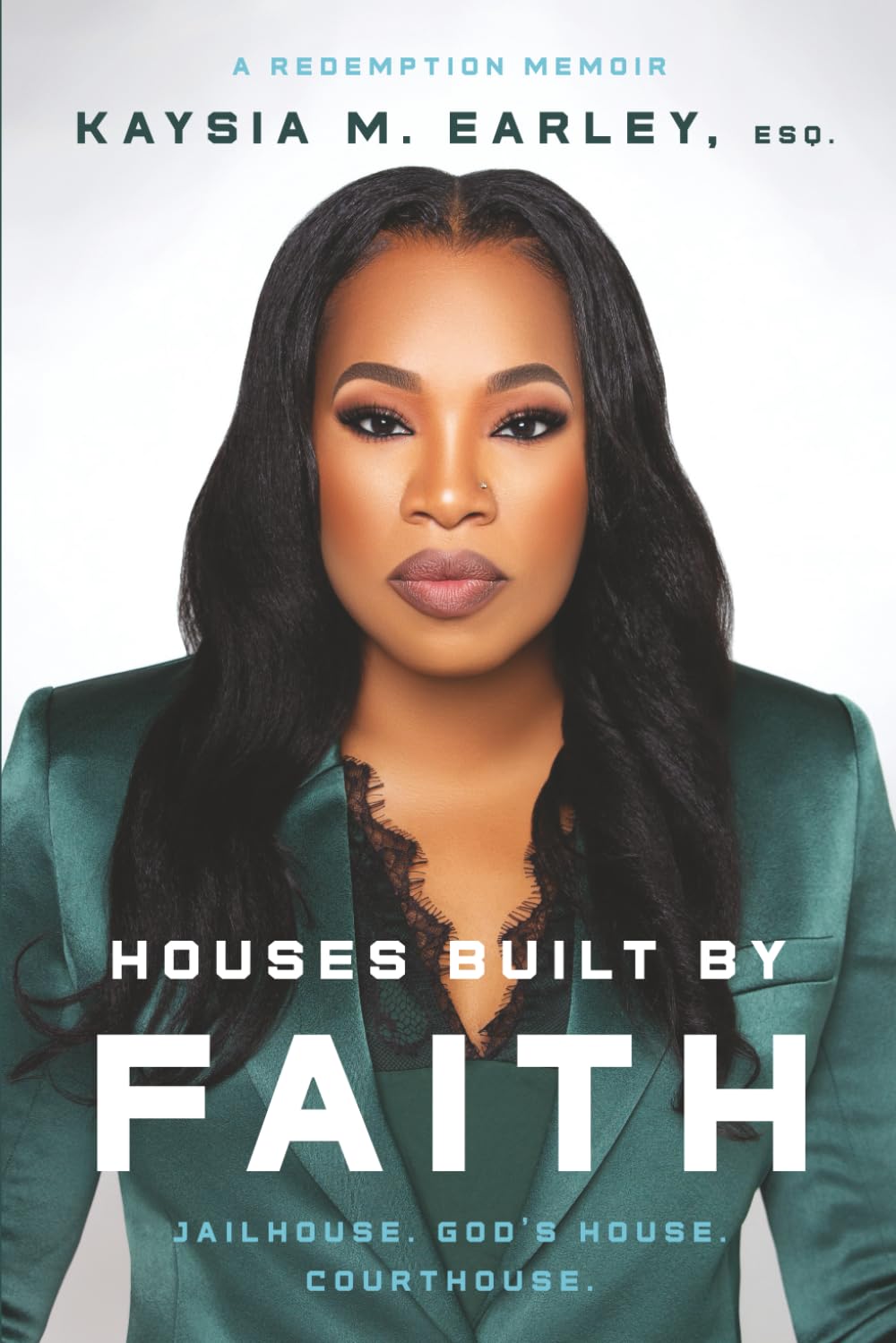

Houses Built by Faith is a redemption memoir that follows author Kaysia M. Earley from a noisy Bronx childhood to Florida, through her father’s abandonment, deep poverty, a jail sentence while four months pregnant, and then into a life as a criminal defense attorney and jail minister who walks back into the same courtroom that once sentenced her, this time as counsel. The story is built around three “houses” in her life, the Jailhouse, God’s House, and the Courthouse, and each section shows how faith reshapes her identity, heals family wounds, and eventually turns her into an advocate for people who stand where she once stood. The book moves from family history and cultural roots, to the shock of incarceration and a supernatural encounter with God in solitary confinement, then into years of slow rebuilding through church, education, bar hearings, and work with incarcerated clients, ending with a practical “blueprint” that invites readers to apply those lessons to their own lives.
The voice is vivid and very cinematic. The childhood chapters in New York and Jamaica felt alive to me, full of smells, sounds, and small details that made the settings stick in my mind. The courtroom framing at the start, with Faith on trial and the reader cast as the jury, is a clever hook, and it sets the tone for the mix of legal language and spiritual language that runs through the book. The style leans more into preaching than storytelling, with scripture woven through almost every chapter and direct exhortations to the reader, yet it still feels honest rather than polished for show. I could feel her background as both a trial lawyer and a church speaker in the rhythm of the sentences, the repetition, the build, the way key lines land like closing arguments. The prose is clear and accessible, and even when it gets intense, it stays easy to follow, like listening to someone talk to you across the table, not reading a legal brief.
Emotionally, the book hit me hardest in the jailhouse and courthouse sections. Her description of solitary confinement, pregnant, stripped of everything, and then experiencing what she understands as God entering that cell, carries a weight that stayed with me long after I finished the chapter. The later scenes with the Florida Board of Bar Examiners and her son’s simple letter about how “Mommy changed” pulled me in too, because they show how redemption has to be proven in ordinary, slow, sometimes humiliating ways, not only in dramatic encounters. I appreciated that she does not pretend the system is kind or fair, yet she also refuses to let her story become only a complaint about injustice. The strongest idea in the book, for me, is how she treats her legal career as a pulpit inside the jail and courtroom, a calling more than a job, planting “spiritual wisdom” in letters to clients and then seeing that seed grow over time. Even when I wished she lingered more on systemic analysis, I respected the way she kept bringing the focus back to responsibility, mercy, and service.
The house metaphor, with God as master architect who repurposes every crack and fracture, gives the memoir a strong spine and makes the closing “blueprint” section feel earned. For readers who come from Christian or church backgrounds, though, especially Black women who know the mix of cultural pride, family fracture, and spiritual resilience that she describes, the tone will feel like home. I also think law students, public defenders, and anyone who works in criminal justice can get a lot from her reflections on how her own incarceration shapes the way she now stands beside her clients.
I would recommend Houses Built by Faith to readers who want a spiritually grounded, emotionally honest story of failure, resilience, and calling, not a detached legal memoir or a sociological study. It will speak most strongly to Christians, to women navigating family wounds and single parenthood, to people who have touched the criminal justice system in any way, and to those who are trying to make sense of their own “houses” in life and wonder if God still has a plan for them. For that audience, I think this book will feel like sitting in church and in court at the same time, and will leave them encouraged, a little undone, and more willing to believe that broken foundations can still be rebuilt.
Pages: 229 | ASIN : B0G38PDLTD



