Blog Archives
The Freedom Christ Offers

From Battlefield to Breakthrough presents a thoughtful framework for readers seeking a deeper relationship with God and a more intentional spiritual life, drawing on Scripture, prayer, personal experience, and guided reflection. What inspired you to create this workbook?
When I gave my life to Jesus, I had a lot of questions, and not everyone knew how to answer them. At times, people even seemed offended that I was asking. It was like they didn’t know how to answer them. I thought that if I had these questions, other believers probably did too. I created From Battlefield to Breakthrough to give readers a safe place to learn, grow, and wrestle with hard questions without feeling ashamed for asking them. I also wanted Scripture to feel understandable and applicable, not intimidating.
The principles in this book changed my relationship with Jesus, and I have watched them impact the people I serve through pastoral counseling, coaching, and ministry. This book is not about collecting more information about God. It is about learning how to know Him, recognize what is keeping you stuck, and apply biblical truth to your everyday life.
One of the workbook’s most valuable contributions is distinguishing among spiritual attack, unrepented sin, and emotional wounds, and guiding readers toward responses appropriate to each. How did you develop that framework, and why do you think so many believers conflate them?
That framework developed through years of studying Scripture, prayer, learning from others, and ministering to people in very different circumstances. Through running a recovery ministry, prison ministry, pastoral counseling, and coaching, I kept seeing the same issues with different faces. I also realized the root was not always the same. Sometimes a person was facing spiritual warfare, and sometimes repentance was needed. Other times, an emotional wound required healing. If we misidentify the root, we can apply the wrong response. I want people to feel the freedom Christ offers.
I also began seeing how deeply our earthly relationships can influence how we perceive God. If your experience with a father was abandonment, anger, or rejection, hearing “God is your Father” may carry a completely different meaning until those wounds are addressed. People are complex, and Scripture addresses spiritual warfare, sin, repentance, forgiveness, healing, and renewal. Sometimes breakthrough begins with one question: What am I actually dealing with?
You connect neuroplasticity to the biblical renewal of the mind using science to explain why repeated practice matters. How did you develop that integration, and how do you present it so it strengthens faith rather than reducing transformation to a brain exercise?
It started because I ministered to a lot of what I jokingly call “doubting Thomases.” They did not necessarily lack faith; they needed to understand the why. Telling someone, “Have more faith” or “Renew your mind” does not teach them how to do either one. Neuroplasticity helped me paint that picture. Romans 12:2 tells us to be transformed by the renewing of our minds, and science helps illustrate why repeated thoughts and behaviors can become deeply established patterns. If you have rehearsed “I am worthless” for twenty years, reading one verse once will not immediately undo that pattern. Renewing the mind means learning to recognize the lie, take it captive, and consistently replace it with God’s truth. Depending on the person, I may go a more visual route like I do in the book and remind them it just takes time. Science explains part of the mechanism; it does not replace the source. Transformation is not just training your brain to think positively. It is coming into agreement with God’s truth and allowing that truth to change how you think, respond, and live. I often say, nothing changes if nothing changes. The brain is not the Savior. Jesus is. Neuroplasticity simply helps us understand why consistently applying His truth matters.
What comes after From Battlefield to Breakthrough, and what questions did the workbook open in you that you want to pursue next?
From Battlefield to Breakthrough is called The Foundation intentionally. I see it as the beginning of a trilogy, followed by From Breakthrough to Healing and From Healing to Freedom. I am still praying through what belongs in those books because I do not want to rush the process. Breakthrough can reveal what needs healing, and healing raises another important question: What does it look like to actually live free? I want each book to meet the reader at that next stage of the journey.
My writing is also expanding into other genres. I am building The Oakmeadow Collection, my Christian children’s series that began with Asher Shines Bright, and I am developing a Christian medieval fantasy project that I am incredibly excited about. They may reach very different readers, but the heartbeat behind my writing remains the same: identity, truth, spiritual authority, healing, and freedom. I want to tell stories and create resources that help people see themselves, their battles, and God differently. May they all break free and have a real relationship with Jesus.
Author Links: GoodReads | Facebook | Website | Amazon
Winner of the 2026 Christian Book Excellence Award for Outstanding Contribution to Christian Spiritual Formation Literature
Finalist in the 2026 Kingdom Book Awards: Truth & Transformation Impact
From Battlefield to Breakthrough is a Scripture-rooted workbook designed to help believers renew their minds, confront destructive thought patterns, and walk in spiritual authority through Biblical truth.
In a world filled with anxiety, confusion, spiritual exhaustion, and identity struggles, many Christians find themselves stuck in cycles they do not know how to break. This interactive workbook guides readers through honest self-examination, prayer, journaling, spiritual warfare principles, renewing the mind, healing from wounds, understanding identity in Christ, and learning how to stand firm in faith.
Drawing from Scripture, personal testimony, practical reflection exercises, and guided prompts, Pastor Kristina Gibbons equips readers to move beyond surface-level inspiration into intentional transformation.
Inside this workbook, readers will explore:
• Renewing the mind through Biblical truth
• Identifying destructive thought patterns and spiritual strongholds
• Understanding identity and authority in Christ
• Prayer, fasting, and spiritual warfare foundations
• Healing from shame, fear, condemnation, and unworthiness
• Building consistent spiritual habits and disciplines
• Journaling prompts, declarations, prayers, and reflection exercises
• Walking through breakthrough with practical application
This workbook is written for believers who are tired of simply surviving and are ready to pursue healing, freedom, spiritual growth, and a deeper relationship with Jesus.
Whether used personally, in small groups, discipleship settings, women’s ministries, recovery ministries, or Bible studies, From Battlefield to Breakthrough provides a structured framework for reflection, renewal, and spiritual growth grounded in Scripture.
I Am My Biggest Stranger


I Am My Biggest Stranger, by Mike Dee, is a personal spiritual journey that uses Dante’s Inferno as a map for self-confrontation, healing, and Christian renewal. Dee begins in his own “dark wood,” shaped by loss, a car accident, broken direction, and the ache of becoming unfamiliar to himself, then moves through the circles of lust, comfort, greed, anger, pride, violence, fraud, and betrayal as mirrors for the modern soul. The book gradually shifts from descent to rebuilding, from naming the giants to mastering the mind, living with integrity, aligning with purpose, and finally inviting the reader to write the unwritten chapter of their own life.
Dee isn’t writing from a polished distance, and that gives the strongest passages their pulse. When he describes hearing Dante’s famous line while watching Patch Adams after the accident, I could feel the strange grace of that moment, the way a single sentence can suddenly give shape to years of confusion. I also found the shelter scene especially affecting. The image of him on his eighteenth birthday with a backpack, a Bible, and fear he doesn’t want to admit has a rawness that lingers. Those moments cut through the more instructional sections and let the book breathe as testimony. I liked Dee best when he trusted story, silence, and image, because his writing has a natural intensity when he lets memory do the talking.
The ideas in the book are earnest, ambitious, and at times genuinely stirring. I appreciated the way Dee reframes inner struggle without softening it: Limbo becomes the slow death of “almost,” lust becomes desire without direction, anger becomes a swamp that traps both the loud and the silent, and treachery becomes a frozen condition of the heart. That structure gives the book a strong spiritual architecture. The language can circle back on itself, especially around purpose, giants, alignment, and victory. Still, that repetition also comes from conviction. Dee clearly believes these truths were hard-won, and there’s something moving about the urgency with which he wants the reader not to waste pain, not to settle, not to drift through life half-awake.
I felt that I Am My Biggest Stranger is less a conventional self-help book than a devotional pilgrimage through the bruised places of the self. Its best qualities are its faith, vulnerability, and insistence that transformation is not cosmetic but costly. The conclusion, with its unwritten final chapter, works because the whole book has been pushing toward that handoff: now the reader has to move. I’d recommend this book to Christian readers who like reflective, spiritually charged personal growth books, especially those wrestling with grief, stagnation, identity, or the uneasy sense that they’ve been living as a stranger to themselves.
Pages: 512 | ASIN : B0GYQYBBF2

Eternal Springs: Joy Found in the Book of John


Eternal Springs: Joy Found in the Book of John is a devotional reflection on the Gospel of John, framed around the conviction that Christian joy is not a decorative emotion but a sustaining spring of peace, courage, humility, and love. Bruce Floren moves chapter by chapter through John’s Gospel, drawing out images of light, living water, bread, vine, shepherd, cross, resurrection, and call. His purpose is not academic commentary, and he says so plainly. Instead, he offers a personal, pastoral meditation on how the life and teachings of Jesus can shape a person inwardly, especially in a fractured world where judgment comes easily and compassion often feels like costly work.
Floren doesn’t treat joy as private consolation alone, though he clearly values its inward tenderness. He returns again and again to the idea that peace, vitality, and assurance are given so that a person can love more fully. I found that emphasis quietly powerful. His reading of the Samaritan woman at the well is a strong example because he sees Jesus crossing ethnic, religious, and gendered boundaries not as a sentimental gesture, but as a revelation of divine generosity. Likewise, his treatment of the man born blind and the raising of Lazarus gave the book some of its most resonant moments for me. In both stories, physical restoration becomes a way of speaking about spiritual sight, courage, and the stubborn hope that life can return even where something has gone dry and grave-cold.
The writing is warmest when Floren lets his own life enter the page. His reflections on sobriety, obedience, doubt, and the difficulty of remaining faithful when joy feels distant give the book an honest pulse. I appreciated that he doesn’t present Christian maturity as a smooth ascent. He knows the mud, and that knowledge gives his exhortations more weight. The prose circles familiar claims around vitality, well-being, peace, and joy. Yet that repetition also reveals the book’s devotional nature. It feels less like an argument advancing point by point and more like a trusted believer returning to the same spring, cupping the same water, trying to persuade the reader that it really can refresh the soul.
I was also struck by the book’s moral seriousness. Floren’s concern about political division, hard-hearted religion, and the temptation to confuse law with love brings the Gospel of John into the present tense. The ideas are sincere, and the best passages carry a gentle urgency. Eternal Springs is a reflective and heartfelt book for Christian readers who want a devotional companion to John’s Gospel, especially those seeking renewed joy, steadier faith, and a more merciful posture toward others. I would recommend it to readers who value personal testimony, biblical meditation, and spiritually serious encouragement over formal scholarship.
Pages:128 | ISBN : 978-1957354903
Listen and Learn


Come, Find Space With God is a guide to Christian spiritual formation designed for readers moving into adulthood and spiritual self-awareness. Why was this an important book for you to write?
We both recall our own mistakes along our journeys and realize how beneficial it would have been to receive wise, empathetic counsel early on. Come, Find Space with God offers wisdom and formation through stories, reflection, sacred reading, and practices that we wish we had access to during our times of transition. We could have benefited from experiencing more reflective spaces to slow down and listen to the still small voice of wisdom
What spiritual challenges do you think young adults face today that previous generations may have experienced differently?
Today’s young adults seem much busier, distracted, overwhelmed, stressed, confused, lonely, and depressed than previous generations. They hear a variety of conflicting opinions on social media; connections may be superficial and shallow, and may not be in person. The culture around them is moving at far too fast a pace to even process issues and make wise choices. They need to listen and learn from ancient spiritual ways of finding balance, peace, and freedom.
Was there a story in the book that was especially difficult to write about?
The story in Evaluating my thoughts and plans was the most challenging to write. I prefer people to think of me (Leoma) as a competent, self-assured person. Most of us want to project that persona. So, to describe the many ways in which I feel insecure, incompetent, and “less-than” in a public forum is daunting. However, I’ve learned over the decades that God’s opinion of me is the most important thing, not what anyone else thinks.
How can readers create a rule of life that feels realistic rather than overwhelming?
The book provides questions and structures in order to create the reader’s own rule of life that fits with his or her stage, schedule, vision, and purpose in life. The idea is really to take time with this and not rush the reflective process. Ultimately, a rule of life should bring balance, provide focus and clarity, offer spiritual growth, and free the reader up from being overwhelmed with life. A good rule of life should include SPACES in days for stillness to reconnect spiritually, and often, less is more. Mainly, this process needs to be about observing your daily habits and activities first and considering if they are still a good fit or if some things could be eliminated, especially time sucks like scrolling the internet or watching too much news. This needs to be intentional, or we will fill our time up and wonder why we have no peace. Not all the questions in the book need to be answered in one sitting; keep it simple.
Author Links: GoodReads | Facebook | Website | Amazon
Come Find Space with God offers spiritual practices and reflections to help individuals navigate life’s challenges and deepen their relationship with God.
Come, Find Space With God

Come, Find Space With God, by Leoma Gilley and Carol Mullen, is a contemplative guide to Christian spiritual formation, written especially for readers moving into adulthood, responsibility, uncertainty, and spiritual self-awareness. The book walks through practices such as stillness, Scripture meditation, prayer, examen, discernment, surrender, sacred community, service, and a rule of life, pairing biblical reflection with personal stories and practical exercises. Its central invitation is simple but searching: make room for God not as another obligation, but as the One who can reshape fear, hurry, wounded thinking, and restless striving into a steadier life of trust.
What I found most affecting was the book’s refusal to treat spiritual growth as tidy or abstract. Leoma’s stories give the material weight: her prayer counseling in England, where a first-grade memory still carried the sting of shame; her long argument with God about Africa; her years caring for her mother; her decision to welcome Ben, Sara, and John into her home even when hospitality became costly and inconvenient. These moments keep the book from floating into devotional softness. The ideas here are deeply pastoral. “Space” is not presented as a pretty metaphor. It becomes a house opened to someone in need, a schedule interrupted, an ambition surrendered, a harsh inner voice confronted, a grief carried honestly before God.
The writing is warm, direct, and companionable, with a rhythm that feels suited to reflection. I appreciated how the authors blend story, Scripture, music, journaling prompts, and spiritual practices without making the reader feel rushed or managed. The structure can feel instructional, especially when the chapters move from story into exercises and group questions, but that same structure is also part of the book’s usefulness. I was especially drawn to the chapters on discernment, negative self-talk, and service because they press into the places where faith becomes concrete: what we do with fear, how we interpret our own failures, and whether we can serve without needing to fix people.
Come, Find Space With God speaks with the calm authority of people who have been formed by long obedience, real disappointment, and repeated redirection. The concluding emphasis on a rule of life gives the book a fitting sense of movement, as though all the earlier practices are gathering into a sustainable pattern rather than a burst of temporary inspiration. I’d recommend this book to Christians in seasons of transition, especially young adults, small groups, spiritual direction groups, and readers who feel crowded by anxiety, decision fatigue, or spiritual noise and want a grounded way to begin listening again.
Pages: 129 | ASIN : B0GX2XNR2T
Rise in Courage

In Aimed & Ready, you emphasize that the seasons of delay, silence, loss, and backward movement can actually be forms of divine preparation. Why was this an important book for you to write?
I wrote this book to address a need I kept seeing in people’s lives. Many Christians know how to celebrate seasons of success, blessing, and prosperity, but often lack a framework for navigating hardship, uncertainty, delay, and disappointment. Over the past six months, this burden grew strongly in my heart, and I felt compelled to put into words the hope and perspective people need during difficult seasons.
The core message of the book is that when life doesn’t make sense, there is still purpose, hope, and destiny available when we choose to trust God and surrender our struggles to Him. Rather than seeing trials as endings, I want readers to recognize that something beautiful may be forming just beyond the present challenge.
I also wanted to provide prophetic encouragement by exploring the emotions people experience in seasons of stretching, waiting, discomfort, and shaking. The book not only acknowledges those feelings but also offers insight into why we experience them and how we can respond in faith.
One of the key metaphors I use is that of an archer pulling back an arrow. The Archer’s aim is never careless. Although the pressure of being pulled back can feel intense, it is actually preparation for forward movement. In the same way, I believe God often uses seasons of tension to position us for growth, blessing, and His greater purpose.
Ultimately, the book challenges readers to rise in courage, break limiting mindsets, and step confidently into God’s calling. I want people to understand that their trials can transform them and become a powerful testimony of God’s faithfulness.
When did the bow-and-arrow metaphor first come to you, and why did it feel central?
The book really began with one simple thought: your pullback is a setup for your comeback. That idea immediately gave me the picture of an archer with a bow fully drawn back. What feels like strain is often actually alignment, and what looks like a setback may be God positioning you for greater impact.
In a world where many people feel like targets, I wanted to remind readers that God didn’t create them to be victims of circumstance—He crafted them to be the arrow. Sometimes the pullback isn’t the end of the story; it’s the beginning of something greater. That’s why the bow-and-arrow metaphor felt so powerful and fitting for this message.
A major theme in the book is surrender. In God’s Kingdom, surrender is never defeat. In His hands, surrender becomes strength, stability, and precision. It allows your life to go farther than human effort alone ever could. Many people think surrender means losing control or identity, but I believe the opposite is true—it places your life in the hands of Someone who knows you completely and sees further than you can see.
Just as an archer never draws back an arrow without intention, God never allows seasons of waiting, silence, or tension without purpose. He sees the obstacles, opportunities, and timing that we often cannot. Sometimes what feels like delay is really a divine reset to align our trajectory with His greater vision.
Ultimately, the message of the book is that every arrow finds its meaning when it yields to the Archer. When we surrender to God, our lives can move with greater clarity, purpose, and precision toward the calling He has set before us. This book, along with its devotional workbook, is designed to help readers grow stronger in the tension, realign with Heaven’s purpose, and step confidently into their God-given destiny.
How can readers tell the difference between spiritual stillness and spiritual distance?
One of the key messages I wanted to communicate is that trust in God must always be the foundation of faith. There are seasons when God can feel distant, but often that sense of distance comes because something is clouding our perspective, or because the answer we’re looking for is not yet visible. It doesn’t mean God has moved away.
I also talk about stillness, because stillness is not the absence of God. I describe it as a holy hush—an intentional choice to silence the noise around us so we can hear, see, and discern what God is doing in that moment. Rather than being empty, stillness can become a place of deep intimacy with Him.
When people feel distance from God, they often assume He is far away or hard to reach. But that is never His heart. God desires closeness and a relationship with His people. Scripture asks, What can separate us from the love of God? and the answer is clear: nothing.
So any feeling of separation is not a truth we should accept, but often a perception shaped by fear, disappointment, or misunderstanding. The reality is that God remains near, loving, and fully present—even in the quiet seasons. My hope is that readers come to see silence not as abandonment, but as an invitation into deeper trust and intimacy with Him.
How do you respond to readers who feel that their pain has no visible outcome?
One of the important truths I explore in the book is that while difficult seasons can feel confusing and unclear, we must be careful not to let that drift into fatalism or hopelessness. Just because we cannot see the outcome doesn’t mean there is no purpose or direction. Often, it simply means the perspective belongs to Someone greater than us. As I say in the book, the archer sees what the arrow cannot yet perceive.
That perspective changes how we view our battles. What looks like an obstacle may actually be the very thing God uses to launch us into what He has already prepared. Your Goliath may not be there to destroy you—it may be the catapult into your next season of purpose and victory. That’s why I encourage readers not to be afraid, but to trust God completely, because true breakthrough happens when His power is behind what He has placed in your hand.
My prayer is that this book would saturate people with faith and hope, bring their hearts into alignment with God, and strengthen their confidence in His purpose. If someone is in a season of waiting, stretching, or feeling hidden, I believe this message can be a real lifeline. It is designed to help readers rest again, realign with God’s perspective, and trust His heart in a fresh way.
Author Links: GoodReads | X (Twitter) | Facebook | Website | Nico Smit | Amazon
With prophetic insight and pastoral clarity, Nico Smit reframes seasons of tension, delay, and apparent retreat-not as disqualification, but as divine preparation. Drawing from a powerful vision of a bow drawn tight and an arrow held under pressure, ‘Aimed & Ready’ reveals a profound truth: what feels like strain is often alignment, and what looks like setback may be God positioning you for greater impact.
This powerful cutting-edge prophetic book speaks to those who feel buried, forgotten, or off-track, reminding them that God does not waste His arrows. The pullback is not punishment-it is precision. The pressure is not abandonment-it is proof of purpose.
With prophetic revelation, biblical insight, and hope-filled exhortation, these pages restore faith for the waiting, courage for the weary, and vision for those standing between promise and fulfillment.
You are not retreating. You are being aligned, sharpened, and prepared. ‘Aimed & Ready’ will restore your perspective and strengthen your faith.
Will you let God aim you?
If your answer is yes, your comeback has already begun.
FOREWORD by Stacey Campbell
This book also has a Devotional Workbook available on Amazon.
Professional Endorsements by: Gary Heyes, Ryan Laubscher, Chelsea Hagen, Elaine Tavolacci, Joshua Sawiris, Ada Boland and Melvain Donyes
Aimed & Ready
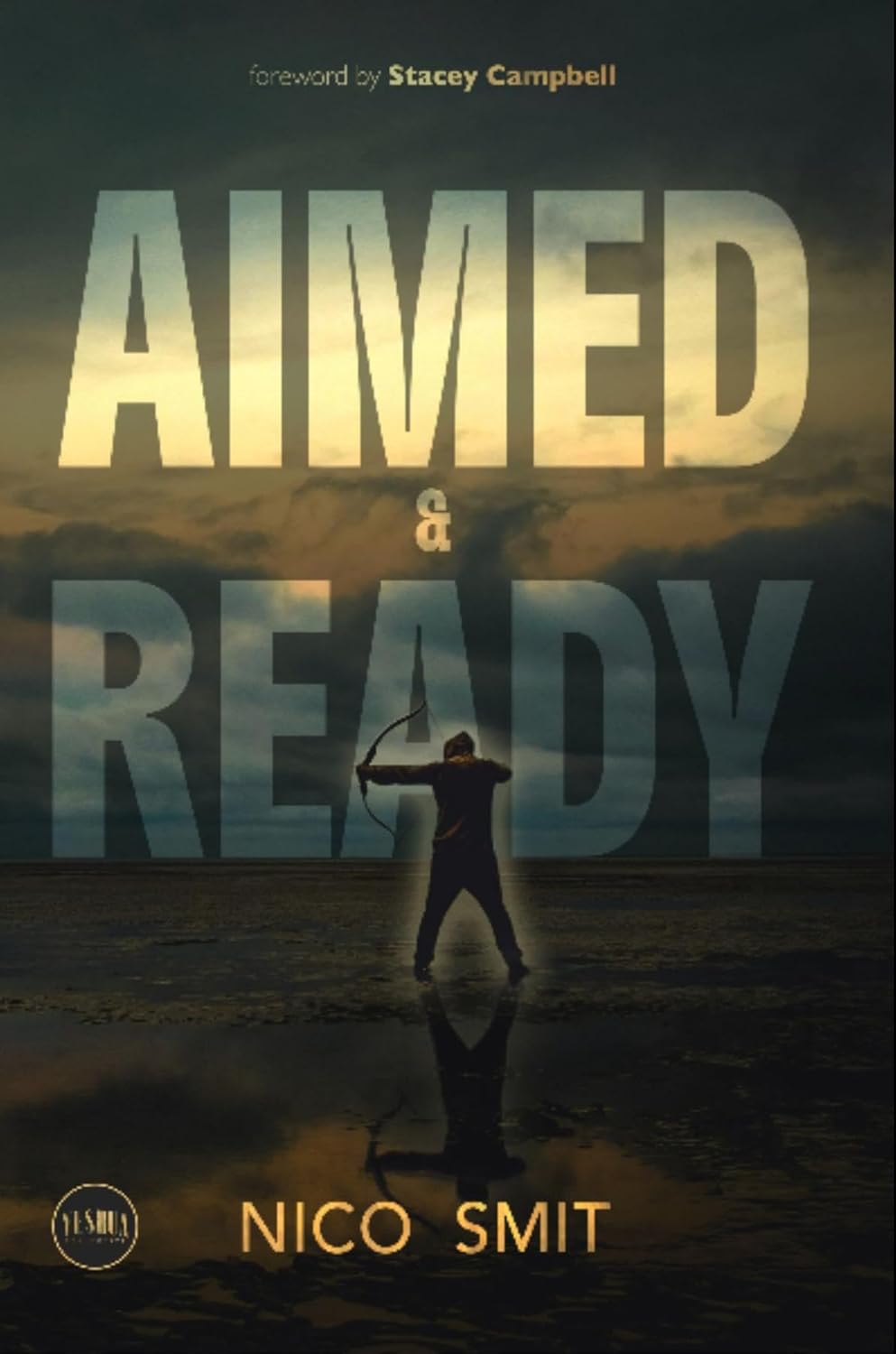
I found Aimed & Ready to be a spiritually focused book about how seasons of delay, silence, loss, and apparent backward movement can actually be forms of divine preparation. Author Nico Smit’s central image is the bow and arrow: the life that feels pulled back is not abandoned, but being aimed. From there, he builds a sustained meditation on surrender, waiting, spiritual alignment, and eventual release, moving through ideas like the “holy hush,” the reset that becomes a re-aim, David’s devastation at Ziklag, and the insistence that hope is not sentimental optimism but evidence that God is still at work. It’s a book written for readers who feel stalled and bruised, and it keeps returning to the same steady conviction that what looks like burial may be the first stage of resurrection.
What stayed with me most was the emotional steadiness of the book. Smit writes with the urgency of a preacher, but also with a pastoral tenderness that keeps the message from feeling harsh or abstract. I liked the way he lingers over images until they start to feel lived in. The bare fruit tree, the buried seed, the rowers facing one way while still moving forward, the ruined city of Ziklag, all of it feeds the same argument from slightly different angles, and that repetition gives the book a kind of devotional pulse. At its best, the writing has real lift. There are passages that feel genuinely bracing, especially when he reframes pressure as alignment and refuses the easy language of defeat. I also appreciated that he opens by reminding readers that this book is not Scripture and shouldn’t replace Scripture. That note of humility matters, and it gives the book a better spiritual proportion than it might otherwise have had.
Smit is so committed to the pullback/comeback framework that nearly everything gets absorbed into it. For readers already attuned to prophetic Christian language, that will probably feel clarifying and consoling. I admired the conviction. The prose can also swell into exhortation. Still, even when I felt the book pressing too insistently on one note, I couldn’t deny the sincerity behind it. Smit clearly believes these ideas down to the bone, and that kind of belief gives the book warmth, gravity, and a persuasive emotional center.
The book gives discouragement a shape people can actually work with. Smit turns spiritual exhaustion into something legible through the bow-and-arrow metaphor, the “holy hush,” and the Ziklag section, so a reader in a hard season can feel less lost inside their own experience. A lot of encouraging books tell you to hold on, but this one tries to explain what holding on feels like from the inside. I think that interpretive quality is one of its real strengths.
I found Aimed & Ready earnest, vivid, and often moving. It’s a book that wants to steady the heart, reframe suffering, and call the reader back into trust. I’d especially recommend it to Christians who are living through a season of disappointment, transition, spiritual fatigue, or long waiting, and to readers who respond to devotional writing that leans on metaphor, exhortation, and hope. For the right reader, this will feel less like a lecture than a hand at the shoulder, firm, warm, and convinced that the story isn’t over yet.
Pages: 168 | ASIN : B0GK9NMGRY
Sharing Hope

In Houses Built by Faith, you share the hardships and intense faith that shaped your early years and paved the way for a life of advocacy. Why was this an important book for you to write?
It was important for me to write this book because of what I witnessed in my work as an advocate/criminal defense attorney for those accused of crimes. I often meet clients at one of the most difficult moments of their lives, while they are incarcerated and enduring the heavy weight of the presumption of guilt. During those moments, I’d sometimes share my own story of past incarceration and the journey that eventually led me to become an attorney.
I’ve seen firsthand how my story changed the atmosphere. Clients who felt defeated suddenly found a reason to believe. After their cases were dismissed or they were vindicated and found not guilty, many of them told me that hearing my story gave them hope while they were behind bars. They saw that someone who once sat where they were sitting could still rise, rebuild, and serve others.
Those conversations made me realize, if my story could bring hope to people inside prison walls, it could also inspire people outside of them. This book is my way of sharing that hope with a broader audience. It’s a reminder that even in the darkest seasons of life, faith, perseverance, and purpose can build something new.
At what point did you realize that the three-house framework was the key to telling your story?
I realized that the three-house framework was the key to telling my story during a speaking engagement where I was sharing my life journey. After I finished speaking, a woman from the audience approached me and said something that immediately stayed with me. She told me that my life took place in “three houses”.
In that moment, everything clicked. I recognized that the stages of my life truly could be understood through those houses, each representing a different season of growth, challenge, faith, and transformation. It was not something I had originally planned, but when she said it, I knew she had captured something profound about my story.
From that moment forward, the three-house framework became the natural way to tell my journey. It fit perfectly, and I do not believe that was a coincidence. In many ways, it revealed that life is a series of places where we grow, rebuild, and rediscover who we are meant to be. I believe there are still more houses ahead of me, new seasons and new chapters waiting on the horizon.
I appreciated the candid nature with which you tell your story. What was the most difficult thing for you to write about?
The most difficult part of writing this book was exposing myself in a very visible and vulnerable way by revealing my mug shot. Looking at that photograph years later was an emotional experience. When I study my eyes in that image today, I can see a woman who was lost, uncertain, ashamed, and deeply distraught.
Seeing that photo again brought back memories that were not easy to revisit. It reminded me of a painful season in my life, one that did not feel good to relive. Yet, I also recognized that the photograph tells an honest part of my story.
today I can look at that image from a different perspective. Instead of only seeing the pain, I see the evidence of how far I have come. That moment did not define the end of my life. It was a chapter in a much larger story of perseverance, faith, and transformation. Including it in the book was difficult, but it was necessary because it reflects the truth of the journey.
What advice would you give to someone considering sharing their own memoir with readers?
My advice to anyone considering sharing their memoir is to be completely transparent. Authenticity resonates with readers because people can sense when a story is coming from the heart. When something is written from the heart, it has the power to reach the heart.
Do not be afraid to share the difficult parts of your journey. Those moments of struggle are often the very places where readers find connection and encouragement. We all endure hardships, and many people are searching for stories that remind them they are not alone.
At the same time, a memoir should not only tell the story of what happened. It should also give the reader hope for a better tomorrow. When readers close the book, they should feel strengthened by the journey you shared. They should walk away with the belief that whatever they are facing, they too can overcome and build something meaningful from their experiences.
Author Links: GoodReads | Facebook | Instagram | Website
Houses Built by Faith: Jailhouse. God’s House. Courthouse. is a powerful, faith-filled journey through places most people fear, but where God does His greatest work. Written by attorney Kaysia Monica Earley, Esq., her extraordinary journey unfolds across three pivotal “houses” that shape a life under pressure:The Jailhouse — where fear, consequences, and uncertainty collide
God’s House — where faith was rebuilt, purpose was restored, and hope was renewed
The Courthouse — where justice, truth, and redemption intersect, and destiny was fulfilled
Through personal insight, spiritual reflection, and real-world experience inside the criminal justice system, Houses Built by Faith reveals how God meets us in our lowest moments and transforms trials into testimony.
This book is for anyone who:Is walking through a legal battle, incarceration, or personal crisis
Feels overwhelmed by consequences but still believes God has a plan
Needs encouragement that their situation is not their sentence
Wants proof that faith can stand firm, even in jail cells and courtrooms
Rooted in Scripture and lived experiences, Houses Built by Faith reminds readers that every house we pass through can still be built on faith, and that God’s purpose is never delayed by man’s process. Once an incarcerated defendant, she rose to become a defender of justice. Houses Built by Faith is a powerful testament, when faith lays the foundation, redemption is inevitable. More than a memoir, Houses Built by Faith is a movement detailing how to break every barrier, heal from within, and activate the transformative power of faith.
ABOUT THE AUTHOR
Kaysia Earley is a devoted Christian, nationally recognized attorney, journalist, legal analyst, author, and founder of Earley Law Firm. She defends the accused with a powerful perspective from both sides of the legal system. She earned her Bachelor of Arts degree in Political Science at Howard University and her Juris Doctor from St. Thomas University School of Law. Kaysia has tried over 100 cases to verdict and earned numerous distinguished legal honors.
Guided by Luke 12:48, “For unto whomsoever much is given, of him shall much be required,” Kaysia mentors young women pursuing law and leads a jail ministry that brings hope through the Gospel of Jesus Christ in monthly sermons.
She resides in Florida with her husband of more than twenty years, David, and their four children, carrying her faith into every role as wife, mother, attorney, and servant of Christ


