Blog Archives
A Meditation On Greatness

Alexander, Pharaoh of Egypt (Ancient Egypt), follows Alexander the Great from his early years, where his education and family shaped him into the man he would become, and the path he took in his quest for godhood. Where did the idea for this novel come from, and how did it develop over time?
The idea for Alexander, Pharaoh of Egypt began in childhood. I first encountered Alexander the Great not as a conqueror, but as a boy—curious, brilliant, and shaped by the towering figures around him: his mother Olympias, his tutor Aristotle, and his father Philip II. That early impression stayed with me, and over time, I became fascinated by the tension between his human vulnerabilities and his relentless pursuit of divinity.
The novel developed over several decades of research, reflection, and writing. My academic background in Egyptology helped me reconstruct the coronation scene with historical precision, but the heart of the story lies in the relationships. I wanted to explore not just Alexander’s military campaigns, but the quieter, more intimate dynamics—his bond with Hephaestion, the resistance of Cassander, and the emergence of figures like Ptolemy and Seleucus who would inherit and fracture his empire.
What shaped the novel most, however, was the experience of physically following in Alexander’s footsteps. I was in Egypt during the Revolution of 2011, a time of immense upheaval and uncertainty. Despite the danger, I travelled out to Siwa—the site of Alexander’s legendary visit to the Oracle of Amun—under armed escort. That journey was transformative. Standing in the desert where he once stood, surrounded by echoes of ancient ritual and modern unrest, gave me a visceral sense of the stakes he faced and the myth he was becoming.
Ultimately, Alexander, Pharaoh of Egypt became a meditation on greatness—how it’s defined, who pays for it, and whether it can coexist with compassion. It’s a story of fractured ideals and enduring friendships, told through the lens of history but driven by timeless human emotion.
What intrigues you about the time period of Ancient Egypt and its history that led you to write this thrilling and insightful period piece?
What intrigues me most about Ancient Egypt is its duality—how it balanced the mystical with the administrative, the divine with the deeply human. It was a civilization obsessed with eternity, yet governed by people whose ambitions, flaws, and relationships were strikingly familiar. That tension between timeless ritual and personal drama is what drew me in.
As someone who studied Egyptology formally, I was intrigued by how much of Egypt’s history is preserved in fragments—temples, tombs, inscriptions—and how much is still open to interpretation. Writing historical fiction allows me to bridge those gaps, to imagine the emotional lives behind the monuments. In Alexander, Pharaoh of Egypt, I wanted to explore what it meant for a foreign conqueror to step into that sacred landscape and claim divinity. What did it cost him? What did it mean to the people who witnessed it?
Egypt’s coronation rituals, its symbolism, its obsession with legacy—all of it offered a rich canvas for storytelling. But ultimately, it was the human element that pulled me in — the friendships, betrayals, and moral choices that echo across centuries. Ancient Egypt wasn’t just a backdrop—it was a character in its own right.
What experience in your life has had the most significant impact on your writing?
It’s hard to pinpoint just one experience that shaped my writing—my early life was full of extremes. My family travelled constantly, which opened my eyes to diverse cultures, landscapes, and histories. But alongside that adventure came profound loss. We lived through the worst weather event ever recorded and later lost everything in a war. At one point, we spent two years living on a ship with no money, no school, no internet, and no music. My father controlled the radio, and as a girl, I wasn’t allowed to mix with the crew. Apart from a few kind cadets who were vetted to speak with me, I spent most of my time alone in a cabin studying. My mother was a trained teacher and set a relentless pace!
That isolation became a crucible for imagination. With no distractions, no peers, and nothing but silence, I turned inward—and that’s when ancient Egypt, art, storytelling, and Alexander the Great found me. I was captivated by the grandeur of lost civilizations, but even more by the emotional complexity of their leaders. Alexander, especially, fascinated me: a boy forged by myth and ambition, driven by a sense of destiny that reached beyond the mortal. He lived with one eye on the present and the other fixed on eternity. That dual gaze—earthbound and divine—is part of why we still remember him.
Writing became a way to make sense of the world—its beauty, its brutality, and the fragile threads of connection that hold people together. That ship, that silence, that solitude—they weren’t just hardships. They were the beginning of everything I write now.
Do you have plans to continue the Ancient Egypt series, or are you working on something new?
Yes, I do plan to continue the Ancient Egypt series—but Cleopatra, the Greek Pharaoh will be the final installment. I’m currently in the early stages of writing it, and it feels like a natural culmination. Cleopatra has always fascinated me—not just as a political strategist and intellectual, but as a woman navigating power, identity, and survival in a collapsing world.
This book will explore the final chapter of Egypt’s dynastic history through her eyes, blending historical rigour with emotional depth. While Alexander, Pharaoh of Egypt examined the cost of greatness through conquest, Cleopatra, the Greek Pharaoh will interrogate legacy and resilience in the face of cultural erasure. It’s a story I’ve wanted to tell for a long time, and I’m excited to bring her world—and her voice—to life.
Ending the series with Cleopatra feels right. She represents both the brilliance and the fragility of empire, and her story closes the arc I began years ago with Moses and Akhenaten.
Author Links: GoodReads | X | Facebook – author | Facebook – book | Website
Alexander III of Macedonia believes in his divine destiny. A golden child tutored by Aristotle while demonstrating qualities of leadership and brilliance, the sixteen-year-old heir rises quickly to prominence with a crushing victory over the Greeks. But when his father is assassinated, Alexander ascends the throne and sets his eye on conquest and godhood.
Surrounding himself with his band of childhood friends and allies, the young king swiftly blazes a vicious path through the East. And though walking in the footsteps of his idol Achilles, Alexander struggles to balance his surging ambition with grace for those beneath him.
Will the self-proclaimed Son of Zeus bring the world to its knees?
With careful research and well-crafted prose, Sharon Janet Hague brings the fourth-century Mediterranean and Asia to vivid life. Exploring the exploits of one of history’s greatest generals and his rival and companion, Cassander, she paints an insightful and unique view of these two fascinating figures.
Alexander, Pharaoh of Egypt is the thought-provoking fourth book in the Ancient Egypt historical literary fiction series. If you like fresh looks at well-known topics, understated humor, and drama of the past, then you’ll love Sharon Janet Hague’s epic tale.
Alexander, Pharaoh of Egypt (Ancient Egypt)


Alexander, Pharaoh of Egypt tells the story of Alexander the Great from a fresh angle. Instead of focusing only on his well-known conquests, it dives into his time in Egypt and casts him in the role of Pharaoh. The narrative begins with his grand entry into Egypt, surrounded by his generals and loyal soldiers, and then it shifts back and forth between his youth, his education, his family, and the forces shaping him. It gives us a sweeping view, filled with politics, myth, childhood dreams, and the powerful personalities around him. There is plenty of detail, from battlefield strategy to palace intrigue, and even moments of tenderness between Alexander and his closest companions.
The writing pulled me in right away. It feels alive and full of movement. Scenes like the taming of Bucephalus or Alexander’s first steps into Memphis come off the page with energy. At the same time, the prose is straightforward and easy to follow. I never felt buried under heavy language or stiff history. Instead, it has the flow of a story told aloud, which makes even the big historical debates feel personal. I liked how the author wove in myths, oracles, and gods alongside the political plotting, since that was very much the mindset of the time. It made Alexander’s ambition feel larger than life, but also relatable, like a boy chasing after Achilles’ shadow.
There were places where I found myself wanting the pace to tighten up. The sheer number of characters and titles sometimes slowed me down. I had to flip back to the glossary often. But in another sense, that richness is part of the book’s charm. It shows how tangled Alexander’s world really was, and it reminded me that his victories were not just about one man but about an entire network of generals, rivals, and allies. And emotionally, I found myself connecting most when the story returned to Alexander’s personal moments, his bond with Hephaestion, his complicated relationship with Olympias, and his hunger for recognition from Philip. Those glimpses made the legendary conqueror feel vulnerable and real.
I enjoyed the book a great deal. I’d recommend it to readers who like history that leans into character as much as event. If you’ve ever been fascinated by Alexander the Great but felt intimidated by dense history books, this story is a welcoming entry point. It’s also perfect for anyone who likes their history with a dose of myth and drama. For me, it struck a nice balance between accuracy and imagination, and it left me thinking about how legends are built, not only by what people achieve but also by how their stories are told.
Pages: 559 | ASIN : B0DXQGBM4R

Ramparts of Winter Iron: When Frost Hammers the Gate
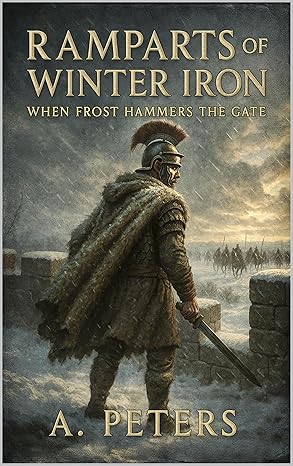

Ramparts of Winter Iron is a gritty and tightly woven historical fantasy set on the snowy fringes of a fading Roman frontier. The story follows Flavius Marcellinus, a seasoned Roman officer tasked with holding the fortress city of Caesarea against a rising tide of nomadic Alan invaders. With only raw recruits, improvised weapons, and the bitter cold at his back, Marcellinus must forge discipline out of desperation. The novel tracks his struggle through military drills, political tension, and a climactic night raid meant to cripple the enemy’s supply line. It’s both a tale of war and a meditation on duty, leadership, and the endurance of civilization under siege.
What I loved most was the sheer sense of place. The cold felt like a character all on its own. It was biting, unforgiving, and always present. Peters’ writing style is direct and powerful. There’s no fluff here, no purple prose. Every sentence pulls its weight. I appreciated how the author balanced action with introspection. Marcellinus isn’t a superhero. He’s tired. He doubts himself. But he pushes on. That kind of worn determination struck a chord with me. The battles are gripping, the tactics believable, and the stakes always feel real.
The book asks a lot from the reader. You’re dropped right into a cold and crumbling world with little time to catch your breath. At times, I found the sheer amount of logistical detail overwhelming, especially regarding the tactics. It’s clear the author did his homework, and I admire that. This book is a great pick for readers who love diving into the gritty, boots-on-the-ground details of Roman combat, from shield formations to siege engines and everything in between. But the details slow the story in moments when I wanted the story to move. Still, those slow patches are outweighed by the raw emotional honesty of the characters. Antonus, the reluctant farmer-turned-soldier, especially stood out. He gave the story a human core beyond all the spears and orders.
Ramparts of Winter Iron surprised me with its depth. It’s about building something worth protecting when the world seems bent on tearing it down. I’d recommend it to readers who enjoy Roman-era fiction, military history buffs, and anyone who’s drawn to stories of quiet bravery and stubborn hope.
Pages: 259 | ASIN : B0F71QK934



