Blog Archives
How We Fill Those Vast Empty Spaces

Late in the Day follows three people who find solace and companionship in one another’s company and together forge a path ahead. What was the inspiration for the setup to your story?
The inspiration was a slow-growth idea that incubated during my longstanding habit of dining out alone in hushed, dimly lit restaurants. I enjoy observing couples at other tables, especially couples who have clearly been together for a long time. I can feel their history at work in their gestures and in the snippets of conversation that I overhear, and it gives me enormous pleasure. At the same time, I wonder how deep the grief and sense of upheaval would be when such couples are separated—by betrayal, by death, or by a slow, gray dissolve. How does one learn to be alone? Is it possible to create another rich history with someone new? Is there enough time and energy? These considerations pressed on me as I grew older, and I wanted to write a story about how such circumstances could play out, how solitude and loneliness take on a different hue as we grow older. And then there is the flip side of loneliness: attachment. How we lose or give up (voluntarily or involuntarily) the people and the objects that gave us a sense of home for so many years, and how we fill those vast and empty spaces.
Your characters are compelling and well developed. What were some driving ideals behind your character’s development?
First of all, let me say how pleased I am that you found my characters to be compelling and well developed, especially since they couldn’t be more different from one another. My driving ideal was a difficult one: to let my characters have some say over who they are. We fiction writers like to think that we have total control over our novels, and in trying to exert that control we often do our characters a great disservice. We can easily flatten them—even suffocate them—with our own desires and needs, rather than letting them show us how they need to evolve. Like any relationship, the relationship between an author and a character is a give-and-take enterprise. As a writer, I need to give space for each character to chart a course. When my characters surprise me with an action or reaction that I hadn’t planned for in the novel, I know I’m on the right path. Another driving ideal for me is to focus on the small things: Will this character say “Yes” or “Yeah”? Will she brush a wisp of hair away from her face or let it hang there? Will he stroke his beard or let his hand rest quietly on the table? Will they walk hand in hand or simply let their arms brush up against each other from time to time? For me, the accrual of such details creates the real and lived-in character.
What were some themes that were important for you to explore in this book?
I was most interested in exploring the possibility of connection, companionship and renewal at a stage in life when we realize that we don’t have all the time in the world to make our life work out the way we assumed it would. As I was putting the final touches on the book, I happened to read an article by Jennifer Senior in The Atlantic. One paragraph struck me in particular. She wrote, “Of course, all deep friendships generate something outside of themselves, some special and totally other third thing. Whether that thing can be sustained over time becomes the question. The more hours you’ve put into this chaotic business of living, the more you crave a quieter, more nurturing third thing, I think. This needn’t mean dull…There’s loads of open country between enervation and intoxicating. It’s just a matter of identifying where to pitch the tent. Finding that just-right patch of ground, you might even say, is half the trick to growing old.” After I read that paragraph, I felt as if she had been looking over my shoulder the entire time that I’d been working on the novel to see if my three characters—strangers to each other and with little in common except their advanced years and their measured solitude—could find that place to pitch their tent, quietly and together.
What is the next book that you are working on and when will it be available?
I am finishing up a solid first draft of another novel. This one is shorter—about 200 pages—and is quite different from my other two novels. The main differences are that it is written in the first person, and the time span of the novel covers about 60 years. My other novels were much longer, were written in the third person, and covered very short time periods. I’m not ready to disclose what the novel is about, but I will say that I believe it’s my best work to date. And my cohort of trustworthy beta readers feel the same way. I’m very excited about it and hope to have it finished and ready for publication in about a year. But who knows? Maybe one of the characters will surprise me with an unexpected path and it will take longer!
Author Links: Amazon | GoodReads
In their advanced years, Honey, Hank and Seth didn’t expect to find themselves unattached through divorce, separation and death. They have little else in common except their morning ritual of taking a solitary walk along the same stretch of Florida coastline to behold the sun breaking through the horizon line with equilibrium and serenity, day after day. Each morning draws them closer until they relinquish their solitude and seek one another out. At first, silence is broken by polite conversation, stillness by small gestures. The bond between them slowly sets roots that are deep enough to guide them toward a bold decision that both embraces and defies their solitary condition and their advanced years.
Late in the Day is a lucid and sober meditation on the possibility of connection, companionship and renewal in three lives that have narrowed with time. With a keen eye for detail, Shapiro chips away at the crust of aging. Something more complex and delicate emerges with a realism that is simultaneously stark, poetic and deeply felt as Honey, Hank and Seth chart a future that is neither straightforward in their hope nor liberated from their pain.
Late In the Day
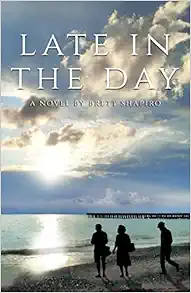

We all sit and think about the future and what’s to come. What should we expect when a tragedy befalls us? Such as losing a loved one. We shake at the mere thought of it. Brett Shapiro’s thought-provoking book, Late in The Day, explores this emotional strife in a thoughtful and candid way that makes the idea approachable.
This enlightening book follows three individuals in three different settings; all wandering in a very similar path in life however. Honey, Hank, and Seth find themselves feeling this sense of detachment in life due to troubled personal circumstances with their spouses, or late spouses. Hank’s wife, Marilyn, died five years ago. His children live afar, leaving him on his own for most of the time except for on special occasions. Seth is left with Winston, his dog, following his divorce with his husband, Yoni. Honey lives with her husband, but not really. Having minimum interactions as they see each other in passing, to sleeping in different rooms to his sudden death. All three are fighting their own battles, but on similar grounds; isolation on Florida’s coastline.
Readers follow the three as they encounter each other due to their similar ritual of a solitary walk on the beach at five in the morning. Their friendship develops further with every step and every walk. Through this friendship the three find the companionship they’ve subconsciously been longing for and find solace in each other.
Late in the Day explores the harsh realities of life and conveys interesting ideas through a unique and uncensored perspective. This heartfelt story also gives a sense of hope to readers and teaches a valuable lesson. Companionship doesn’t just come from a romantic relationship; it could also come from friendship. And no matter what stage in life you are, it’s never too late to make friends!
One of my favorite sayings from the book is an exchange between Hank and Honey, where Hank says, “Nothing belongs to us. We don’t possess anything.” To which Honey responds, “but there are certain things that we cling to anyway, as if our life depended on it. For me, it’s this place. If this place has to change, I want to have a say.” This is a profound exchange that reflects the contemplative feel of the whole book.
Pages: 358 | ASIN: 1639885331




 LITERARY TITAN