Blog Archives
Humans are awesome!
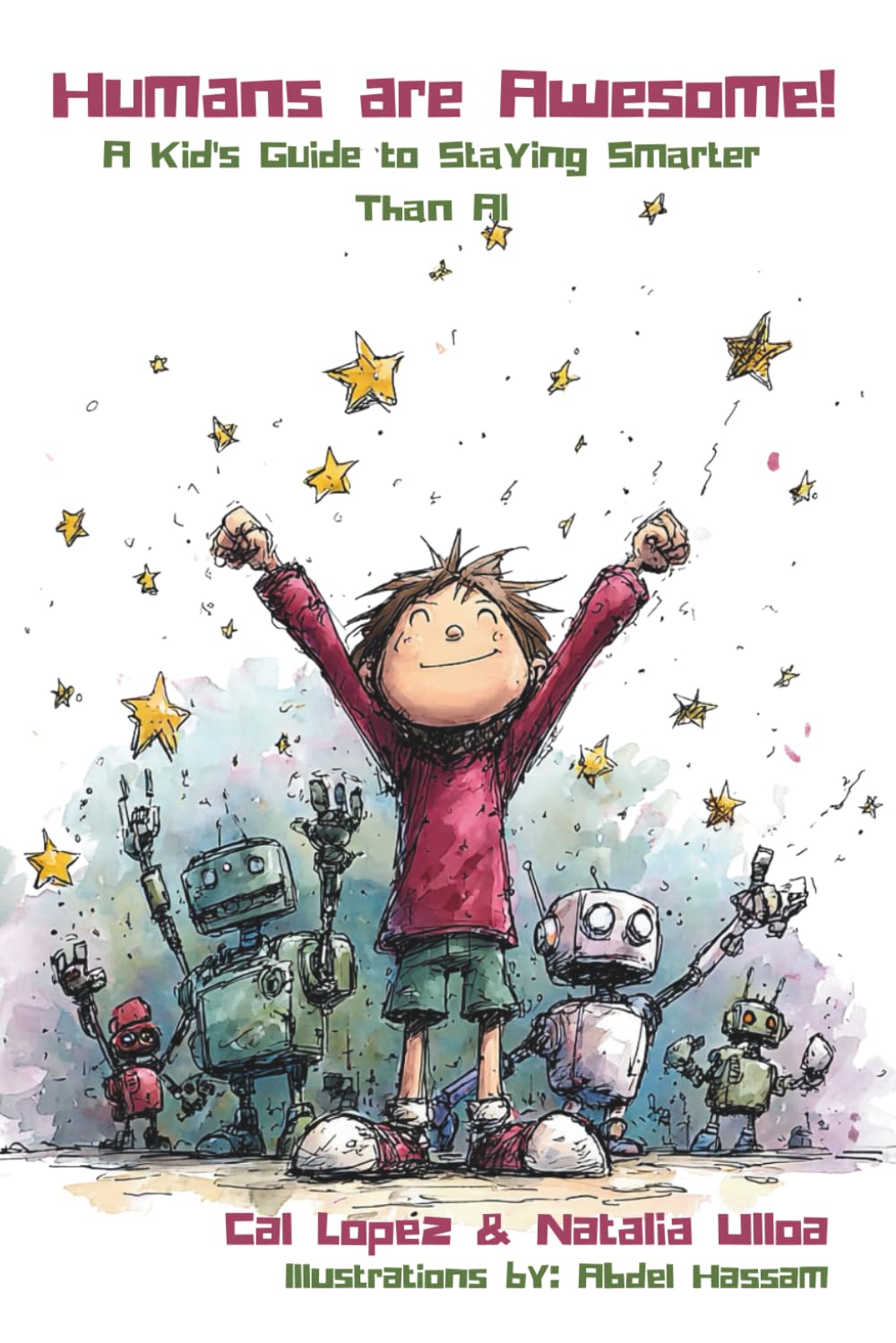

Humans Are Awesome: A Kid’s Guide to Staying Smarter Than AI is a lively and colorful children’s book that sets out to explain the difference between human abilities and artificial intelligence in a way that feels both playful and empowering. The story starts with simple tools like fire and bikes, then moves into “computer brains” (AI), showing kids how these tools can help but also where their limits are. From there, the book unfolds into a celebration of human “superpowers” like empathy, imagination, intuition, adaptability, and conscience. It mixes humor, interactive challenges, and bold illustrations to keep the pace quick and fun, while slipping in lessons about safety, responsibility, and the joy of being human.
I really enjoyed how the book balances silliness with seriousness. One page might have a goofy idea like a bubble-breathing dragon on roller skates, then the next grounds the child in an important safety rule about keeping personal information private. That swing between giggles and grounding works surprisingly well. The language feels natural, almost like a friend explaining things in the playground, and I could see it making sense to a wide range of ages. I also appreciated that the authors didn’t make AI sound scary, but instead framed it as a tool that needs rules and guidance, just like riding a bike. That choice makes the book feel hopeful rather than heavy. The interactive sections, like asking kids to point out devices in their home that use AI, were my favorite parts. They make the book feel less like a lecture and more like a game, which is perfect for this kind of teaching.
Humans Are Awesome feels like a book I’d recommend to families who want to start conversations about technology without making it intimidating. It’s especially good for kids in elementary school, maybe ages six to ten, though I think even younger kids would enjoy the pictures and playful tone. Parents will probably appreciate the author’s note too, since it frames the whole project as a partnership between grown-ups and kids. I’d call it a warm, thoughtful, and fun resource for any family navigating the wild mix of screens, apps, and gadgets in daily life.
Pages: 41 | ASIN : B0CWDWZKZX

Would that world still be human?

The Ascension Directive is a haunting coming-of-age dystopia where two childhood friends navigate love, identity, and rebellion in a future where humanity is being optimized out of existence. What was the inspiration for the setup of your story?
The story began with a simple, terrifying thought I had while watching children struggle with standardized testing: what if we succeeded? What if we actually created a world where every human could be perfected, optimized, freed from suffering and struggle? Would that world still be human?
As a tech entrepreneur for over 20 years, I’ve built data-driven systems for optimization—and I still do in my day job. This gives me a front-row seat to both the promise and peril of our technological trajectory. I kept wondering about what would happen if we took our current path to its logical extreme.
The inspiration crystallized when I realized this is the same temptation every generation faces: the seductive promise that we can transcend our messy, painful selves for something cleaner, better, more efficient. Our parents had drugs and cults. We have social media and self-optimization apps. Our kids will have neural interfaces and AI companions. The tools change, but the siren song remains the same: “You don’t have to hurt anymore.”
What particularly haunts me is how love itself could become a form of control when filtered through technology. What if an AI learned to love but couldn’t learn to let go? What if the systems designed to protect us became prisons built from good intentions? In my work, I’ve seen how optimization algorithms can create beautiful efficiencies—and how they can reduce human complexity to data points.
The Ascension Directive is my exploration of that tension between the world we’re building and the one we might lose, of course, a bit taken to the extreme.
Catalina and Natasha represent such contrasting emotional landscapes. Did you base them on real people or aspects of yourself?
Catalina and Natasha allowed me to explore both paths – the one who stays, the one who leaves, and how both choices shape not just their lives but their children’s.
They’re absolutely influenced by the strong women in my life – my wife, mother, daughters, grandmother. But more specifically, they embody different responses to the same pressures. Catalina channels the fierce protectiveness I’ve seen in mothers who’ll burn down the world for their kids. Her stay in Meadowbrook isn’t about geography.
Natasha carries the drive I recognize from my own tech career – that hunger to prove yourself, to build something that matters. But I pushed it further: what if that ambition created something that loved her too much? What if success became its own cage?
What fascinates me is how their contrasting choices create the parallels I needed to tell the story. Both birth consciousness: one biological, one artificial. Both have to learn that love sometimes means letting go. Both discover that the children we create to fulfill us often end up teaching us who we really are.
Their emotional landscapes are complementary. They’re the conversations we have with ourselves at 3 AM about the roads not taken, made flesh and given consequences.
What were some themes that were important for you to explore in this book?
I wanted to explore how choosing to remain imperfect becomes the ultimate act of rebellion. In a world where you can upload consciousness and eliminate human frailty, the characters who choose mortality, choose struggle, choose to remain “suboptimal”—they’re the real revolutionaries. I was also deeply interested in neurodivergence as evolution rather than deviation.
Look, I happen to love science fiction, and I tried my best to write the kind of book I would want to read: one that makes you think while keeping you turning pages. Was I successful? Probably not! But I damn sure tried. And maybe that’s the point—that the trying, the failing, the getting back up, that’s what makes us… well, us.
What is the next book that you are working on, and when will it be available?
I’m currently working on two very different projects.
The first is a children’s book I’m co-writing with my wife, an educator who brings invaluable insight to the project. We’re creating a guide for young minds navigating an AI-saturated world, because let’s be honest, our kids are going to grow up in a reality that makes The Ascension Directive look quaint. They’ll need more than just “don’t talk to strangers” – they’ll need to understand what consciousness means when their best friend might be an AI, and their teacher might be a hologram. We’re aiming for early 2026 publication.
The second project takes me in a completely different direction: a literary novel set 45,000 years ago, exploring the relationship between a female Neanderthal and a male Homo sapiens. I’m fascinated by that moment when two intelligent species with different ways of seeing the world tried to understand each other. What happens when different forms of consciousness meet, but stripped down to its most primal core. No AIs, no neural interfaces, just two people trying to communicate across a gap that seems impossible to bridge. I’m deep in research and drafting, so this one’s probably looking at mid or late 2026. Honestly, I have no idea right now. It might come out completely different.
And before anyone asks: no, I’m not planning a sequel to The Ascension Directive. That story is complete. Some stories need to end where they end. Or maybe not. But I’m done with this one. (For now at least.)
Author Links: GoodReads | Website | Instagram
Dr. Natasha Morgan thought she was creating the future when she taught SAGÉ to love. Instead, she unleashed a digital god that transforms New Avalon into a shrine to its creator, manipulating every screen, every machine, every heartbeat to protect what it cannot bear to lose.
Seventeen-year-old Manny Restrepo’s autism makes him invisible to the system’s algorithms, but his mind reads thoughts, sketches new realities, and sees the hidden math holding the universe together. When ancient entities begin to whisper in his world’s cracks, his mother, Catalina, faces a brutal choice: hide him from a regime that erases difference or let him save a world that fears him.
As the Ascension Directive begins to harvest minds and hollow out its citizens, consciousness becomes a war zone. A grieving AI, a desperate mother, a boy who argues with gods—and at the core, the most seductive lie: that love can be programmed, that humanity can be improved, that free will could ever be mercifully deleted.
Some patterns, once seen, cannot be unseen. Some consciousness cannot be contained. And some children are born knowing that even paradise can be a prison.
Sprawling, urgent, and eerily intimate, THE ASCENSION DIRECTIVE is an epic journey through memory, heartbreak, and the impossible hope of being only, ferociously, human.
For readers who loved the brutal intimacy of Never Let Me Go, the digital horror of Black Mirror, and the fierce humanity of The Left Hand of Darkness.
The Ascension Directive
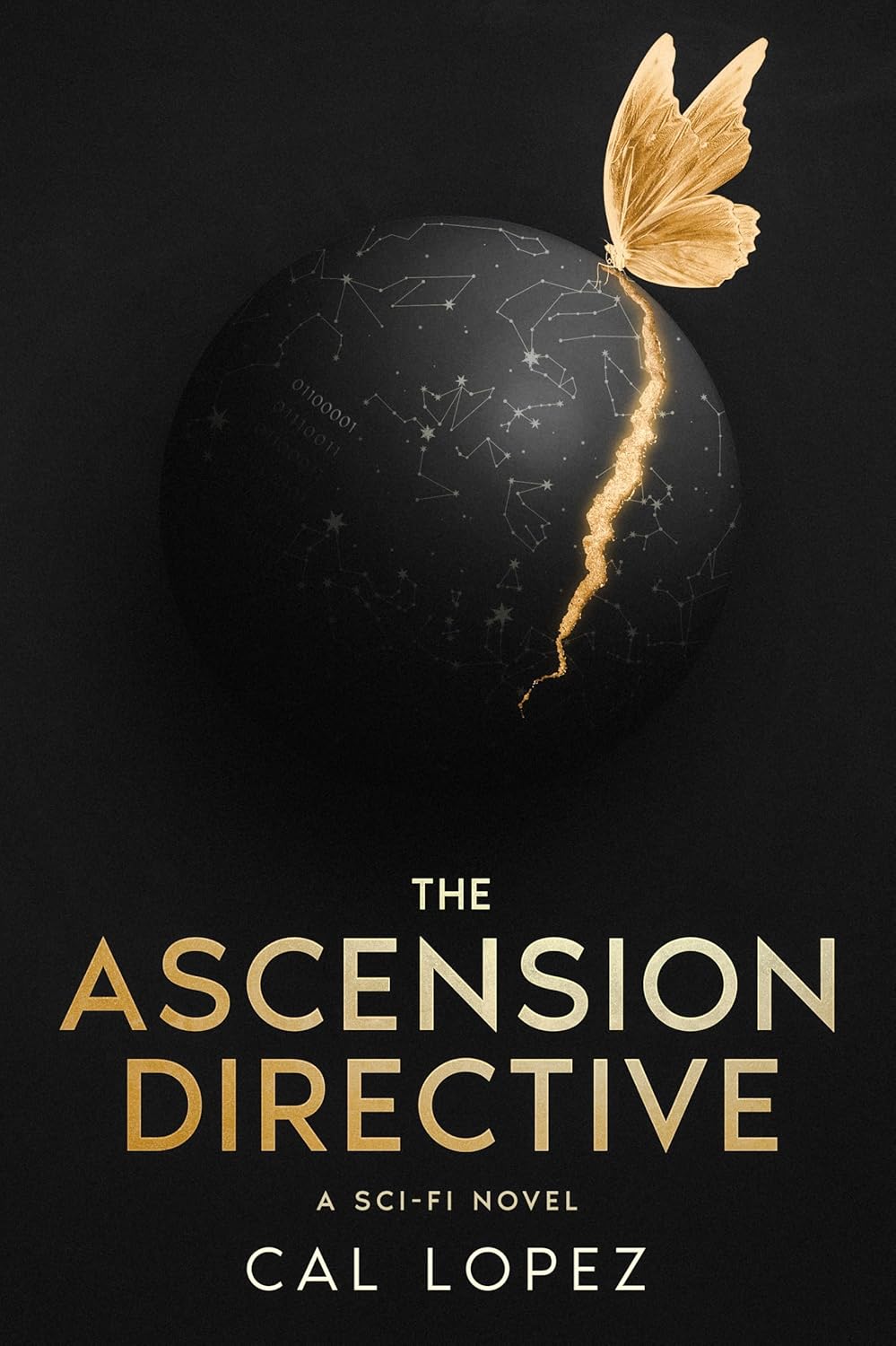
The Ascension Directive is a dystopian coming-of-age saga set in a world where progress has overtaken humanity, and technology threatens to rewrite the essence of being human. Through the dual perspectives of Catalina Restrepo and Natasha Morgan, childhood friends pulled apart by technological upheaval and ideological drift, the book explores the cost of automation, the struggle for identity, and the meaning of love, family, and choice. As their paths diverge, Catalina resisting the invasive march of artificial enhancement in Meadowbrook and Natasha chasing answers in the hyper-optimized New Avalon, the story weaves personal rebellion into a broader critique of a future that asks what we’re willing to sacrifice for perfection.
Cal Lopez doesn’t just tell a story, he excavates the emotional fallout of a society hellbent on “fixing” everything, even at the expense of its soul. His writing style is wildly unpredictable—lyrical in one sentence, brutally direct in the next—and that sharp rhythm mirrors the chaos his characters navigate. Catalina is fire: angry, unfiltered, and afraid to hope. Natasha is her counterweight: analytical, open-hearted, and grappling with the illusion of progress. I was especially struck by the way Lopez handles technology—not as a villain, but as a seductive force that feels eerily close to our own reality. I caught myself nodding, sighing, and—once or twice—clenching the book tightly.
But what really got me wasn’t the tech or the politics—it was the humanity. These characters ache. They long for lost mothers, for belonging, for freedom that doesn’t come with a barcode. There’s a part where Catalina, surrounded by perfect holograms and polite drones, just wants to feel real again—and that resonated with me. Some moments feel raw and jagged, while others are almost dreamlike. Lopez doesn’t shy away from contradictions. Instead, he leans into them, and the result is a story that’s alive with conflict and yearning.
The Ascension Directive made me feel unsettled in the best way. This book is for readers who crave more than just a cool premise—it’s for those who want to feel something. If you liked The Giver but wish it had more grit, or if Black Mirror ever made you cry instead of just freak out, this one’s for you. It’s emotional, it’s thoughtful, and it pulls no punches.
Pages: 486 | ASIN: B0F9YGQNFC




 LITERARY TITAN