Blog Archives
Government’s Role in Religion

Thrown to the Wind follows a young boy and his family fleeing religious persecution from France who wind up on a journey to America. What was the inspiration for the setup of your story?
I have been researching my family genealogy for over 20 years and came across a note in the family histories that claimed that Etienne Gayneau, Sr. and his family fled La Rochelle in the middle of the night to avoid arrest. That intrigued me, so I started digging and found records showing where he lived, even down to the description of the white and blue tilework, and others indicating that 400 Huguenots did, in fact, flee the city in October of 1664. This was during King Louis XIV’s rise to power in his own right as he came of age. I was able to find ship logs, and passenger lists with the travel amounts owed, and then fill in the historical context with information from the King’s decrees (in translation) and other historical background. And the story started to take shape.
Did you find anything in your research of this story that surprised you?
The most surprising thing I discovered was an accounting in the old New Harlem records about how Etienne had been attacked and arrested for “stealing” cherries from Mr. Palmer, who was renting Captain Carteret’s house. The situation was played out and resolved as I described in the book, though the actual event took place a few years later than in my book. The event was simply too good of a story to leave out and resolved a plot point I had, so I included it.
What were some themes that were important for you to explore in this book?
As a history teacher, the curriculum required that we compare and contrast the various reasons for colonization and the colonies in New England, the middle colonies, and Southern colonies. As I was researching this book, I saw a lot of the same themes, but relating to a colony we often ignore in mainstream classrooms. So, it seemed natural to explore them in this story.
The main theme is that of the reasons for immigration to a new and foreign land. As teachers, we often over-simplify them to say that the Pilgrims and Puritans came seeking the freedom to practice their own religion, while the Jamestown colonists came to pursue economic ventures. But as we can see from Etienne’s story, it is more complex. Others also came for religious freedom, but also to pursue trade and to provide a better life for their families.
There is also the theme relating to the government’s role in religion. Two of the freedoms granted in our First Amendment are freedom to practice our own religions, and freedom from a state-instituted religion. These freedoms have direct linkages back to the reasons many settlers came to our shores in the 17th century.
Is this the first book in the series? If so, when is the next book coming out, and what can your fans expect in the next story?
Thrown to the Wind is the first book in the series. The second book, A Home in the Wilderness, and the third book, At the Mercy of the Sea, are both out now.
In the second book, Etienne must navigate the challenges of living in the wilderness. He makes friends with two Lenape teens. When word of an Esopus attack on the Dutch fort at Wiltwyck reaches New Harlem, the settlement begins to build fortifications and to train the militia for war. Etienne is torn between protecting his family’s community and his new Lenape friends, as he becomes embroiled in the Second Esopus War. This book demonstrates the complexity of knowing friend from foe and the diverse relationships between various colonial groups and diverse Native American tribes.
The third book continues Etienne’s journey as he returns to the sea as a sailor, and adds the stories of Alsoomse, Etienne’s Lenape friend, and Abraham, a new friend he meets in the second book. It deals with several coming-of-age themes as all three young people are rebelling against what is expected of them as they try to find places within their respective communities. This book deals with issues relating to gender roles, mixed ethnicity, and standing up for what is right when no one around you supports your stance.
I am working on the fourth book, which should finish this series. I am hoping to get it out next year.
Author Links: GoodReads | Twitter | Facebook | Website | Amazon
Based on a true story.
In October 1660, Etienne Gayneau rushes through the cobblestone streets of La Rochelle, France, to meet his cousin at the harbor. A ship carrying King Louis XIV’s elite musketeers is docking. He dreams of becoming one himself, but has no idea that their arrival will force his Huguenot family to flee in the dead of night. His cousin has offered him a safe haven. Now he must choose – stay and pursue his dream or leave and face an uncertain destiny. Both choices are fraught with dangers. Either way his life will never be the same.
This story traces one boy’s journey from France to America in 1660 as he finds the courage to save himself and those he loves. Etienne Gayneau’s family is fleeing La Rochelle in the dead of night to avoid his father’s certain arrest in the morning, but his cousin has offered him a safe haven. Now he must choose. If he leaves with his family, he will never become a musketeer, but if he stays, he will never see his parents and sisters again. Bothe choices are fraught with dangers and uncertainty. One this is sure – his life will never be the same again.
did in fact flee the city in October of 1664. This was during King Louis XIV’s rise to power in his own right as he came of age. I was able to find ship logs, passenger lists with the travel amounts owed, and then fill in the historical context with information from the King’s decrees (in translation) and other historical background. And the story started to take shape.
Did you find anything in your research of this story that surprised you?
The most surprising thing I discovered was an accounting in the old New Harlem records about how Etienne had been attacked and arrested for “stealing” cherries from Mr. Palmer, who was renting Captain Carteret’s house. The situation was played out and resolved as I described in the book, though the actual event took place a few years later than in my book. The event was simply too good of a story to leave out and resolved a plot point I had, so I included it.
What were some themes that were important for you to explore in this book?
As a history teacher, the curriculum required that we compare and contrast the various reasons for colonization and the colonies in New England, the middle colonies, and Southern colonies. As I was researching this book, I saw a lot of the same themes, but relating to a colony we often ignore in mainstream classrooms. So, it seemed natural to explore them in this story.
The main theme is that of the reasons for immigration to a new and foreign land. As teachers we often over-simplify them to say that the Pilgrims and Puritans came seeking the freedom to practice their own religion, while the Jamestown colonists came to pursue economic ventures. But as we can see from Etienne’s story, it is more complex. Others also came for religious freedom, but also to pursue trade and to provide a better life for their families.
There is also the theme relating to the government’s role in religion. Two of the freedoms granted in our First Amendment are freedom to practice our own religions, and freedom from a state instituted religion. These freedoms have direct linkages back to the reasons many settlers came to our shores in the 17th century.
Is this the first book in the series? If so, when is the next book coming out, and what can your fans expect in the next story?
Thrown to the Wind is the first book in the series. The second book, A Home in the Wilderness, and the third book, At the Mercy of the Sea, are both out now.
In the second book, Etienne must navigate the challenges of living in the wilderness. He makes friends with two Lenape teens. When word of an Esopus attack on the Dutch fort at Wiltwyck reaches New Harlem, the settlement begins to build fortifications and to train the militia for war. Etienne is torn between protecting his family’s community and his new Lenape friends, as he becomes embroiled in the Second Esopus War. This book demonstrates the complexity of knowing friend from foe and the diverse relationships between various colonial groups and diverse Native American tribes.
The third book continues Etienne’s journey as he returns to the sea as a sailor, and adds the stories of Alsoomse, Etienne’s Lenape friend, and Abraham, a new friend he meets in the second book. It deals with several coming-of-age themes as all three young people are rebelling against what is expected of them as they try to find places within their respective communities. This book deals with issues relating to gender roles, mixed ethnicity, and standing up for what is right when no one around you supports your stance.
I am working on the fourth book, which should finish this series. I am hoping to get it out next year.
Author Links: GoodReads | Twitter | Facebook | Website | Amazon
Based on a true story.
In October 1660, Etienne Gayneau rushes through the cobblestone streets of La Rochelle, France, to meet his cousin at the harbor. A ship carrying King Louis XIV’s elite musketeers is docking. He dreams of becoming one himself, but has no idea that their arrival will force his Huguenot family to flee in the dead of night. His cousin has offered him a safe haven. Now he must choose – stay and pursue his dream or leave and face an uncertain destiny. Both choices are fraught with dangers. Either way his life will never be the same.
This story traces one boy’s journey from France to America in 1660 as he finds the courage to save himself and those he loves. Etienne Gayneau’s family is fleeing La Rochelle in the dead of night to avoid his father’s certain arrest in the morning, but his cousin has offered him a safe haven. Now he must choose. If he leaves with his family, he will never become a musketeer, but if he stays, he will never see his parents and sisters again. Bothe choices are fraught with dangers and uncertainty. One this is sure – his life will never be the same again.
Thrown to the Wind
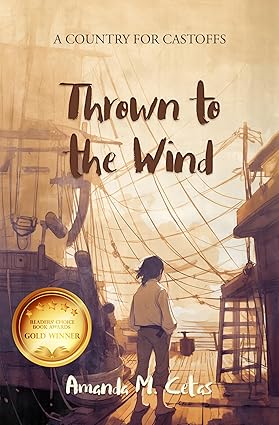

Thrown to the Wind by Amanda M. Cetas transports young adult readers to 1660s France, introducing us to Etienne Gayneau, a young boy whose aspirations soar beyond his father’s wishes for him to continue the family stove-making business. Set against a backdrop of religious persecution, this historical fiction novel traces Etienne and his family’s harrowing exodus from France to Amsterdam and finally to America. Etienne, grappling with familial expectations and the loss of his brother, discovers strength in the steadfast love of his relatives. This emotional support becomes his anchor as they endure the hardships of their journey. Along the way, Etienne encounters numerous perils that test his fortitude, compelling him to either conform to family expectations or forge his own destiny.
Thrown to the Wind is an enthralling narrative of endurance, love, and the relentless pursuit of one’s future. It skillfully combines historical richness with the essence of human resilience. The tale is a testament to hope, with Etienne navigating the storms of fate in his quest for redemption and a new beginning. As a devotee of historical fiction, I approached this book with high expectations, which were not only met but exceeded. The author’s meticulous research enriches the narrative, blending historical precision with engaging storytelling. The vivid descriptions and dynamic pacing make it difficult to put the book down. Etienne’s evolution from a hesitant boy into a cornerstone of strength for his family is profoundly moving, illustrating the power of human connections formed under the most challenging circumstances. The relationships Etienne forms—whether with his cousin, a girl he bonds with, or comrades on a ship—highlight the significance of interpersonal connections across life’s tumultuous journey. His sacrifices and the poignant moments of relinquishing personal dreams for family resonate deeply, enhancing the emotional depth of the narrative. The recurring motif, “Everything will look better in the morning,” poignantly underscores the family’s daily struggles with a sense of enduring hope.
Thrown to the Wind is a captivating exploration of historical events through the lens of personal struggle and growth. It not only entertains but enlightens, leaving readers more connected to the past and reflective of the human condition.
Pages: 246 | ASIN : B07VBHD217




 LITERARY TITAN