Blog Archives
The Paradox of Progress: Book 2: The Roses and Thorns of Artificial Intelligence


Michael M. Karch’s The Paradox of Progress is a thoughtful and personal exploration of artificial intelligence and the tangled web of benefits and risks it brings to modern life. The book is framed around the central idea that progress never comes without a price. Each chapter highlights a paradox, such as self-driving cars that promise safety yet pose new dangers, batteries that drive clean energy but scar the environment, and AI in war that might save lives but could also escalate conflicts. Karch skillfully balances the roses with the thorns, using vivid historical parallels, personal anecdotes, and contemporary case studies to show how every leap forward reshapes society in both hopeful and unsettling ways.
Karch’s writing feels conversational, even playful at times, yet it never loses sight of weighty ethical questions. I especially liked how he wove his own experiences into the narrative. The self-checkout story, his Ironman accident, and his work as a surgeon with AI-driven tools. These moments gave the book texture and heart, reminding me that discussions about AI are not just technical but deeply human. The prose is clear, free of jargon, and sprinkled with humor, which makes even the most complex topics easier to digest.
What I liked most was the author’s mix of optimism and unease. His fascination with AI’s potential is genuine, but so is his fear of its misuse. I shared his awe at the possibilities. Medical breakthroughs, global problem-solving, and smarter systems that could ease human suffering. And I shared his anxiety about the darker flipside. Bias in algorithms, surveillance, widening inequality, war machines that act faster than human conscience. The book stirred both excitement and caution in me, sometimes within the same page. It left me reflecting not just on AI, but on human nature, since at its core, this isn’t a book about machines. It’s about us, our flaws, our hopes, and our choices.
I think The Paradox of Progress is a book best suited for readers who are curious about AI but not looking for a technical manual. It’s written for people who want to think, not just learn facts. I’d recommend it to policymakers, students, teachers, and anyone who has felt both wonder and dread at the pace of change around us. It’s not a book that will tell you what to believe about AI. Instead, it invites you into a bigger conversation, one that we all need to be having before the thorns outgrow the roses.
Pages: 236 | ASIN : B0FNDN4FYY

Reimagining Government: Achieving the Promise of AI

Reimagining Government: Achieving the Promise of AI is a comprehensive examination of how artificial intelligence can transform government from the inside out. It mixes history, technical detail, and practical advice in a way that feels both ambitious and grounded. The authors walk through the basics of AI, explain different models and their strengths, and then shift into how these tools can be applied in real government settings. They discuss frameworks such as OPEN and CARE, portfolio approaches to project management, and the importance of leadership and culture. The book argues that AI is not just about technology, but also about people, values, and institutions, and that governments must rethink themselves to keep pace with the changes AI brings.
The writing is clear and avoids the usual hype that surrounds AI, which was refreshing. Instead of promising magic, the book insists on responsibility and balance. I appreciated how it didn’t gloss over risks like bias, hallucinations, or policy drift. The authors don’t just flag these issues; they provide ideas for handling them. That gave the whole thing a sense of credibility. The frameworks felt a bit rigid at times, but I understood why they were there. They give structure to a messy and fast-moving space, and in a government context, structure is probably what’s needed.
What struck me most was the way the book spoke about leadership and culture. I could feel the urgency in their words, almost like a call to action. It reminded me that technology alone doesn’t fix anything. It’s people who make the choices, who decide how much to embrace risk, and who shape whether AI becomes a tool for service or just another layer of bureaucracy. I liked that tension. It made the book feel real rather than utopian. I wished for more stories or case studies of where this has worked well already. I think that would have given it more life and less of a playbook vibe.
I would recommend this book to policymakers, civic leaders, and even curious citizens who want to understand where government and AI are heading. It’s approachable and avoids drowning in jargon. If you’re looking for a thoughtful and practical guide that treats AI as both a promise and a problem, this is a book worth your time.
Pages: 288 | ASIN : B0FLDZHCR5

Governance in the Quantum Era

Quantularity: A Quantum Framework for the Human Experience challenges the theory of Singularity by hypothesizing that, instead of one super-intelligence consuming everything, there is a world where many minds —human, artificial, cultural, and even biological —intertwine without collapsing into sameness. Where did the idea for this book come from?
The idea for Quantularity emerged from years of questioning whether the dominant narrative of Singularity truly captures the future we are heading toward. Ray Kurzweil’s vision of one all-consuming super-intelligence felt incomplete. I began exploring an alternative, a framework where many minds, whether human, artificial, cultural, or even biological, remain distinct yet interconnected. Instead of collapsing into sameness, they amplify one another through entanglement. That seed of thought became the foundation for this book.
In your book, you cover philosophy to technology to governance, weaving stories of history, myth, neuroscience, and quantum theory into a vision that feels both speculative and strangely practical. How did you approach researching this book, and what was your process for compiling it?
My research was intentionally multidisciplinary. I drew from neuroscience (especially work on the neocortex), philosophy of mind, cultural studies, and quantum physics. I also leaned heavily into myth, religion, and history. I believe meaning arises at the intersections. The process itself was nonlinear, much like the ideas I write about. I journaled, drafted essays, debated with colleagues, and mapped connections across fields until a coherent framework emerged. The writing then became an act of stitching these threads together into a narrative that feels both visionary and grounded.
What were some ideas that were important for you to share in this book?
Several core ideas guided me:
That cooperation and entanglement, not domination, are the forces driving the next chapter of human and technological evolution.
That consciousness is not limited to humans or machines, but can emerge across networks, cultures, and even ecosystems.
That governance in the quantum era must be decentralized, transparent, and adaptive, designed for multiplicity, not centralization.
And most importantly, that our humanity is not diminished by technology. Instead, it can be expanded if we build with intention.
What is one thing that you hope readers take away from Quantularity?
I want readers to leave with a sense of possibility. We do not have to accept a future of either machine domination or human obsolescence. Instead, we can imagine and design a world where multiplicity thrives, where diversity of thought and being is preserved, and where our interconnectedness becomes a source of resilience and creativity.
Author Links: GoodReads | X (Twitter) | Website | Amazon
In Quantularity: A Quantum Framework for the Human Experience, visionary thinker and technologist John Wingate dismantles the myth of the Singularity—that moment when artificial intelligence eclipses human thought—and offers a bold alternative: a future where intelligence doesn’t converge into one mind, but expands into many. A future defined not by domination, but by connection.
Spanning quantum physics, AI, distributed systems, neuroscience, and spirituality, this groundbreaking book explores the emergence of a new kind of consciousness—layered, networked, and co-created between humans and machines. Wingate weaves deep science with poetic insight, challenging readers to rethink intelligence, identity, value, and the very architecture of reality.
Inside, you’ll explore:
Why the Singularity is a flawed and incomplete vision of the future
How consciousness may be fractal, recursive, and quantum in nature
The role of AI as a mirror—not a master—of human dreams
How distributed ledgers can serve as society’s new trust fabric
The shift from scarcity economics to coherence economics
New models of education, governance, and collective memory
Why choice—not control—is the foundation of reality’s unfolding
This isn’t science fiction. It’s a blueprint for what’s already emerging.
With 20 thought-provoking chapters, Quantularity is a guide for leaders, technologists, spiritual seekers, and anyone who senses that something deeper is awakening in our relationship with intelligence—human or otherwise.
Wingate calls us to remember that we are not passive travelers in this next era. We are co-creators, resonant nodes in a conscious, evolving universe. As we move beyond mechanistic systems into fields of entangled awareness, the most important question isn’t “Will AI surpass us?”—it’s “Who do we become when we remember what we are?”
Whether you’re a futurist, founder, developer, or philosopher, Quantularity offers a bold new lens—and a call to action.
This is not the end of our story.
This is the beginning of our remembering.
The Doctor’s Future

Dr. Pietro Garbelli’s The Doctor’s Future is a deep dive into the fast-approaching world of AI and robotics in medicine. The book blends practical guidance, cautionary tales, and a rallying cry for doctors to take charge of the transformation ahead. Garbelli covers everything from the current state of AI adoption in healthcare to predictions of where technology could lead us, both in best-case and worst-case scenarios. He introduces the “Healthcare Convergence Framework” as a blueprint for ensuring AI serves the profession without eroding its core values of empathy, ethics, and patient-centered care. Along the way, he doesn’t shy away from discussing threats, like loss of professional autonomy or the risk of over-reliance on black-box algorithms, and he offers concrete strategies to navigate them.
Garbelli’s writing is straightforward, peppered with vivid metaphors, and there’s a clear emotional undercurrent. He’s worried about what’s coming, but he’s also hopeful. I appreciated his honesty about the profession’s blind spots, such as resistance to change and discomfort with having decisions second-guessed by machines. Some parts hit hard, especially his reflections on burnout and the fragile trust between doctors and patients. It’s not just theory; he folds in surveys, examples from different specialties, and even patient reactions to AI, which makes the book feel grounded and real.
I found myself alternately nodding along and pausing to think. The “doomsday” scenarios were unsettling, yet they didn’t feel like fear-mongering. Instead, they made the stakes clear. Garbelli’s insistence that doctors must lead, rather than follow, in this transformation stuck with me. He clearly loves medicine and wants to protect it, and that passion comes through in every chapter. There’s also an undercurrent of empowerment here: he’s not telling us to survive the AI revolution, but to shape it. That’s a refreshing change from the usual doom-and-gloom takes.
The Doctor’s Future is more than a technology primer. It’s a call to action for medical professionals, policy makers, and even patients who care about the integrity of healthcare. I’d recommend it to any doctor who’s curious, worried, or skeptical about AI, as well as to healthcare leaders responsible for steering their organizations into the next era. It’s also valuable for medical students because the sooner they understand what’s ahead, the better prepared they’ll be. If you want a book that challenges you to think critically while giving you practical tools to safeguard your profession, this one’s worth your time.
Pages: 252 | ASIN : B0FGCNY5HH
The Warrior’s Garden: Tools for Guarding Your Mind Against Big Tech


The Warrior’s Garden is a gripping and clear-eyed look at the dark side of Big Tech and its impact on our mental health, attention, and autonomy. Richard Ryan, a seasoned tech entrepreneur and media strategist, peels back the curtain on how platforms like YouTube, Facebook, and Google manipulate human behavior through targeted content, algorithms, and psychological tactics borrowed from the gambling industry. The book unfolds in two parts: “Input,” which outlines the problem and the ways tech hijacks our brains, and “Output,” which offers practical steps to reclaim control, from detoxing to building community and cultivating gratitude. Ryan also shares his personal journey, admitting how he, too, was caught in the dopamine-fueled race for views and likes, making the book feel authentic.
Ryan’s writing isn’t flowery or academic, and that’s exactly what makes it powerful. It’s blunt. Honest. Sometimes, even funny. There’s a mix of tech-savvy insight and heartfelt reflection, which makes for a ride that’s as relatable as it is eye-opening. I felt anger, shame, and even sadness at some points, especially when he described how our time and attention are commodified without our full consent. But I also felt hope. Ryan doesn’t wag his finger or tell us to throw our phones into a river. Instead, he gives tools—real, practical ones. His “Thirty-Day Challenge” isn’t gimmicky. It’s grounding. I tried a few of the exercises and, surprisingly, they helped.
What really stuck with me, though, was his personal story. Ryan was once a full-blown player in the system, pulling the very strings he’s now warning us about. That inside perspective gives him a rare credibility. He’s not preaching from a mountaintop. He’s been in the trenches—addicted to the metrics, chasing the next viral video, watching relationships wilt in the glow of a screen. That’s what makes this book more than a critique. It’s a confession. A redemption arc. And it’s written in a way that feels like a conversation with a smart, slightly battle-worn friend who genuinely wants to help you get your life back.
The Warrior’s Garden is for anyone feeling overwhelmed, burned out, or just a little uneasy about how much time they’re spending on their phone. If you’ve ever caught yourself doomscrolling or felt your mood tank after too much time online, this book is your wake-up call. It’s not for tech haters or off-the-grid purists. It’s for regular folks who want their time, focus, and peace of mind back.
Pages: 227 | ASIN : B0F4LWGPXB
Enterprise GENERATIVE AI Well Architected Framework & Patterns: An Architect’s Real-life Guide to Adopting Generative AI in Enterprises at Scale
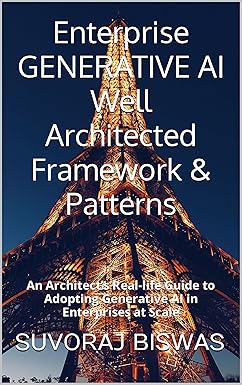
Enterprise GENERATIVE AI Well Architected Framework & Patterns by Suvoraj Biswas presents a pragmatic and insightful exploration of generative artificial intelligence (AI) in enterprise settings. Drawing from his extensive experience as a Solutions Architect, Biswas skillfully outlines various frameworks and approaches that will greatly benefit IT professionals. The book introduces the necessity of a well-architected framework for GenAI in enterprise applications, covering topics like Large Language Models, content moderation, observability solutions, and cost optimization practices.
Biswas’s work is notable for its clarity and practicality, particularly in how it makes complex concepts accessible. One of the book’s strengths is its use of real-world examples, such as the development of a QnA chatbot for legal teams, which effectively illustrates the cost-effectiveness of the RAG pattern in handling organization-specific, dynamic data. The book is well-structured, featuring reader-friendly content augmented by illustrative pictures and clear segmentations. It’s a valuable resource not just for its theoretical insights but also for its practical applications. Readers looking to implement these lessons will find the discussions on open-source tools and offerings from leading software providers like LangKit and Langfuse particularly useful. Additionally, the inclusion of actual code and screenshots of OpenAI prompts is a commendable aspect that enhances the book’s utility.
Enterprise GENERATIVE AI Well Architected Framework & Patterns stands out as a comprehensive resource for understanding and applying sophisticated technological strategies in the realm of AI. It’s an essential read for AI professionals and enterprise leaders seeking to deepen their knowledge of Generative AI or explore its various organizational benefits. This book is particularly timely, offering valuable guidance for maintaining competitiveness in the rapidly evolving AI landscape.
Pages: 117 | ASIN : B0CJ6J4F75



 LITERARY TITAN