Blog Archives
Kinker Circusing the Seventies


Kinker: Circusing the Seventies by Dave Letterfly Knoderer is a sprawling coming-of-age memoir and firsthand account of life under the big top. Beginning with a teenager determined to escape an unhappy home and pursue the dream his father helped plant, the book follows Knoderer from rookie drummer and canvas hand to animal trainer, horseman, performer, artist, and seasoned showman. Its long journey through one-day stands, winter quarters, roadside breakdowns, Canadian tours, and changing circus companies gives the story the scale of a travel memoir, while the author’s reflections on family, ambition, addiction, creativity, and belonging make it deeply personal. Knoderer describes the finished work as a story of love, dedication, risk, and the rewards of traveling show life, which captures its range well.
The book is most absorbing when it settles into the practical rhythms of the circus. Knoderer explains how tents rise and fall, how a show moves overnight, how performers respond to musical cues, and how every employee contributes to the daily transformation of an empty lot into a functioning world. His descriptions of mud, canvas, machinery, cookhouse meals, improvised repairs, livestock care, and backstage labor give this circus autobiography real documentary value. The extensive circus vocabulary feels natural because readers learn it while watching people work, and the glossary at the end turns the memoir into a useful piece of circus history as well as an adventure story.
Its emotional center is Knoderer’s need to create a place for himself. He keeps expanding his skills, sometimes recklessly, training ponies, building equipment, painting banners, learning horsemanship, developing acts, and finding fresh ways to remain useful. That drive carries him through broken vehicles, failed plans, dangerous weather, professional conflicts, substance abuse, financial strain, and a devastating accident that leaves him stranded with animals and damaged equipment. The book’s episodic structure can feel abundant, since nearly every person, project, and mishap receives room on the page, but that fullness also reflects the restless life being remembered. Knoderer’s plainspoken enthusiasm makes the historical circus memoir feel less like a polished legend and more like a long conversation with someone who still marvels at where the road took him.
By the final chapters, the many trades and relationships begin to form a coherent picture of a young man learning that independence also requires responsibility, patience, and help from others. His relationship with Beth, his devotion to his animals, and the culminating elephant performance give the ending warmth without separating it from the hard physical work that defines the rest of the book. Kinker: Circusing the Seventies is an expansive memoir about apprenticeship, reinvention, and life inside a fading entertainment tradition. Readers interested in circus history, classic horsemanship, unconventional careers, or personal stories of recovery and creative persistence will find plenty worth lingering over.
Pages: 494 | ASIN : B0DL46KMM9

Speedy Hurled Through Havoc

In Speedy: Hurled Through Havoc, David “Letterfly” Knoderer turns a life on the road into a memoir about art, fathers, horses, circus people, alcoholism, recovery, and the strange grace of finding your way by leaving home. It begins with the pull of the highway and the glamour of the circus, then keeps circling back to the ache beneath it all: a son trying to understand a difficult, dazzling father nicknamed Speedy, and a man gradually learning that talent alone won’t save him. The book moves through big-top childhood mythology, carnival midways, airbrushed RV murals, old horsemen, mentors, AA, spiritual surrender, Betty the mule, and finally a late, tender openness to love.
Knoderer writes about his father with a rare mixture of hurt and reverence, and I believed both. The father who could electrify a room with stories about locomotives, motorcycles, dirigibles, and the circus is also the father who left his son feeling unseen and not good enough. That tension gives the memoir its unique feel. I loved the way the author doesn’t simply condemn him or canonize him. Instead, he keeps turning the jewel in his hand, studying every flawed surface until some light comes through. The chapter where father and son travel together through the carnival circuit in that chrome yellow VW bus felt especially moving to me. It’s messy, funny, awkward, and alive. Reconciliation here doesn’t arrive like thunder. It creeps in through shared work, questions, asphalt, paint, and proximity.
The story is sometimes sprawling, even a little overstuffed, but I found that part of its charm. Knoderer writes like someone who has spent his life decorating surfaces, filling blank spaces with color, detail, and motion. His descriptions of the 1931 circus train arriving before dawn, the elephants raising the big top, the Wallendas on the wire, and the liberty horses moving like a living kaleidoscope are lush and immersive. The ideas are earnest, maybe old-fashioned in places, but never hollow. The book believes deeply in apprenticeship, service, animals, sobriety, forgiveness, and the healing power of work done with one’s own hands.
By the end, I felt less like I’d read a conventional memoir and more like I’d sat with a traveling artist while he unpacked a lifetime of painted panels, road dust, regrets, and blessings. It’s a generous book, and its best moments have the warmth of a story told after supper by someone who has finally made peace with the road behind him. I’d recommend it to readers who enjoy reflective memoirs about unconventional lives, circus and carnival history, folk art, recovery, father-son relationships, and the slow, stubborn work of becoming whole.
Pages: 261 | ASIN: B096C69ZM5
It Forced Me To Tell The Truth

The Galloping Snapper is a vivid memoir in which you transform loss, addiction, and restless drift into a life of craft, horsemanship, sobriety, and hard-earned meaning. Why was this an important book for you to write?
This book mattered because it forced me to tell the truth about a chapter of my life I could have easily softened or skipped. Losing the pony act wasn’t just a career shift—it was the collapse of an identity I had built my world around. What followed was drift, addiction, and a kind of quiet unraveling. Writing The Galloping Snapper became a way to face that honestly and show how meaning isn’t something you find once—it’s something you rebuild, often from wreckage. I needed to document that transformation, not just for others, but to understand it myself.
How did painting scrollwork and restoring showpieces change the way you understood performance, beauty, and your own identity?
Painting taught me that performance doesn’t end in the ring—it lives in the details people almost overlook. Scrollwork, line, balance, color—those became a different kind of choreography. Instead of movement through space, I was creating movement for the eye. I began to understand beauty as something intentional, something built through discipline and patience, not just flair. That shift grounded me. It took me from being someone who performed identity to someone who crafted it. The work slowed me down, demanded precision, and in doing so, reshaped how I saw myself—not just as an entertainer, but as an artisan.
What were some ideas that were important for you to share in this book?
I wanted to show that reinvention isn’t glamorous—it’s gritty, uncertain, and often lonely. I wanted to talk about addiction without dressing it up, about loss without rushing to resolution, and about the slow, deliberate process of rebuilding a life with integrity. Another key idea was that creativity can be a lifeline—not just expression, but survival. And underneath all of it, there’s the idea that purpose isn’t handed to you. You earn it through showing up, through doing the work, even when no one is watching.
Bingo feels like more than a horse in the book. How would you describe that partnership in your own words?
Bingo wasn’t just a partner—he was a mirror and a stabilizer. Horses don’t respond to who you pretend to be; they respond to who you actually are in the moment. With Bingo, there was no hiding. If I was scattered, he felt it. If I was grounded, he met me there. That relationship demanded honesty and presence in a way nothing else did at the time. He gave me something steady to build on when everything else felt uncertain. In many ways, he carried me—not just physically, but emotionally—through a period where I was learning how to stand on my own again.
Author’s Linktree: https://linktr.ee/letterfly
Overwhelmed by difficulties, a troubled young circus performer is forced to sell his beloved liberty horses. Although he is consumed with grief, the self-reliant and adventurous Dave recognizes the need to forge a new path and decides to take a chance on his artistic talents. He soon launches his career as an itinerate sign painter, landing among the turbulent world of the traveling carnival. Embracing the benefits of the voyager lifestyle, Dave finds talented tradesmen to mentor his insatiable curiosity and enhance his skillset.
But even his passion for his growing art can’t keep Dave’s heart from yearning for another chance to perform in the spotlight, this time with a classically trained dancing horse. He begins to seek the influential personalities of the classical dressage world to help him develop horsemanship skills and guide his seat, hand, and heart to promote oneness with horses. As his talents grow in both art and horsemanship, he is amazed to discover each of his passions influencing the other—the future looks bright with opportunities aplenty in both fields.
Yet an invisible adversary threatens to interrupt his momentum and take everything away if he can’t admit his problem. Although the evidence is strong, Dave finds himself continually falling prey to old habits with the bottle. Only after another tragedy strikes and a deep depression takes root in his heart does Dave face the facts. But perhaps hitting bottom is the bedrock upon which he can build his new life.
The Galloping Snapper Confesses Everything
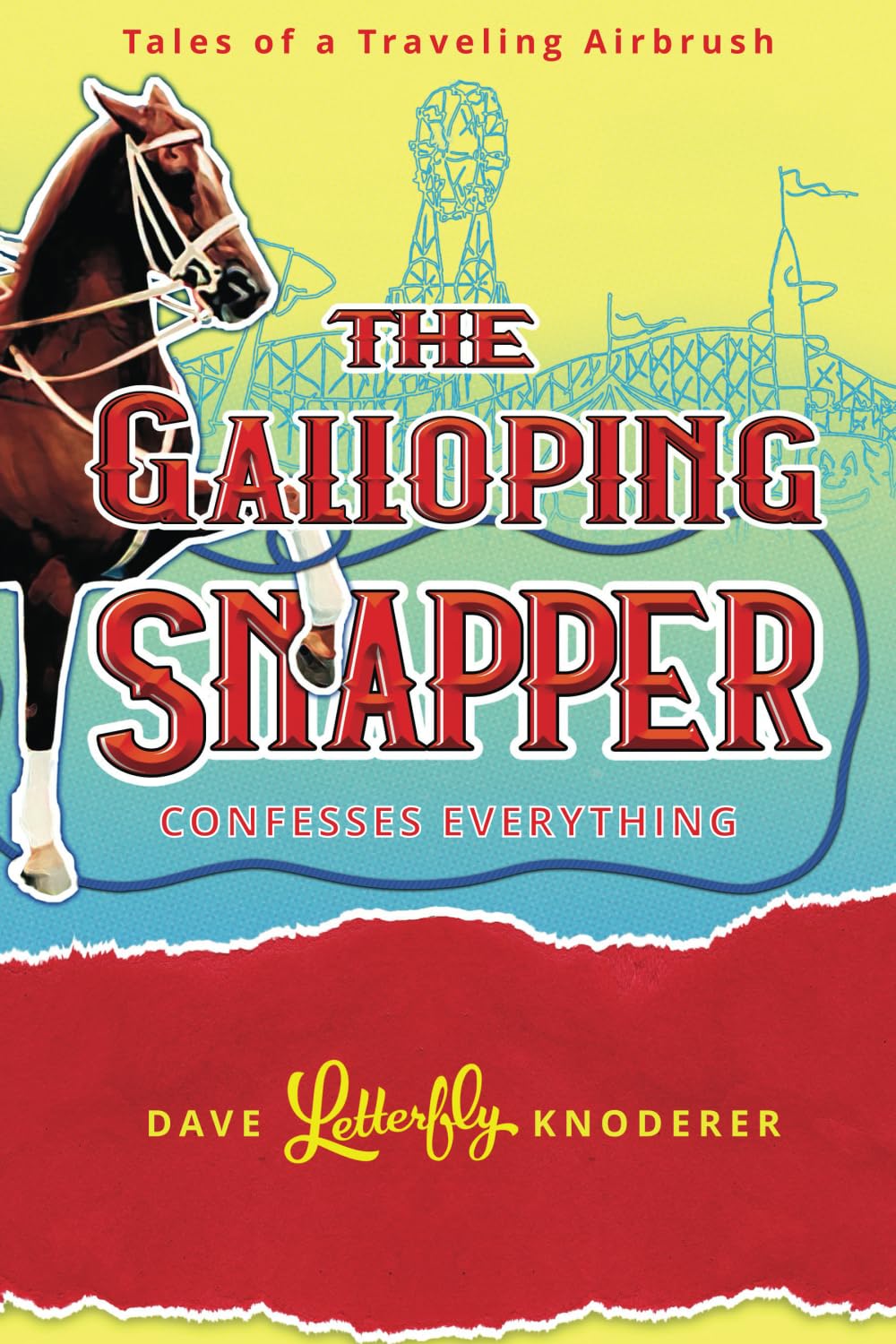
The Galloping Snapper is a memoir of reinvention. Dave “Letterfly” Knoderer begins in the ache of surrender, selling the six-pony liberty act that had given his young life shape and meaning, and then follows the long, uneven road by which performance, painting, horsemanship, family, love, and recovery slowly braid into a new self. What stayed with me most was the way the book keeps turning loss into motion. A man leaves Canada grieving his ponies, finds his way into painting ornate scrollwork on a restored calliope truck, returns to the fairgrounds and circus ring with Bingo, and eventually arrives at a harder, deeper transformation through Alcoholics Anonymous, spiritual surrender, and the making of a home and vocation that feel earned rather than merely desired. It’s a classic American road memoir in some ways, but also more intimate than that, because it never lets the outward adventure eclipse the inward reckoning.
Knoderer is very good at the tactile particulars of his world: the old White Horse van waiting for circus scrollwork, the bank of brass calliope whistles he studies stroke by stroke, the smell and clatter and competitive glitter of the midway, the gossip in the popcorn trailer, the hard practical labor behind all that spectacle. Those passages have real charm, and more than charm, they have authority. I felt the book’s affection for handmade work on every page, and I liked that its reverence for art isn’t abstract. Painting here isn’t a lofty pose. It’s weather, deadlines, ladders, gloss ruined by rain, and the stubborn joy of making something vivid enough to pull strangers closer. The prose can sometimes be very earnest, but even when the language grows florid, I rarely doubted the feeling underneath it.
What gave the memoir its emotional weight for me, though, wasn’t the carnival color but the accumulation of moral and spiritual change. The early wound of selling the ponies, the tenderness of Hayes telling him the sight of those “yellow ponies” on pasture had stayed with him, the later healing with his father on the fair circuit, and the shift from beer-soaked drift into recovery all give the book a real arc instead of a mere sequence of adventures. I was especially moved by the way the narrative keeps circling back to companionship, human and animal alike. Bingo isn’t just a horse but a partner in craft and performance. Gail arrives not as a convenient happy ending but as part of a larger reordering of life around sobriety, discipline, fellowship, and love. The AA material is openly devotional and will probably land differently depending on the reader, but I found its conviction more affecting than preachy because it grows out of ruin. The book’s deepest idea, I think, is that a life can be rebuilt not by denying its mess but by putting that mess to work in service of something steadier and more generous.
The Galloping Snapper is warm and vivid. What I came away with was less the image of a daredevil life than the harder thing: a man teaching himself, over many years, how to turn appetite into vocation, loneliness into fellowship, and spectacle into meaning. I’d recommend it most to readers who love memoirs of craft, travel, recovery, horsemanship, and old, odd corners of American show business, especially those who don’t mind a voice that runs fervent and full-hearted.
Pages: 408 | ASIN: B0CZ8TY3LS


