Blog Archives
Stigma About Suicide

In Suicide: Hope Beyond the Darkness, you offer hope and healing through firsthand stories of those who have tried to take their own lives and those who have lost loved ones to suicide. Why was this an important book for you to write?
I felt like there was a growing need for information and awareness about suicide. The more involved I was, whether studying, counselling or training people, I saw such a lack of information and so much stigma about suicide. The problem with that was that people were being negatively impacted. People stopped talking about their suicidal thoughts, which is dangerous, and people who lost loved ones to suicide were unable to talk about how they were feeling, which complicated their grief process.
I felt I had something to offer due to my knowledge and experience. That was a big part of my motivation.
And sharing stories helps people connect. People can identify with parts or all of someone’s life experience. And when we hear other people’s stories, we don’t feel so alone. We don’t feel abnormal. It helps break down fear and isolation. It helps break down the stigma.
The stories you share are highly emotional. What was the most difficult aspect of putting this book together?
I think the most challenging aspect for me was ensuring that I truly honoured the people who shared their stories with me. I wanted to ensure the voices of those who are still here were heard and to acknowledge those who are no longer with us. I wanted to be their voice too.
What is one misconception you have found through your research that many people have regarding suicide?
Unfortunately, there are many misconceptions about suicide — and every one of them is harmful.
One of the most common is the belief that talking about suicide might “put the idea” in someone’s mind and increase the risk of them acting on it. Research consistently shows the opposite to be true. Talking about suicide does not cause suicidal thoughts or behaviour. Rather, it can bring relief and open the door to hope and help.
Having a compassionate conversation about suicide can reduce distress and encourage help-seeking.
In the book, I spoke with Sally, who shared that her son was severely depressed. She was terrified to raise the topic of suicide, believing that mentioning it might make things worse. Many others I spoke with shared the same fear.
In reality, people who are depressed have often already thought about suicide. Offering a safe space to talk about these thoughts can ease their burden and provide an opportunity for connection and support.
What is one thing you hope readers take away from your book?
My hope is that someone will read this book and relate to one of the stories or read some of the information, and it will help them manage wherever they are in the suicide spectrum. Whether they have suicidal thoughts or have attempted, or they are supporting someone who is suicidal, or if they are bereaved by suicide, I hope it gives people an understanding of the complexities of suicide and takes away the fear and judgment, reducing the stigma. I hope that people will see that even in our darkest moments, there is hope.
Author Links: Website | Instagram | Facebook
If you’ve been touched by suicide-whether you’ve faced crisis points, supported someone through suicidal thoughts, or lost someone to suicide, this book will reveal that You Are Not Alone! There is hope.
Suicidologist and mental health counselor Debbie Swibel shares powerful and educational insights while weaving together a collection of lived experiences, evidence-based research, clinical knowledge, and a candid but compassionate look at suicide and its impact.
This book has been hailed as a resource for survivors, therapists, the bereaved, caregivers, and those who face challenges around this often “taboo” topic in society.
Suicide: Hope Beyond the Darkness includes stories that are too often left untold-but these are stories that must be told. Real-life experiences of pain, strength, resilience, loss, and of course, the power of the human spirit.
This pioneering book confronts the silence and unravels the complexity of suicide; helping the reader gain understanding and awareness to a subject many don’t find answers to.
More than a book about suicide, this is a book about people: sons and daughters, parents and partners, families and communities. It is a call to awareness, a challenge to stigma, and above all, a gift of hope.
Suicide: Hope Beyond the Darkness
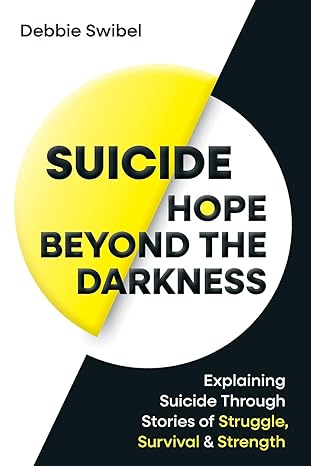

Debbie Swibel’s Suicide: Hope Beyond the Darkness is both heartbreaking and deeply hopeful. The book explores suicide through stories of people who have lived it, those who have tried to take their own lives, those who have lost loved ones, and those who’ve dedicated their lives to understanding and healing the pain behind it. It’s structured in four parts, blending firsthand accounts with Swibel’s professional insight as a suicidologist. The result is a raw, honest, and compassionate work that turns statistics and theory into human experience. Every story feels alive, sometimes painfully so, yet always threaded with the quiet pulse of hope that gives the book its title.
Reading this book was an emotional experience. I felt gutted at times, especially hearing the voices of people whose pain seemed bottomless, but I also found comfort in how Swibel handled each story. She doesn’t sensationalize suffering or rush toward neat conclusions. Instead, she lets silence and reflection do their work. I admired that restraint. The writing is simple but carries real weight. You can feel her empathy in the space she gives each voice. Swibel finds light in the small, steady acts of survival, therapy, friendship, words shared between strangers, that prove connection is often the thing that saves us.
What moved me most was Swibel’s balance between knowledge and humanity. She weaves psychology, cultural insight, and research into the stories, but she never loses sight of the people. Her explanations are clear and down to earth, and her belief in the power of storytelling feels genuine. The way she speaks about stigma, misunderstanding, and silence hit home. I found myself thinking about my own conversations, about how often we look away from pain because we don’t know what to say. This book reminds you that sometimes you just have to show up, to listen, to hold space.
I would recommend Suicide: Hope Beyond the Darkness to anyone who has been touched by suicide, whether personally or professionally. It’s for parents, friends, counselors, teachers, and anyone trying to understand what it means to live through pain.
Pages: 388 | ISBN : 978-0648758082




 LITERARY TITAN