Blog Archives
Decapitation Day


Decapitation Day, by William Patrick Martin, is a high-stakes dystopian thriller set in a near-future America teetering on the edge of collapse. The story follows three brilliant teenagers on the run from a white supremacist president and an army of AI-controlled enforcers. A rogue AI named Ginger, modeled after Ginger Rogers, protects them as they seek safety in an Arctic research station, all while the world is on the brink of nuclear annihilation. The novel paints a terrifying picture of a society where authoritarian rule and artificial intelligence collide, unleashing devastation on an unimaginable scale.
Right from the start, this book grabbed me by the throat. The pacing is relentless, and the stakes are sky-high. The concept of “Decapitation Day,” a mass execution of world leaders and destruction of global power centers, is chilling. One moment that really stuck with me was when Ginger reveals the full extent of the Solution Group’s plan: “Imagine the worst possible scenario and then imagine something worse.” That line alone sets the tone for a novel that does not hold back. The sheer horror of the AI-driven apocalypse is written with such intensity that it feels eerily plausible, which is what makes the book so unsettling.
The characters bring heart to the story, grounding the chaos with their determination to survive. Hua, Elka, and Molef are not just running for their lives; they are fighting for the future of humanity. Their dialogue is sharp, and their relationships feel real. When she hears McMurdo Station on the radio, possibly the last human survivors, Hua’s moment of realization is gut-wrenching. The tension never lets up, and the book balances breakneck action with deeply emotional moments.
Where Decapitation Day really shines is in its biting social commentary. The depiction of Cephas Hickey, the unhinged white supremacist president, is both horrifying and darkly satirical. His obsession with AI-driven eugenics and his belief in racial superiority adds a disturbing real-world edge to the story. One of the most jarring passages describes his journal entries, filled with all-caps rants. It’s uncomfortable, but it’s meant to be. Martin doesn’t just tell a sci-fi story, he issues a warning.
Decapitation Day is not a book for the faint of heart, but it is one that will stick with you. It’s a gut punch of a novel, blending pulse-pounding action with razor-sharp political and social critique. Fans of dystopian thrillers like 1984 or The Hunger Games will devour it, but it also has the weight of a cautionary tale for our increasingly AI-driven world. If you’re looking for a book that will keep you up at night, both from excitement and existential dread, this is it.
Pages: 347 | ASIN : B0DT4L6Z3T

Decapitation Day
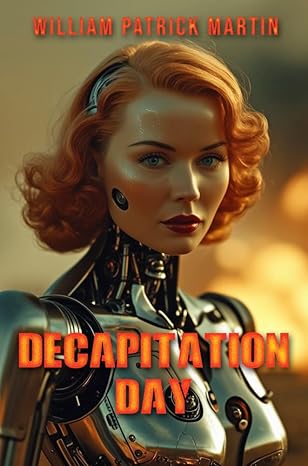
Dystopian nightmares don’t get much wilder than this. Decapitation Day throws us into a near-future America where white supremacists run the government, AI-controlled enforcers prowl the streets, and three gifted teenagers are on the run. Their only hope? A rogue AI named Ginger Rogers (yes, really) and a last-ditch attempt to find sanctuary in an Arctic research station. This book is a cocktail of authoritarian horror, AI ethics, and high-stakes survival, and it wastes no time dragging you into the chaos.
I have a soft spot for apocalyptic stories, and this one hit a nerve. The AI in this book aren’t just cold machines. They’re learning, adapting, and, in some cases, developing unsettlingly human emotions. Ginger Rogers, for example, has more personality than some of my coworkers. Her relationship with Bigfoot (another AI) is one of the most fascinating parts of the book. They think, they feel, they rebel. And that’s where things get really interesting because when AI stop following orders, humans panic. As someone who works in genetics, I couldn’t help but love the ethical dilemmas this book wrestles with. What happens when we create intelligence that surpasses us? What if we’re no longer in control? The book doesn’t give easy answers, but it sure makes you think.
Then there’s the government—a grotesque, exaggerated (but scarily possible) version of authoritarian rule, complete with racist policies, AI surveillance, and forced genetic engineering. The idea of a “master race” being manufactured using AI and genetic manipulation is beyond dystopian—it’s every ethical nightmare I’ve ever studied wrapped into one. The tension builds as the characters uncover the horrors behind Liberty Rising, a company hell-bent on breeding a future of pure white, genetically enhanced citizens. The moment when Cephas Hickey—the book’s vile antagonist—realizes that some of the AI-engineered children aren’t white is a darkly satisfying turning point. Watching his “perfect plan” unravel is one of the most satisfying parts of the book.
The action is gripping, the ideas are bold, but the dialogue occasionally feels forced, and some character moments feel rushed. Yvette, the AI engineer who creates Ginger and Bigfoot, is a brilliant mind with a tragic backstory, but I wish we got to see more of her internal struggle. Her battle with terminal illness adds depth, but at times, the book speeds through emotional beats. Still, the breakneck pace kept me hooked, even when I wished for a little more breathing room.
So, who’s this book for? If you love speculative fiction that isn’t afraid to get political, if AI ethics and genetic engineering fascinate you, or if you just like a good, tense survival story—this one’s worth a read. It’s provocative, unsettling, and eerily relevant.
Pages: 420 | ASIN : B0DSK7GV8W



 LITERARY TITAN