Blog Archives
To Improve Tolerance And Understanding
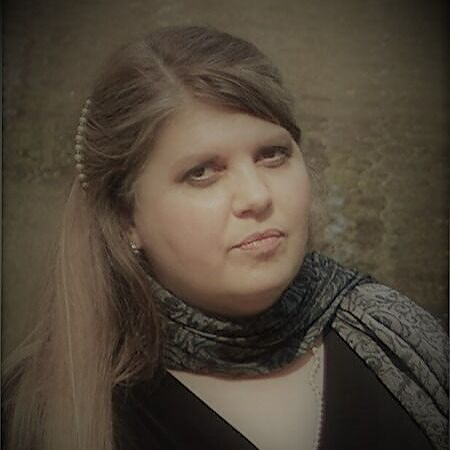
Homespun follows the people from two small South Carolina towns who struggle with adapting to the changing world. This is an intriguing setup for a novel that is high in social commentary. What was your moral goal when writing this novel, and do you feel you’ve achieved it?
I wanted to showcase the South in a fresh light, and I accomplished that, I do believe. The characters aren’t perfect, but you grow to care about them, and that’s the main moral goal—to improve tolerance and understanding.
Ginny and Jack face a moral dilemma in dealing with her family’s opposition to them seeing one another, but my real purpose in that situation was more along the lines of showing how each party’s stubbornness caused the most lasting harm. Conflict inevitably occurs in all families, but to hold grudges forever can be literally heartbreaking, as we see in Homespun.
Promoting the development of empathy has always been an underlying goal of The Silk Trilogy. I think most novels do achieve this, at least to an extent. Let’s hope that my distinctive characters—for example, Ginny’s domesticity as opposed to Vivian’s more outgoing lifestyle—put that empathy-learning curve on the accelerated track. Empathy makes for kinder, not-so-dismissive people; plus it’s simply intriguing to try to figure out what prompts certain decisions. Everyone has reasons for what they do, even if they’re bat-shit crazy ones—but more often, they’re not.
That said, Homespun is perhaps less motivated this way than the other two novels in the trilogy. I’m afraid it even tends towards campy at times. Maybe that has to do with it being inspired, in large part, by true events or rumors—which are all highly fictionalized. For instance, the story of Henry up in the tree, waiting to jump down on Buford, was inspired by a real-life situation I heard about my great-grandfather. In retrospect, I probably didn’t plumb the true depths of his feelings there, though I suppose I must have seized on some of his rationale.
Neglect is a great evil that can’t so much be applied to Jessie’s host of negative traits, so it seemed only fair to bring it up. It’s one fault that our new antagonist, Zingle Caddell, is imbued with, and it causes his family much grief. With many millions of refugees in the world today—whom I rarely hear about anymore in the news—and more specifically the refugee camps near our border with Mexico, it seems important to be cognizant of what harm comes from neglecting people. Factory farms for livestock animals terribly neglect their basic needs for movement and fresh air as well, violating nature in the extreme—and I suspect those creatures can bear it less well than humans, actually, as we are more cerebral and can escape through deep conversation and within our imaginations, at least.
Each character in this novel is unique and memorable. What character did you enjoy writing for the most? Was there one that was more challenging to write for?
Vivian was the most fun to write, of course! When I was penning the trilogy’s early draft, I even had a dream of Vivian going off and parachuting into the jungle—only afterwards realizing that her personality was being tapped from a friend of mine who really did go rafting down the Amazon. She was her sorority’s president and became an ER doc and ran marathons. She’s working on a book, too, and is an advocate for patients’ rights. She can do anything, and it’s all in the attitude. She’s bright enough, certainly, but there are countless people just as bright and attractive who never have the courage nor the vision to succeed like her. Vivian even looks like her, I realized. The great-aunt whose spot she fills was someone I never met and know very little about—except for that whole baby-giving scene. It was inspired by my grandfather’s indignation, even into his old age!
You might be surprised to learn that Ginny was the most challenging character to write. Her perspective felt narrow, even claustrophobic. Ginny wasn’t a reader, and she was secretive and held grudges—but she was also loving. I was trying to depict how she’d been damaged by her upbringing, absorbing some of Jessie’s behaviors without necessarily sharing her mentality. Those formative earliest years had been different for Vivian, who had her mother, and Gaynelle, who had Vivian, and even for Annie, who had Ginny. I’m afraid, though, that Ginny comes across as more flawed than I’d meant for her to, although some of those flawed aspects of her personality were there, too, in the ‘real’ Ginny, if not to that extent. Her character is based on my granny, a woman who was actually such a comfort to be around that the local hospital once offered her a job to simply come and sit with patients—that’s how soothing she was. I’m convinced I did not capture that portion of her personality very well, and I’m sorry for it. Isn’t it fascinating that she came across as so incredibly soothing—and yet once had a nervous breakdown herself?
As this ends the trilogy, where do you see your characters after the book ends?
Since this is a highly-fictionalized version of my own genealogy, I have a very clear idea—undoubtedly clearer than most novelists—of what happens to all the characters afterwards. The epilogue in Homespun actually gives a broad overview.
What are your plans now that this series is completed? Have you started another story?
I’m writing two separate series, both entirely different. The Silk Trilogy has a slender connection, however, with one of them. In Tapestry: A Lowcountry Rapunzel, the middle book of The Silk Trilogy, there’s a brief discussion—to Rosa Pack’s embarrassment—about how she is descended from King George II. Well, my next book happens to be about King George II’s mother, Sophia Dorothea of Celle. Set in the Baroque era in the Holy Roman Empire, it’s a biographical novel about her life—but in that story, I don’t purposely change the names, nor is it quite so fictional!
You might be surprised to learn that the other series is a YA Fantasy about a runaway princess, a wild boy, and a wolf-dog. At this point it is a duology. It may stay that way, as that was my original intent, but I was surprised at the end of the second novel’s draft when I left it set up for another adventure, as if I couldn’t help myself, so we will see if that’s how it stays. This storyline came into being when we went on a trip to the Poconos, where my favorite childhood author vacationed as well—we’d actually visited Lloyd Alexander near Philadelphia for our first anniversary, so he was high in my thoughts as we headed back to Pennsylvania for another anniversary (when I was twelve, I’d even dreamt that he was my actual father—hence my pen surname). I might have been in the midst of writing Sophia Dorothea’s story at the time of our Poconos vacation, but the connection to Lloyd Alexander called for something different; he had been writing-obsessed during his own Poconos vacation, as well, as he related in his charming book about his wife, Janine is French. I’d already been toying with the idea of starting a fantasy novel in his honor while there, but when I fell sick with a miserable flu early during our vacation and couldn’t go out, that cinched it. I seized the opportunity to begin my first fantasy novel, hoping to draw inspiration through that special place with that amazing fantasy author. I think it might have worked.
Author Links: GoodReads | Twitter | Facebook | Website
Meet Zingle Caddell, who doesn’t regret the destruction left in his wake so much as he is annoyed by it. Figuring no man can continue to have such bad luck, Zingle is waiting for his fortunes to improve. He knows what he likes–alcohol, women, and family, in about that order–and he’ll continue on with them as before. That is, until he’s surprised by a violent encounter with his match, Jessie Bell, when her stepdaughter doesn’t come home as expected. Bad blood is rampant between the Bells and the Caddells by the time Jessie’s daughter and Zingle’s nephew unwittingly fall in love. Forbidden to see one another, the couple must decide how much they’re willing to risk. Is it worth being ostracized from their families? Destitution? Their very lives?
Homespun
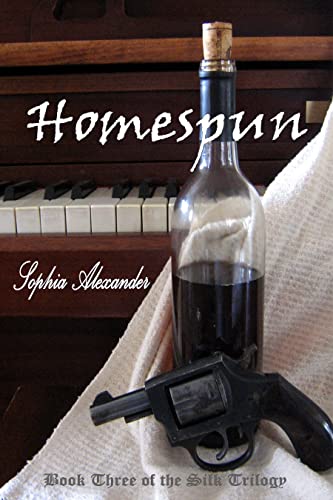

It is a time of significant change in South Carolina. The time between the First and Second World Wars is filled with progress in industry and social structures. Women are taking a more active role in the world, and things like automobiles, electricity, running water, and radios are becoming more commonplace in homes. But, for the Bell and Caddell families, their long-standing feud continues, and it is on the younger generation to try and mend fences. When Ginny and Jack fall in love, it is a forbidden romance full of strife and struggle. Family ties are stretched to their limits, and the question of “Is love enough” hangs in the air.
As the third and final installment of Sophia Alexander’s ‘Silk Trilogy,’ readers return to the small towns of Greeleyville and Kingstree in Homespun. Jessie’s personality is as hateful and disagreeable as ever, but her villainous deeds are overshadowed by the introduction of Zingle. A character that feels no remorse has no morals and no saving grace. While misguided, Jessie’s character stands behind her family values and morals; Zingle offers no redeeming qualities and gives readers someone new to hate and despise. He is the perfect villain for this final novel.
What stands out about ‘Silk Trilogy’ is the focus on ordinary people and their struggles during this time of rapid change in America. Between the war, industrial revelation, and women taking on roles outside the home and showcasing they have more to offer than just raising babies, this series shed light on how the average citizens faced these changes. From the country families to the small-town residents, everyone is shown fighting to find a place. Vivian’s character is inspirational and has been from the start. Homespun allows her to shine through and gives her character, as well as women from this time, a voice. Ginny reminded me of someone stuck between two generations, trying to bridge the gap and find herself. Many women will relate to her coming-of-age story in this novel, even in modern times. The struggle to balance family and breaking off to follow their own path is still relevant today.
Homespun is a gripping and captivating conclusion to the historical fiction ‘Silk Trilogy.’ Readers will be drawn into the drama and transported back in time to the South Carolina countryside and experience the winds of change that were blowing through the Lowcountry South. Some of the best fictional stories have roots in the truth, and the world that Sophia Alexander has created here is one that stays with readers long after they finish the story.
Pages: 377 | ASIN : B09VSYQZL9



