Blog Archives
Author Interview – Kiril Kristoff – “Finding Your Roots”
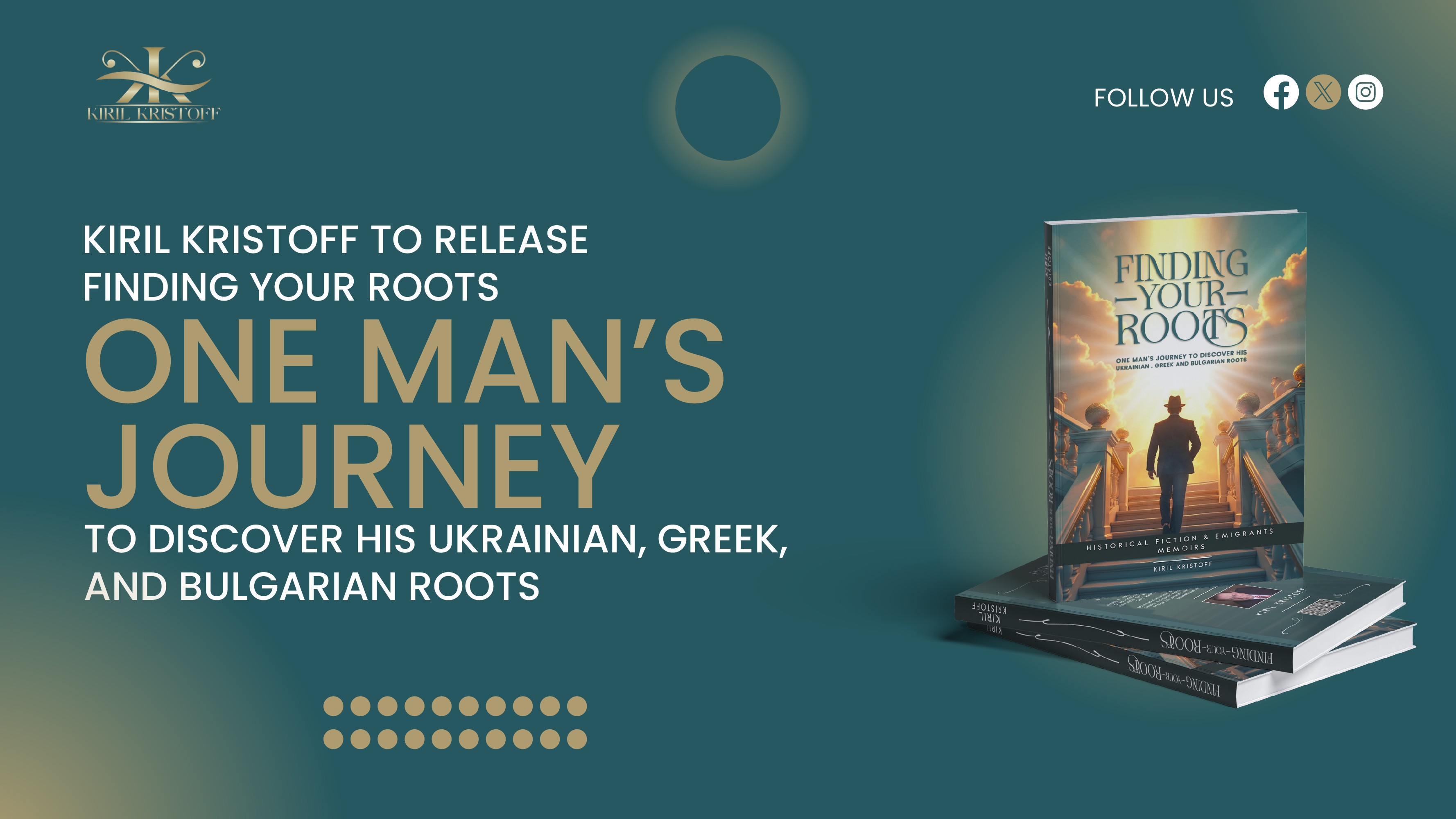
“Finding Your Roots” ‘One Man’s Journey to Discover His Ukrainian, Greek, and Bulgarian Roots’ follows an American man born into privilege who, after a near-fatal car accident, is transported back in time to 19th-century Tsarist Russia as a serf, where he faces the struggles and hardships that his ancestors once endured. What was the inspiration for the setup of your story?
The seed for this story came from a very simple but haunting question: What if we could truly step into the lives of our ancestors and feel what they felt? I’ve always been fascinated by the contrast between where we stand today and what those before us endured to get us here. For many of us, privilege, security, and opportunity are things we take for granted—but just a few generations back, the reality was far harsher.
I chose the device of a car accident and time travel because I wanted the contrast to be immediate and visceral. One moment, the protagonist is surrounded by the comforts of modern America; the next, he’s stripped of everything and forced to survive in a world where human dignity was often denied. It’s not just about history—it’s about empathy. By placing him in the shoes of a serf, I wanted to collapse the distance between past and present, so readers could feel that struggle as if it were their own.
Ultimately, the setup was inspired by my belief that our roots are never as far away as we think. The hardships of our ancestors still echo in us, and sometimes it takes a dramatic shift—whether in life or in literature—to remind us of that truth.
What inspired you to create Alexander Kakhovskiy, and how did you craft his outlook on life and the emotional changes he experiences?
Alexander Kakhovskiy was born into privilege—a spoiled child of the American Dream, raised in excess, never wanting. He was a prince of modern times, arrogant in his entitlement, untouched by struggle. He had it all— money, power, status—but no sense of who he was. Then, in a single night, everything was ripped away, and everything changed for Alex and Jennifer. After being drunk and high at a bar, a life-altering accident strikes him and his girlfriend, by another reckless driver. He falls to the ground, his body crushed beneath the weight of his choices. The next thing he knows—he is not in America anymore. He is no longer the wealthy, carefree boy of the 21st century, his family patron St. George sends them into a coma. Due to Saint George in Heaven, and his Grandpa George’s prayers on Earth, Alex survives, but remains immobilized in a Chicago hospital. But the accident triggers an otherworldly journey that defies time, faith, and even death. Alex and Jenniffer soon find themselves in the 19th-century Tsarist Russia, in the animal barn of his great-great-grandfather in his Kakhovka estate. It’s 1860, during the reign of Emperor Alexander II, the Liberator. There, the rebellious grandson meets his great-great grandfather, Alexander Kakhovskiy ( his namesake), a wealthy nobleman. Alex is not part of Kalhovskiy’s powerful family, but as a mere serf-a peasant bound to the land, a nobody, a slave in a world that does not know his name.
Then Alex begins to understand the true legacy of his ancestors. He is not just Alexander Kakhovskiy, the rich boy from America. He is part of a lineage that stretches across centuries—a bloodline shaped by war, ambition, loyalty, and betrayal. As he walks in the footsteps of his forefathers – Georgiy and Vasiliy Kakhovskiy-he sees the world through their eyes. One brother, Georgiy, stood for honor and tradition, remaining loyal to the empire that defined his people. The other, Vasiliy, was a radical, a Bolshevik, a man consumed by revolution and the birth of the USSR. Their choices shaped history. Their actions changed nations. And now, their story is his.
Now Alex must choose his destiny, whether he prefers the harsh cold of empires or the warm bonds of family. Discover faith, love, and redemption-and a battle between good and evil.
What were some themes that were important for you to explore in this book?
Several themes guided me as I wrote this story, but at the heart of it all was the question of identity—who we are when everything familiar is stripped away. I wanted to explore the fragile balance between privilege and survival, between the comforts of modern life and the raw struggles of those who came before us.
Heritage was another vital theme. By sending my protagonist back into the lives of his ancestors, I wanted to show that our roots are not abstract—they are lived realities that continue to shape us. The sacrifices, suffering, and resilience of those who endured oppression and hardship echo in us whether we acknowledge them or not.
I was also drawn to themes of empathy and transformation. Alexander’s journey is, in many ways, about learning to see the humanity in others and to measure worth not by wealth or status but by dignity, compassion, and endurance.
And finally, I wanted to explore time itself—how the past and present are never fully separate, how stories, memories, and even bloodlines carry forward across generations. By blending history with fiction, I hoped to show that while the settings may change, the human struggles of belonging, loss, and hope remain universal.
Where do you see your characters after the book ends?
For me, the ending of the book is not a closure but an opening. Alexander doesn’t return to his old life as the same man—he carries the imprint of what he has endured, and that awareness changes the way he looks at privilege, family, and responsibility. I imagine him moving through the modern world with a different kind of vision, one that allows him to see both the fragility and the strength of human existence.
The ancestors he encountered—those who shaped him in ways he could never have imagined—remain alive within him. Their voices may not guide his every step, but their lessons form a compass he will never be able to set aside.
In a broader sense, I see the characters continuing to live in the minds of readers. Their journeys don’t belong only to the page—they’re meant to spark reflection on our own roots, our own resilience, and the choices we make in light of those who came before us.
So while the written story ends, their inner lives keep unfolding—quietly, persistently—like heritage itself.

About the Author
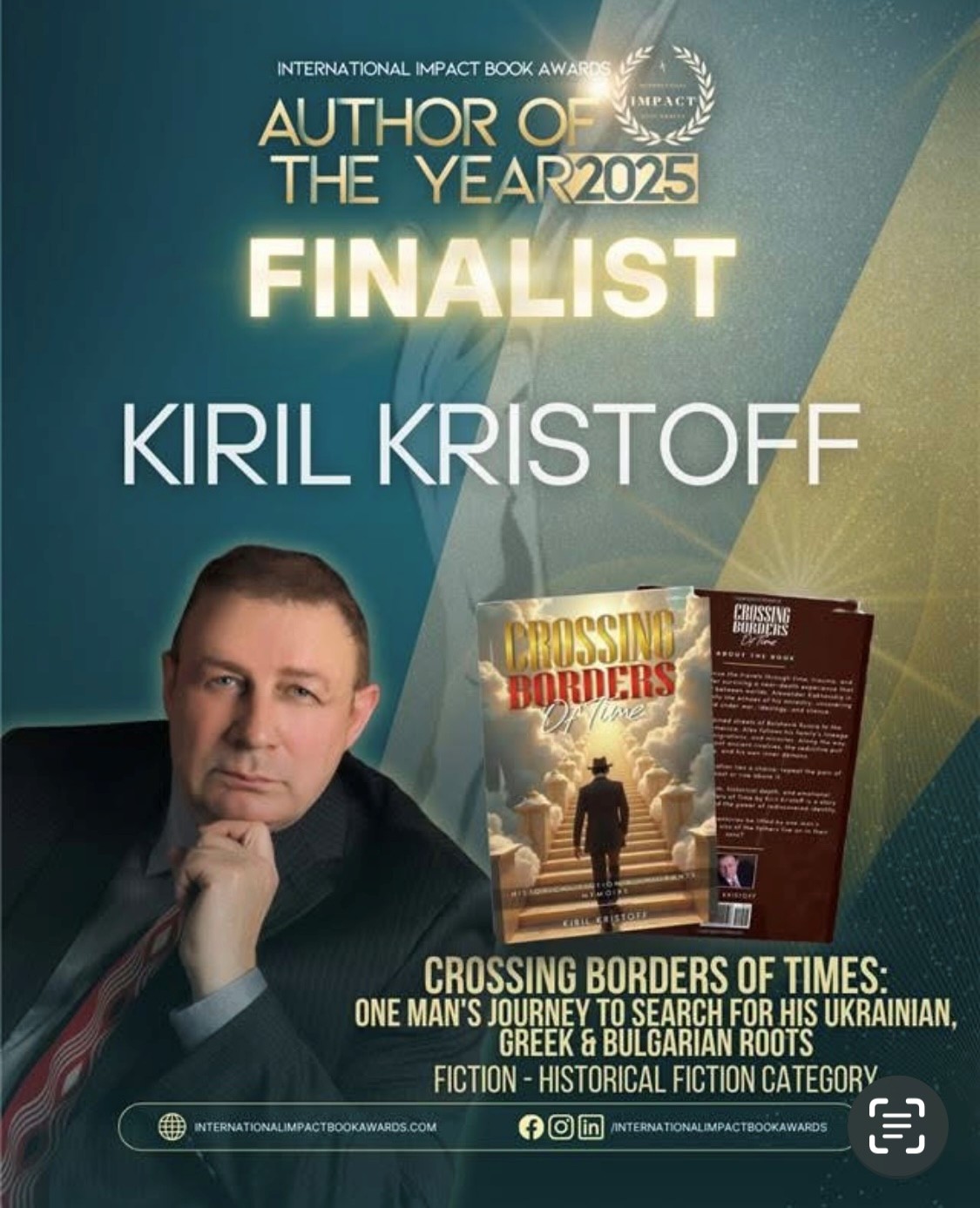
Kiril Kristoff is an internationally recognized author whose works combine historical fiction, spirituality, and the immigrant experience. He is the recipient of the Literary Titan Gold Book Award, the International Impact Book Award (Author of the Year 2025) , Fiction & Historical Fiction), and accolades from Indies Today. His contributions to diaspora literature have been featured in The Philadelphia Journal.
📧 Email: kirilkristoff3@gmail.com
🌐 Website: booksbykirillristoff.com
Facebook: https://www.facebook.com/authorkirilkristoff/
Linkedin: https://www.linkedin.com/company/kiril-kristoff
Instagram: https://www.instagram.com/kirilofficial1/
Pinterest: https://www.pinterest.com/kirilkristoff/
Author Interview – Kiril Kristoff – “Crossing Borders of Times”

“Crossing Borders of Times”‘One Man’s Journey to Search ForHis Ukrainian, Greek & Bulgarian Roots’ is a multigenerational saga where a grandfather and grandson unravel their family’s past through letters, dreams, and manuscripts to confront the pull of heritage and belonging. Why was this an important book for you to write?
In two short days on 10/04/2025 I will have Gala dinner & celebration when I will receive my International Impact Book Award 🏆my Oscar of books award, when my third sequel gained recognition in Hollywood, I felt ready to take this step.
I decided to submit my book to the International Impact Book Awards because this award is about more than recognition—it’s about sharing a story that can inspire others. My story begins in Bulgaria, where growing up under communism, it wasn’t easy to express a truth rooted in the Bible that the government didn’t allow. When my wife and I came to America, we carried only two suitcases and $200, but we also carried our faith, our stories, and our dreams.
For many years I looked for a traditional publisher or literary agent, but most doors were closed. Instead of giving up, I chose to self-publish. Today, I have written five books in English and two in Bulgarian, and my third English-language sequel—Crossing Borders of Time—has brought me here to Hollywood and this award.
To me, this recognition is proof that when you have a message and you persevere, the world will eventually hear it. My main message is simple: Never give up on your dream—because freedom and the opportunity to create are the greatest gifts a person can receive.”
This book was important to me because it represents both a personal and universal search for identity. I grew up under communist regime, surrounded by stories of displacement, resilience, and cultural memory, and I always felt that those voices—especially the quieter ones in the family—deserved to be heard across time.
By weaving together the experiences of a grandfather and a grandson, I wanted to show how heritage is not a static thing we inherit once and place on a shelf—it’s a living force that shapes how we see ourselves and the world. The letters, dreams, and manuscripts in the story are not just literary devices; they are metaphors for the ways we all try to reach across generations to make sense of who we are.
Writing Crossing Borders of Times was my way of honoring the struggles and sacrifices of those who came before us, while also asking what it means for the new generation to carry that legacy forward. It’s about belonging, yes, but also about courage—about daring to face painful truths and still finding the strength to carry them with love.
Your book blends memoir, novel, and meditation. How did you decide on this hybrid form to tell such a personal yet universal story?
From the very beginning, I felt that one single form wasn’t enough to contain the scope of this story. A traditional memoir would have kept me tethered to my own perspective, while a straight novel might have distanced me too much from the lived experiences that inspired it. What I wanted was a way to honor memory, imagination, and reflection all at once.
The memoir elements anchor the book in lived truth—those emotional landscapes that come only from direct experience. The novelistic passages allowed me to reimagine events, to step into the lives of ancestors and give voice to silences in the record. And the meditative sections provided the breathing space I needed to explore broader questions of time, belonging, and heritage, beyond just my own family’s story.
This hybrid form felt the most honest, because identity itself is layered—we live between fact and memory, between what happened and what it meant, between the past and the present moment. Blending these genres gave me the freedom to capture that complexity and, I hope, to offer readers not just a family story, but an invitation to reflect on their own.
George’s struggles with immigration and identity feel vivid and raw. Were these drawn directly from family experiences, or did you reshape them into fiction?
George is both personal and imagined. His struggles are deeply rooted in the real stories I grew up hearing—of leaving behind everything familiar, of carrying one’s culture across oceans, of learning to survive in places that were not always welcoming. Those accounts, especially from my family and community, gave me the emotional foundation for his journey.
At the same time, I didn’t want George to be a replica of any one individual. Instead, I reshaped those lived experiences into a character who could embody the universal immigrant condition—the constant negotiation between holding on and letting go, between remembering and reinventing. By fictionalizing parts of his story, I was able to protect the privacy of real people while also deepening the emotional truth.
So George is a mosaic. He carries the voices of my grandparents, the resilience of countless immigrants I’ve known, and the imaginative flourishes that allowed me to explore what isn’t always spoken aloud. In many ways, he became the vessel through which I could tell not just my family’s story, but the story of anyone who has ever felt torn between two worlds.
Alex’s search sometimes feels overshadowed by the past. Do you see this as a generational struggle we all face when trying to honor our roots while forging our own paths?
Yes, absolutely. I think every generation inherits both gifts and burdens. For Alex, the weight of history is so present—it arrives through letters, dreams, and stories that refuse to stay silent. That can feel overwhelming, almost as if the past is dictating the present. But that tension is real, and it’s one that many of us live with: how do we honor those who came before without losing ourselves in their shadows?
I believe it’s a universal struggle, especially in families marked by displacement or upheaval. Roots give us strength, but they can also feel like anchors. Alex’s journey is about learning to carry that inheritance without being consumed by it—understanding that honoring the past doesn’t mean repeating it, but rather finding ways to transform it into something new.
In that sense, his story mirrors what so many young people experience today: a longing for authenticity while still forging a future that belongs to them alone. The balance is delicate, but I see it as one of the most vital parts of identity—turning memory into possibility.
About the Author
Kiril Kristoff is an internationally recognized author whose works blend historical fiction, spirituality, and the immigrant experience. He is the recipient of the Literary Titan Gold Book Award, the International Impact Book Award (Author of the Year, Fiction and Historical Fiction), and honors from the Indies Today Awards. His writing has been featured in The Philadelphia Journal for its contributions to immigrant literature in diaspora.
📧 Email: kirilkristoff3@gmail.com
🌐 Website: booksbykirillristoff.com
📌 Facebook | Instagram | LinkedIn | Goodreads
Author Links
Facebook: https://www.facebook.com/authorkirilkristoff/
Linkedin: https://www.linkedin.com/company/kiril-kristoff
Instagram: https://www.instagram.com/kirilofficial1/
Pinterest: https://www.pinterest.com/kirilkristoff/
“Finding Your Roots” One Man’s Journey to Discover His Ukrainian, Greek, And Bulgarian Roots


When I picked up Finding Your Roots: One Man’s Journey to Discover His Ukrainian, Greek, and Bulgarian Roots by Kiril Kristoff, I didn’t expect the ride I was about to take. The story follows Alexander Kakhovskiy, an American born into privilege, raised on excess and status, with little sense of who he really is. In one devastating night, he loses it all. After a near-fatal car accident, Alex wakes not in modern Chicago but in 19th-century Imperial Russia, stripped of his wealth and freedom, forced into the life of a serf. What begins as punishment unfolds into a profound journey of survival, faith, and love, where saints and ancestors shape his path and the brutal world of serfdom teaches him humility, responsibility, and sacrifice.
This book surprised me with its depth and scope. At first, I bristled at Alex’s arrogance, but as he stumbled through hardship, I found myself rooting for him, even protective of him. His encounters with Elizabeth, his soulmate in another lifetime, added tenderness that balanced the weight of war, betrayal, and spiritual reckoning. The way Kristoff shifts between past and present, dream and reality, sometimes left me dizzy, yet it mirrored Alex’s inner chaos. The novel also stretches beyond Alex, weaving in the stories of forefathers like Georgiy and Vasiliy, who stood on opposite sides of faith and revolution, and reminding us how much of who we are is inherited through blood and history.
Some passages hit me hard. The spiritual visions, the crushing trials, the echoes of immigrant struggles across borders and generations all resonated. At times, the prose felt heavy, yet it often swung back with vivid, aching beauty that lingered. What stayed with me most was its insistence that freedom, identity, and redemption are never free, that every generation pays its price. It is a bold, multifaceted story that dares to mix history, myth, and spiritual allegory in a way that feels rare.
Finding Your Roots isn’t a light read, but it digs deep and stays with you. I’d recommend it to anyone drawn to stories about faith, heritage, and the resilience of families across generations. If you like novels that wrestle with identity and legacy, or if you’ve ever wondered how the past continues to shape us, then this book is worth your time.
Recipient of the Literary Titan Book Award.

Crossing Borders of Times

Crossing Borders of Times, One Man’s Journey to Search For His Ukrainian, Greek & Bulgarian Roots tells the story of a family stretched across countries, decades, and memories. It follows George, an aging immigrant reflecting on his life, and Alex, his grandson, who stumbles into their tangled heritage. Their lives intertwine with ancestors from Bulgaria, Ukraine, and Greece through letters, dreams, pictures, and rediscovered 142-year-old lost manuscripts. He discovered in the basement of his old house in Khan Asparuh Street, Sofia, Bulgaria, narrative moves between nursing homes in America, historic struggles in Eastern Europe, and the restless search for identity in a modern world. It is part memoir, part novel, part meditation on belonging.
Reading this book felt like sitting in someone’s living room as they pulled old photo albums and told stories that were raw, unpolished, and heavy with feeling. The prose has a weight, an almost aching pull toward the past, but it’s balanced by warmth.
From the first lines, we dive right into the story. Crossing Borders of Time”: ‘One Man’s Journey to Search for His Ukrainian, Greek, and Bulgarian Roots’ by Kiril Kristoff is a masterfully crafted narrative that deftly blends memoir and fiction.
The Literary Titan Book Award winner Kristoff uses elegance, nuance, and clarity to depict a deeply personal and moving story. In addition to honoring the immigrant experience, this book offers a poignant meditation on spiritual inheritance, cultural identity, and intergenerational connection.
The story immerses readers in a universe full of historical resonance and emotional weight from the very first sentence. Kristoff establishes the mood early on with a narrative voice that is both personal and sweeping. By introducing readers to George, whose life and legacy act as the story’s emotional compass, the opening paragraph foreshadows the great voyage that lies ahead. It is a powerful beginning that entices readers to keep turning the pages because it is vivid and full of promise.
The complex, multi-layered tale of Grandpa George, a Bulgarian immigrant who overcomes poverty, war, and cultural displacement to start over in America, is at the core of this book. George’s hardships – beginning at the bottom of an auto repair shop, overcoming anti-immigrant sentiment, and attempting to establish a dignified life – are realistically and compassionately depicted. No matter how minor, his personal triumphs are incredibly fulfilling and give the story a powerful emotional undertone.
A Saga of four Generations of Americans of Bulgarian Roots men: This is history and geography all wrapped in a story of culture, hardship, and achievement in the American dream. Grandpa George & grandson Alex are not ordinary travelers. Adventure is a tapestry in this historic, fictional emigrant’s travel novel memoir where courage, friendship, relationships, family, and love are threads. George has the elixir of curiosity, empathy, an indefatigable nature, and creativity to explore the hidden corners of a faraway place and draw out the stories from relatives he met in Bulgaria and Eastern Europe. After the Afterlife, George received the most straightforward, informative answers to questions about what happens after a person passes into the afterlife, which he wrote in his memories.
The topics explored range from human and personal issues, such as who greets the person after their passing, to insightful descriptions of the nature of consciousness and reality. Meeting all his past way parents & relatives, He found many answers to all these questions with his characteristic laid-back directness in a no-nonsense way that brings our understanding of the afterlife into the twenty-first century.
At times, I’d be caught by an image so sharp and tender that it stopped me. It’s not a clean, tight novel. It’s messy in the way life is messy, which oddly made it more convincing. The book insists that roots matter, even when you’ve spent years pretending they don’t. I felt the tension of being between cultures, never quite at home anywhere, and the heartbreak of seeing traditions fade with each generation. The sections on Alex’s obsession with his great-great-grandfather’s manuscript made me restless, because I know that pull, the need to give voice to those who came before us. At times, I wanted the story to dig deeper into Alex’s present struggles, but maybe that’s the point. The past overshadows everything, and it’s left to us to wrestle with it or ignore it.
I’d say this book is best for readers who crave stories of migration, memory, and the ache of belonging. If you want to sit with a book that makes you think about your grandparents, your childhood, or the stories that shaped you, it delivers. It’s for the ones who wonder where they come from and for those willing to accept that the answer may never be simple.
Pages: 513 | ASIN: B0F79TRN5J




 LITERARY TITAN