Blog Archives
A Poet and An Artist

Moses and Akhenaten: Ancient Egypt Fiction Series Book 1 explores with great detail and some imaginative storytelling the theory that the biblical Moses and the Egyptian Pharaoh Akhenaten were the same person. Where did the idea for this novel come from and how did it develop over time?
Akhenaten amazed me as a child. He was considered the “first monotheist” and “first individual in history”.
As an adult, I wanted to write literary fiction and chose Akhenaten as a subject. This book is a response to a man who was not only a king with a unique religious vision, but also a poet and an artist.
Fiction is an art form that uses elements of the imagination as an artist uses paint. Many paintings are layered and this was my approach. It seemed appropriate because King Akhenaten was many things.
First, there is the little boy, Akhy, and his family, all of whom are based on real people instantly recognizable to those familiar with Egyptian history.
Akhenaten crossed his own time and culture to be of interest to people in many countries living in times different from his own. It is the reason he debates with modern academics in the novel and why a time machine is included.
The real King Akhenaten was an artist so far ahead that much of his work appears to be out of his time. His art, for instance, has been described as expressionistic. It is the reason this novel shows him painting both within his own time and in ours.
Likewise, his ownership of Bessie, the dinosaur is an echo of the Biblical leviathan. This creature is mentioned in Psalm 104, which is also dubbed the Song of Moses. It is this psalm that scholars have equated with Akhenaten’s own Hymn to the Aten. They both appear at the end of this novel where readers may compare the two works at their leisure.
There have been heated responses to the Moses and Akhenaten theory. Ahmed Osman had his book, which boldly stated that Akhenaten was the prophet, burned in the streets of Cairo.
My book is not an altogether serious religious discussion, which is better served in the academic realm of non-fiction. Rather, it is a celebration of the artist and the poet whose religious ideas still intrigue us.
Children appear in the novel because they, more than any of us, express the joy of life and creativity.
As for Akhenaten, Egyptologist and Director General of the Cairo Museum (2004 to 2010), Wafaa El-Saddik once said he was of huge importance, not simply as an Egyptian pharaoh but to the history of the world.
It must be remembered there is still a lot for us to discover about the Egyptian king. In the meantime, while the academics debate and archaeologists dig, this novel invites the reader to celebrate a genius who was a significant thinker and innovator in human history.
Did you find anything in your research of this story that surprised you?
My conclusion, which is that Akhenaten is not Moses.
Once heralded as a forerunner of Christ and the first monotheist, Akhenaten was later considered to be a fanatic who ruled in a manner not unlike that of the Nazis. (This is the reason there is a reference by Akhenaten in the novel to this latter-day interpretation.)
Many people, including the famous psychoanalyst Sigmund Freud, were captivated by both the prophet Moses and the pharaoh Akhenaten without making a connection that the two could be the same individual. Other writers made the connection, including the Egyptian author Ahmed Osman, who declared Akhenaten to be none other than Moses.
I visited Egypt several times, fuelled by the desire to discover more about both Moses and Akhenaten. I am also qualified in Egyptology with a postgraduate degree in the discipline.
The whole process was a massive undertaking and the novel was shelved for many years. Now, after further thought, I have concluded that Akhenaten was not the prophet Moses. Part of the reason is that there are new academic theories and archaeological evidence that support this conclusion.
However, Akhenaten’s revolution was important and still intrigues many historians. What is interesting is that the prince of Egypt, who caused issues in Egypt has no other historical parallel except with Pharaoh Akhenaten.
Both Moses and Akhenaten were raised in Egypt. Moses’ Ten Commandments are a brilliant abbreviation of the Negative Confessions within ancient Egyptian writings. It is no accident, either that there are echoes of Akhenaten in the holy books.
Even while scholars debate Psalm 104 and the Hymn to the Aten, and whether Akhenaten was a monotheist or not, his city is still out there. Badly in need of restoration, my view is that it is a city of global importance, not simply another local heritage site (as valuable as such sites are).
Despite the deep connections between Akhenaten and Moses, for me, Akhenaten stands on his own as a great Egyptian prophet who was light years ahead of his time. There is no need for him to be Moses to hold his place in history.
Egypt should be credited with his achievement as with other great works of their civilization such as the pyramids. The ancient Egyptian civilization was the most advanced of its time, and as Wafaa El-Siddik pointed out, Akhenaten is of immense importance to the world.
What were some ideas that were important for you to share in this book?
I wanted people to think about Akhenaten. We are all aware of Moses from holy texts. Three monotheistic religions recognize him as a prophet. However, archaeological evidence shows that there once lived a king who spearheaded a religious revolution and did something so extraordinary that we are still talking about it. The site of Akhenaten’s city, Tell el-Amarna, which the ancient Greeks referred to as the City of Moses, still exists in the middle of Egypt.
When will book two be available? Can you give us an idea of where that book will take readers?
Book two is available. The Tutankhamen Friendship has a British style because it is about the English discoverers of Tutankhamen’s tomb. Both English and European readers love it, perhaps due to the style and their familiarity with the story.
Book three, The Queen Who Became King is also available. It is based on the true story of an ancient Egyptian queen, and incidentally one of Akhenaten’s ancestors. Feeling that she had to protect her young nephew Tuthmosis, this extraordinary woman stepped up to rule as king. At her death, Hatshepsut left a legacy of a strong country to her nephew. Tuthmosis III, known as Tuthmosis-the-Great, inherited her throne and went on to become Egypt’s greatest conqueror. To this day, he is thought to be Egypt’s foremost military ruler.
Author Links: GoodReads | X | Facebook | Website | Book Review
He could inherit the throne of Egypt …
… and change the world forever.
But does he?
This is the first novel to set Akhenaten in his childhood.
Making use of the theories surrounding a king, who has been thought to be Moses, the book entertains with a poetic tale of children and what might have been, if only it were true!
Moses and Akhenaten: A Child’s Tale
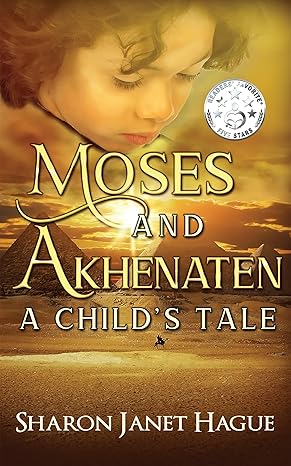

Moses and Akhenaten by Sharon Janet Hague takes on the ambitious theory that the biblical Moses and the Egyptian Pharaoh Akhenaten were the same person. The book weaves historical analysis and imaginative storytelling, proposing that the famous biblical exodus and Akhenaten’s religious revolution are intertwined stories of the same man. Through a blend of fictional dialogue, historical narrative, and philosophical musings, Hague presents a compelling story for this theory.
The book is a unique mix of informal conversation and deep historical exploration. At times, it feels like sitting in on a heated debate among scholars as characters such as Walter, Tom, and Ernest discuss the possible connections between Moses and Akhenaten. For instance, Tom’s logical statement, “If Theodore Davis’ discovery in cache number fifty-five was Akhenaten’s body, then Akhenaten cannot be Moses,” drives home the tension between hard evidence and speculative theory. This dynamic made the book engaging and made me feel like I was part of an intellectual journey, though I feel that sometimes the debates veered into detailed and repetitive territory.
One of the things I loved about the book was its willingness to tackle big ideas with an unapologetic mix of history and conjecture. The idea that Akhenaten’s monotheism predates and even influences the Jewish faith is thought-provoking, and Hague doesn’t shy away from pushing that theory. She writes, “Nobody can convince me that billions of people worshipping one god, thirty-one centuries later is anything but a success”, showcasing Akhenaten’s monumental impact, whether or not he was Moses. While the story borders on speculative fiction, Hague’s presentation of Akhenaten as a revolutionary and somewhat tragic figure is heartfelt, bringing life to what could otherwise have been a dry historical argument. At one point, Akhenaten himself complains about modern perceptions of him: “I can’t tell you how heartily sick I am of being labeled everything from a weak king to a Nazi.” Moments like this add a humorous, almost anachronistic flavor that, while entertaining, sometimes undermines the gravitas of the subject. Still, the book’s casual conversations helped break down the dense historical material, making it more digestible and approachable for readers less familiar with ancient Egypt’s intricacies.
Moses and Akhenaten is a fascinating blend of historical theory and speculative storytelling. It’s ideal for readers who enjoy mixing history with a splash of imaginative fiction. If you’re a fan of ancient history, religious studies, or philosophical debates on the origins of faith, this book will keep you thinking long after you’ve finished it.
Pages: 301 | ASIN : B0BQCT1G1Q




 LITERARY TITAN