Blog Archives
Poetry is Powerful

Rosebud is a book of poems that is characterized by its beauty and accurate representation of what it’s like to be alive. What inspires you to write poetry?
I call writing my ‘pressure release valve.’ As a highly emotional, passionate person ever under internal duress, bouncing from ecstasy to agony, writing is my foremost mode of self-therapy. Without the ability to write, especially verse, I’m convinced that I’d be a resident of a mental health institution, similar to the one in which I worked for four years here in Bend, Oregon, which has most definitely influenced my writing. Also, I consider myself an extremely romantic person who has a propensity for ‘falling in love easily,’ as a former coworker and friend told me. I gain crushes easily, and seem to collect muses, all of them representing unrequited affections. The question is whether or not I’m the one creating the conditions that keep them unrequited, or whether I’m fated for it, or both… I can’t help but think of the early romantic poets, many of whom commented on the fact that their words reflect an ardent longing for something or someone, yet they doubt they actually want it, for if they had it they’d be pacified, losing the painful passion compelling their best writing.
What were some themes that were important for you to explore in this collection?
Thematically, Rosebud is very much widespread. I didn’t write it with any themes or target readership in my mind. Rather, as with most of what I write, it arose organically, and so sprouted every order of flora, so to speak, which seems to have annoyed one reviewer, who called it ‘intriguing but uneven.’ Here I am thinking, Yeah, that’s the point. Poetry isn’t meant to be consistent and stoic, or hemmed into a single category or definition; it’s about a release of the most profound ideas and pent-up emotions, entirely disloyal to definition. That said, if I were to pick some prevalent themes, the obvious ones are unrequited affections, in this case for two women I fell in love with at different times (the last one of whom betrayed me in the worst way); wrestling with personal pains in the desire to uncover their long-term purpose; philosophical and spiritual rumination, especially in matters of prevailing societal value systems that I consider to be oppressive; and the divergence between religion and spirituality, which the majority of people do the grave disservice of conflating. I’m philosophically-minded by nature and have been highly spiritual since my twenties, when I began conversing with the divine, as we all do, but which I believe I understand and acknowledge in a way that most don’t. I have serious issues with religion, believing it to essentially be a narrowing corruption of spirituality intertwined with a history of Church and State collusion controlling the masses; this is a sub-theme of the philosophy and spirituality.
My favorite poem from this collection is ‘All the Time’. Do you have a poem that stands out to you from this book?
First off, I sincerely appreciate the fact that you chose a favorite. ‘All the Time’ was written while thinking of the muse that I worked with who ultimately stabbed me in the back, reflected towards the end of the book. It’s about the aching loneliness threatening to consume me, and yet the salvation seeming so simple: her. Looking into those gorgeous eyes; her presence permitting a forgetting of all my troubles. I’m not sure I have a favorite poem… excepting the fact that a number of them were highly cathartic to write, which is a primary motive for writing in the first place: releasing emotions which might otherwise tear me asunder. ‘The Trouble With the Heart’ is about this, generally, about the heart being the ultimate double-edged sword. ‘Presence,’ ‘Each of the Knot,’ ‘Overgrowth’ and ‘Starting’ are in the same vein: the promise of the simplest, sweetest salvation coming from someone who can wield the sword away from cutting me, towards being my champion. Yet the poems on spirituality and its near mutual-exclusivity with religiosity (like ‘True Gospel,’ ‘Spirit’s Inquisition of Religion’ and ‘Forever Bound’) are favorites of mine from another, more analytical perspective, as I firmly believe that nothing grants humankind greater potential for healing and unification towards our mutual best interests than pure spiritual revelation, starting with the ‘non-dualist’ revelation: we’re all finite manifestations of the one eternal being, God, or Spirit, and to divide Spirit from ourselves or any of us from any other is to be a victim of the worst ignorance: a misunderstanding of true Self, which conservatism and religion promotes, as divide and conquer is profitable for the few at the cost of the many.
Do you have plans to publish other works of poetry?
I actually have two other books of poetry that have mostly been unread, which I published through Amazon’s KDP platform years ago. They’re called ‘Love of Wisdom (2017)’ and ‘Thin Line Between (2020).’ They’re both highly philosophical, reminding me of my favorite line from Emerson: “The true philosopher and the true poet are one, and a beauty, which is truth, and a truth, which is beauty, is the aim of both.” ‘Thin Line Between’ is largely about my inability to purge one particular muse from my heart, who is dug in there like a tick still, four years since we last saw one another. Beyond this, I imagine I’ll be collecting poems and compiling them into books forever, until it somehow loses its cathartic power. I go through phases with what I write and why, but I can’t imagine I’ll ever actually stop. I’m currently readying ten more poems for the next compilation, including this one, which I wrote two days ago, during an intense rainstorm that hit us here in Bend, Oregon:
The Oldest of Friends
Oh cleansing, comforting, blanketing beauty
Born of the fraternity of condensing pressures
Of the friction foretelling the fortune of fall
Of the force for change, eroding the unstable
Of the crackling electricity thundering above
Of the rivulets running between chasms below
By the gods, the oldest, most ancient of friends
Feeding our food, forgiving our misfortunes
Gifting us the renewal of tomorrow’s growth
Taking from us the entrenchment of trouble
Seeding our hope with the sound of our tears
Rhythmically resounding, multitudinous magic
Rain, how I love your cool, caressing visitation
Author Links: GoodReads | Website | Facebook
Desperately buds sought in vain
Watering beyond drenching rain
Fertilization far past every need
Foolish ever more killing creed
By legend, by lore, a bud doth show
Gripping, crushing, before it can grow
Overly needing of the absent flower
Prettily alluring, myself I devour
In this book of poems, the writer uses poetry for manifold purposes, from wrestling with his inner demons, to seeking that elusive angel amongst his muses, to evoking every color of the emotional spectrum, to pulling progressivism from the greed and controls of prevailing culture and politics, to seeking the nature and imparted wisdom at the very source of all truth and being: the eternal Self: Spirit, or God.
Rosebud: A Poetry Collection
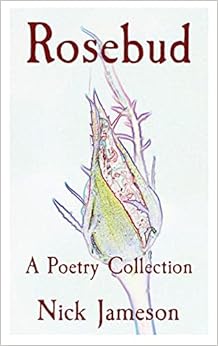

Rosebud: A Poetry Collection by Nick Jameson is a book of poems that is characterized by its beauty and accurate representation of what it’s like to be alive. The poems presented are varied and highly relatable to the human experience, to something deep that lives inside of every one of us. Life, love, spirit and pain are some of the many subjects covered through the different poems, each of them painted in a beautiful manner that will resonate with the readers.
The moment I started reading this book I realized how special it was going to be. From the beginning it addressed relevant philosophical topics in a delicate and simple way. These themes came alive through every new poem, weaving a thread for the reader to follow and inspect within themselves the meaning and beauty of life. The narrative voice that Jameson uses is very comforting and soothes the soul. Even those poems that dealt with the pain and suffering of being alive illustrated their ideas in such a lovely way that the main feeling that one got from them was of being seen and understood, a reassuring and warm sentiment. By the end, Jameson had recreated through his poems a feeling and idea that is so profound to the human soul yet abstract and hard to describe. It is the feeling of being alive, of loving and of finding one’s way in this strange world that’s been given to us.
Through every page, each new poem speaks to the readers’ soul as an ancient friend would. It guides them and consoles them, painting a captivating picture filled with life and inspiration. The fervor to love and to live a spiritual life is felt along many of the poems, letting the readers reconnect with something important that lives inside of us. Here lay the utmost important ideas that have been forgotten in this modern world and are needed to live a fulfilled life. Expect to recur to the words written in these poems in times of worry and self-doubt.
The themes covered in this poetry collection are varied yet all intertwine in one way or another. There are many narrative styles used that help in conveying the ideas presented in an imaginative way. The result is a fantastic masterpiece that will resonate with the hearts of many. There are so many lines worth highlighting in this small poetry collection that will remind you of the magic contained in every moment, in nature, and the potential of living life with love and passion.
Pages: 152 | ASIN: B09YHD7BQT




 LITERARY TITAN