Blog Archives
Literary Titan Gold Book Award: Poetry

The Literary Titan Book Award recognizes poets who demonstrate exceptional artistry and proficiency and push the boundaries of language and expression. The recipients are poets who excel in their technical skills and evoke deep emotional responses, challenge thoughts, and illuminate new perspectives through their work. The award honors those who contribute to the literary landscape with their unique voices and powerful words.
Award Recipients


Visit the Literary Titan Book Awards page to see award information.
The Blue Flame


The Blue Flame by Andy Cash is an illustrated poetry collection and unconventional Miles Davis biography that follows the musician from his Illinois childhood through bebop, cool jazz, modal jazz, jazz fusion, the lost years, and his eventual comeback. Cash writes largely through an imagined first-person voice, giving the poems the bluntness, swagger, anger, humor, and vulnerability associated with Davis. This work of biographical poetry turns albums, performances, relationships, addictions, and personal losses into emotional scenes. The book’s structure makes the scale of Davis’s evolution especially clear, tracing how he moved among styles while continually assembling remarkable bands and searching for a new sound.
The strongest sections treat jazz history as something physical and lived. Charlie Parker, Dizzy Gillespie, John Coltrane, Bill Evans, Wayne Shorter, Herbie Hancock, Tony Williams, and others enter the poems as mentors, collaborators, rivals, brothers, and ghosts. Cash’s jazz poetry often adopts short, percussive lines that feel closer to spoken word or improvised phrasing than traditional narrative verse. That approach works particularly well in pieces such as “Illinois Rap,” “Café Bohemia,” “So What,” and the compact “Fusion” sequence. The language can be abrasive, but it has energy, and its repeated references to breath, blood, blue light, electricity, rhythm, and silence create a musical vocabulary that holds the collection together.
This music biography also spends meaningful time with Davis’s family and romantic relationships. His parents emerge as foundational forces, with his father representing pride, education, independence, and discipline, while his mother brings music, beauty, and a fiercer emotional presence. The poems involving Irene, Juliette Gréco, Frances Taylor, Betty Davis, and Cicely Tyson explore affection, regret, possessiveness, racial pressure, addiction, and recovery. Cash doesn’t separate Davis’s artistic brilliance from the damage surrounding it. Poems such as “The Darkness of Porgy and Bess” directly confront his controlling treatment of Frances, while the lost-years poems move into paranoia, illness, isolation, and creative exhaustion.
Visually, The Blue Flame is as much an illustrated biography as a poetry book. Cash’s portraits and loose, neon-like figures have the spontaneous quality of drawings made while music is playing, and the recurring blacks, blues, white outlines, instruments, flames, and distorted faces complement the collection’s shifting moods. The background notes are a valuable closing section, explaining the historical events, recordings, and musical ideas behind each poem without interrupting the main sequence. Taken as a whole, this illustrated jazz poetry collection is an expressive tribute to Miles Davis’s restless creativity. It gives readers a lively route into his life and music, while longtime jazz listeners will recognize the albums, collaborators, transformations, and contradictions that kept his blue flame burning.
Pages: 102 | ASIN : B0H3814M8B

What Nature Teaches Us: A Book About Being the Light

What Nature Teaches Us by Clay Vilhauer and Amber Vilhauer is a reflective children’s book that turns familiar parts of the natural world into lessons about kindness, courage, patience, belonging, and growth. Each section focuses on one subject, such as the sun, moon, rain, birds, trees, rivers, or mountains, then describes what children might learn by paying closer attention to it. The authors invite readers to return to the book, talk about its ideas, and add their own thoughts, which makes it feel more like a shared conversation than a story meant to be read once and shelved.
The writing has a calm, poetic rhythm, with brief observations that are easy to read aloud but carry enough meaning to prompt a longer discussion. Some lessons are especially memorable, including the rainbow’s reminder that every color contributes, the tree’s example of rest and renewal, and the river’s ability to adjust its path while continuing toward the ocean. The book’s approach works well because it connects big emotional ideas to things children can actually see, touch, and observe.
Joni-Leigh Doran’s illustrations give the book much of its warmth. The small watercolor images are loose, gentle, and surrounded by plenty of white space, so every sun, cloud, bird, flower, wave, and mountain feels like an object being quietly noticed. Their hand-drawn quality fits the book’s invitation to slow down and look closely, while the limited splashes of yellow, blue, green, and purple keep the pages lively without crowding the words. The activity pages near the end also leave room for children to draw, attach found objects, or write down what nature has taught them.
This is a thoughtful book for families, classrooms, counseling spaces, or any setting where an adult and child can pause and talk together. Its strongest quality is the way it treats children as capable of reflection without making the language stiff or overly complicated. The final message, that the light has always been inside the reader and nature can help them remember it, gathers the individual lessons into a reassuring conclusion. It’s the sort of book that can grow alongside a child, since different pages are likely to feel meaningful at different moments.
Pages: 50 | ASIN : B0HBXHZ5NB
The Voice of Cuba

The Voice of Cuba by Amarilys Gacio Rassler is a collection of fiction, drama, poetry, and nonfiction centered on Cuba, political oppression, exile, faith, and the difficult work of building a life in a new country. Rather than treating Cuban history as something distant or abstract, Rassler brings it into family homes, prison cells, airports, classrooms, and makeshift rafts. The book moves across decades and points of view, but its emotional center stays consistent: ordinary people are trying to protect the people they love while forces larger than themselves reshape their lives.
The fiction contains some of the anthology’s most intense moments. “Seis Dedos, Six Toes” follows a young girl whose courage takes a shocking physical form, while “The Tree of Hope” portrays political prisoners struggling to preserve their dignity and faith under brutal conditions. “The Rafters” turns a family’s escape by sea into a painful story about sacrifice, and the play “From Worms to Butterflies” captures the confusion and heartbreak of a child leaving Cuba. Rassler often blends English and Spanish within the same conversation, so the language feels rooted in Cuban family life. Food, songs, religious expressions, nicknames, and familiar objects give the stories warmth even when the events become frightening.
The book reminded me of Cristina García’s Dreaming in Cuban, especially in the way both writers connect political history to intimate family relationships. García’s novel is more layered and stylistically experimental, moving among generations whose feelings about Cuba often conflict. Rassler’s anthology is more direct and testimonial. Her characters tend to speak clearly about freedom, faith, and the damage caused by the Castro regime. That directness gives the book the feeling of oral history passed from parents and grandparents to younger generations. It’s less interested in creating distance between the reader and the subject than in making sure these experiences are remembered.
What stayed with me most was the anthology’s movement from terror and separation toward memory, love, and cultural continuity. The nonfiction pieces near the end, including the funny and affectionate courtship story “Romance in the U.S.A.” and the tender “The Shoe,” show that exile contains awkwardness, humor, romance, and ordinary family negotiations alongside grief. Rassler’s writing is at its strongest when a small object or gesture carries a much larger history: a shoe touched by a mother, a guava-filled cookie, a pearl necklace, a song, or a shared phrase in Spanish. The Voice of Cuba feels personal because it is personal. It gathers stories that might otherwise remain inside individual families and turns them into a record of endurance, faith, and Cuban-American identity.
Pages: 129
Love Her Blind & Other Poems

Love Her Blind & Other Poems is a restless, emotionally exposed collection that moves through romantic betrayal, childhood violence, family memory, aging, faith, mental illness, and the strange negotiations required to survive all of them. David Somerfleck’s poems often begin with an ordinary object or encounter, then push it into a more charged psychological space. A rocking chair becomes part of a child’s understanding of violence, a bicycle becomes both escape and resistance, and a grandfather becomes something nearly cosmic. The collection’s range is clear in titles such as “My Grandfather’s God,” “Bicycle Rider,” “What I Didn’t Know About Love,” “Tall Time,” and “Mum.”
Somerfleck writes in a dense, image-driven style, piling physical detail onto memory until the past feels immediate and unstable. His strongest poems let metaphor deepen the experience rather than simply decorate it. In “Bicycle Rider,” reading and riding give the speaker a way to move beyond family cruelty, even when that cruelty follows him into sleep and imagination. In “My Grandfather’s God,” ancestry, nature, grief, and belief merge into a vision of blood moving through soil, roots, trees, and stars. These poems don’t treat memory as a tidy record. Memory becomes a living environment, full of weather, animals, wounds, voices, and figures that appear larger than life.
The book’s emotional center is its ongoing attempt to understand love without simplifying it. Love appears as tenderness, obsession, protection, grief, dependency, and renewed possibility. “What I Didn’t Know About Love” begins with harsh, dangerous images, but gradually makes room for a love that can be delicate, clear, and newly understood. That movement gives the collection more than darkness. Even when the poems enter frightening or surreal territory, they keep reaching toward connection, whether through a partner, a parent, a grandparent, an animal, a remembered landscape, or the act of writing itself.
What makes the collection memorable is the sense that every poem has been wrestled out of experience rather than calmly observed from a distance. Somerfleck’s voice can be raw, funny, grotesque, affectionate, angry, and unexpectedly gentle, sometimes within the same piece. The result is a book that feels intensely personal while still opening outward toward questions many readers will recognize: what families pass down, how pain changes perception, why love survives its own damage, and how imagination gives us somewhere to go when reality closes in. Love Her Blind & Other Poems turns bruised memory into fierce, strange music that keeps sounding after the page goes quiet.
Pages: 90 | ASIN : B0GN54HFYQ
The Hunting of the Snark
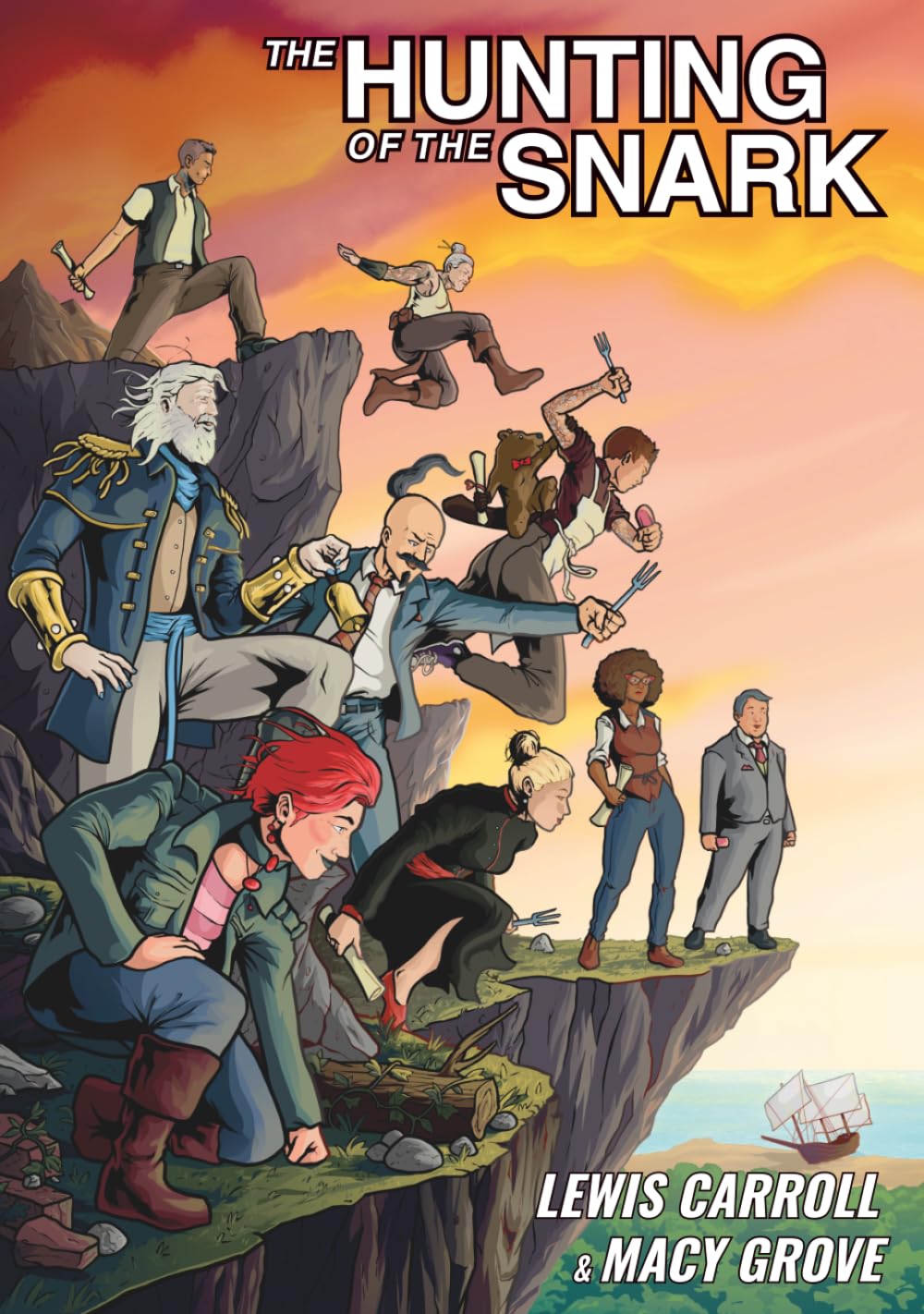
Macy Grove’s The Hunting of the Snark is a vibrant graphic novel adaptation and fantasy adventure built around Lewis Carroll’s famously strange 1876 poem. Grove preserves Carroll’s rhythmic language while giving the expedition a contemporary visual identity, with illustrations credited to Anonymous, Macy Grove, and Nyx Grove. The story follows the Bellman and a wonderfully mismatched crew as they cross an impossible sea, land in a landscape of chasms and crags, and begin searching for a creature they can barely describe. It’s playful from the start, but the silliness always carries a faint sense of danger.
The cast gives this illustrated fantasy poem much of its personality. The crew includes a Baker who has forgotten her name, a lace-making Beaver, a Butcher who can kill only beavers, a Barrister, a Banker, a Broker, and several other specialists whose talents are either oddly specific or completely useless. Grove updates the hunters into a broader, more varied group while making that choice part of the book’s own mischievous mythology. The character designs help turn Carroll’s list of occupations into an ensemble you can recognize, follow, and care about, especially as the Beaver and Butcher move from mutual fear to genuine friendship.
What makes the book especially enjoyable is the way its surreal comedy and comic book storytelling work together. Carroll’s absurd logic remains intact: the Bellman navigates with a blank map, treats repetition as proof, and instructs the crew to hunt with thimbles, forks, railway shares, smiles, and soap. The art gives those jokes physical shape, but it also deepens the mood when the Jubjub, Bandersnatch, and Boojum enter the story. Scenes that sound ridiculous on the page can suddenly feel lonely, eerie, or threatening when placed against dark valleys, jagged cliffs, and an approaching night.
The final part lands with more emotional force than the book’s comic setup might suggest. The Baker appears to find the Snark, calls out in triumph, and then vanishes when the creature proves to be a Boojum. That ending gives this dark fantasy graphic novel a haunting aftertaste, turning the hunt into a story about ambition, fear, friendship, and the things people chase without fully understanding them. Grove’s adaptation feels lively, affectionate, and visually generous, making it an inviting way to experience Carroll’s poem while also giving longtime readers plenty of new details to notice.
Pages: 99 | ASIN : B0FP54JXFZ
My Spiritual Journey

Sitting by the Windowsill of Life With a Spiritual Friend is a collection of 166 short reflections on love, grief, and spiritual awakening in which George Harrison is imagined as a spiritual companion offering comfort and tenderness. What inspired you to write this collection?
My spiritual journey inspired me to write this book. During this journey, I rediscovered George Harrison – not just as a Beatle, a solo artist, or a member of the Traveling Wilburys, but as a spiritual mentor. I am a spiritual seeker, connecting with another and exploring my own spiritual side. He inspired me, and this book, Sitting by the Windowsill of Life with a Spiritual Friend, Volume I, is the result.
This book is urgently needed at this time of unrest and many challenges in our world. The simple words of love, hope, guidance, compassion, and wisdom give us the strength and resilience we need in our constantly changing world. It also shares basic principles of healthy living – physically, mentally, emotionally, and spiritually – and highlights emotional well-being, the importance of letting go, living in the present, and understanding what it means to be both human and a soul.
Did writing these reflections change the way you think about loss and remembrance?
These reflections confirmed my belief that our soul is eternal and life never truly ends, but changes as we go through the exit door into another form of existence. Our loved ones never truly leave us. I’d like to think they are just a “wink of an eye away,” and love is the eternal connection on Earth and beyond. We are born into love, and we leave this world surrounded by love.
Author Links: GoodReads | Amazon


