Blog Archives
The Power of Stories

Our Song, Our Voice follows a young golden crow as he embarks on a journey to save his grandmother and preserve his flock’s fading traditions, proving that courage, wisdom, and song can bridge generations. What was the inspiration for the setup of your story?
The main inspiration for this Our Song, Our Voice can be found in the UNESCO Indigenous Languages Decade (2022-2032). When I learned more about the topic on their website, the idea of approaching the issue through nature developed in my mind. After all, human cultures are directly connected to nature and the changes that occur within it. Just as indigenous peoples are affected by the changes caused by the modern world, the ecosystem, with its animals and plants, also undergoes a similar experience.
In my story, golden crows that once inhabited vast areas have become increasingly rare as wilderness areas shrink and diminish. Their customs and songs, which correspond to the cultures and languages of smaller groups of people, are also threatened.
I feel great sympathy for the languages of the people. Small language areas, in particular, are in danger when larger languages encroach upon them. The new unilateral development is gaining momentum from global communication, where a few languages dominate. It is inherently good that the people of the world understand each other as widely as possible and without linguistic barriers. Alongside such development, we should also strive to preserve the languages of smaller regions, peoples, and cultures. This is essential for individuals’ identity.
What role do you believe storytelling plays in preserving cultural traditions in the real world?
The power of stories is eternal. It has undoubtedly been utilized for as long as humans have been able to speak. Even in its simplest and most original form, it has been, after primitive basic skills, the most crucial tool for the survival of the human species and the development of culture. In addition to transmitting knowledge and skills, stories have conveyed all the human experiences and emotions that have fueled the progress of the human species, enabling complex forms of cooperation to arise.
The power and need for stories have not diminished as societies have evolved. They are used everywhere: in education, politics, and marketing; the list is endless. The immense power of storytelling can serve both good and bad purposes. At best, it continues to convey valuable information and emotion, forming the basis for human action. At worst, its messages are deliberately distorted, aimed at manipulating people to serve questionable goals and selfish interests.
In my children’s books, I explore and utilize the possibilities of storytelling for various essential purposes. I aim to convey information about today’s world, including history and traditions, to children in an appropriate manner. I believe this approach helps them gain a better understanding of society and function within it.
What were some themes that were important for you to explore in this book?
A central underlying theme in this storybook is the changes occurring in nature. The consequences of drastic economic projects for all living beings are often alarming and, at worst, irreversible. Increasing numbers of animal and plant species, as well as entire ecosystems and life forms, are under threat.
However, I believe that changes in nature should not be presented to children in an overly frightening or threatening way. My goal is to instill in them a respect for nature and a sense of responsibility for preserving it, rather than blaming them or projecting overwhelmingly disturbing images of danger.
I want to highlight the significance of cooperation and care between different generations as a vital foundation of humanity. By being deeply connected with people of various ages, we can pass down traditions and transfer knowledge to future generations as part of human interaction. The experiences of our predecessors pave the way for subsequent travelers on the paths of life.
My little protagonist’s name is “SISU,” a Finnish word that reflects an important theme in the story. It means determination, not giving up, and trying hard despite difficulties. It represents a stubborn strength that doesn’t make a big fuss about itself but acts regardless of obstacles. I thought it was a funny name for a little character, but it holds significant meaning and plays a crucial role in the national identity of people from my home country.
How did you develop the deep, heartfelt bond between Sisu and his grandmother, Una?
Relationships between members of different generations have always been meaningful to me. Important individuals older than me have greatly influenced my life.
To describe the special bond between Sisu and her grandmother in the story, I have drawn from moments and conversations I shared with my grandparents, who were part of my life for the longest time. Now, they are just a dear memory.
My grandfather, who lived in northern Finland, was an honest, old-fashioned man. He was skeptical of reforms that changed his world too much or too quickly. One detail in the story particularly relates to him: using tree resin for healing.
I have heard that my grandfather collected resin while walking in the forest and rolled it into a ball to take home. He would cut off pieces as needed and treat wounds or skin lesions with that gift from nature. Today, the disinfectant properties of resin are also recognized in medicine.
The story also reflects the peaceful togetherness I’ve experienced with my grandparents. They made time for me and shared many lessons that I still carry with me on my life journey.
Author Links: GoodReads | Website | Amazon
Sisu’s grandmother Una wants to teach him important lessons about life, including the crows’ traditional songs and language. The flock is among the last of their species, and Grandma worries their unique songs and customs will disappear forever.
Then little Sisu takes on a big task, a journey that is not only important to his grandmother but also to the future of all golden crows.”
Our Song, Our Voice
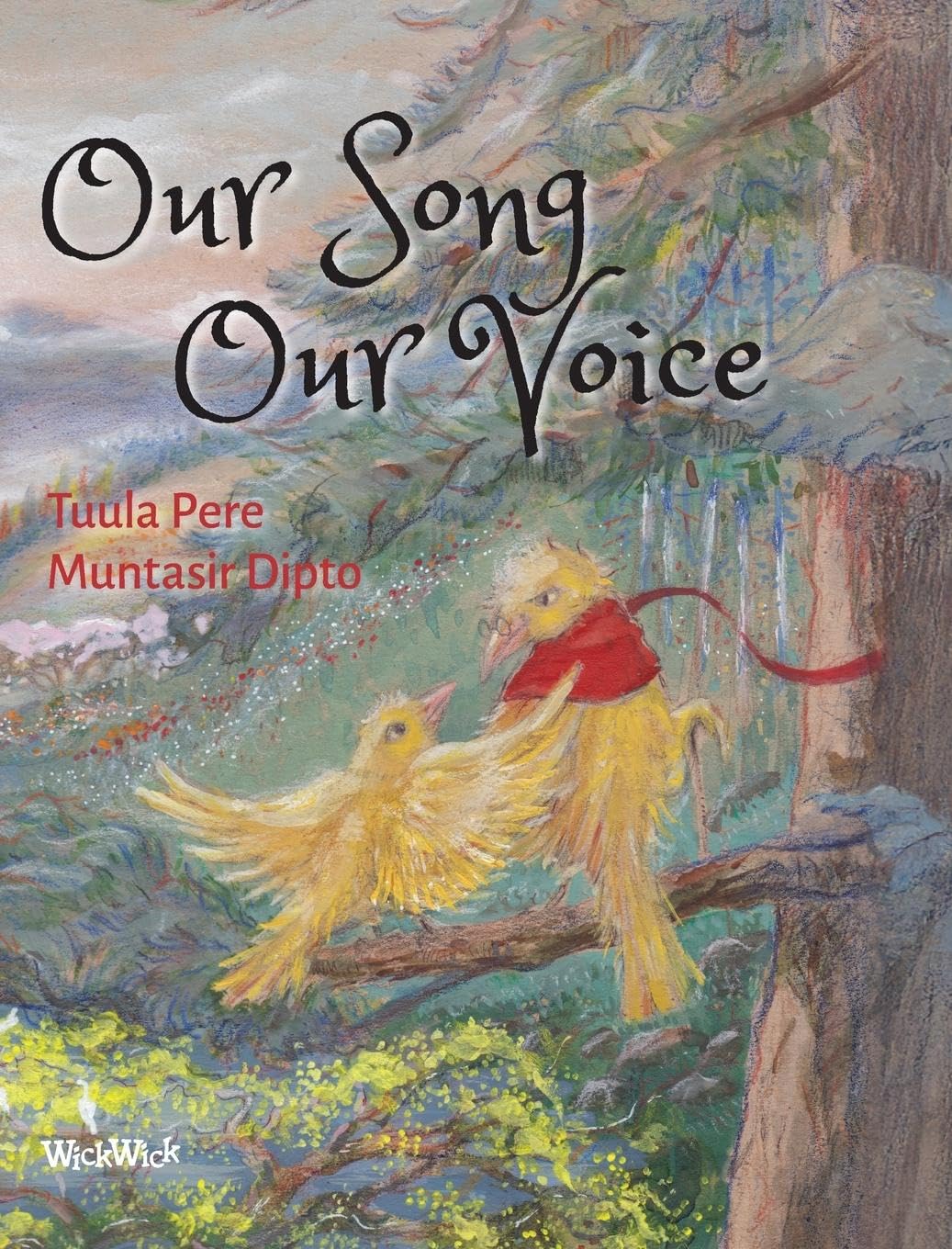

Tuula Pere’s Our Song, Our Voice is a heartfelt story about a young golden crow named Sisu who embarks on a journey to save his beloved grandmother and preserve the traditions of his endangered flock. Set in a valley threatened by deforestation and invasive species, the book follows Sisu as he learns ancient songs, finds his courage, and sets out to retrieve a powerful healing resin from the distant Blue Mountains. Along the way, he discovers the power of music, the wisdom of elders, and the importance of preserving one’s heritage.
One of the most touching aspects of the book is the relationship between Sisu and his grandmother, Una. Their bond feels genuine and warm, full of love and wisdom. Una teaches Sisu not only about survival but also about values, culture, and the importance of knowing where one comes from. The way Pere weaves life lessons into the story feels natural and never preachy, making them all the more effective.
The story also does a great job of portraying resilience and bravery. Sisu, though small and inexperienced, takes on a daunting journey when no one else believes in the old traditions. When his parents dismiss his grandmother’s wisdom, he listens anyway. When he’s told he’s too young or weak, he pushes forward. His moment of triumph, when the old golden crows recognize his song and guide him, is one of the most rewarding parts of the book. The idea that language, tradition, and song can connect generations, even across time and distance, gives the story emotional weight.
The destruction of the golden crows’ home due to deforestation mirrors the plight of many endangered species today. The struggle to keep traditions alive, especially when they are deemed unnecessary or outdated by others, is something many cultures face. Our Song, Our Voice doesn’t just tell a story, it encourages readers to think about what’s worth preserving.
Our Song, Our Voice is recommended to anyone who enjoys meaningful, emotionally rich stories. Younger readers will appreciate the adventure, while older ones will find deeper themes to reflect on. It’s perfect for families to read together, as it sparks conversations about heritage, bravery, and the environment. Pere’s storytelling, combined with Muntasir Dipto’s charming illustrations, makes this children’s book both engaging and thought-provoking.
Pages: 40 | ISBN: 9528202179




 LITERARY TITAN