Blog Archives
A Cynical Reality

The Fox and the Garbage War pits two favorite fairy tale protagonists against one another as a crafty fox declares he will get revenge on the town’s wolf mayor by running against him in the upcoming election. Where did you get the idea for this story?
This book, The Fox and the Garbage War, is the sixth in a series in which I examine the different forms of power and its misuse in our world today. My inspiration always comes from real-world global events—issues that are often quite serious.
To make these topics accessible to children, I adopt a humorous, often sarcastic perspective. In this story, the focus is on the collision between science and personal greed. As a “partner in crime,” we meet a researcher whose misguided ambition leads them to abandon professional ethics in favor of fame and wealth.
The story reflects a cynical reality we often see today: even environmental responsibility and scientific integrity are cast aside to serve a personal agenda. Through satire, I want to show and warn young readers how easily noble goals can be corrupted when greed takes the lead.
Francis the Fox is charming but untrustworthy—how did you approach creating a character children would both enjoy and question?
I wanted to move beyond the traditional, one-dimensional hero and create someone more like the figures we see in real life—charismatic and persuasive yet ultimately driven by their own interests. Francis is charming because that is how power often presents itself; it’s rarely ugly at first glance.
By making my fox somewhat likable yet untrustworthy, I invite children to practice critical thinking. I want them to enjoy his quick actions while feeling a hint of suspicion. One thing I find fascinating about Francis is his incredible resourcefulness and persistence; even in his most questionable schemes, he never gives up. It’s a quality one could truly admire, if only it were directed toward better goals.
Interestingly, when readers discuss the series with me, many—especially adults—cite examples from their own home countries. It seems that ‘Francis-like’ characters, who use their drive and charm to mask personal agendas, are a global phenomenon. The Fox Series teaches children to look beyond a leader’s energy and polished words to see the real impact of their actions.
Do you have a favorite character in this story? One whose dialogue was especially fun to write?
My favorite dynamic to write was definitely the interaction between Francis the Fox and the researcher, Linda Lupo. Their dialogue evolves in a chilling way. It begins with light conversation and calculated flattery, but they are quickly bonded by their shared ambition—even if their ultimate goals differ.
Francis is a master manipulator; he skillfully uses every trick of persuasion and manipulative charm to bind Linda to his cause. However, as the crisis deepens, the tone shifts dramatically. The flattery turns into harsh commands and, eventually, into outright blackmail and threats. I still get goosebumps thinking about how their relationship spirals, culminating in the moment when the researcher is imprisoned in a cellar. Writing that transition from ‘partners’ to ‘captor and prisoner’ was incredibly intense.
While the dialogue between Francis and Linda was the most intense to write, my favorite character is William the Wolf, the old mayor. He is the complete opposite of Francis: unfailingly kind, firm, and honest.
Even as an old, somewhat frail wolf, William is the voice of reason and calm experience. He has a deep understanding of what is happening behind the scenes and often anticipates the villains’ moves. What I love most about him is his quiet strength—when the situation demands it, he is willing to step into the most dangerous parts of the finale to do what is right.
To me, William represents the kind of leadership we need more of in the real world: a steady, ethical force that stands in stark contrast to the opportunistic and self-serving nature of characters like Francis. He reminds us that true wisdom and integrity ultimately hold a community together.
What kinds of conversations do you hope this book sparks between children and adults?
Ultimately, I hope this book serves as a bridge for meaningful conversations between children and adults. Challenging stories naturally spark deep reflections, and I want to encourage children to look beyond ‘polished promises’ and ask: ‘Is this person acting for the common good, or just for themselves?’
We need to talk honestly about the fact that those in the spotlight are not always the ones working in our collective best interest. While characters like Francis chase the hype, real leadership is often found in the quiet work behind the scenes—the kind of effort that rarely receives the applause it deserves.
I don’t mean that children should be prematurely immersed in the harsh reality of world news—every family must decide the right timing for themselves. However, since children are inevitably exposed to heavy and unpleasant topics through the media, it is vital that parents have tools like these books. They offer a way to process even the most difficult subjects in an age-appropriate way, showing that true integrity means staying true to your ethics, even when no one is watching.
This is the sixth episode in the Francis the Fox Series. The fox’s twisting path has already led readers through the dark worlds of power struggles, the trampling of freedoms, construction schemes, election fraud, and fake news. And there is more to come!
I recently spoke with the incredibly talented Italian illustrator Andrea Alemano at the Bologna Children’s Book Fair about where Francis’s crooked trail might lead next. Andrea and I, the storyteller, remain deeply inspired by our cunning, questionable hero. Stay tuned, because the adventures definitely continue!
Author Links: GoodReads | Website | Warm Values | Facebook | LinkedIn | Amazon
When the fox’s shady accomplices get their paws in the election results, everyone’s in for a surprise.
Mystical Encounter
A Stargazer centers around a sick little girl who is convinced she has been healed by a star boy and his magical stardust. Where did the idea of Vesper, the “star boy,” come from?
Already early on, I borrowed all the space-themed nonfiction books from the small library in my home village and tried to observe the starry sky on dark winter nights. However, without a telescope, you couldn’t see much detail, although you could spot some constellations. For my story, A Stargazer, I drew inspiration and details primarily from this childhood fascination with the starry sky.
There is also a particular incident that closely resembles the meeting between my story’s little girl and the starboy. As a child, I built a snow lantern in windy weather so enthusiastically and for so long that I ended up with a very high fever. I had to stay in bed for days, and the illness wouldn’t let up. Finally, in my feverish delirium, I saw a translucent figure descend onto my blanket and smile kindly at me. When I told my mother about this angelic visitor, she quickly arranged for me to see a doctor.
I’ve slightly modified this mystical encounter with my clear angel figure to the beginning of my book. As a teenager, I fell in love with David Bowie’s song “Starman.” There was – and still is – something very captivating about its lyrics and melody. What do we really know? What if this isn’t all there is? What else could there be in the universe?
Do you believe wonder is a starting point for learning, especially in children?
Absolutely. Curiosity and a desire for knowledge are powerful forces. It’s good to satisfy them by reading, asking questions, and listening to those who are more experienced and knowledgeable than you.
I have personally gained a lot of knowledge from libraries. Of course, schools and later studies have continually added to those lessons. I hope that learning never stops, not even now that I am in my senior years. At least, I remain just as curious about everything around me—only the things that need explanation have changed.
I believe that curiosity and wonder keep people engaged and active at any age. Mental fitness influences us throughout life and can support overall well- being. It’s unfortunate when adults discourage a child’s enthusiasm for exploring the world. I always try to encourage young minds to make their own observations and think independently. I see my children’s books as a tool for this as well!
Life is such an interesting and valuable gift, regardless of your age, that it’s worth embracing it as the ultimate journey of discovery. We never know where the winds and currents will carry us. There’s plenty to wonder about along the way, and the destination itself invites reflection.
The artwork in your book is wonderful. Can you tell us about your collaboration with illustrator Nyamdorj Lkhaasuren?
I have had the pleasure of working with Mongolian illustrator Nyamdorj Lkhaasuren on several children’s books. Our collaboration started years ago through our mutual connection, Mongolian publisher Nepko Kids.
Initially, Nyamdorj Lkhaasuren illustrated my Axel and Ava Series. His interpretation added warmth, color, and humor to the everyday adventures of young children. When I started working on the Lyrics of Life Series for slightly older children, two stories immediately came to mind that would be perfect for Nyamdorj Lkhaasuren to illustrate. He was excited about the topics, so A Stargazer and The Hermit’s Hut were recently created and recently published in English and Finnish.
Lkhaasuren’s art is vibrant and detailed. In our two latest collaborations, his style creates enchanting and magical worlds with richer colors and more mystical details. He utilizes modern digital technology to its fullest, and the spreads he creates are a constant inspiration to me. He is exactly the kind of illustrator whose visual interpretations of my stories inspire me to write more and more.
I hope we can soon continue our collaboration on new books. I have already drafted some stories for this purpose. But first, I’m going to pitch A Stargazer and The Hermit’s Hut to the publishers I’ll meet at the Bologna Children’s Book Fair later this spring.
What do you hope children feel when they recognize themselves in Aylin?
Aylin, the main character, is both vulnerable and strong. I hope children find inspiration and encouragement in this story when they need to dig deep to build self-confidence and pursue their dreams.
Life is about standing your ground, even when others oppose you. Sometimes, obstacles are tough and require a lot of courage to overcome. Other times, they’re more subtle and involve just some headwinds. Aylin faces both types. It’s never easy to be the only one who believes in something, and enduring the laughter, teasing, and belittling from others makes it even harder.
Aylin’s behavior in the book also demonstrates a vital lesson: the value of seeking help and forming alliances with trustworthy, like-minded people. The young girl receives support from three different adults, each aiding her in a unique way. Her father shares her fascination with space and assists with the telescope, while the librarian respects her curiosity by guiding her toward the right books. Additionally, she finds a surprising kindred spirit in the old janitor of the observatory, who also has stardust in his eyes.
By featuring such a diverse cast of supporters, the story aims to encourage making friends across different ages and backgrounds and finding common ground with them. The best companions for life’s various journeys aren’t always found among peers—while those connections may feel more effortless, they don’t always challenge and refine our thoughts in the same way.
Growing up around people of all ages and generations simply taught me about humanity and the value of collaboration. These experiences gave me the courage to face life’s challenges together with others. I often say that age is a fluid concept. Some are born old, while others remain eternal children. These different starting points lead to fascinating encounters, where you might even find yourself talking about stardust, if the mood strikes you!
Author Links: GoodReads | Website | Warm Values | Facebook | LinkedIn | Amazon
But when Aylin’s class visits the city observatory, things don’t go the way she expects. Her most important questions are met with impatience-and laughter. Just when she’s about to give up, an unexpected friend appears: the observatory’s elderly janitor, who seems to understand stardust and the beauty of the universe better than anyone.
A luminous picture book about curiosity, resilience, and keeping your sense of wonder-even when others don’t understand.
Memories From Childhood Summers
The Ghost of the Deserted House follows two friends who sneak into an abandoned house on a summer night, where they encounter an unexpected visitor and wonder if the house is haunted. What was the inspiration for your story?
My Active Kids Series currently includes four books: The Ghost of the Deserted House, Luke’s Sailing Adventure, A Museum Robbery, and The Leading Role. Already, the series’ name and the books’ titles suggest that the heroes are a group of children who encounter surprising, interesting, and sometimes even exciting situations. These stories are based on my own childhood games and the friends and siblings who joined in.
This particular book takes place during the summer and tells the story of a visit to a friend’s family’s summer cottage. I had similar visits as a child, and they always felt like an adventure. Spending the night with a strange family can be tough for a kid. It might be an unfamiliar place to sleep, and the family might eat something different from what you’re used to at home.
And how well do your skills hold up in unfamiliar environments? A beach can feel strange and unsettling. Is it deep? Is the bottom muddy, or are there nasty, slimy aquatic plants growing in the water? What about those dark, enticing yet scary attics or abandoned houses? I still get chills thinking about how exciting a nature walk at dusk is!
What were some ideas that were important for you to share in this book?
The main focus of this book is actually summer nature. At least Finnish children have the chance to experience it in many ways. I want to take my readers to an environment filled with summer scents, trees, plants, and birdsong. It was also the rural environment of my childhood, by the beautiful lakes of Eastern Finland.
I’ve drawn many memories from childhood summers throughout my adult life. I can still close my eyes and return to those landscapes in my mind. Nature is the greatest teacher. It allows us to see and experience things from small to large, helping us reflect on life as a whole. And children feel connected to the vastness of nature, even when they’re just playing a simple game with stones and squatting on the ground.
I also remember how inspiring it was to constantly learn new things. I believe a child is a kind of explorer, whom we adults should give a rich environment to explore and challenges to face. Ideally, children should explore and learn early with their friends. In this story, two young friends share the same experience, and supporting each other becomes essential when things get too exciting. – They say shared joy is double the joy, and I believe that, too!
What scene in the book did you have the most fun writing?
The adult me was, of course, captivated while writing a nostalgic journey through my childhood and its experiences in nature. But the most fun and inspiring part was writing the sections where the children set out on their own adventure in the abandoned house.
After all, the attic scene is the most exciting part of the story. There, the children display independence and a bit of daring. Such activities are usually the most fascinating for young readers.
I wanted to take my readers on an experience they might not have in real life. It’s always fun when an adult in a story does something funny or even gets caught up in a prank or trick. I think the father snoring in a hammock is quite endearing, especially when the kids attack this “ghost” in the dark attic.
What is the next book that you are working on, and when will it be available?
In our small family business, I get involved in various parts of our publishing process. It’s rewarding to have direct contact with the people who create illustrations, edit, and lay out the work. As usual, I have numerous book projects at different stages. Some are still in the illustration phase on the artist’s desk, while others have just returned from editing.
I just published my 80th English children’s book in my writing career—there are even more in Finnish. The book The Hermit’s Hut is the fourth installment in my Lyrics of Life Series. This time, the story was inspired by John Lennon’s song Imagine. I believe the next sequel to this series will likely be published sometime next year.
Before that, I plan to publish two slightly longer novels for young readers. Those are really fun to write now and then. You get to create a longer adventure with a more complex plot, which allows more focus on the characters. These upcoming children’s novels include the exciting time travel adventure Professor Dreistein and the Captured Lightning and The Singing Ghost of Troll Village, which centers on a talent competition in a troll village. We can expect these new novels to be released later this year.
Until then, we at Wickwick need to focus on promoting our Bilingual Books Series—there are many titles featuring various language pairs! I hope these books help children worldwide master situations where they need to immerse themselves in two languages. It’s definitely more enjoyable with a good story and beautiful illustrations.
Creating new books is truly wonderful, but it’s also rewarding to share them with international publishers, such as at the Bologna Children’s Book Fair or the Frankfurt Book Fair. I was especially excited this spring when the Finnish version of one of my stories, “Carried by Wings,” was nominated for a prize in a Finnish competition. Wish me luck!
Author Links: GoodReads | Website | Warm Values | Facebook | LinkedIn | Amazon
Something strange happens when the boys decide to escape the heat and mosquitoes and go to the attic of the deserted house next door.
Do ghosts suffer from the heat too?
Diverse Setting
A Museum Robbery follows two adventurous kids who stumble upon the shocking truth behind a puzzling heist, and the key to solving the mystery lies in a spilled jar of jam. What inspired you to create a mystery around a museum and a grumpy caretaker?
Sometimes, I enjoy writing lighter adventure books. Usually, my stories explore serious topics, but in this Active Kids Series, I have the child protagonists do exciting things that aren’t too heavy, so there’s less worry about the outcomes. I like to turn the protagonists into kind of small heroes that readers can easily relate to. They might imagine themselves in similar situations.
In A Museum Robbery, the children go on adventures in a museum, probably because I’ve always loved museums of all kinds. They also create a diverse setting for a children’s detective story, where a real crime happens in that very special environment. I described the criminal, the retiring caretaker, in a way that no one really needs to be afraid of him. In the illustration, the thief actually looks quite harmless.
Museum and exhibition guards are also interesting characters in real life. Some are friendly and enjoy interacting with visitors, while others are irritated and tired of their job, like Mr. Oddyman in this story.
The chalk art illustrations add so much charm—did you have a specific vision for the style, or was that the illustrator’s choice?
The illustrator of this book was discovered by chance through internet connections from Brazil. I have not previously worked with Dane D’Angel, but his illustration style seemed to fit well with these four Active Kids stories. In addition to A Museum Robbery, three other books have been published in the series: Luke’s Sailing Adventure, The Ghost of the Deserted House, and The Leading Role.
Dane D’Angeli has illustrated all four books quite independently. Of course, we discussed the work a bit during the process, but I try to give my illustrators a lot of freedom. I believe this approach makes illustrating more motivating for them, and the result looks more natural. I only address points that are particularly important. Naturally, the genre and interpretation need to align with the mood and the ideas expressed by the story’s twists, turns, and main points. However, the smaller details aren’t as important. Sometimes, the illustrators themselves come up with fun details or a new perspective that supports the story. It’s always enjoyable to see how the artwork develops.
If you were to write a sequel. What kind of mystery would Emma and Oliver solve next?
That’s a fun idea. I could have them investigate a case involving environmental littering, like one that causes serious damage in a remote hideout. Such a topic would fit well into my repertoire because nature and taking care of it are important to me.
I could also write a story about art forgeries. It might involve an entire gang of criminals and a lot of money. I think I’ll go ahead with such a story because it’s already starting to develop in my mind. I won’t reveal more, but that will surely come in time.
I already have a couple of separate children’s detective stories written, which I haven’t published yet. However, they feature completely different main characters. They take you, for example, through wilderness areas to find valuable river pearl mussels, which are forbidden to catch.
Children’s detective stories are a great way to introduce situations where readers have to think about right and wrong. It is also important to give children the opportunity to realize they have skills, such as sharp eyes and good observation, which can help uncover dishonesty and hold wrongdoers accountable.
Emma and Oliver feel like real kids—are they based on anyone you know?
I’m very happy if I have succeeded in creating realistic characters like Emma and Oliver. They don’t have direct role models, but they are a mix of many children I know.
Actually, I also see myself in this book, as a little girl playing with my best friend. Together with him, we even started a secret adventure club where we could do lots of exciting things. With the help of imagination, even the ordinary surroundings of the home village become exciting, and you can imagine anything happening there!
As a child, I was a big adventurer in my own environment, often exploring alone. It’s easy and fun to write stories about those experiences and memories for today’s children. When I immerse myself in writing to go on a fantasy adventure, I reconnect with my childhood. It feels as if I am just as enthusiastic and excited, and my imagination conjures up events that would have fascinated me as a child.
We can’t go back to our childhood, but we can immerse ourselves in the magic of children’s book adventures with our children. I believe many adults can still experience the same hilarious feelings they once had when reading bedtime stories aloud.
Author Links: GoodReads | Website | Warm Values | Facebook | LinkedIn | Amazon
Does Mr. Oddyman really have trouble walking? And why has he made so much jam? Emma and Oliver’s sharp eyes help to uncover the villain.
Noble Intention
The Dream House follows a family who starts to build their dream home when things start going wrong, and soon their dream home is a nightmare. What was the inspiration for your story?
The spark for this story, The Dream House, came from a deeply personal and meaningful connection. I have an acquaintance with roots in India who now lives on the other side of the world. He has long been a reader of my children’s books, and we often have deep conversations about the stories and characters I create. He has always appreciated how my books tackle real emotions through a child’s eyes.
During one of our discussions, he shared two “true stories” from his life that he felt might hold the seeds of new picture books. These anecdotes were vivid and rich in authentic human detail. They stayed with me for a long time, circling in my mind as I thought about how to give them narrative shape. In fact, both of those “story seeds” eventually blossomed into published books: one became The Old Rose Villa, and the other became The Dream House.
While the core idea—the struggle of building a home—is rooted in real experiences, I let my imagination lead. As a storyteller, I didn’t want to write a literal biography. Instead, I transformed the experience into a “fable-like” version of reality, using the freedom of fiction to lean into fantasy and exaggeration where the story needed it. In a children’s book, you can amplify the “nightmare” aspects of the house—the cracks, the leaks, and the sheer absurdity of the situation—to create a stronger emotional impact. By stepping away from the literal facts, I was able to focus on universal feelings: the excitement of a new beginning, the frustration of being misled, and the ultimate joy of finding a solution.
What were some ideas that were important for you to share in this book?
At the heart of this story is a father’s deep desire to reconnect with his roots by building a dream vacation home in the mountains where he grew up. He feels significant pressure and a longing to show his family how magnificent his home region is. However, this noble intention becomes tangled in a whirlwind of excessive enthusiasm and unrealistic expectations. I wanted to explore how our passions can sometimes blind us; the father is so eager to see the dream realized that he overlooks the warning signs about the builder. This is a very human trait—the way our hopes can outpace our common sense in a chaotic mix of excitement and pressure.
When I write, I usually start with a situation that forces characters to reveal who they really are. In The Dream House, one of the most important themes was exploring trust. We often teach children to follow their dreams, but we don’t always talk about how dreams often require help from others. When that help is dishonest, it creates a particular kind of hurt. I also wanted to highlight that the most stable foundation isn’t concrete or steel; it’s the relationships and the community around you.
The villagers’ role is crucial—they embody an honest strength that stands in stark contrast to the builder’s flashy promises. A key motivation was the idea that help often comes from unexpected, humble places. Ultimately, the story suggests that a “dream house” isn’t defined by its architectural grandeur but by the peace and authenticity within its walls. The story teaches us that being honest and keeping things simple is what truly makes a home beautiful.
The art in this book is fantastic. What was the art collaboration process like with the illustrator Akanksha Priya?
For this project, I put a great deal of effort into finding an illustrator with the right cultural connection. It was very important to me that the artist be from India, so the environment, houses, and people would be depicted with authentic detail. Since the book’s inspiration came from a friend’s history, I felt a responsibility to ensure the book’s visual world honored those roots with a genuine spirit.
I was fortunate to find Akanksha Priya, a versatile artist who is also deeply involved in traditional handicrafts. Her approach was truly unique. She created the original illustrations by hand and incorporated mixed media elements, such as fabric scraps, to add a rough, tactile “local color” to the pages. This gave the art a wonderful texture that digital illustration simply couldn’t replicate.
I found this artistic choice incredibly successful. It brought a sense of the real world into the “fable.” Last summer, we displayed the original physical illustrations on the walls of the Wickwick Summer Shop in Finland. It was wonderful to see visitors’ reactions; the art sparked so much admiration because people could see the intricate details and the physical materials she used. Our collaboration was grounded in a shared goal of authenticity. I provided the narrative framework, but Akanksha brought the village to life with her artistic craftsmanship, ensuring the story remains beautifully rooted in the landscape that inspired it.
What is the next book that you are working on, and when will it be available?
I am always working on multiple projects simultaneously. My process is a constant flow: some stories are being written, others are being edited, some are in the illustration phase, and others are in the final layout stage. There is always interesting work to do in the world of books!
I recently presented several works, including The Hermit’s Hut, A Stargazer, The Fox and the Garbage War, and Thomas and the Magic Violin, to partners at the Bologna Children’s Book Fair. Now, my focus has shifted to new stories that address pressing contemporary issues. I am working on an important book about water—an essential condition for life. Water is the foundation of agriculture; it enables cities to function and provides energy. However, when water management fails, it can lead to serious disputes in real life. Even worse, neighboring areas, towns, and nations may start fighting over ownership of water supplies. I am exploring this vital theme through a fable, translating complex global issues into a story for children.
In addition, I have written three novels for young children, scheduled for publication later this autumn. My goal is to present them at the upcoming Frankfurt Book Fair. Before then, there is still much to do: we have to finalize the layouts and develop compelling cover art—designs that hint at the grand adventures within. It is an exciting time at Wickwick Books, and I am motivated by the chance to create more stories that help children think, feel, and see their own challenges in a new light.
Author Links: GoodReads | Website | Warm Values | Facebook | LinkedIn | Amazon
Fortunately, loyal friends from the village come to the rescue. But what will the vacation home be like in the end?
Mental Health and Resilience
Colin the Crab Feels Tired follows a helpful crab that takes on too much work and neglects his own needs. What was the inspiration for this children’s story?
Colin the Crab is a very special character to me. I have written about him and his friends for years. The main Colin the Crab Series is aimed at slightly older children, while the Mini Crab Series is for younger readers or those whose parents still read the books to them.
This book, Colin the Crab Feels Tired, is part of the Mini Crab Series. The theme that inspires all my books remains the same. It’s interesting to see how a community made up of diverse individuals functions. This allows us to explore cooperation and friendship from many angles.
It’s important to find ways to make living together more balanced and rewarding for everyone. It’s also worth paying attention to conflicting issues and how to handle them. This particular story is inspired by a situation where a community member, like the kind and helpful Colin, feels overwhelmed by numerous demands and expectations. He struggles to say “no” to his friends.
As an adult reading this, I, too, could relate to Colin and his need to help everyone. Do you find yourself in situations like this? What do you do to prevent burnout?
I must admit that my own behavior patterns are often quite similar to Colin the Crab. For example, I sometimes tend to neglect my own needs. I often assume I should always find time to sympathize with and help others. There’s a risk I might end up in situations that feel overwhelming.
I have to remind myself constantly that I can’t be responsible for everything that happens around me. Of course, I want to help whenever and however I can, but there need to be practical limits to that. Otherwise, there’s a risk that I’ll draw so much energy from my own battery for others that I won’t have enough left for myself.
I can usually tell when I’m nearing my risk limit – the point of exhaustion – by observing my mood. That’s when it’s crucial to take immediate action to restore balance. I have several ways to return to normal in life.
Nature is, without a doubt, the most vital element that supports my mental health and resilience. Another way is to knit wool socks and listen to music. I have also included these personal ways of feeling good in the stories I write from time to time.
In my 80th children’s book, which was just published – The Hermit’s Hut – nature and knitting hold great significance, both literally and symbolically, as ways to share peace and warmth with those around.
If you had the opportunity to live anywhere in the world for a year while writing a book that took place in that same setting, where would you choose?
This is truly a very challenging question. I love traveling and have probably visited nearly every European country. I have firsthand knowledge and experience of what it’s like to live there and what one might expect from such a stay as a writer. Many old cities, with their history and cultural attractions, inspire and provide interesting settings for stories. I could enjoy the cultural offerings and delicious food of those places while also writing that wonderful novel for adults or a fast-paced adventure series for children.
In inland Spanish cities like Seville, Granada, or Toledo, I would definitely find an inspiring writing environment for a year. I would stay in one of the Parador hotels, which are often former fortresses, monasteries, or other beautiful buildings. When I visit them, my imagination always begins to wander into the past.
On the other hand, I am drawn to the idea of spending a year in a country and environment I haven’t experienced. I could live for a year high up on a mountain, living simply and contemplating the greatest ideas I can imagine. The slopes of the Himalayas would definitely make a great environment for a peaceful retreat and some literary reflection.
Alternatively, I might go to a northern island where nature is rugged, but the local sheep produce the finest wool yarn in the world. There, I could watch storm winds and listen to the sound of the sea—and pull thick woolen sweaters around myself for warmth. Such experiences would definitely be available in places like the Faroe Islands or the Shetland Islands.
Answering this question definitely sparked new travel ideas!
Do you have plans to write more stories about Colin and his friends?
There are already four books in the main series about Colin the Crab, and our friend has come a long way in his life. The episodes so far–The Caring Crab, Colin the Crab Finds a Treasure, Colin the Crab Falls in Love, and Colin the Crab Gets Married—have introduced us to a whole riverside community.
I can imagine more challenges Colin might face now that he has found a spouse. Waiting for offspring, delays in having them, possible foster children, and maybe even his own little crabs someday are all topics that Colin’s well-meaning friends will surely have opinions on and advice to give. And once again, Colin, and now his spouse as well, should find a way that works best for them. Those issues would be worth exploring further in new stories.
There’s also something new happening in this Mini-Crab Series for the youngest kids. After the two already published books—Colin the Crab’s Friends and Colin the Crab Feels Tired—two more are in progress and are currently with the series’ illustrator, Ukrainian Roksolana Panchyshyn. The riverside fantasy world she has colorfully created gives Colin the Crab’s adventures a unique setting and brings the various characters to life.
I believe I’ll continue writing stories about Colin the Crab for as long as I can. He’s become such a good friend to me and to so many children. How could anyone not love this truly kind and humble character?
Author Links: GoodReads | Website | Warm Values | Facebook | LinkedIn | Amazon
Feeling exhausted, Colin locks himself away in his house, and his friends are baffled. How can they cheer him up? Perhaps it’s time to work together, have some treats, and take out Ms. Catfish’s old gramophone.
Even a helper needs a little rest sometimes.
Thomas and the Magic Violin


I found Thomas and the Magic Violin to be a deeply moving picture book that I would be delighted to share with children in my classroom. The story follows Thomas as he works hard to prepare for a spring concert, facing the frustration, self-doubt, and perseverance that are such familiar parts of learning something worthwhile. What I loved most is the book’s gentle message that growth often comes through patience, encouragement, and the quiet support of others. It presents musical practice honestly, while still wrapping the story in warmth and wonder.
This book stands out because it treats children’s emotions with real respect. Thomas is discouraged, embarrassed, determined, and hopeful, and those feelings are shown in a way young readers can understand. The relationship between Thomas and the older violinist across the courtyard is especially beautiful. Their connection is not built through long conversations, but through music, listening, and kindness. From a teacher’s perspective, that makes the story especially powerful, because it shows children that mentorship can be quiet, meaningful, and life-changing.
Illustrator Sofia Panchyshyn’s artwork is soft, expressive, and full of feeling, using warm pastel colors, floral details, and flowing musical lines to create a calm, magical atmosphere. The pictures help tell the story by showing Thomas’s changing emotions, the beauty of the courtyard setting, and the almost dreamlike presence of the master violinist’s music. I was especially taken by the scenes where the music seems to travel through the air, turning sound into something children can see.
I would highly recommend this book for classrooms, libraries, and families. It opens the door to thoughtful conversations about practice, resilience, artistic expression, grief, and gratitude, all in a way that remains accessible to young readers. Most of all, it is a lovely reminder that encouragement can leave a lasting mark on a child’s life. Thomas and the Magic Violin is a tender, memorable book that I loved, and I believe many children will find both comfort and inspiration in its pages.
Pages: 38 | ISBN : 978-9528206088

The Leading Role
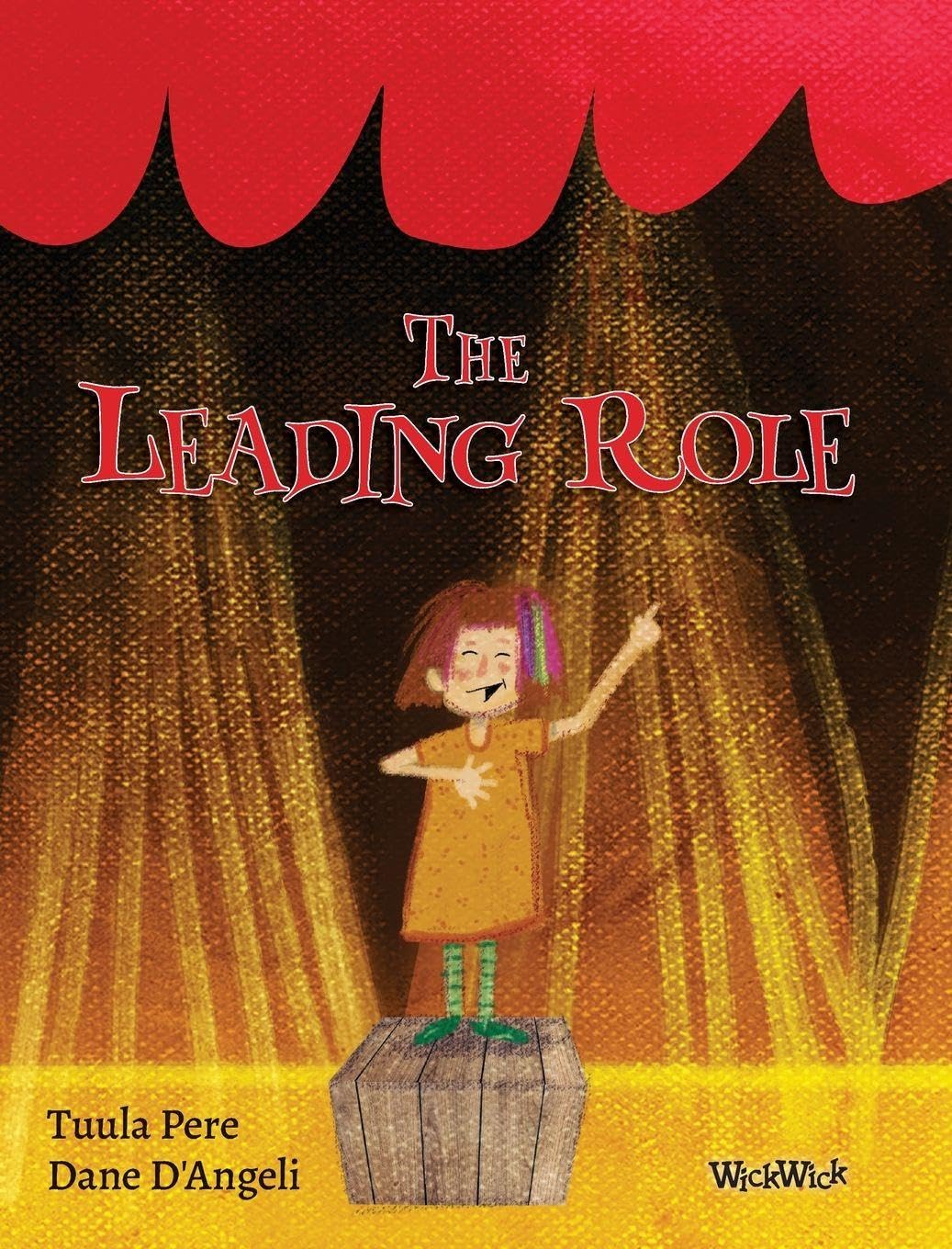
The Leading Role, by Tuula Pere, is a heartwarming children’s book that really understands how big childhood projects can feel. Emma’s idea of turning her attic into a little theater is instantly charming, and the story does a nice job of showing how excitement, creativity, and teamwork can turn an ordinary space into something magical. I liked that the book doesn’t just focus on performing, but on all the different jobs that go into putting on a play. That gives the story an inclusive feel, as if every child reading it can imagine a place for themselves in the Attic Theater.
What makes the story especially engaging is the way it shifts from Emma’s confident leadership to Lily’s quieter journey. Lily begins as someone who would rather stay out of the spotlight, helping from the side as a prompter, and that makes her eventual moment of courage feel earned rather than forced. Anthony’s lost voice creates the perfect bit of drama before the premiere, and the resolution is both satisfying and encouraging. The message comes through clearly without feeling heavy-handed: sometimes the person least eager for the leading role is exactly the one who can rise to it.
The illustrations are a big part of the book’s appeal. Illustrator Dane D’Angeli gives the attic scenes a cozy, theatrical glow, especially in the spreads with the curtain, stage lights, and warm reds and golds. I liked how the artwork makes the attic feel both homemade and magical at the same time. The characters have expressive faces and simple, child-friendly designs that make their emotions easy to read, and the stage scenes in particular have a dramatic, storybook quality that fits the theme perfectly. The illustrations truly sell the excitement of rehearsal and performance.
Pere’s book is a lovely conversational read-aloud for kids who enjoy pretend play, theater, or stories about finding hidden confidence. It’s gentle, positive, and easy to follow, with a message about cooperation and bravery that feels genuine. I’d recommend it especially for younger readers who may see a bit of themselves in Emma’s enthusiasm or Lily’s shyness. The Leading Role feels like a celebration of creativity and the idea that every child has something important to bring to the stage.
Pages: 32 | ISBN : 978-9528202523


