Blog Archives
Beauty, Hope, and Kindness

Beanie’s Web follows a gentle country spider who must show a wary city fly that kindness, generosity, and friendship can be stronger than fear and first impressions. What was the inspiration for the setup of your story?
Life on our planet is becoming more and more complex. The universal theme of peace, kindness, and joy expressed in Beanie’s Web offers an opportunity to step back from the complex and embrace the simple qualities that make us human.
Why was it important for Beanie to earn Frieda’s trust through his actions rather than simply persuade her with words?
Actions speak louder than words. Frieda’s intrinsic fear of spiders could not have been quelled by words alone. Beanie’s actions, such as freeing insects from his web and tending a bountiful garden of fruits and vegetables, gave tangibility to his words, “I am a vegetarian.”
How did the themes of peace, kindness, and joy develop as you were writing the story?
I believe that beauty, hope, and kindness can always be found if we choose to look for them in the world around us. As a Marine in Vietnam, I discovered that even in life’s darkest moments, light can still be found when we lift our eyes. Peace, kindness, joy, and other rays of light are the theme and matrix of Beanie’s Web.
What do you hope children and parents will talk about together after reading Beanie’s Web?
Beanie’s Web was written for a young audience whose hearts still hold a natural sense of love, joy, unity, and simplicity. By creating words and illustrations that reflect these lofty qualities, it is hoped that children and parents will discuss, develop, and nurture these attributes.
Author Links: GoodReads

The Bear and Cat Chronicles


Kris Neely’s The Bear and Cat Chronicles is a warm, thoughtful book built around the everyday lives of two old friends. Bear is earnest, reflective, and prone to overthinking, while Cat is older, sharper, and often able to cut through a problem with one well-placed question. Their cottage, garden, checkerboard, and nearby Fine Gold Creek become the setting for short stories about presence, acceptance, change, friendship, and the odd ways we complicate our own lives. The book describes its chapters as small meditations that can be read in sequence or individually, and that structure suits the material beautifully.
What gives this book its personality is the way big ideas arrive through wonderfully ordinary things. A broken vase becomes a lesson in seeing obstacles differently. An empty bowl opens a conversation about making room for what comes next. A buried seed exposes the difference between patience and mentally living in the future. Checker games, muddy paw prints, a scratched gate, spilled coffee, an old fishing net, and even a badly chosen hat all become opportunities for Bear and Cat to notice what’s really happening. Neely draws heavily from Zen and Taoist philosophy, but the stories work because the philosophy is attached to recognizable emotions: embarrassment, grief, impatience, anxiety, loneliness, self-consciousness, and the desire to control an uncertain world. The recurring humor, especially Cat’s dry observations and Bear’s occasional physical mishaps, keeps the reflective material lively.
As the book progresses, the friendship gains more emotional weight. Cat’s history as a frightened stray, the death of her mother, her aging body, and her memories of people and creatures who have disappeared from her life add depth to what might otherwise have remained a collection of charming philosophical exchanges. Some of the strongest chapters deal directly with loss and letting go. In “The Impossible Move,” grief becomes something one moves through, while “The Unfinished Game” explores the painful habit of waiting for another person to provide closure. Cat eventually puts away a checker game left unfinished by her absent friend Pim, keeping one piece simply as a remembrance, and that small action captures one of the book’s most affecting ideas: loving something and waiting for it aren’t the same thing.
That emotional foundation makes The Bear and Cat Chronicles an inviting example of inspirational and contemplative books about mindfulness for readers who like their reflection delivered through story. Its final chapter, “The Purr,” is especially fitting because it brings the book’s philosophy back to the friendship at its center. Bear is overwhelmed by practical worries, and Cat doesn’t respond with a solution. She simply sits with him and purrs until the problems feel like circumstances he can face instead of emergencies swallowing the moment. Her conclusion that friends can’t fix one another’s lives but can refuse to let each other face them alone gives the collection a satisfying emotional destination. The Bear and Cat Chronicles ultimately feels like spending time with two companions who’ve learned that wisdom often shows up while making tea, playing checkers, watching the creek, getting muddy, and staying close when somebody needs a purr more than an answer.
The Science of Positive Psychology

Positives follows three children as they discover how practicing gratitude can transform their outlook, improve their emotions, and help them build meaningful new friendships. What inspired you to create this story for young readers?
Our troubled world. We’re having so many problems, and there’s so much tension and anxiety and people bickering and division going on in our world right now. I saw this, and I found myself very concerned about the next generation. Initially, I felt really hopeless and depressed. I thought, “What can I do?” I can’t change the political landscape, but I’ve been teaching a class on positive psychology for the last 16 years. Surely, I have something to offer. So I chose to write a children’s book that infuses positive psychology into the lives of these young people right at the time that they’re really going to need it. So, on the surface, the book seems to be about helping to improve happiness, but the real driving force behind it is helping them to become more optimistic and resilient.
Another strong motivator for the book is how happiness spreads. The science of positive psychology has proven that when one person becomes happier, it has the same spread as a virus. If you want to look it up, it’s Nicholas Christakis, and he has a book called Connected. So when one person becomes happier, it spreads to a thousand people per person! So if we get these books into even one classroom, it has the potential to help 30,000 people! So I’m hoping at a time in our history when we really, really need it, that this very small little book can help to make a big difference in our troubled world.
Dan begins the story feeling discouraged, while Annie and Zeke help him discover a new perspective. What did you want young readers to understand about changing difficult emotions?
I’ve been a therapist for nearly 20 years now, and I found that some people view difficult emotions like the weather. They believe the best they can do is get out their little umbrella and hope that it passes quickly. By teaching these positive psychology techniques, I’ve helped my students and my clients for years to realize that with a little bit of effort, they can improve their mood. It is incredibly empowering when you realize that there’s something that you can do to help yourself feel better. I felt like it was very important to instill this into our young people. Hopefully they take this skill home and teach it to their families. The next thing you know, happiness and optimism and resiliency are spreading throughout the country.
Annie shares a practice she learned from her grandfather. How did family wisdom and intergenerational connections influence the message of the book?
Well, I have to admit: in my personal family we’re a little short on intergenerational wisdom. So I’ll talk about my adopted family of positive psychology. In my class, Happiness 101, I often refer to Aunt Sonja, Aunt Barbara, and Uncle Dan. These are actually the giants of positive psychology: Sonja Lyubomirsky, Barbara Fredrickson, and Dan Gilbert. And in Positives, when Annie refers to Grandpa Marty, she’s alluding to Martin Seligman, the founder of positive psychology. There’s a ton of intergenerational wisdom there!
One of the things that I absolutely love about positive psychology is how it is supported by science. In fact, I think the scientific rigor for us to support what we’re saying is even more stringent. We want to prove the positive psychology interventions actually work. So, yeah, there’s tons and tons of research out there. If you want to read some books, I would highly recommend Martin Seligman’s book Flourish and, of course, Sonja Lybomirsky’s book, The How of Happiness, Barbara Frederickson’s Positivity, and Dan Gilbert’s book called Stumbling on Happiness.
What message do you hope young readers take away when they see Dan, Zeke, and Annie work through their feelings together?
My real hope for young readers is that they know they can improve their happiness – and that it is even better when you have other people to help support you. I want them to understand that they do not have to just be subject to whatever mood they are in – that they always have a choice!
Author Links: GoodReads | Facebook | Website | Instagram | TikTok | YouTube | Amazon
Positives is a heartwarming children’s book that teaches kids the proven “Three Good Things” exercise from positive psychology. Through a fun and relatable story, children learn how noticing good things in their lives can lift their mood, build resilience, and strengthen friendships.
Follow Dan, Zeke, and Annie—three kids who each struggle with their own challenges—as they discover the power of sharing “positives” together. With the help of Annie’s imaginary emotional support cat, Mr. Face, they learn that even small moments of gratitude can make a big difference.
This engaging story is based on the science of Dr. Martin Seligman, the father of positive psychology, and is designed to help children:
Feel happier and more hopeful
Build emotional resilience
Strengthen social connections
Practice gratitude in a fun, simple way
Positives is perfect for bedtime reading, classroom activities, or starting a new family tradition.
Give your child the tools to feel happier—one positive at a time.
Izzy Can’t Talk But He Can Make Friends

Izzy Can’t Talk But He Can Make Friends! is a warm children’s book about autism, friendship, and communication. The story follows Izzy, a nonspeaking autistic boy who feels nervous around his new neighbor, Jimmy. As the boys spend time together, Izzy learns that friendship can grow through shared interests, laughter, patience, and simply enjoying another person’s company. The book presents Izzy’s speech device, service dog, safe space, routines, and stimming as natural parts of his everyday life.
The story works especially well as a social-emotional learning book for children because the friendship develops through believable little moments. Jimmy accidentally sits in Izzy’s special spot, visits his treehouse, watches Izzy’s favorite cartoon, and discovers that they both love chicken nuggets. Aunt Bee helps Jimmy understand Izzy without speaking for every feeling he has, while Jimmy shows a willingness to listen, apologize, and adjust. That gives young readers a practical picture of empathy and inclusive friendship.
The bright cartoon illustrations make this inclusive children’s book lively and easy to follow. Izzy’s emotions are shown clearly through his face, body language, and changes in color and lighting, including a striking scene where he appears frozen inside a blue block when meeting Jimmy. The pictures also add playful details, such as superhero costumes, toy dinosaurs, Uncle Gus getting stuck in the treehouse window, and Lucky the service dog joining the action. These visual touches keep the book energetic while helping children understand experiences that Izzy doesn’t express through spoken words.
As an autism awareness picture book and friendship story for kids, the book has a clear, encouraging message: communication can take many forms, and connection doesn’t depend on speech. Its straightforward explanations make it useful for families, classrooms, and conversations about neurodiversity, while the humor and familiar childhood activities keep the story approachable. Izzy and Jimmy’s friendship feels satisfying because it grows from curiosity, shared joy, and time spent together.
Pages: 34 | ISBN : 978-1962636087

Izzy Can’t Talk
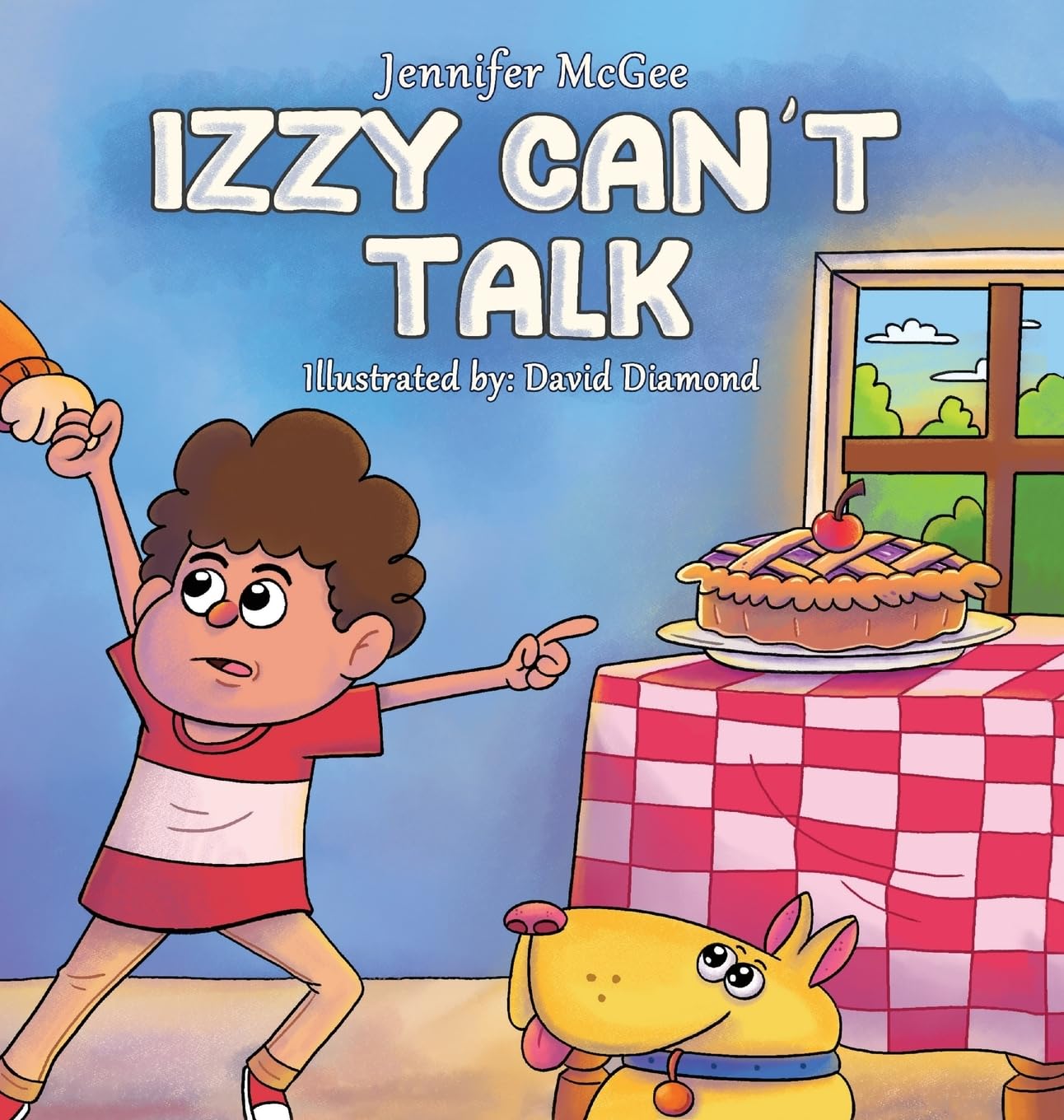
Izzy Can’t Talk, by Jennifer McGee and David Diamond, is a warm and brightly illustrated picture book about a young autistic boy who communicates without spoken words. Izzy lives on a farm with Aunt Bee, Uncle Gus, and his service dog, Lucky. When he becomes excited about Aunt Bee’s razzleberry pie, his family tries to understand what he wants by offering water, a pillow fort, and time on the trampoline. The simple setup gives young readers an easy way to follow Izzy’s growing frustration while recognizing that he has clear thoughts, feelings, and preferences.
The story’s strongest idea is that communication can take many forms. Izzy rocks, jumps, flips a light switch, uses facial expressions, and responds to pictures, but the people around him don’t immediately understand those signals. The book treats this confusion with patience and gentle humor, especially through Uncle Gus’s enthusiastic mistakes and physical comedy. That playful tone keeps the story light while still showing how exhausting it can be when someone knows exactly what they want but can’t make others understand.
David Diamond’s cartoon illustrations give the book much of its personality. The pages use bold colors, exaggerated expressions, and clear visual action, making the emotions readable even before the text is spoken aloud. The pictures also help explain tools such as sign language, picture cards, a service dog, and a speech pad. When Lucky brings the device and Izzy presses the “Eat” button, the moment feels satisfying because the solution gives Izzy direct control over his message rather than asking his family to keep guessing.
This children’s book will be especially appreciated by families, preschool and early elementary teachers, speech-language professionals, and children who are learning about autism or augmentative communication. It could also be meaningful for nonspeaking children who’d enjoy seeing a character whose inner life is active, joyful, and understood. The ending delivers the book’s central point clearly: Izzy can’t talk, but he can communicate. That makes Izzy Can’t Talk a useful and affectionate read-aloud for starting conversations about listening, patience, and giving every child a dependable way to be heard.
Pages: 34 | ISBN : 978-1962636001
The Happiest Therapist Presents: Positives

Positives is a lively children’s book and social-emotional learning book about three kids who discover how gratitude can shift their mood and strengthen new friendships. Dan starts the day feeling low, Zeke wants to help but isn’t sure how, and Annie introduces them to “Three Good Things,” a positive psychology exercise she learned from her grandfather. The story turns a practical emotional wellness tool into a kid-friendly conversation that feels natural rather than instructional.
Positives works best when the characters begin sharing specific reasons for their gratitude. They appreciate family members, teachers, friendship, a beloved cat, and even ordinary things like dirt and bolts. Those unexpected examples add humor while showing children that gratitude doesn’t have to focus only on major events. The changing color of Dan’s mood ring gives young readers a clear visual measure of how his feelings improve, and the happiness ratings help reinforce that emotions can shift without suggesting they’ll disappear instantly.
The book also succeeds as a children’s mental health picture book because each main character brings a recognizable concern to the group. Annie feels anxious around new people, Zeke struggles with belonging, and Dan feels burdened by responsibilities and wakes up in a gloomy mood. Their conversation shows kindness, courage, and active listening in a way that children can easily follow. Mr. Face, Annie’s imaginary emotional support cat, adds warmth and silliness, and he gives anxious readers a playful example of using imagination for comfort.
Cat Charm’s bright, expressive illustrations carry much of the book’s personality. The characters’ body language is easy to read, the comic-style page layouts keep the dialogue moving, and the color-coded text helps distinguish each speaker. Mr. Face’s translucent blue design makes him instantly memorable, while visual jokes involving hats, mud pies, bolts, and superhero poses keep the lesson buoyant. Overall, Positives is an engaging picture book that gives families, counselors, and classrooms a simple activity they can discuss and practice together.
Pages: 40 | ASIN : B0GHPZ4SHP
Just Me: Now That I’m in School?

Just Me: Now That I’m in School! introduces children to the idea that school is a shared community rather than a place where everyone can simply do as they please. Using the image of a classroom as a boat, the book explains that “smooth sailing” depends on cooperation, listening, honesty, kindness, responsibility, and respect. It gradually connects these everyday behaviors to the larger idea of democracy, showing young readers that citizenship begins with small choices such as taking turns, helping others, following rules, and using words instead of anger.
I appreciated the book’s clear sense of purpose. It doesn’t tiptoe around expectations, and there’s something reassuring about that. The writing is simple, direct, and built for repetition, which makes the ideas easy for young children to absorb. I especially liked the comparison between parents having jobs and children having school as their job. That line gives learning and classroom behavior a sense of dignity. The message is more instructional than story-driven. The plainspoken approach feels intentional, and it gives parents and teachers plenty of natural openings for conversation.
The book’s most interesting choice is its use of the word “democracy.” That’s a large and potentially abstract idea for a picture book, yet the author brings it down to a child’s level without stripping it of meaning. Democracy here isn’t presented as a distant lesson about government. It’s presented as the daily work of living alongside other people. I found that thoughtful and quietly ambitious. The artwork supports that approach with uncluttered pages, expressive stick figures, and familiar school situations. The illustrations’ stick-figure simplicity keeps the focus on behavior and emotion. A worried face, a high five, two children sharing a book, or a group gathered on a boat communicates the point immediately.
I found Just Me: Now That I’m in School! to be a sincere and practical book with an unusually thoughtful message about community. It works best when read aloud slowly, with pauses for children to talk about fairness, truthfulness, cooperation, and what they owe to the people around them. I’d recommend it for families with children entering elementary school, as well as teachers, counselors, and homeschoolers looking for a gentle way to begin conversations about classroom citizenship. It’s a useful reminder that learning how to belong is every bit as important as learning how to read.
Pages: 36
Rowen and the Animal Shelter

Rowen and the Animal Shelter follows a young boy who finds a stray dog near his home and, with his mom’s help, learns what animal control does, how shelters care for lost pets, and why microchips, heartworm prevention, adoption, and volunteering matter. As Rowen visits the shelter, reads to the dogs, gathers donations with friends, and eventually adopts a border collie named Finn, the story grows from a simple stray-dog encounter into a gentle lesson about responsibility, compassion, and community care.
I appreciated how practical this children’s book is without feeling cold. As a parent, I liked that it doesn’t soften every difficult piece of shelter life into something cute. The gray dog is scared. The shelter is short on space. Heartworms are serious. Adoption takes time and thought. Those details give the story emotional weight, and I think kids can handle that when it’s presented with this much kindness. The writing is direct and explanatory, sometimes a little information-heavy, but it works because Rowen’s questions feel like real kid questions. He’s curious, worried, hopeful, and occasionally disappointed in a way that feels honest.
Animal control officer Ben and Ms. Jill at the shelter aren’t treated like background adults. They’re patient, careful, and deeply humane, which quietly expands a child’s idea of what community service can look like. I also loved the idea of reading to shelter dogs. It’s such a tender, doable action for a child, and it gives the book a lovely emotional center. Morgane Schmidt’s artwork has a soft, sketchy warmth that keeps the heavier topics approachable. The dogs’ faces carry a lot of feeling, especially the wary little gray dog and the hopeful border collie, and the simple backgrounds keep the focus where it belongs: on care, attention, and small acts of goodness.
Rowen and the Animal Shelter is a thoughtful, useful, and quietly moving picture book. It blends story and education in a way that may spark real conversations at home, especially with children who love animals or are beginning to understand what it means to help beyond their own family. I’d recommend it for elementary-aged kids, animal-loving families, classrooms, shelters, and parents who want a gentle but honest book about empathy, pet responsibility, and the many ways children can make a difference.
Pages: 40 | ISBN : 978-1966786436


